


What if that missed bank shot wasn't a lack of skill, but a failure of physics caused by your lighting? You've likely spent weeks selecting a premium American Heritage or Nixon Billiards table, so it's frustrating when annoying shadows under the rails or eye strain during long evening sessions disrupt your flow. Many homeowners settle for fixtures that look like cheap bar lights, but your game room deserves a focal point that complements your luxury furniture while providing a tactical advantage.
You want tournament-quality illumination that makes every corner of the slate visible. Discover how the right Billiard Light Fixtures can transform your space by eliminating dark spots and meeting the rigorous 520 lux intensity standards used by the pros. We'll show you exactly how to hang your lights at the WPA-specified heights of 40 to 65 inches to ensure clear visibility for every shot. This guide previews the latest 2026 trends in high-output LED technology and sleek linear designs to help you create a professional-grade arena right in your home.
Key Takeaways
- Understand why a 90+ Color Rendering Index (CRI) is essential for accurately distinguishing ball colors during high-stakes games.
- Select the ideal Billiard Light Fixtures by comparing the timeless appeal of 3-lamp bars with the sleek efficiency of modern linear LEDs.
- Master professional installation by centering your fixture based on the cushion nose measurements rather than room walls for perfect slate coverage.
- Create a cohesive luxury aesthetic by coordinating fixture finishes with your premium pool table and implementing a layered lighting strategy.
- Eliminate dead zones on your playing surface by calculating the specific lumen output required for your table size.
The Role of Billiard Light Fixtures in Precision Gameplay
Precision in billiards is a game of millimeters. You know that feeling when a bank shot looks perfect, but the ball rattles the jaw and stays out? Often, the culprit isn't your stroke; it's the lighting. Standard home lighting usually relies on recessed cans or peripheral lamps that fail to reach the center of the table. This creates "dead zones" where the felt looks dull and the balls lose their crisp definition. High-quality Billiard Light Fixtures solve this by bathing the entire playfield in uniform, high-intensity light. This creates a "stadium effect" that naturally draws the eye to the action and signals that it's time for serious play.
Shadow Management: The Rail and Pocket Problem
Shadows are the enemy of accuracy. When light comes from a single point or an incorrect angle, the rail cushions cast long, dark silhouettes across the slate. These shadows distort your perception of where the cushion actually begins. If you can't see the "nose" of the rail clearly, your bank shots will always be slightly off. Professional-grade lighting must reach deep into the pocket entrances to ensure you aren't shooting into a black hole. For standard billiard table dimensions found in 7ft and 8ft home models, we recommend the "Three-Point" rule. This involves using a fixture with at least three distinct light sources or a continuous linear LED to ensure the head, center, and foot of the table receive equal illumination. This targeted task lighting is what separates a casual basement setup from a professional home arena.
Atmosphere vs. Functionality in Modern Game Rooms
Your game room is likely a multi-use space where you host family gatherings and holiday parties. Balancing tournament-level clarity with domestic warmth is key to a successful design. You don't want your lounge to feel like a sterile hospital wing. Modern Billiard Light Fixtures act as the visual anchor for the entire room, framing the table as a piece of fine furniture. By using dimmers, you can transition from high-stakes competitive play to a relaxed social lounge setting in seconds. This flexibility reduces eye fatigue during those marathon Friday night sessions. Consistent, flicker-free light keeps your vision sharp and your focus on the game, ensuring you stay comfortable until the final 8-ball drops. It's about creating a space where the quality of the equipment matches the quality of the time spent with family and friends.
Technical Specifications: Lumens, CRI, and Color Temperature
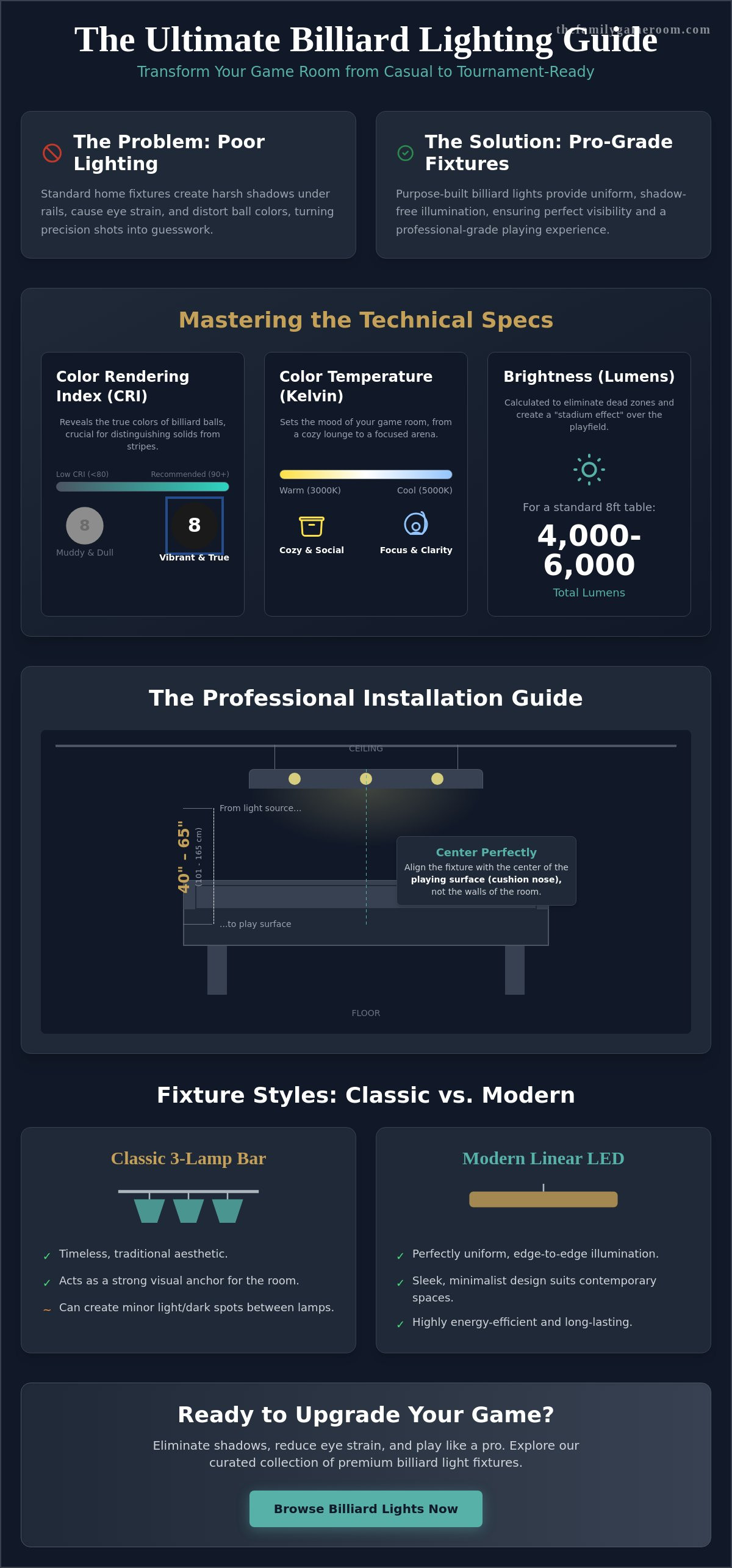
Beyond the aesthetic of the shade, the internal components of your lighting determine your game's quality. You should prioritize high-quality LED drivers to eliminate the "flicker factor." Even if invisible to the naked eye, poor drivers create stroboscopic effects that cause headaches and eye fatigue during long matches. Choosing the right Kelvin rating also shifts the room's mood. While "Warm White" (3000K) offers a cozy, domestic feel, "Cool Daylight" (5000K) mimics tournament conditions and keeps your mind sharp. Mastering these technical lighting specifications ensures your equipment performs as well as it looks.
The Science of Color Rendering (CRI) for Billiards
CRI is the ability of a light source to reveal the true colors of objects compared to natural sunlight. In a game where the difference between a dark blue 2-ball and a black 8-ball is critical, color accuracy isn't a luxury. Low CRI ratings make the 1-ball and 9-ball look muddy or indistinguishable under artificial glow. Professional tournaments prioritize 90+ CRI LED arrays because they provide the saturation needed to identify thin cuts on the stripes. This level of clarity allows you to react instantly without second-guessing what you're seeing.
Calculating Ideal Brightness for Your Table Size
Brightness is measured in lumens, but the effect on your table is measured in foot-candles. Aim for a standard of 50 foot-candles at the center of the playfield for tournament-grade visibility. For a standard 8ft table, this usually requires a fixture outputting between 4,000 and 6,000 lumens, depending on your ceiling height. Be careful not to overdo it. Overly bright lights create harsh glare on polished phenolic resin balls, which can be just as distracting as shadows. If you want to find a balance between power and polish, you can browse our curated billiard lighting to find the perfect match for your home.
Adjusting for height is vital. If your ceiling is particularly high, you'll need higher lumen counts to compensate for the "drop" in light intensity. Conversely, a lower hanging fixture focuses that energy more efficiently. By matching your lumens to your specific room volume, you ensure every bank shot is perfectly illuminated without washing out the room's ambiance. High-performance Billiard Light Fixtures should offer this level of precision, giving you the confidence to play your best game every time you step up to the table.
Styles and Configurations: 3-Lamp Bars vs. Modern Linear LEDs
Don't mistake a generic kitchen island light for a professional billiard reflector. While they look similar, island lights often lack the opaque backing and deep-cone design required to shield a player's eyes from glare. Specialized Billiard Light Fixtures are engineered to push every lumen downward onto the slate, ensuring the room stays atmospheric while the playfield remains bright. Whether you're outfitting a classic basement or a high-end modern lounge, your choice of configuration will define the room's visual anchor. Precision matters when selecting a style that matches your table's footprint and your home's aesthetic.
The Classic 3-Lamp and 4-Lamp Billiard Bars
The 3-lamp bar remains the gold standard for 7ft and 8ft tables. These fixtures use individual shades to create overlapping pools of light that cover the entire slate surface. If you have a larger 9ft table, a 4-lamp configuration is usually necessary to ensure the light reaches the short rails without fading. You can choose between individual shades or a single long housing, depending on how much "character" you want the light to have. Individual shades offer a traditional look, while a single housing provides a cleaner, more unified profile. Material choices like matte black offer a modern industrial vibe, while brushed nickel and antique brass provide a more timeless, upscale feel. These fixtures ensure that the light is concentrated exactly where the cue ball meets the tip.
Contemporary Linear and Perimeter Lighting
Modern game rooms are increasingly moving toward linear LED fixtures. These sleek, single-piece units offer perfectly even, shadow-free illumination across the entire perimeter of the table. They eliminate the "scalloped" light patterns that can sometimes occur with individual bulbs. These linear designs are the natural companion for modern tables like those from Nixon Billiards, where minimalist frames and bold geometry take center stage. Many of these contemporary units now feature smart home integration. You can use voice commands to dim the rest of the room while bringing the table into sharp, tournament-ready focus. It's a frictionless way to transition from a family dinner to a competitive match.
For those seeking artisanal warmth, Tiffany-style lights add stained-glass character that acts as a piece of fine furniture. If you're working with a smaller space or a secondary table, a single-shade pendant can work well, provided the shade is wide enough to prevent rail shadows. No matter the style, your Billiard Light Fixtures should serve as the curator of the room's energy, balancing professional performance with domestic comfort.
The Professional Installation Guide: Height, Centering, and Safety
Precision installation is just as critical as the quality of the fixture itself. You've already learned about the importance of lumens and color rendering, but those specs won't save your game if the light is hung at the wrong height. Proper placement ensures that the light reaches the nose of the cushions without blinding the players. If you're currently in the process of building your dream room, hang your Billiard Light Fixtures before the table is assembled. Working over an empty floor is much safer and easier than maneuvering ladders around a heavy slate table. This sequence prevents accidental damage to your new cloth and gives you plenty of room to work.
Step-by-Step Mounting and Alignment
Getting the alignment right requires more than just a quick glance. Follow these steps to ensure a professional result:
- Step 1: Locate the exact center point of the table placement. Don't measure from the room walls, as they are often slightly uneven. Instead, use the intended footprint of the table.
- Step 2: Verify ceiling joist support. Heavy multi-lamp fixtures or large linear LEDs can weigh significant amounts and require more than just a standard drywall anchor.
- Step 3: Adjust the chain lengths. Use a level to ensure the fixture is perfectly horizontal. Even a slight tilt will create uneven light distribution across the slate.
- Step 4: Conduct a "glare test." Stand in the lowest shooting position at the head of the table. If you can see the bare bulbs, the fixture is likely too high or needs a deeper shade.
Electrical and Safety Considerations
The "Golden Rule" for height is to position the bottom of the shade between 38 and 42 inches above the slate surface. This height provides the ideal balance between maximum light spread and player comfort. However, you must also consider cue clearance. Serious players often execute "masse" or "jump" shots that require a near-vertical cue angle. If your light is too low, you risk cracking a shade during a high-arched shot. Many competitors suggest measuring 70 inches from the floor, but table heights vary. Always measure from the playing surface itself for accuracy.
Safety extends to the electrical setup as well. Large game room arrays often benefit from a dedicated circuit to prevent flickering when other appliances in the home kick in. Using LED technology is a smart move here. Unlike older halogen bulbs, LEDs stay cool to the touch. This keeps the area directly under the light comfortable for players, even during intense matches. If you're ready to upgrade your setup, shop our professional-grade billiard lighting to find a fixture designed for easy, secure mounting.
Centering the light correctly is the final touch. Align the fixture exactly over the center of the table, measuring from the nose of the cushions. This ensures the light is distributed evenly to all six pockets. When your Billiard Light Fixtures are installed with this level of care, they do more than just illuminate. They transform the table into a professional arena where every shot is clearly defined.
Designing Your Ultimate Game Room with Luxury Lighting
A high-end game room is more than a collection of tables; it's a curated environment where every element speaks the same design language. Your chosen Billiard Light Fixtures should do more than just light the cloth. They must unify the room's architecture. We recommend a "layered lighting" approach for the best results. This involves using your primary billiard light as the focal point while adding peripheral accent pieces to soften the corners. This strategy prevents the "cave effect" where only the table is visible, leaving the rest of the room in darkness. To maintain a cohesive look, ensure your seating matches the prestige of your table. Choosing the right Bar Stools helps bridge the gap between the competitive play area and the social lounge.
Pairing Lights with Premium Tables
Matching finishes is the easiest way to achieve a professional look. If you've invested in rustic wood textures, wrought iron or oil-rubbed bronze fixtures provide a grounded, artisanal feel. Conversely, minimalist designs are the perfect partner for modern American Heritage Billiards Pool Tables. Consider your felt color carefully during the design phase. A high-output 5000K light will make Tournament Blue felt pop with vibrant energy, while warmer tones can make Burgundy felt look deep and luxurious. Your lighting choice literally changes the "personality" of your table's surface.
Completing the Aesthetic with Accessories
Don't let your lighting exist in a vacuum. Proper placement ensures your fixture illuminates the table without obstructing the view of your Pool Cue Racks. Use directional lighting to highlight other features like wall-mounted dartboard cabinets or foosball tables. This creates a rhythmic flow throughout the room, guiding guests from one activity to the next. At The Family Game Room, we curate fixtures that match the craftsmanship of premium furniture. This ensures your home entertainment center is both a functional arena and a luxury showroom.
Final checklist for your 2026 transformation:
- Harmonize wood stains between the table frame and light housing.
- Install dimmable accent lights for social transitions.
- Verify that peripheral equipment like poker tables or air hockey units are also adequately lit.
- Ensure all Billiard Light Fixtures are centered precisely to highlight the table's geometry.
By treating your lighting as a precision instrument and a decor piece, you elevate your game room into a professional-grade sanctuary. It's about creating a space where the quality of the atmosphere matches the quality of the play.
Master Your Game Room Transformation
Your journey toward a professional-grade home arena ends with a single flip of a switch. By prioritizing 90+ CRI LED technology and adhering to the industry-standard 38 to 42-inch mounting height, you've transformed your table from a simple piece of furniture into a precision instrument. You now understand that the right illumination does more than just show the path of the ball; it creates a sanctuary for family competition and social connection. It's about ensuring every bank shot is visible and every evening spent together is comfortable.
As an authorized dealer for American Heritage Billiards, we've provided family-owned expertise since 2022 to help homeowners curate the perfect atmosphere. We believe high-end entertainment should be frictionless, which is why we offer free national shipping on our premium game room furniture. Whether you're drawn to classic 3-lamp bars or sleek modern frames, selecting the right Billiard Light Fixtures is the final step in securing your tactical advantage. Browse our curated collection of luxury Billiard Light Fixtures and start your transformation today. We're excited to help you build a space where every shot is clear and every memory is bright.
Frequently Asked Questions
How high should a billiard light be from the floor?
A billiard light should typically hang between 60 and 64 inches above the floor. While floor measurements offer a quick reference, the most accurate method is measuring 38 to 42 inches from the top of the slate to the bottom of the light shade. This height ensures even coverage without obstructing your view or causing glare.
Can I use a regular dining room chandelier for my pool table?
You should avoid using standard dining chandeliers because they often feature upward-facing bulbs or translucent shades. Professional Billiard Light Fixtures use opaque, downward-facing reflectors to focus intensity on the slate. This specialized design prevents light from hitting your eyes directly when you lean over to aim a shot.
How many lumens do I need for an 8-foot pool table?
You'll need between 4,000 and 6,000 lumens to achieve the necessary 50 foot-candles of light at the table's center. This brightness level allows you to see the fine details of the cloth and ball texture. If your ceiling is higher than 10 feet, you might require a higher lumen count to compensate for the light's travel distance.
What is the best light bulb for a billiard fixture?
LED bulbs with a 90+ Color Rendering Index (CRI) are the best choice for modern Billiard Light Fixtures. They provide the color accuracy needed to tell the difference between dark balls in low-light situations. LEDs also stay much cooler than traditional bulbs, which keeps the playing area comfortable during long matches.
How do I center a pool table light if the table isn’t delivered yet?
Mark the exact center of the table's future footprint on your floor using the manufacturer's specifications. Don't rely on room walls for centering, as they're rarely perfectly square. By using a plumb bob from the ceiling to your floor marks, you'll ensure the light is perfectly aligned before the table arrives.
Do LED billiard lights get hot during long games?
LED fixtures stay cool to the touch even after several hours of continuous use. This is a major advantage over older halogen or incandescent lights that can radiate significant heat onto a player's head and shoulders. It's a simple way to maintain focus and comfort during competitive sessions with friends.
What is the difference between a pool table light and an island light?
The primary difference lies in the shade design and light direction. Pool table lights are engineered with deep, opaque reflectors that prevent light from spilling out horizontally at eye level. Island lights are often designed for ambient room glow, which can cause distracting glare when you're shooting from the rails.
Should the light fixture be the same length as the pool table?
Your light fixture should generally be about one-third to one-half the length of your table. For a standard 8-foot table, a fixture between 40 and 60 inches long is ideal. This sizing provides a professional look and ensures the light spreads evenly across the head and foot of the table without feeling bulky.