


What if the sticker price on that stunning slate table is actually less than half of your total first-year investment? It’s a common surprise for many enthusiasts. While the beauty of a handcrafted table is undeniable, the hidden costs of owning a pool table often catch homeowners off guard. You likely understand that quality requires a premium initial investment, but the journey from the showroom to your first break involves several technical and financial layers that many buyers overlook.
We agree that your game room should be a sanctuary for family and friends, not a source of structural anxiety or maintenance confusion. This guide provides the clarity you need to move forward with confidence. We'll break down the essential expenses of professional installation, room preparation, and the long-term care strategies that preserve your table’s timelessness. From structural floor requirements to the nuances of premium cloth care, you’re about to discover how to curate a world-class entertainment space without any unwelcome surprises.
Key Takeaways
- Master the essentials of professional white-glove installation to ensure your slate table remains perfectly level for decades of accurate play.
- Uncover how the quality of your billiard balls and chalking habits directly impacts the lifecycle and replacement frequency of your table's felt.
- Prepare your game room by managing environmental threats like humidity and temperature that can compromise solid wood craftsmanship and slate stability.
- Navigate the hidden costs of owning a pool table with our comprehensive roadmap covering everything from room structural requirements to cue maintenance.
- Learn why investing in premium construction from brands like American Heritage Billiards serves as a strategic move to reduce long-term ownership and repair expenses.
Beyond the Purchase Price: Professional Installation and Room Preparation
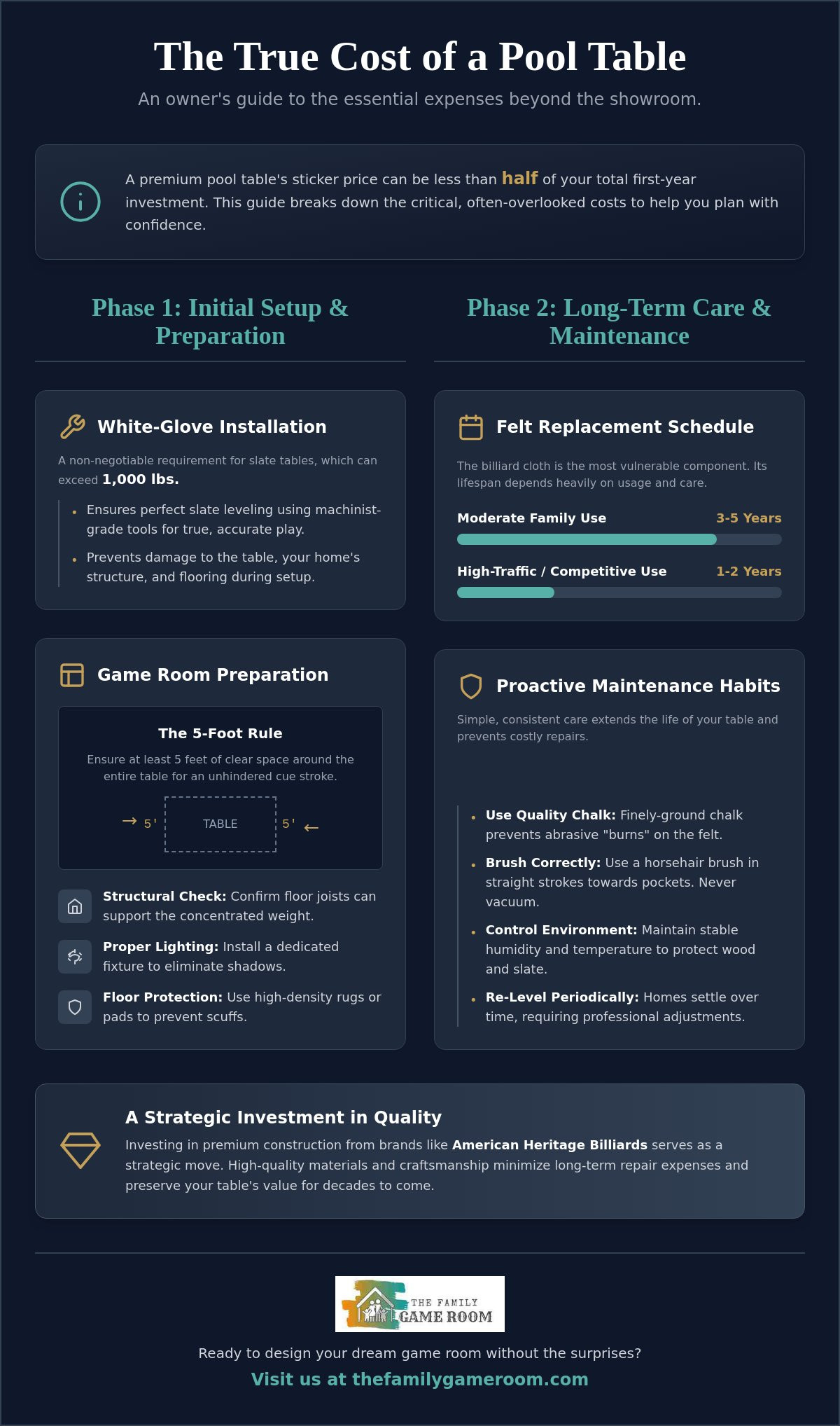
Bringing a premium billiard table into your home is a landmark moment for any homeowner. It's an investment in decades of social connection and skill. However, the sticker price is only the first chapter of the story. One of the most significant hidden costs of owning a pool table involves the complex transition from the showroom to your game room floor. This is not a furniture delivery you can handle with a few friends and a pickup truck. A high-quality table features a heavy slate bed, often divided into three precision-cut slabs. Understanding the Anatomy of a Pool Table reveals why professional white-glove service is a non-negotiable requirement. The weight alone, which frequently exceeds 1,000 pounds, can compromise your home's structural integrity if you haven't prepared the space correctly.
- Structural Integrity: Confirm your flooring and joists can support the concentrated weight of the table legs without sagging.
- Entryway Logistics: Measure every doorway and tight corner to avoid the unexpected expense of removing trim or widening passages.
- The Cue Stroke Rule: Look beyond the table's footprint. You need at least five feet of clear space around the entire perimeter to allow for a full, unhindered cue stroke.
The Precision of Professional Slate Leveling
Accuracy is the soul of the game. Professional installers don't just "eyeball" the surface or use a standard carpenter's level. They employ machinist levels, which are sensitive enough to detect slopes as slight as 0.005 inches per foot. If your house settles over time or you decide to move the table across the room, you'll face the cost of a professional re-leveling. Trying to shim the legs yourself is a gamble that often leads to slate shifting or permanent damage to the felt. It's a technical task that ensures your shots roll true every time you break.
Optimizing Your Space for Long-Term Playability
Your game room needs more than just empty floor space to be functional. You must identify the "dead zone," which is the area where bar stools, floor lamps, or pillars might interfere with a player's backswing. If a wall is too close, you'll find yourself forced to use "short cues," which significantly compromises the competitive experience. Don't forget about flooring protection. Hardwood and laminate surfaces scuff easily under the immense pressure of a half-ton table. High-density rugs or specialized protective pads are small but necessary additions to your initial budget. Finally, consider your lighting. A dedicated billiard fixture eliminates distracting shadows on the rails, reducing eye strain and sharpening your game. These thoughtful details transform a simple room into a professional-grade gallery.
To ensure the rest of your room matches the quality and longevity of your table, consider sourcing complementary pieces from a trusted family-owned retailer like Darseys Furniture & Mattress, which specializes in premium home furnishings that can elevate any entertainment space.
Long-Term Maintenance: Protecting Your Slate and Felt Investment
Think of your billiard table as a high-performance vehicle. You wouldn't skip an oil change for a luxury sedan, and you shouldn't neglect the maintenance of your slate bed and felt. The hidden costs of owning a pool table often stem from reactive repairs rather than proactive care. By treating maintenance as investment protection, you extend the life of your table and maintain its resale value for the next generation. Don't let your game room centerpiece become a depreciating asset through simple neglect.
The billiard cloth is your table's most vulnerable component. While standard nylon blends are common in budget setups, worsted wool offers a faster, more professional play surface that resists "pilling." Regardless of the material, the primary enemy of felt is actually chalk dust. Choosing "cheap" chalk is a common mistake that leads to long-term damage. These budget cubes often contain large, unrefined grains that embed themselves in the felt fibers. This creates abrasive friction, which generates heat and burns the cloth during high-speed shots. Investing in high-performance, finely-ground chalk is a small price to pay to avoid the premature expense of re-felting.
Cloth Care and Periodic Re-felting
Daily habits define the lifespan of your felt. Use a specialized horsehair brush to sweep dust toward the pockets in straight, deliberate strokes. Never use a vacuum with a rotating brush, as this can stretch the cloth and pull it away from the slate bed. For tables seeing moderate family use, expect to re-felt every 3 to 5 years. High-traffic game rooms may require service every 1 to 2 years to maintain tournament-grade conditions. This periodic refresh is one of the most consistent hidden costs of owning a pool table, so budget accordingly.
Cushion Resilience and Rail Maintenance
Your table's rails provide the kinetic energy for every bank shot. Over time, the rubber cushions inside the rails can harden or lose their "bounce," a condition players call "dead rails." This typically happens due to extreme temperature fluctuations or the natural aging of the rubber. Replacing these cushions is a technical job that requires removing the cloth and rails. To protect the exterior, keep rings and watches away from the wood finish to prevent deep nicks. If you're ready to upgrade to a table that prioritizes these high-end materials, explore our curated collection of premium pool tables to find a foundation built for longevity.
Finally, remember the pockets. Leather care for high-end drop pockets is essential for maintaining that luxury aesthetic. High-quality leather can dry out and crack without occasional conditioning. A quick wipe with a leather-safe cream once a year keeps the pockets supple. This prevents the heavy weight of falling billiard balls from tearing the seams, saving you from the cost of a full set replacement.
The Essential Accessory Ecosystem and Upgrades
A world-class game room is defined by more than just the table. It's the synergy between the slate and the accessories that creates a truly professional atmosphere. While the table is your primary investment, the hidden costs of owning a pool table include the ongoing maintenance and eventual upgrades of your cue sticks, billiard balls, and lighting. These aren't just aesthetic choices. They are functional requirements that protect your equipment and sharpen your skills. Neglecting the "tools of the trade" can lead to a frustrating playing experience and accelerated wear on your table's surface.
Premium Cues and Storage Solutions
Most beginners start with the "house cues" included in a bundle. As your accuracy improves, you'll likely transition to custom cues tailored to your grip and stroke. This evolution brings new maintenance needs. Leather tips compress and glaze over time, requiring scuffing, shaping, and eventually professional replacement. Ferrules can crack under the force of powerful break shots, necessitating a technical repair to maintain the cue's structural integrity. Proper storage is the most effective way to avoid the cost of replacing warped shafts. Never lean your sticks against a wall. Gravity and temperature changes will eventually bow the wood, ruining the cue's accuracy. Utilizing dedicated Pool Cue Racks ensures your equipment stays perfectly straight and ready for play.
Billiard balls are another often-overlooked expense. Standard polyester balls are prone to "pockmarking" and can transfer excessive friction heat to your felt. This leads to the tiny white burn marks that degrade the aesthetics of your room. Premium phenolic resin balls are denser and more heat-resistant. They stay cleaner longer and dramatically reduce the wear on your cloth, serving as a silent protector of your table's most delicate surface. Investing in a high-quality ball set is a strategic move that saves money on re-felting costs over the long term.
Billiard Lighting and Game Room Ambience
Correct illumination is the difference between a casual hobby and a competitive sport. Standard room lights often cast deep shadows under the rails, making it impossible to judge bank shots accurately. Professional-grade Billiard Light Fixtures should be mounted exactly 30 to 36 inches above the playing surface. This height provides a uniform wash of light across the entire slate bed without blinding the players. Modern LED options offer incredible energy efficiency while mimicking the classic warmth of traditional pool hall aesthetics. Investing in proper lighting is a one-time cost that prevents eye strain and ensures every shot is visible from every angle, regardless of the time of day.
Environmental Factors: The Invisible Threat to Your Table
Your game room is a living environment that directly interacts with your billiard equipment. While professional installation and quality cues are vital, the local climate remains a significant source of the hidden costs of owning a pool table. Solid wood frames and slate beds are sensitive to their surroundings. Stability is key. Ignoring these factors can lead to warped rails, shifted slate, or brittle felt. Protecting your investment means mastering the atmosphere of the room as much as the game itself. Don't let your basement or sunroom environment compromise the integrity of your table's craftsmanship.
Climate Control and Humidity Management
Billiard tables thrive in a stable climate. Ideally, you should maintain a humidity level between 35% and 50%. Basements present unique challenges for owners. In these spaces, you'll likely need to run a dedicated dehumidifier year-round. The cost of running a dehumidifier is a recurring utility expense that many owners overlook. While it adds a small amount to your monthly bill, its role in preventing a multi-thousand dollar slate or frame repair is invaluable. High moisture makes the felt fibers swell. This causes the balls to roll slower and less predictably. Conversely, overly dry air can cause the solid wood frame to shrink and crack. UV exposure is another silent enemy. Direct sunlight through a window will fade your felt unevenly. It can even cause the wood finish to "alligator" or peel over time. Always use a high-quality table cover when the game is not in play to mitigate dust and light damage.
The True Cost of Relocating a Table
One of the most expensive hidden costs of owning a pool table arises when you decide to move it. Perhaps you're refinishing the floors or moving to a new home. Never slide the table. You cannot simply lift or push a slate table across a room. Doing so risks cracking the slate at the wax joints. It can also permanently warp the frame. Professional relocation involves a full disassembly, careful transport, and a complete re-installation at the new site. This process typically requires new felt. The original cloth is rarely reusable once the staples are pulled and the tension is released. Strategic placement is your best defense against these future costs. Before the installers arrive, visualize your long-term floor plan. Consider any future renovations, like new carpeting or wall removals, that would necessitate moving the table. By getting it right the first time, you save yourself from the logistical headache and financial burden of a professional relocation.
Ready to select a centerpiece that stands the test of time and environment? Browse our premium game room collections to find a table engineered for superior durability and style.
Why Quality Construction Minimizes Hidden Ownership Costs
Selecting a pool table based solely on the lowest initial price often leads to a cycle of expensive repairs. Budget-friendly tables constructed from Medium Density Fiberboard (MDF) lack the structural integrity to support heavy slate long-term. Over time, these materials inevitably sag under the weight, leading to a warped playing surface that no professional can truly fix. This structural failure is one of the most frustrating hidden costs of owning a pool table. By prioritizing superior craftsmanship from the start, you bypass the structural issues that plague lower-end models and ensure your game room remains a center of excellence for decades.
The Engineering of Premium Billiards
Stability begins with the slate. While some manufacturers use thinner slabs to cut costs, industry leaders like American Heritage Billiards Pool Tables utilize 1-inch certified slate. This thickness provides the necessary mass to stay perfectly level despite the natural vibrations of play. High-quality joinery, such as mortise and tenon construction, further reinforces the table against shifting. These technical details prevent the frame from loosening, which is a common cause of slate misalignment. Choosing a table built with high-grade components ensures that your investment remains stable, effectively reducing the frequency and necessity of professional service calls over time. Additionally, buying new provides a financial safety net through manufacturer warranties that used or refurbished equipment simply cannot match.
Maximizing Utility with Multi-Functional Designs
Modern homeowners often look for ways to maximize their square footage without sacrificing luxury. A Pool Table with Dining Top offers a remarkable return on investment by serving two primary functions in a single footprint. This dual-purpose design eliminates the need for separate furniture, saving you thousands in additional game room or dining room costs. Beyond the financial savings, the dining top acts as a massive protective shield for your felt. It prevents accidental spills, dust accumulation, and UV damage during family gatherings or holiday meals. This added layer of protection significantly extends the life of your billiard cloth, deferring the hidden costs of owning a pool table related to frequent re-felting. It's a lifestyle upgrade that blends domestic warmth with high-end entertainment, ensuring your home remains the preferred destination for every social occasion.
Invest in quality once, and enjoy the game forever. Selecting a table with a solid wood frame and premium slate isn't just about aesthetics; it's a strategic decision to minimize maintenance and maximize playability. When you choose a table engineered for durability, you spend less time worrying about leveling and more time perfecting your bank shot.
Elevate Your Home Entertainment with Expert Confidence
You now possess the essential roadmap to navigate the hidden costs of owning a pool table with absolute clarity. From the precision of professional machinist leveling to the strategic benefits of climate control, your investment represents more than just a piece of furniture. It’s a multi-generational asset that thrives on quality care. By choosing premium construction and staying proactive with felt and cue maintenance, you ensure your game room remains a world-class sanctuary for decades.
The Family Game Room is a family-owned business dedicated to your long-term satisfaction. As an authorized retailer for industry-leading partners like Nixon Billiards and American Heritage, we simplify every step of the ownership process. We coordinate expert national shipping and professional installation services to ensure your table arrives and plays with tournament-grade accuracy. Our team provides the professional polish you expect from a premium retailer while remaining grounded in the importance of family life.
Ready to select a table that minimizes long-term repairs while maximizing your home's aesthetic appeal? Browse our selection of premium American Heritage Billiards tables today to find your perfect match. We can't wait to help you curate the ultimate game room experience for your home.
Frequently Asked Questions
How much does professional pool table installation usually cost?
Industry standards for professional installation typically range between $300 and $500, though complex room access or oversized tables can push this toward $700. This fee covers the technical assembly of the slate bed, precision wax jointing, and initial leveling. Professional service ensures your warranty remains intact and your playing surface is perfectly flat from the first break.
How often does a pool table need to be re-felted?
Expect to re-felt your table every 3 to 5 years under normal residential play conditions. If your game room serves as a high-traffic social hub, you might require new cloth every 1 to 2 years to maintain optimal ball speed and accuracy. Consistent brushing and using high-quality chalk can significantly extend the life of your felt fibers.
Can I move a slate pool table myself to save money?
Moving a slate table yourself is highly discouraged because it almost always leads to cracked slate or warped frames. These heavy items require full disassembly and professional re-leveling at the new location to ensure accurate play. Attempting a DIY move usually results in structural damage and repair expenses that far outweigh the initial savings of skipping professional help.
Do I really need a special light for my pool table?
Specialized billiard lighting is essential for eliminating distracting shadows under the rails that ruin competitive accuracy. These fixtures provide a uniform wash of light across the entire slate bed, reducing eye strain during long sessions. Mounting a dedicated light at the correct height transforms your room into a professional-grade gallery and sharpens your game.
What happens if I don't maintain the humidity in my game room?
Neglecting humidity levels causes solid wood frames to expand or shrink, which can lead to cracked finishes or shifted slate. High moisture also swells felt fibers, making the table play "slow" and unpredictable. Maintaining a stable environment is a key strategy for managing the hidden costs of owning a pool table over its multi-generational lifetime.
Is a used pool table cheaper in the long run than a new one?
Used tables often carry unseen financial burdens like the immediate need for professional relocation, re-felting, and cushion replacement. While the initial sticker price is lower, these technical requirements add up quickly. A new table provides the security of a manufacturer’s warranty and the assurance that all components are in peak condition from the start.
How long do the rubber cushions on a pool table last?
High-quality rubber cushions typically maintain their resilience for 10 to 15 years before they begin to harden or lose their bounce. Environmental factors like extreme temperature swings or direct sunlight can accelerate this degradation. You'll know it's time for a professional replacement when the balls no longer rebound with consistent kinetic energy off the rails.
What is the most expensive part of maintaining a pool table?
Professional re-felting and re-leveling are the most frequent recurring expenses you'll encounter. However, structural repairs caused by improper moving or environmental neglect are the costliest burdens. Investing in premium construction and professional installation from the beginning is the best way to keep the hidden costs of owning a pool table manageable and predictable.