


A 360-degree swivel means the seat can rotate all the way around, but it doesn’t tell you whether the stool will fit your island or feel stable. In the choice between swivel vs stationary bar stools, swivel seats turn independently from their bases, while stationary seats stay fixed in position. The spin is only one part of the decision.
It’s easy to focus on the convenience of turning toward conversation, especially when the island is where everyone gathers. The right stool also needs to leave enough room to sit comfortably, suit the counter height, and feel steady in everyday use. This guide explains what to assess before choosing swivel vs stationary bar stools, including clearance, comfort, stability, assembly, and the details to compare when buying online. You’ll come away with a practical way to match the stool style to your layout and your household’s routines.
Key Takeaways
- A 360-degree swivel describes the seat’s rotation, not how much clearance the stool needs or how stable it feels.
- Measure counter height, aisle space, and room between seats before choosing a style for your island.
- Swivel stools make turning and sitting easier, while fixed stools have fewer moving parts and stay in one position.
- Compare the base, seat dimensions, assembly details, and return information when shopping online.
- Choose based on how your household uses the island, and consider mixing stool styles when needs differ.
What does a 360-degree swivel tell me about a counter stool?
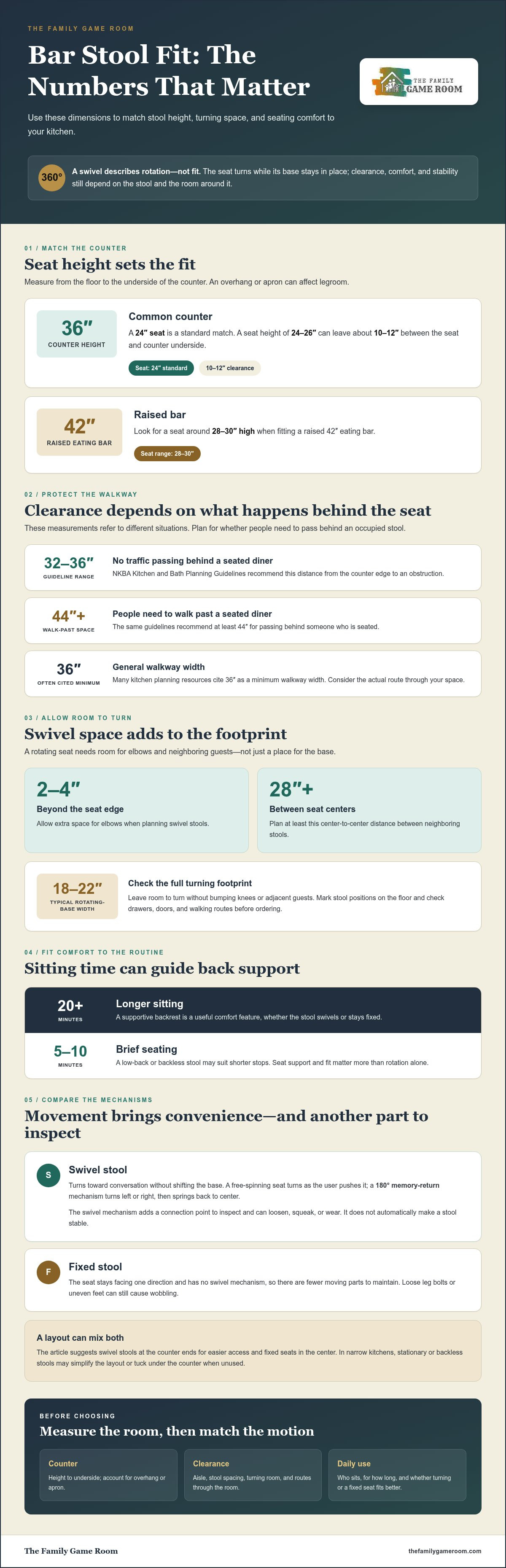
A 360-degree swivel means the seat can rotate all the way around, while its base stays in place. On a stationary stool, the seat and back remain facing the same direction. That specification describes movement, not the stool’s comfort, stability, or clearance needs. Measure the stool and its surroundings before deciding whether a full turn suits your kitchen.
Start with counter height. For a common 36-inch counter, a 24-inch seat is a standard match; a seat height of 24 to 26 inches can leave about 10 to 12 inches between the seat and counter underside. For a raised 42-inch eating bar, look at seats around 28 to 30 inches high. Measure from the floor to the underside of the counter, since an overhang or apron can affect legroom.
Next, map the aisle. The NKBA Kitchen and Bath Planning Guidelines recommend 32-36 inches between a counter edge and an obstruction behind a seated diner when no traffic passes. They recommend at least 44 inches to walk past a seated diner. Many kitchen planning resources cite 36 inches as a minimum walkway width. These clearances describe different situations, so account for whether people need to pass behind occupied stools.
For swivel stools, allow 2 to 4 inches beyond the seat edge for elbows, and plan at least 28 inches center-to-center between neighboring stools. A rotating base is usually 18-22 inches wide. Those measurements help estimate the footprint, but leave room for people to turn without bumping knees or adjacent guests. In an open-concept space, include the route between the kitchen, dining area, and living room in your floor plan. A stool that turns easily at the island still needs to preserve that walkway.
In a narrow kitchen, stationary stools can simplify the layout because they don’t need room to turn. Measure the seat width and the space needed when someone is seated, not just the empty floor. A backless stool can tuck under a counter or table when unused, freeing space in a compact room. Swivel stools can also work when their bases and turning movement fit the measured footprint. Mark each stool’s position on the floor before ordering, then check that drawers, doors, and walking routes remain usable.
How much do swivel and stationary bar stools cost on average? There’s no single average that applies to every stool. Materials, upholstery, construction, and the swivel mechanism all affect cost. Swivel models generally cost more than stationary stools, so compare similar materials and features instead of relying on a broad average.
Advantages and drawbacks of swivel versus fixed stools
A swivel stool lets guests turn toward conversation without shifting its base. A stationary stool keeps its seat facing one direction, which can make seating feel more predictable. The right choice depends on who uses the island, how often they sit, and whether the extra movement suits the room.
A free-spinning swivel rotates as the user pushes it. A 180-degree memory-return mechanism turns left or right, then springs back to center. That return can keep stools aligned along the counter after guests stand. Neither mechanism automatically ensures stability; construction and assembly also matter. Lower-quality swivels can grow noisy, loose, or wobbly with use.
Seat backs change the trade-off. A backed swivel stool can support relaxed sitting and turning, but its back may hit the counter if someone spins carelessly. A backless model has a lower profile and can tuck beneath the counter when unused. A stationary stool with a back stays oriented toward the island, while a backless fixed seat has fewer parts and a simpler shape.
Which type of bar stool is safer for children or older adults? A stationary stool may suit households with toddlers or guests who might spin or climb because it doesn’t rotate. For older adults or people with mobility limitations, a swivel can make turning and settling into the seat easier, though stability and ease of use still matter.
Do swivel bar stools require more maintenance or repairs? Their moving mechanism can loosen, squeak, or wear, creating more potential maintenance points than a stationary stool. Fixed stools have no swivel mechanism, so they have fewer moving parts to maintain.
Are swivel bar stools more likely to scratch floors or damage flooring? A swivel can reduce how often you move its base, which may limit dragging across hardwood or tile. Stationary stools often need to be pulled or slid for access, so suitable floor glides can help protect hardwood, luxury vinyl, and tile.
Which type of bar stool is more comfortable for long periods of sitting? For sessions lasting 20 minutes or longer, a supportive backrest is a useful comfort feature, whether the stool swivels or stays fixed. For brief seating around 5 to 10 minutes, a low-back or backless stool may suit the use. The seat’s support and fit matter more than its rotation alone.
For a busy kitchen where guests move between the island and conversation, swivel seating makes turning easier. For a household that prioritizes a fixed position and fewer mechanical parts, stationary stools may fit better. A mix can also work: place swivel stools at the counter ends for easier access, then use fixed seats in the center. Match the mechanism to daily movement, not just appearance.
Assembly and wobble considerations
A bar stool’s stability depends on its frame, fasteners, floor contact, and assembly. Swivel models add a rotating plate or mechanism beneath the seat, creating another connection point to inspect. A stationary stool has no swivel joint, but loose leg bolts or uneven feet can still cause wobbling. During setup, lay out every part and match each fastener to the instructions before tightening anything.
Assemble the stool on a level surface, following the manufacturer’s sequence. Start each bolt by hand so the threads align, then tighten fasteners as directed. If the instructions call for tightening after the frame is assembled, follow that order instead of fully securing one side first. For a swivel stool, check after assembly that the seat rotates freely and the base stays planted when someone turns.
The ANSI/BIFMA X5.1 stability test calls for a chair to withstand a 135-pound downward load placed 2.4 inches from the front seat edge, plus a 20-newton horizontal pull, without tipping forward. This is a test criterion, not proof that every stool has been tested or that a specific model will feel wobble-free in your kitchen. Use manufacturer information to understand which test results apply to the stool you’re considering.
A comparison of stools measured 0.15 inches of lateral deflection under a 10-pound force for a pedestal stool with a cast-iron base. That result describes one tested stool, not a universal performance standard. It illustrates why base construction matters: a broad, heavy base can resist side movement, while the seat and swivel connection still need secure assembly.
If the stool rocks after setup, test it on another level spot before adjusting anything. A dip in the floor can mimic a loose frame. Then check that all feet contact the floor and inspect each fastener, especially at the joints between the legs, crossbars, and seat. For a swivel model, turn the seat through its range and listen for scraping or clicking. Stop using a stool that tips or has a visibly loose connection until it’s corrected according to the instructions.
Test the assembled stool before placing it at the island. Press each corner of the seat, then sit down gradually and shift your weight from side to side. For a rotating model, repeat the check while turning; the seat should move without the base lifting or sliding. Recheck fasteners after the first use if the instructions recommend it. Careful assembly and a final stability check help distinguish a loose connection from movement built into the swivel mechanism.
Buying swivel stools online
Online photos show style, but dimensions determine whether a swivel stool works at your island. Start with the listed seat height, overall height, seat width, and base diameter. Compare each measurement with your counter and floor plan. A stool may look compact in a staged kitchen but take up more room once you account for its base and turning movement.
Check the seat height separately from the overall height. For a common 36-inch counter, a 24-inch seat is a standard reference; raised 42-inch bars typically pair with 30-inch seats. A padded seat may sit about an inch higher than a standard seat. Compare the exact listed measurement with the counter underside, since a thick cushion or apron can change legroom.
Read the base dimensions and weight capacity before choosing a model. Residential swivel counter stools typically have a capacity of 220-275 pounds, but that range isn’t a substitute for the specific stool’s stated limit. For households with children or older adults sitting daily, aim for a base diameter of at least 18 inches. A wider base takes up more floor space, so compare it with your available position at the island.
- Measure the footprint: Mark the base diameter and seat width on the floor with painter’s tape. Include neighboring stools and the route people use to walk behind them.
- Study the mechanism: Identify whether the seat spins freely or returns to center. Product descriptions should distinguish a full rotation from a 180-degree memory-return swivel.
- Review assembly details: Note which components require assembly, what tools the instructions call for, and how the swivel plate attaches underneath the seat.
- Inspect the photos: Look for side and rear views that reveal back height, footrest position, and how far the seat projects backward.
Customer photos can help clarify scale, but use the listed measurements for planning. A photo may show a stool beside an island with a different overhang or counter height. Compare like with like across models, such as base diameter against base diameter, rather than seat width against overall width.
Before ordering, read the return and delivery terms, then save the product dimensions and assembly instructions. If the stool arrives in multiple pieces, compare them with the instructions before assembly. A practical online choice fits your measured space, provides the seat height you need, and clearly describes the swivel mechanism. Let the measurements lead; let the finish complete the room. For those seeking premium interior design and elevated bar seating, Benjamin & Maxwell provides curated luxury furnishings crafted to make a lasting impression.
Your final decision rests on fit, function, and price.
What are the pros and cons of stationary bar stools?
Stationary stools keep each seat facing one direction, creating a consistent line along an island or counter. That can suit a kitchen where people face the cook, share breakfast, or help with homework. With no swivel mechanism, the design has fewer mechanical parts that could loosen, squeak, or wear. The choice between swivel vs stationary bar stools starts with how people use the seating, not simply how it looks.
Fixed stools can also be easier to move and store. A stackable set, for example, can clear the floor when guests need extra room, while a lighter stool can move between an island and another gathering spot. Stationary stools generally cost less than swivel stools, though materials and construction still affect the comparison. Compare similar frames, finishes, and seat details to understand the trade-off.
The main drawback is getting in and out. A seated person must pull or slide a fixed stool away from the counter, then move it back afterward. Repeating this can be inconvenient in a narrow kitchen or for someone with limited mobility. Suitable floor glides help protect hardwood, luxury vinyl, or tile as stools shift. Choose glides that fit the stool legs and flooring, and replace worn ones before they expose the floor to direct contact.
Comfort depends on fit and support as well as movement. For longer sitting, a supportive backrest can make a stationary stool more suitable; for a quick breakfast, a backless seat may be easier to tuck away. Check the seat height against the counter and consider whether the footrest supports a relaxed posture. The swivel vs stationary bar stools decision should reflect who uses the island most and how long they typically sit there.
Picture a typical gathering before choosing. If guests sit facing the kitchen and leave their seats in place, stationary stools keep the arrangement orderly. If people often turn toward nearby conversation, moving a fixed seat each time may interrupt the flow. Also consider storage: stackable designs can free floor space, while stools left at the counter keep seating ready for everyday use.
Use these checks to decide:
- Choose stationary stools for fixed seating, fewer mechanical parts, or a stackable option.
- Plan for access if users need to move each stool before sitting or standing.
- Protect the floor with glides suited to hardwood, luxury vinyl, or tile.
- Match comfort to use by considering seat height, footrest, and back support.
That flexibility matters when the seating isn’t needed all the time. Consider where each stool will go when moved and whether a stackable set suits your storage space. If you regularly put stools away, ease of moving and storing them matters alongside their fixed seating position and lack of a swivel mechanism. A stackable option may be more useful when saving space is a priority; otherwise, base your choice on how the stools will be used at the counter.
The Family Game Room: Pool Table Dining Tops
The Family Game Room offers Pool Table Dining Tops for households planning a flexible space for dining and recreation. After choosing stools for your island, consider how the wider room can support meals and game nights. A dining top lets a pool table serve another purpose when it’s time to gather around it rather than play.
If you’re shaping a game room around different ways to spend time together, The Family Game Room also offers Indoor Shuffleboard Tables, Air Hockey Tables, and Foosball Tables. These options suit different room plans and entertainment preferences, so consider how each piece fits your household’s space and routines.
For a next step beyond stool selection, explore Pool Table Dining Tops and the other game room offerings from The Family Game Room. Choose the pieces that suit your space and how you like to gather.
Make room for the way you gather
Let your island seating support the larger rhythm of your home, from everyday meals to lively evenings with friends. Treat the choice between swivel and stationary bar stools as one part of planning a welcoming entertainment space. The pieces around your island can help the room feel considered, comfortable, and ready for company.
The Family Game Room offers American Heritage Billiards Pool Tables, Nixon Billiards Pool Tables, and Pool Table Dining Tops. A dining top lets a pool table serve both game nights and shared meals, adding another flexible gathering place to the room. Explore these options as you plan how your home can make more space for time together.
Contact The Family Game Room to explore possibilities for your space. Make your next gathering a good one.
Frequently Asked Questions
What is the difference between swivel and stationary bar stools?
A swivel stool’s seat turns independently from its base, while a stationary stool stays fixed in one position. For example, someone seated on a swivel stool can turn toward a person entering the kitchen without moving the stool’s base. On a fixed stool, the user has to shift or reposition the seat. That difference affects how people approach the counter and interact with others nearby.
What are the pros and cons of swivel bar stools?
Swivel stools make it easier to turn toward guests or step away from the counter, which can help when people move between nearby seating areas. Their rotating mechanism adds parts that may loosen or become noisy over time. A practical test is to consider who uses the island most: a household that often turns to talk may value the movement, while a room prioritizing fixed seating may favor simplicity.
Which bar stool type works best in small spaces or narrow walkways?
Stationary stools often suit narrow walkways because they don’t need extra turning room, while backless models can tuck beneath a counter when unused. Swivel stools can still work in compact kitchens if their bases and turning movement fit without blocking doors or traffic paths. Mark the base footprint on the floor, then test the route past it with the stool pulled out as it would be during a meal.
How much do swivel and stationary bar stools cost on average?
There is no single average: cost varies with materials, upholstery, construction, and the swivel mechanism. Swivel stools generally cost more than comparable stationary stools.