


Most players treat shuffleboard wax like an afterthought, but the wrong technique is the fastest way to ruin a professional-grade playfield. It's stressful to watch your pucks stutter across a surface you've invested thousands in, especially when you're worried about accidental scratches or choosing the wrong speed rating. You deserve a table that offers a smooth, fast-playing experience every single time you gather friends for a game.
This 2026 shuffleboard wax application guide will help you master the art of table maintenance through a professional three-layer system. You'll learn how to select the perfect wax speed for your skill level, apply it without damaging the wood, and maintain a surface that meets International Shuffleboard Association standards. We'll walk through the essential steps to transform your home game room into a venue for peak performance and long-term quality.
Key Takeaways
- Understand that modern shuffleboard wax consists of precision-engineered silicone beads rather than traditional beeswax to protect your table's professional finish.
- Identify the ideal speed rating on the 1 to 7 scale to match your specific table length and desired puck velocity.
- Follow our professional shuffleboard wax application guide to master the "Salt and Pepper" technique for perfectly uniform bead distribution.
- Learn to neutralize environmental factors like humidity that cause drag and correct "tracking" issues that disrupt your puck's natural path.
- Discover how premium table construction and strategic game room lighting work together to simplify your long-term maintenance schedule.
Understanding Shuffleboard Wax and Your Table Surface
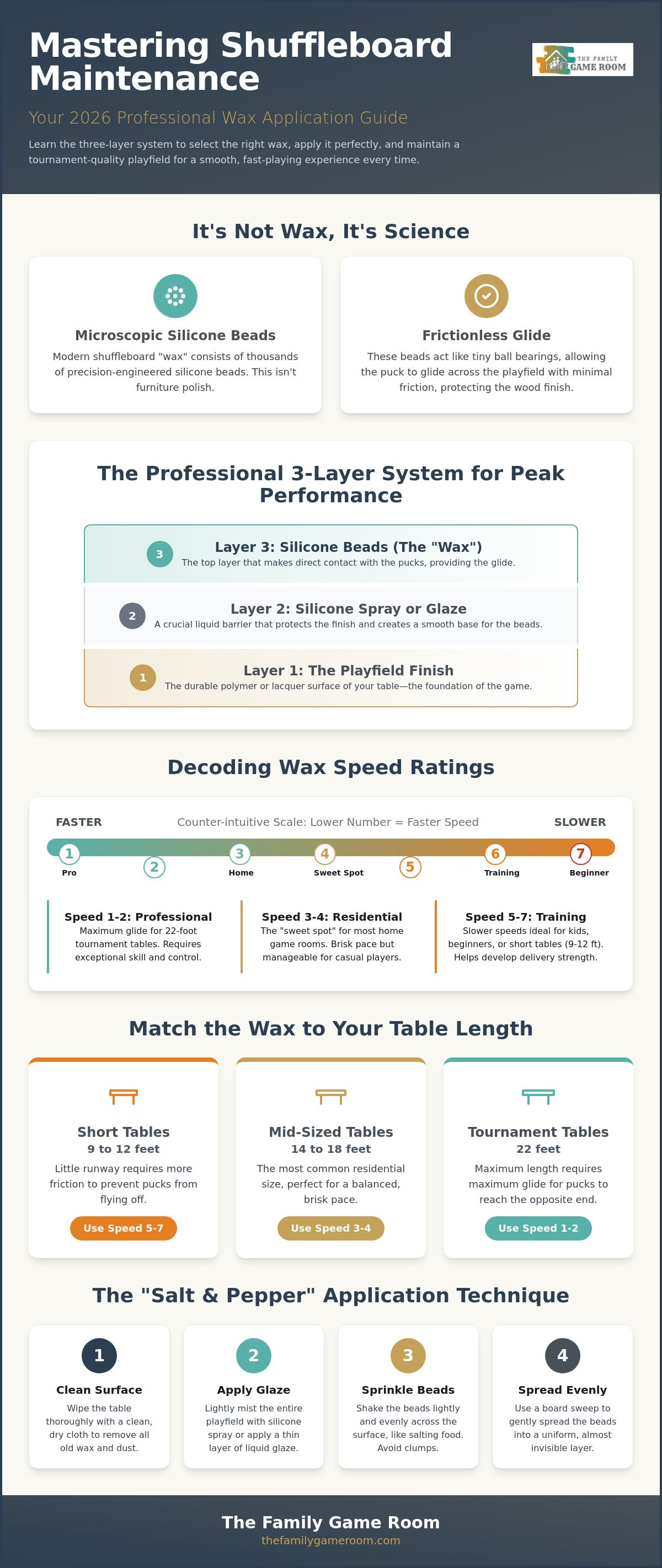
To master the game, you must first understand that "wax" is a bit of a misnomer. In the world of competitive play, what we call wax is actually thousands of microscopic silicone beads. Unlike the beeswax or paraffin used on furniture, these beads act like tiny ball bearings. They allow the puck to glide across the playfield with minimal friction. Without this specialized material, your pucks would grind against the wood, causing permanent damage and inconsistent speeds. This shuffleboard wax application guide focuses on maintaining that friction-free environment to ensure your table remains a centerpiece of home entertainment for decades.
Every professional maintenance routine relies on a three-layer system. First is the playfield itself, typically a thick slab of North American maple. Second is the liquid layer, consisting of silicone spray or glaze, which acts as a lubricant and a protective barrier. Finally, the silicone beads sit on top of that liquid layer. The History of Shuffleboard shows how the game evolved from 15th-century English pubs to the high-end residential game rooms of today, and modern chemistry has perfected this three-part harmony. If you skip the liquid layer or apply the beads unevenly, you risk "tracking." This occurs when pucks wear a physical groove into the wax, forcing every subsequent shot to follow the same predictable path.
Polymer vs. Traditional Wood Finishes
Modern indoor shuffleboard tables usually feature a poured polymer finish. This thick, clear coating is incredibly durable and creates a glass-like surface that requires less frequent maintenance. You can identify this by the "reflection test." Look at a light source in the surface of your table; if the reflection is perfectly crisp, you likely have a polymer finish. Traditional lacquer finishes, while beautiful, are thinner and more susceptible to environmental changes. They require regular hydration and more frequent applications of glaze to prevent the wood from drying out or cracking under the friction of high-speed play.
The Essential Role of Silicone Spray and Glaze
Applying beads to a dry table is a common mistake that leads to surface scratching. You must use a high-quality silicone spray or liquid glaze as a base. This liquid layer fills microscopic scratches and pores in the playfield, creating a perfectly level foundation for the beads. Think of it as a primer for your table. It boosts puck velocity and ensures the beads stay distributed rather than clumping together in high-traffic areas. Using a dedicated maintenance kit ensures these chemicals won't react poorly with your table's specific finish, preserving that factory-fresh slide for every guest who visits your home.
Selecting the Correct Speed Rating for Your Playstyle
Choosing the wrong speed rating is like putting racing tires on a tractor; the performance just won't match the equipment. The 1-7 scale is the industry standard for measuring puck velocity, but the numbers are counterintuitive. A lower number indicates a faster wax, while a higher number provides more friction for a controlled, slower game. This shuffleboard wax application guide emphasizes that your choice should depend on two factors: the length of your table and the skill level of your players.
If you're hosting a family tournament on one of our indoor shuffleboard tables, you'll likely want something in the middle range. According to the Table Shuffleboard Association, matching the wax to the environment is key for competitive integrity. Beginners often struggle with "Speed 1" waxes because the pucks fly off the end of the table with even the slightest touch. Starting with a "Speed 6" or "Speed 7" allows new players to develop their "weight" or delivery strength without the frustration of constant fouls.
Decoding Shuffleboard Wax Speed Numbers
Speed 1 is the professional choice; it's designed for 22-foot tournament tables where maximum glide is required. Speeds 3 and 4 represent the sweet spot for most residential game rooms, offering a brisk pace that remains manageable for casual enthusiasts. For children or those practicing on very short tables, Speeds 6 and 7 act as trainers. These slower waxes provide a "heavy" feel that helps players master the physics of the game before moving up to faster, more sensitive ratings.
Matching Wax to Your Table Length
Table length is the most critical technical factor in your selection. A 9-foot table has very little "runway," so using a professional Speed 1 wax will make the game nearly unplayable. For tables between 9 and 12 feet, stick to ratings between 5 and 7. Mid-sized tables from 14 to 18 feet perform best with Speeds 3 or 4. Only the full 22-foot heirloom models should regularly use Speed 1 or 2. In 2026, we see a growing trend toward using high-visibility yellow beads on dark maple playfields, while traditional white beads remain the standard for lighter woods. Regardless of the color, you'll typically need about 2 to 3 ounces of wax for a 14-foot table to ensure full coverage without clumping.
Professional players often use a secret technique: mixing waxes. By combining a Speed 3 with a small amount of Speed 1, you can create a custom "2.5" profile. This allows you to fine-tune the table's response to your specific room temperature and humidity. Experimenting with these ratios is the hallmark of a true shuffleboard curator, ensuring your home entertainment experience is always tailored to your guests' abilities.
The Step-by-Step Shuffleboard Wax Application Process
Mastering the "how" of maintenance is just as important as choosing the right materials. Before you begin, gather your professional toolkit: distilled white vinegar, room-temperature water, several clean microfiber towels, a high-quality silicone spray, and your speed-rated wax. You must also check your Climatic Adjusters. These metal bars under the playfield control the table's curvature. Ensure the wood is slightly concave, about the thickness of a single sheet of paper, so the beads don't migrate toward the gutters during play. This shuffleboard wax application guide ensures every step preserves the life of your investment.
Cleaning and Preparing the Playfield
Never apply new wax over old, dirty beads. This creates a "sludge" that hampers puck velocity. Start by mixing a solution of one part white vinegar to four parts water. This specific ratio provides enough acidity to break down old silicone buildup and skin oils without stripping the protective polymer finish. Use a microfiber towel to wipe the table in long, continuous strokes. Avoid circular motions, as these can trap debris. Once the surface is clean, use a fresh, dry towel to remove every trace of moisture. The playfield must be bone-dry. Even a microscopic amount of water will cause the silicone spray to turn gummy, forcing you to restart the entire process.
Applying the Base and Spreading the Wax
The base layer is what truly protects your table. Use a "Cross-Hatch" method when applying your silicone spray. Move the can vertically down the length of the table, then follow up with horizontal passes across the width. This guarantees total surface coverage. Wait roughly 60 seconds for the spray to "flash," or set, before moving to the beads. If you apply the wax too early, the beads will sink into the liquid rather than sitting on top of it.
The "Salt and Pepper" technique is the professional secret to a perfect game. Hold the wax canister about six inches above the table and use a steady, side-to-side sweeping motion. Aim for a light, uniform dusting where the wood grain remains visible through the beads. While some purists prefer hand-tossing, we recommend using a dedicated wax spreader for home owners. A spreader eliminates human error and prevents clumping, which is the primary cause of puck stutter. Finally, remember one critical safety rule: never wax the gutters or the alley. These areas must remain high-friction zones to safely catch pucks and prevent them from bouncing back onto the playfield.
Troubleshooting Common Issues and Environmental Factors
Environmental conditions are the invisible players in every shuffleboard match. Even the most precise shuffleboard wax application guide can't overcome a room that isn't climate-controlled. Humidity is your primary adversary; high moisture levels create microscopic "drag" on the silicone beads. This causes your pucks to feel sticky or sluggish, even if you've used a high-speed wax. Conversely, excessively dry air during winter months generates static electricity. This static causes the beads to clump together in patches, leaving other areas of the playfield dangerously bare and prone to scratching.
Climate Control in the Game Room
Consistency starts with your thermostat. Aim to keep your game room between 68 and 72 degrees Fahrenheit with a humidity level between 40% and 50%. Using a dedicated dehumidifier during summer months is a professional secret for maintaining tournament-level puck velocity. If the air gets too dry, a small humidifier will prevent the wood from shrinking and keep your beads from clumping. These small adjustments ensure that the physical properties of the silicone remain stable, providing a predictable slide every time you play.
Fixing Surface Inconsistencies
If you notice your pucks aren't sliding true, perform a "Puck Test." Gently slide a puck down the center of the table with minimal force. If it consistently veers toward the gutters, your table's curvature needs attention. Climatic adjusters are the metal bars located under the table used to correct the curvature of the playfield. Adjusting these can eliminate "dead spots" where the puck loses momentum unexpectedly due to an uneven surface.
Tracking is another common issue where pucks follow the same path every time. This happens when the wax is pushed to the sides, creating a physical groove in the bead distribution. To fix this, don't just add more wax. You must strip the table completely and restart your three-layer application process. This prevents "gunk" buildup and ensures your table remains a high-performance centerpiece. If your current table requires constant adjustment just to stay playable, it might be time for an upgrade. Browse our selection of professional indoor shuffleboard tables to find a model built for superior stability.
Follow this 2026 maintenance schedule to protect your investment:
- Daily: Use a dedicated shuffleboard brush to redistribute beads after every few games to prevent tracking.
- Weekly: Perform a full "Strip and Flip" by cleaning the table with your vinegar solution and applying fresh silicone and wax.
- Monthly: Apply a liquid glaze or buffing agent to fill microscopic scratches and maintain the factory-grade polymer shine.
Enhancing Your Experience with Premium Equipment
Even the most meticulous shuffleboard wax application guide can't save a table with a subpar playfield. High-end equipment provides the foundation for consistent play. Elite manufacturers like American Heritage Billiards Pool Tables apply the same rigorous standards to their shuffleboards, using thick polymer finishes that resist the pitting and scratching common in lower-tier models. These premium surfaces are designed to hold silicone beads in a uniform layer, reducing the frequency of deep cleans and re-waxing. When you invest in quality, you spend less time troubleshooting and more time enjoying the game.
Proper illumination is often overlooked in home game rooms. Installing professional Billiard Light Fixtures allows you to see the "grain" of your wax application. Without direct, even light, it's nearly impossible to spot the thin patches or clumps that cause puck stutter. Clear visibility ensures your "Salt and Pepper" sprinkle remains consistent from the starting line to the scoring triangle. Beyond the technical benefits, premium lighting adds a professional polish that transforms a simple room into a true entertainment destination.
The Value of a Professional-Grade Playfield
Cheap tables often use thin veneers that develop "pockmarks" or pitting over time. Once the surface is compromised, wax distribution becomes impossible to manage. Professional-grade tables feature poured polymer tops that are virtually indestructible. These surfaces stay perfectly level, which is critical for wax performance. If your table isn't level, your silicone beads will slowly migrate to one side, ruining your game's integrity. A lifetime investment in a quality table ensures the wood remains stable regardless of seasonal humidity shifts.
Completing Your Luxury Game Room
A guest-ready space requires more than just a well-waxed table. Adding functional furniture like bar stools provides spectators with a comfortable view of the action without crowding the players. Organization also plays a role in maintenance. Store your waxes and silicone sprays in a cool, dry cabinet to prevent the chemicals from breaking down. Keeping your weights (pucks) in a padded case prevents the bottom of the stainless steel from developing burrs that could scratch your playfield. Ready to upgrade your game? Explore our full collection of Indoor Shuffleboard Tables to find the perfect centerpiece for your home.
Final Guest-Ready Checklist:
- Check table levelness using a professional spirit level.
- Ensure lighting is centered to eliminate shadows on the playfield.
- Verify pucks are clean and free of debris or oils.
- Confirm wax speed matches the skill level of your expected guests.
Elevate Your Game Room Experience
Mastering the perfect slide requires a blend of precision chemistry and consistent technique. You now have the professional knowledge to select the ideal speed rating and implement the three-layer system for long-term playfield protection. This shuffleboard wax application guide ensures your home entertainment remains a source of pride and high-speed excitement for every guest who visits your home.
We've been a family-owned and operated curator of fun since 2022. As an authorized retailer for industry leaders like American Heritage and Nixon Billiards, we provide only the highest quality equipment with national US shipping on all premium game tables. We are deeply invested in your post-purchase happiness and the social memories you'll create around your table.
Ready to upgrade your competition? Browse our Premium Indoor Shuffleboard Tables to find a centerpiece that matches your newfound expertise. Your table is ready for the next tournament; it's time to let the pucks fly.
Frequently Asked Questions
How often should I apply new wax to my shuffleboard table?
Apply fresh beads before every game session to ensure a smooth, professional slide. For a full "strip and flip" cleaning, follow a weekly schedule if you play regularly. This prevents the silicone from becoming gummy and trapping skin oils or dust that can scratch the playfield. Consistent maintenance protects your investment and keeps the game fast for every guest.
Can I use car wax or floor wax on my shuffleboard?
Never use automotive or floor waxes on your shuffleboard table. These products are designed to be buffed into a static shine, whereas shuffleboard "wax" consists of microscopic silicone beads that must act as ball bearings. Using the wrong product will create a sticky residue that ruins puck velocity. It may also permanently damage the high-end polymer finish of your playfield.
What is the difference between shuffleboard 'sand', 'powder', and 'wax'?
These terms all refer to the same product: the tiny silicone beads used to reduce friction. While "sand" is a common misnomer because of the texture, modern "wax" is actually a precision-engineered polymer. Following this shuffleboard wax application guide helps you identify the correct speed rating regardless of whether the manufacturer calls it powder or sand.
How do I remove old shuffleboard wax buildup safely?
Use a 1:4 mixture of white vinegar and water to break down old silicone and grime without harming the finish. Wipe the table in long, straight strokes with a clean microfiber towel. Avoid using abrasive household cleaners or scrubbers. These can create microscopic scratches that catch the puck and cause "stuttering" during play, which ruins the luxury feel of the game.
Is silicone spray necessary every time I add more wax?
Silicone spray is essential during your weekly deep clean but isn't required for every single sprinkle of beads. This shuffleboard wax application guide recommends the spray as a base lubricant and surface protector. If you only add beads to a dry table, they won't distribute evenly. They are much more likely to migrate into the gutters during your first few shots.
What happens if I use a wax that is too fast for my table length?
Using a professional Speed 1 wax on a 9-foot table makes the game nearly unplayable. Pucks will fly off the end with almost no force, leading to constant fouls and frustration. For shorter tables, stick to Speeds 5 through 7. These ratings provide enough friction for a controlled, strategic game that helps players develop their skills without losing pucks.
Can humidity actually change how my shuffleboard table plays?
Yes, high humidity creates microscopic drag on the beads, making the table feel "heavy" or slow. In contrast, very dry air causes static electricity that makes beads clump together in patches. Maintaining a room humidity of 40% to 50% is the best way to ensure the physics of your table remain consistent. This prevents the wood from expanding or contracting throughout the year.
How do I know if my shuffleboard table needs to be leveled?
Perform the "Puck Test" by sliding a weight slowly down the center of the table. If it consistently drifts toward one side before reaching the end, your table is out of level. Check the climatic adjusters underneath first to ensure the board has the correct concave shape. Then, use the leg levelers on the cabinet to ensure the entire playfield is perfectly horizontal.