


A 700-pound shuffleboard table isn't just a piece of furniture; it's a structural commitment to your home's foundation. While the sheer mass of a premium American Heritage or Nixon Billiards table might feel intimidating, that weight is actually the ultimate hallmark of professional-grade stability. You're likely wondering if your hardwood or carpet can handle the pressure, or if you'll need a specialized crew just to move it through the front door. We understand that these shuffleboard table weight considerations can feel overwhelming when you're simply trying to upgrade your home entertainment experience.
It's natural to feel a bit of anxiety about the logistics of such a substantial investment. You want the best for your family, but you don't want to risk structural damage. This guide will help you master the technical nuances of table mass to ensure your floor remains safe and your gameplay stays level. We'll explore specific weights by table size, discuss why a heavier table represents a superior long-term investment, and give you the confidence to manage the installation process. By the end, you'll know exactly how to prepare your space for a lifetime of high-end competition and domestic warmth.
Key Takeaways
- Understand how weight serves as a proxy for craftsmanship, ensuring your table remains stable and level during high-stakes play.
- Get a clear breakdown of weight by size, from compact 9-foot models to regulation 22-foot professional tables.
- Master shuffleboard table weight considerations to confidently assess your floor’s structural integrity and avoid costly point-load damage.
- Learn why professional white-glove installation is a necessity for safely managing the logistics of heavy, solid-wood furniture.
- Explore how design choices between brands like American Heritage Billiards and Nixon Billiards influence both the aesthetic and total mass of your game room centerpiece.
Why Shuffleboard Table Weight is a Critical Quality Indicator
Weight is the silent architect of every perfect shot. In the world of high-end gaming, mass acts as a direct proxy for material density and playfield thickness. When you evaluate shuffleboard table weight considerations, you aren't just looking at a shipping number; you're looking at the structural integrity of the piece. A heavier table resists the environmental changes that cause thinner playfields to twist or warp over years of use. This mass ensures that the wood remains a stable, reliable surface for your family to enjoy for decades.
High-mass tables also introduce the "No-Nudge" factor. During intense matches, players often lean against the cabinet or accidentally bump the frame. A lightweight table will shift, ruining the trajectory of a sliding puck. A heavy, solid-wood cabinet from a brand like American Heritage Billiards stays anchored. It provides a truer glide by dampening the micro-vibrations that occur when a puck travels at high speeds. A 500lb table absorbs these forces, whereas a 200lb alternative might chatter, disrupting the professional feel of the game.
Stability and the Professional Gameplay Experience
Achieving a perfectly level surface is the first step to professional play. Mass makes this process easier. Once you adjust the leg levelers on a high-weight table, the sheer gravity of the piece keeps it locked in place. Lighter tables tend to drift out of alignment as they are used. This stability is why professional tournaments adhere to specific shuffleboard table specifications and history, prioritizing high-mass builds. Weight also ensures a consistent puck speed that cheaper, lighter materials simply cannot replicate.
Material Density: Solid Wood vs. Engineered Alternatives
The difference in weight usually comes down to the core materials. Premium models, such as those from Nixon Billiards, utilize dense North American Maple rather than hollow alternatives. This density is often paired with thick polymer finishes that add significant mass while protecting the wood from humidity. In contrast, budget cabinets often use MDF to lower shipping costs. These lighter alternatives sacrifice the approachable excellence of a luxury home game room. Choosing heavy-duty construction guarantees your investment won't degrade over time.
- North American Maple: The gold standard for density and weight.
- Polymer Finishes: Adds protective mass to the playfield.
- Solid Wood Cabinets: Prevents the table from shifting during intense play.
Weight Breakdown: Comparing Shuffleboard Tables by Size and Material
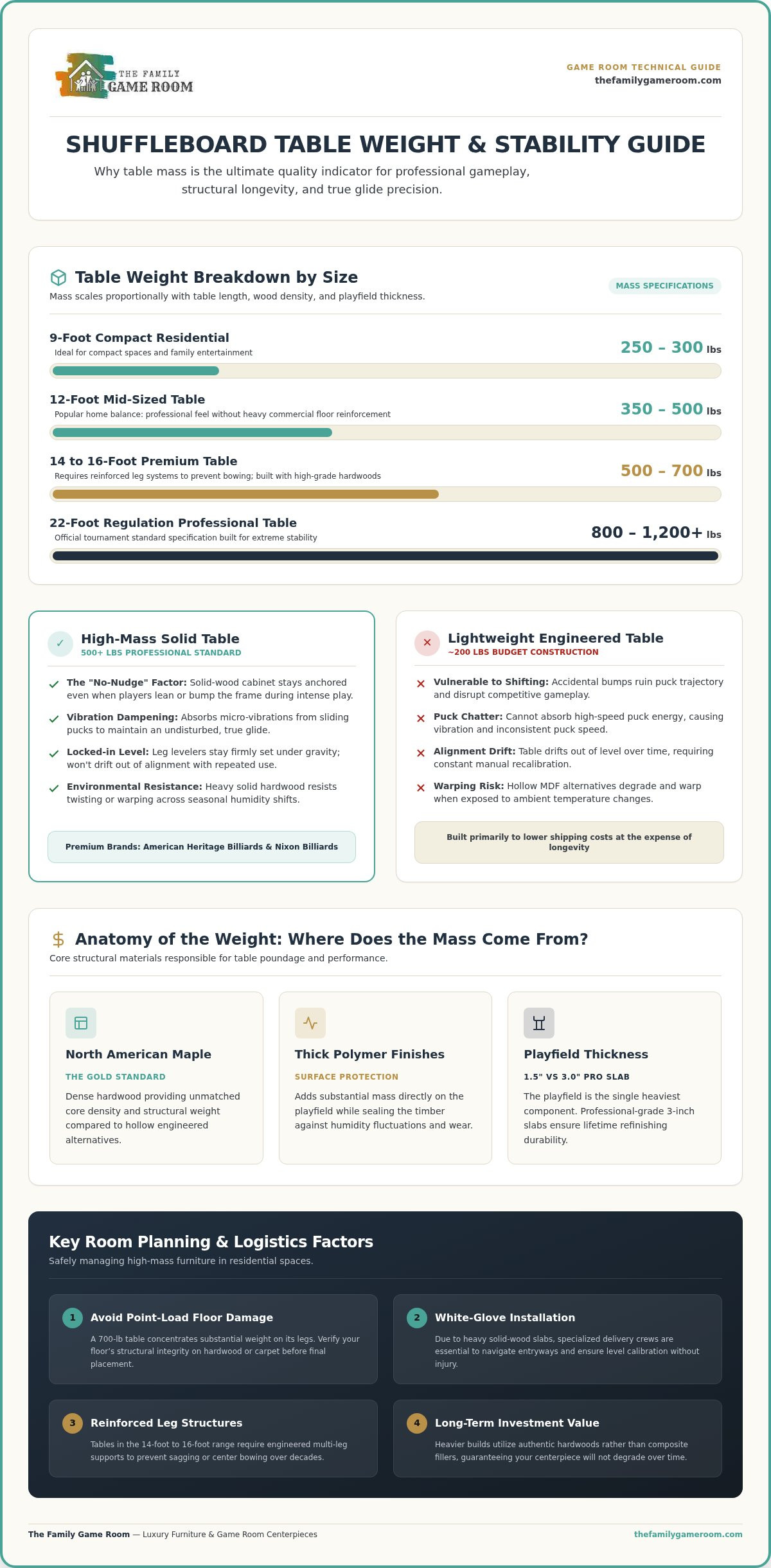
Understanding the specific pounds involved is the first step in successful room planning. While every model varies, shuffleboard table weight considerations usually scale with the length and the density of the wood used. For most residential spaces, a 9-foot table weighs between 250 and 300 pounds. As you move up to a 12-foot model, expect the mass to increase to 350 or 500 pounds. These mid-sized tables are popular because they offer a professional feel without requiring the structural reinforcements often seen in commercial venues.
- 9-Foot Tables: Approximately 250 to 300 lbs.
- 12-Foot Tables: Approximately 350 to 500 lbs.
- 14 to 16-Foot Tables: Approximately 500 to 700 lbs.
- 22-Foot Regulation Tables: 800 to 1,200+ lbs.
Size-to-Weight Ratios for Residential Tables
Larger tables, specifically those in the 14-foot to 16-foot range, often tip the scales at 500 to 700 pounds. This significant mass requires reinforced leg systems to prevent bowing or instability over time. If you're looking at premium options like American Heritage Billiards Pool Tables, you'll notice that the weight reflects the use of high-grade hardwoods and thick playfields. These heavy-duty builds are designed for longevity. You can explore our premium shuffleboard collections to see how these specifications translate to different styles.
Playfield Thickness and Its Impact on Poundage
The playfield is the heaviest individual part of the assembly. A standard 1.5-inch thick playfield is manageable for two or three people, but a professional-grade 3-inch thick slab adds immense weight. This extra thickness is a mark of quality. It allows for more frequent refinishing throughout the table's life. To manage this heavy wood slab, manufacturers include climatic adjusters. These metal bars allow you to tension the playfield, ensuring it stays slightly concave regardless of the humidity or the weight of the wood itself.
Distribution matters as much as the total number. Most of the weight is concentrated in the playfield, while the cabinet and legs provide the base. Pedestal legs offer a wider footprint and a lower center of gravity compared to post legs, making the table feel more anchored. If you choose a model with an integrated dining top or buffet cover, remember to add another 100 to 150 pounds to your calculations. This extra mass is great for stability but requires more care during the initial move into your home.
Structural Planning: Is Your Floor Ready for a Premium Table?
Bringing a professional-grade shuffleboard into your home requires more than just clear floor space. You must evaluate your home’s structural capacity to handle a permanent dead load. In residential engineering, a dead load refers to the constant weight of fixed objects like your table, while a live load accounts for the people moving around it. Standard US residential floors are typically designed to support a live load of 40 pounds per square foot. While most modern homes handle a 500-pound table with ease, shuffleboard table weight considerations become vital when you move into the 700 to 1,000-pound range.
The primary concern isn't just the total mass, but the point load distribution. Unlike a sofa that spreads weight across a large area, a shuffleboard table concentrates hundreds of pounds onto four or six small leg contact points. This pressure can compress carpet padding or even indent softer hardwoods like pine or cherry. Using heavy-duty furniture pads or placing the table on a dense area rug helps distribute this pressure, preserving the aesthetic of your flooring while providing a stable base for your game.
Calculating Floor Load Capacity for Game Rooms
If you're planning an installation in a second-story bonus room, check the direction of your floor joists. Standard construction usually provides enough strength for tables up to 14 feet. However, if you're eyeing a 20-foot or 22-foot regulation model, it's wise to consult a structural engineer. They can verify if your subfloor requires additional bracing. For the ultimate peace of mind, basement installations on concrete foundations are the gold standard. A concrete slab offers zero deflection, ensuring your table remains perfectly level regardless of its total poundage.
Placement Strategies to Minimize Structural Stress
Strategic placement can significantly reduce the strain on your home's framework. Always try to position your table perpendicular to the floor joists rather than parallel to them. This allows the weight to be shared across multiple structural beams instead of resting on just one or two. Placing the table near a load-bearing wall also provides superior support compared to the center of a wide, open span.
When designing a multi-game space, consider the cumulative weight of your inventory. If you're pairing your shuffleboard with other heavy items like Air Hockey Tables or pool tables, space them out to avoid overloading a single section of the floor. This balanced approach ensures your game room remains a safe, high-end sanctuary for family entertainment. Proper planning now prevents structural headaches later, letting you focus on the excitement of the game.
Logistics and Installation: Managing the Mass
Receiving a 600lb crate at your curb is a moment of excitement mixed with logistical reality. This isn't a standard parcel; it's a high-end furniture installation that requires a clear plan. When you factor in shuffleboard table weight considerations, you quickly realize that curbside delivery is just the first step in a larger process. Moving a solid wood playfield into your home involves more than just muscle. It requires an understanding of the physics of mass and the limitations of your home's layout.
Professional Installation vs. DIY for Heavy Tables
Attempting a DIY move for a premium table carries significant risks. A single slip can lead to structural damage or cosmetic scarring that ruins the aesthetic of your game room. Professional installers use specialized dollies and lifting straps designed for high-mass items. These tools allow them to navigate tight corners and hallways without straining the wood or your flooring. Pros also prioritize the leveling of the cabinet base before the playfield is even unboxed. If the base isn't perfectly aligned, the sheer weight of the playfield will prevent the table from ever offering a professional-grade glide. These shuffleboard table weight considerations are the reason white-glove service is often a necessity rather than a luxury for serious collectors.
The 2-Piece Playfield Option for Difficult Access
Sometimes, the architecture of your home dictates your equipment choices. If you're moving a table into a basement with a sharp turn or a high-rise apartment with a small elevator, a 12-foot or 14-foot single-piece playfield might not fit. In these scenarios, a 2-piece playfield is a brilliant solution. This design splits the mass into two manageable sections, making it possible to navigate stairs and narrow doors that would otherwise be impassable. Modern joining techniques ensure that once assembled, the playfield feels as solid and seamless as a single slab. It solves the weight-per-component issue without sacrificing the elite performance you expect from brands like Nixon Billiards.
Once your table is in place, it needs time to settle into its new environment. The mass of the wood will subtly shift as it acclimates to your home's humidity and temperature. This is where climatic adjusters become essential. These metal bars allow you to fine-tune the playfield’s shape after it has settled. Regular adjustments during the first few months ensure your table remains perfectly level for a lifetime of play. If you're ready to bring home a masterpiece, browse our selection of professional indoor shuffleboards to find the perfect fit for your space.
Balancing Weight and Aesthetics in Your Home Selection
Choosing the right table involves a delicate dance between visual appeal and structural reality. While you might be drawn to a specific silhouette, the design style you select directly impacts the total mass of the piece. Industrial designs often incorporate steel frames or heavy metal legs that provide a low center of gravity, while traditional styles rely on thick, carved hardwoods for their presence. These shuffleboard table weight considerations are essential because a heavier frame doesn't just look more substantial; it also supports high-end integrations like electronic scorekeepers and professional lighting kits that lighter frames might struggle to hold securely.
American Heritage Billiards: Traditional Mass and Craftsmanship
For those seeking a classic look, American Heritage Billiards represents the benchmark for furniture-grade game room equipment. These tables utilize traditional wood-carved cabinets that contribute significant weight to the overall build. This mass is a testament to the solid wood construction, ensuring the table feels like a permanent part of your home's architecture rather than a temporary fixture. To complete the high-end aesthetic, many owners pair these heavy-duty tables with Billiard Light Fixtures. A well-lit, heavy-set table creates a focal point of domestic warmth and luxury that is hard to replicate with lighter, mass-produced alternatives.
Nixon Billiards: Modern Engineering and Structural Integrity
If your home leans toward a contemporary aesthetic, Nixon Billiards offers modern engineering without sacrificing structural integrity. These designs achieve high weight through the use of dense, premium materials and sleek, often metallic, support systems. You get the visual lightness of modern lines combined with the rock-solid stability of a tournament-grade model. This makes them ideal for multi-functional spaces where you might be weighing Air Hockey vs. Foosball for additional entertainment. A heavy Nixon table remains anchored even in a busy room filled with other high-energy activities.
Before you make your final decision, run through this compatibility checklist to ensure your selected table matches your home's needs:
- Weight: Does your floor have the capacity for the specific model's poundage?
- Size: Is there enough "puck-swing" room around the ends of the cabinet?
- Aesthetics: Does the material (Solid Wood vs. Metal) match your existing decor?
- Installation: Have you planned for a professional crew to handle the mass?
Investing in a heavy, high-quality table is a commitment to professional-grade gameplay and long-term satisfaction. Whether you prefer the carved elegance of American Heritage or the sharp, modern edges of Nixon, the weight of your table is the ultimate indicator of its value and durability. By prioritizing mass and material density, you ensure your game room remains a place of excitement and excellence for years to come.
Elevate Your Home with Professional-Grade Stability
Mastering the technical nuances of table mass is the final step in creating a truly elite game room. High-mass construction serves as the ultimate proxy for quality, ensuring your playfield remains stable, level, and responsive for decades. By carefully balancing your floor's capacity with the specific requirements of your chosen model, you turn potential installation anxiety into a structured plan for success. These shuffleboard table weight considerations prove that a heavier investment is almost always a superior one for the serious player.
At The Family Game Room, we bring family-owned expertise to every high-end home entertainment project. Our expertly curated selection features the gold standard of structural stability, including authorized collections from American Heritage and Nixon Billiards. We provide national delivery on all new premium game tables, ensuring your piece arrives with the professional care it deserves. Whether you're outfitting a modern high-rise or a traditional basement, we're here to help you curate a space defined by excellence and domestic warmth.
Browse Our Collection of Premium Indoor Shuffleboard Tables and discover the perfect anchor for your home's entertainment today. Your family deserves a setup that plays as beautifully as it looks.
Frequently Asked Questions
How much does a standard 12-foot shuffleboard table weigh?
A standard 12-foot shuffleboard table typically weighs between 350 and 500 pounds, depending on the thickness of the playfield and the cabinet materials. Premium models from brands like American Heritage Billiards often sit at the higher end of this range due to their solid wood construction. When evaluating shuffleboard table weight considerations, remember that this mass ensures the table remains stable during play. Check specific weights before finalizing your room layout.
Can my second-floor game room support a 500-pound shuffleboard table?
Most modern US residential floors can safely support a 500-pound shuffleboard table. Standard building codes usually design for a live load of 40 pounds per square foot. Since a 12-foot table distributes its weight across multiple legs and a large footprint, it rarely exceeds these limits. However, placing the table perpendicular to floor joists or near load-bearing walls provides additional peace of mind for upper-story game rooms.
Does a heavier shuffleboard table mean better quality?
In the context of shuffleboard table weight considerations, mass is a reliable indicator of superior craftsmanship. Heavier tables typically feature dense North American hardwoods and thick, professional-grade playfields. These materials resist warping and provide a truer puck glide compared to lightweight, hollow alternatives. A high-mass table from a trusted curator like The Family Game Room represents a long-term investment in both gameplay performance and structural durability.
Is it possible to move a shuffleboard table by myself?
Moving a professional shuffleboard table alone is not recommended and can be extremely dangerous. Even smaller 9-foot models weigh several hundred pounds, while the playfield itself is often a single, unwieldy slab of dense wood. Attempting a solo move risks serious personal injury and structural damage to the table's frame or finish. We always suggest professional white-glove installation to ensure your investment is handled with the appropriate tools and expertise.
Will the weight of the shuffleboard table damage my hardwood floors?
A heavy table won't necessarily damage your hardwood floors, but the concentrated pressure on the legs can cause indentations over time. To protect your flooring, we recommend using high-density furniture pads or placing the table on a thick area rug. This helps distribute the point load across a wider surface area. Taking these simple precautions ensures your premium American Heritage or Nixon Billiards table remains a welcome addition without leaving lasting marks.
What is the weight difference between a solid wood and an MDF shuffleboard?
The weight difference between solid wood and MDF (Medium Density Fiberboard) can be substantial, often exceeding 150 to 200 pounds for a mid-sized table. Solid wood cabinets and playfields utilize dense maple or oak, which provides the necessary mass for vibration dampening and stability. MDF alternatives are lighter and easier to ship, but they lack the "no-nudge" factor and long-term structural integrity found in our premium, heavy-duty collections.
Do I need to reinforce my floor for a regulation 22-foot table?
For a regulation 22-foot table, which can weigh over 1,200 pounds, a structural evaluation is highly recommended. While basement concrete slabs handle this mass without issue, upper-story installations may require floor reinforcement. You should consult a structural engineer to ensure your joists can manage the permanent dead load. These extra-long tables concentrate immense weight on six or more legs, making proper structural planning a necessity for a safe and level installation.
How many people are needed to carry a shuffleboard playfield?
Carrying a shuffleboard playfield typically requires at least three to four capable adults for tables 12 feet or longer. The playfield is the heaviest component and is often awkward to grip, especially when navigating stairs or tight corners. For 20-foot to 22-foot regulation slabs, even more hands or specialized lifting equipment may be necessary. Professional installers utilize lifting straps and dollies to manage this mass safely, protecting both the crew and your home.