


The most impressive-sounding material isn’t necessarily the one that matters most to your game. Shuffleboard table materials can be difficult to compare when product descriptions use broad quality labels without saying whether they refer to the playing surface, frame, or finish.
That distinction matters. The playfield is where pucks glide, the frame supports the table and shapes its appearance, and the finish affects the exposed surface and its care routine. When comparing tables for your home game room, look at each component separately rather than assuming one material description applies to the whole table.
This guide explains the main table components and what common material terms can tell you about play, upkeep, and appearance. You’ll learn how solid and engineered wood differ, what finishes do, and how to compare care instructions. Use these details to choose an indoor shuffleboard table that suits your space and the way you plan to enjoy it.
Key Takeaways
- Separate the playfield, supporting structure, finish, and playing materials to understand what each specification describes.
- Compare shuffleboard table materials by their stated use and trade-offs, not by broad quality labels alone.
- Weigh play characteristics, appearance, and care needs without assuming every material performs the same way.
- Before choosing a table, look for clear details about the playfield, frame, finish, and recommended care.
- The American Heritage Quest Shuffleboard Table in Glacier Finish is one example of how a listed finish can help you assess a table’s style.
Shuffleboard Table Materials: What Each Part of the Table Does
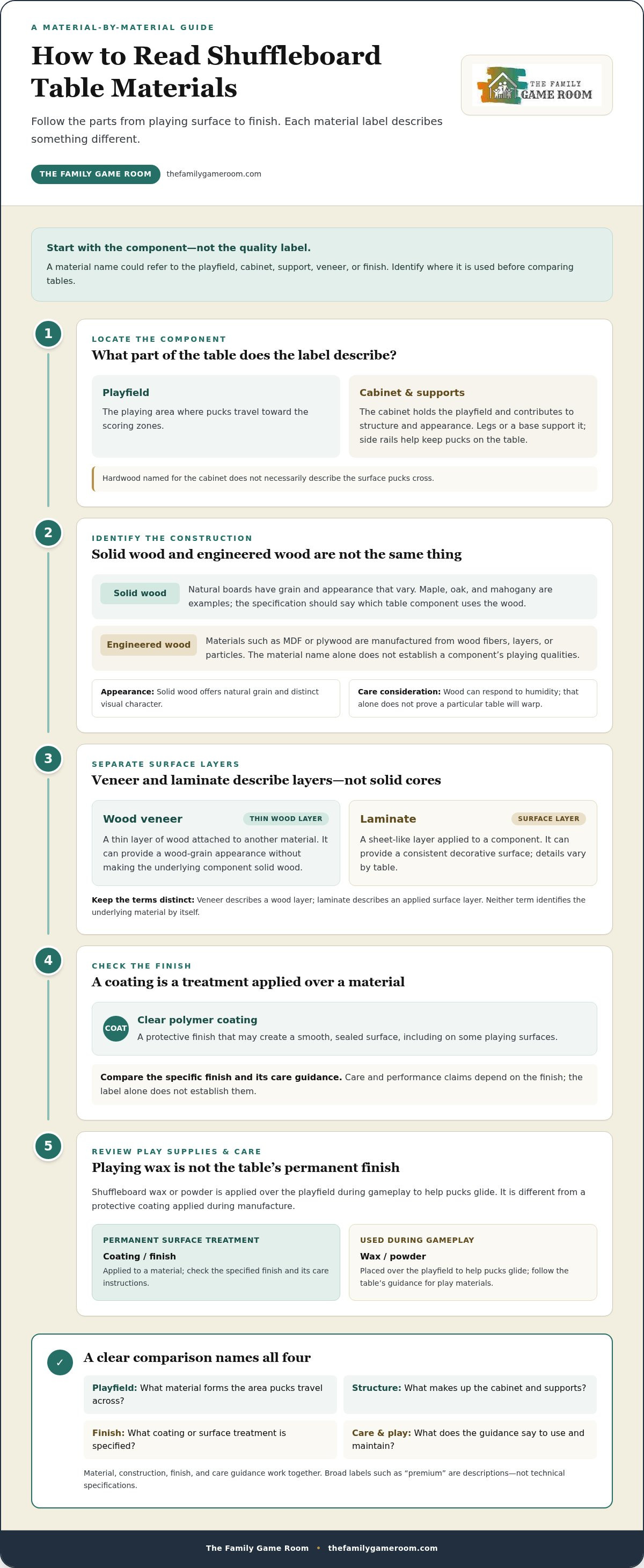
An indoor shuffleboard table combines a playfield, supporting structure, protective finish, and playing materials such as pucks and shuffleboard wax. These parts work together, but they serve different purposes. A wood name in a product description might refer to the cabinet, playing surface, or decorative layer. First identify the component the specification describes.
Playing surface, cabinet, and finish: the essential distinction
The playfield is the table’s playing area, where pucks travel toward the scoring zones. Its material and surface treatment can vary by table. “Playfield” describes the component’s function, not a universal material. For an overview of table shuffleboard and its equipment, see the Table Shuffleboard Overview.
The cabinet is the supporting body beneath and around the playfield. It holds the playing surface in place and contributes to the table’s structure and appearance. Legs or a base support the cabinet, while side rails help keep pucks on the table. If a listing names hardwood for the cabinet, that describes the supporting structure, not necessarily the surface the pucks cross.
A finish is a treatment applied to a material. On the playfield, a clear coating may protect the underlying surface and create a smooth playing layer. A wood veneer is different: it is a thin layer of wood attached to another material. Veneer describes construction, while coating describes a surface treatment. One does not establish the other.
Playing wax or powder is different again. It is applied over the playfield for gameplay to help pucks glide across the surface. It is not the table’s permanent protective finish, and it should not be confused with a coating applied during manufacture. Follow the table’s care instructions for cleaning and play materials rather than assuming every surface uses the same products or routine.
Why material labels alone don’t tell the whole story
Product descriptions may mention several materials in a few words. A wood species could identify the playfield, cabinet, legs, or veneer; a term such as “polymer” may describe a coating rather than the underlying material. Read each claim in context. If the component isn’t named, the material label alone doesn’t show where it is used.
A material name also doesn’t prove how the table will play or how long it will last. Performance and upkeep depend on how the material is used, the construction, the finish, and the care guidance. Treat broad terms like “premium” as descriptions, not technical specifications.
- Playfield: What material forms the area pucks travel across?
- Structure: Which materials make up the cabinet and support?
- Finish and play supplies: What coating is specified, and what does the care guidance say to use during play?
Separating these details gives you a clearer basis for comparing shuffleboard table materials and understanding what a product description actually tells you.
How Wood, Engineered Materials, and Coatings Shape a Shuffleboard Table
Material descriptions make more sense when you connect each one to its job. Wood or an engineered material forms a component; a finish or surface layer changes how that component looks or is protected. Neither category alone explains how the complete table is built or how it will perform.
Solid wood and engineered wood in table construction
Solid wood comes from natural boards, so its grain and appearance vary. Maple, oak, and mahogany are examples discussed in shuffleboard-table contexts, but they aren’t universal specifications. The Shuffleboard Table Wood and Finishes guide also discusses wood choices and playing-surface finishes. Engineered wood, such as plywood or MDF, is manufactured from wood fibers, layers, or particles. Veneer is a thin layer of wood applied to another material, creating a wood-grain appearance without making the underlying component solid wood.
Wood can respond to changes in humidity. That is a consideration for materials and care, not proof that a particular table will warp. Check which component the specification names: solid wood in a cabinet doesn’t establish what the playfield is made from. Likewise, engineered construction alone doesn’t determine performance or longevity.
| Material category | Common use | Potential advantage | Trade-off to consider |
|---|---|---|---|
| Solid wood, such as maple, oak, or mahogany | May be used in table components, depending on the design | Natural grain and distinct visual character | Wood characteristics and care needs vary; identify which part uses it |
| Engineered wood, such as MDF or plywood | May form structural or other table components | Offers an alternative to solid-board construction | The material name doesn’t establish the component’s playing qualities |
| Wood veneer | Visible outer layer over another material | Provides a real-wood appearance | It describes a surface layer, not a solid-wood core |
| Laminate | Applied surface layer on a component | Can provide a consistent decorative surface | It isn’t the same construction as a clear coating; details vary |
| Clear polymer coating | Protective finish, including on some playing surfaces | May create a smooth, sealed surface | Care and performance claims depend on the specific finish |
Laminate and polymer finishes: what to compare
Laminate is a sheet-like surface layer; a clear polymer coating is applied over a material as a finish. They serve different construction roles, so don’t treat the terms as interchangeable. A coating may be described as protective, but that doesn’t establish its exact resistance to wear or care requirements. Compare the stated finish, where it is used, and its maintenance guidance.
A structural material supports the table, while a surface coating treats the layer exposed to play. One cannot stand in for the other. Shuffleboard table materials are easiest to compare when product descriptions identify both the component and its construction. Follow the manufacturer’s care instructions for cleaning and play. You can also explore indoor shuffleboard tables with these distinctions in mind.
Comparing Shuffleboard Table Materials by Play, Upkeep, and Appearance
A useful comparison looks beyond a material’s name. Consider where it appears, what the maker says about the playing surface, and what care the table needs. A particular wood grain may suit your room, while clear care instructions may matter more for everyday use. The right fit depends on your priorities, not on which label sounds most expensive.
| Material or feature | Play considerations | Appearance | General upkeep considerations | Pros and trade-offs |
|---|---|---|---|---|
| Solid wood component | Its effect on play depends on whether it forms the playfield and how that surface is finished. | Natural grain varies by wood and board. | Follow guidance for the specific component and finish; wood may respond to indoor humidity changes. | Offers natural character, but the material name alone doesn’t prove performance or longevity. |
| Engineered wood component | Look for separate details about the playfield rather than inferring them from the frame. | May be covered with veneer or another visible layer. | Care depends on its surface treatment and the maker’s instructions. | Provides another construction option, but its label doesn’t establish how the table plays. |
| Veneer or laminate layer | Usually describes a visible layer, not the full playfield construction. | Can create a particular wood look or a consistent finish. | Use care instructions appropriate to the stated surface. | Helps describe appearance, but doesn’t identify the material beneath it. |
| Clear protective coating | The playing surface’s specified finish is relevant; performance claims should be tied to that finish. | May affect sheen and how the underlying material appears. | Use only the care routine recommended for the table. | Serves a different role from the structural material and isn’t automatically maintenance-free. |
Which material considerations matter most for your priorities?
For appearance, compare descriptions of visible grain, veneer, and finish rather than assuming a wood species identifies the whole table. For upkeep, distinguish routine care of the exposed surface from care of the supporting structure. For play, prioritize specific information about the playfield and the manufacturer’s guidance. Shuffleboard wax or powder is a playing consumable applied as directed, not the table’s protective finish.
These general considerations don’t guarantee a particular outcome. Two tables described with the same material may differ in construction, coating, and care requirements. A premium-sounding material isn’t automatically the right choice if its documented features or maintenance expectations don’t match your needs.
How room conditions can affect material decisions
Wood can expand or contract as indoor humidity changes, so a reasonably stable environment may be a practical consideration for wood components. That doesn’t mean a table will warp or crack; outcomes depend on the product and its conditions. Follow the maker’s guidance on placement, cleaning, and care. Compare the stated instructions instead of assuming every wood table needs the same routine.
Weigh play, appearance, and upkeep together. The clearest choice is the one whose documented construction and care expectations suit the way you’ll use and enjoy your game room.
How to Evaluate Shuffleboard Table Materials Before Choosing
Compare product descriptions component by component, then consider how the table will fit your home and routine. Specific construction details and care instructions are more useful than broad labels such as “premium” or “built to last.” Use this checklist to distinguish published specifications from general sales language.
Questions to answer from the product description
Look for a clear material description for both the playfield and cabinet. A wood species named without a component may describe only part of the table. Check whether the finish or coating is identified specifically, and read the manufacturer’s care instructions before buying. Note any stated environmental or use limitations. If a description uses quality language without explaining construction, treat it as a general claim, not a material specification.
- Identify the playfield material. Find the description of the surface pucks travel across. Don’t infer its material from details about the cabinet, legs, or trim.
- Identify the structural materials. Look for materials specified for the cabinet, support, and other structural components. A veneer description refers to a surface layer, not necessarily the material beneath it.
- Read the finish or coating details. Look for explicit terms describing the finish and where it is applied. Don’t assume “wood finish” names a coating’s composition or that a decorative layer is the playing surface.
- Review care requirements. Check the documented instructions for cleaning, play materials, and ongoing care. Confirm which products or methods the maker recommends for that table.
- Note stated conditions or limitations. Record manufacturer guidance about indoor conditions, placement, or use. Don’t turn a general material characteristic into a prediction about how a particular table will perform.
Match material expectations to the way you will use the table
Think about who’ll play and how often. A table used regularly by family and guests may call for a clear, manageable care routine; occasional play may make appearance and room style more prominent in your decision. Neither use pattern proves that one material will last longer. Weigh the actual construction details and stated maintenance needs together.
Then consider the visual fit. Descriptions of visible grain, veneer, and finish can help you picture how a table will complement your game room, while playfield specifications and maker guidance answer practical questions. When comparing shuffleboard table materials, give published details more weight than assumptions based on a wood name or prestige label.
Quick comparison rule: Record the playfield material, structural materials, finish, and care instructions for each table. Then compare only what’s explicitly stated.
Explore indoor shuffleboard tables as you put those details to work in choosing a table for your home.
Explore Indoor Shuffleboard Tables for a Refined Game Room
A thoughtful table choice brings together more than a material name. Identify the playfield and supporting components, compare the construction details the product description actually states, and understand the care routine before deciding. This helps you balance how a table will look in your home with how you plan to use and maintain it.
Apply the material checklist to an indoor table
As you compare indoor tables, read each product description component by component. Look for separate details about the playing surface, cabinet or other structural parts, and finish. Then review the maker’s care guidance so you understand the routine upkeep. If a description highlights a finish or wood species without naming where it is used, don’t assume it describes the playfield.
Consider the setting, too. A game-room centerpiece should suit the room’s other furnishings, while its care expectations should work for the people who’ll enjoy it. Match the appearance you want with documented construction and maintenance information, not assumptions about performance based on a material label.
The American Heritage Quest Shuffleboard Table in Glacier Finish is one indoor shuffleboard table offered by The Family Game Room. Its name and listed finish provide a starting point for considering style; they don’t, by themselves, describe the playfield or cabinet materials. Use the same component-by-component approach with any table you’re evaluating, and rely on its product details for construction and care information.
A polished next step for your home game room
Creating a welcoming entertainment space means choosing pieces that suit both the room and the way you gather in it. Complementing your game setup with matching bar features or artisan bottles & glass display stands can help tie the whole area together. A shuffleboard table can become part of that experience, but a confident selection starts with clear expectations: know which materials are specified for each component, distinguish the playing finish from the structural construction, and understand the care instructions before deciding.
Keep your comparison practical. If playing performance is your priority, focus on published playfield details and manufacturer guidance. If the room’s look is central, consider the described finish and visible materials. If easy upkeep matters most, weigh the documented care routine alongside the table’s appearance. No single material label answers all three questions; the right choice fits your household’s preferences.
With a clearer way to assess shuffleboard table materials, you can explore indoor options with a more discerning eye. Explore indoor shuffleboard tables and find a refined addition to your home game room.
Make Room for Your Next Favorite Game
Choosing a shuffleboard table is also a chance to shape how your game room feels and how people gather in it. Let your priorities guide the decision: how the table complements your home, the play experience you want, and the care routine that feels manageable. A clear comparison of shuffleboard table materials can help you move forward without letting impressive-sounding labels make the choice for you.
The Family Game Room offers premium game-room products to customers nationwide. Its indoor selection includes the American Heritage Quest Shuffleboard Table in Glacier Finish, one option to consider as you explore styles for your home. Keep your priorities at the center as you browse.
Explore indoor shuffleboard tables and find a shuffleboard table for your home game room.
Frequently Asked Questions
Is solid wood always the best material for a shuffleboard table?
No. Solid wood may appeal for its natural grain, but the material alone doesn’t tell you how the table will play, what care it needs, or how it’s constructed. Compare playfield details separately from the cabinet and finish. A table may use solid wood in its visible structure without specifying that the playing surface is solid wood too. Choose based on stated construction and your priorities, not a material’s reputation alone.
Can humidity affect a wooden shuffleboard table?
Yes. Wood can respond to changes in moisture by expanding or contracting, though that doesn’t mean a particular table will warp or crack. Consider the room’s conditions and follow the manufacturer’s recommendations for placement and care. Where practical, avoid exposing the table to sudden environmental changes, such as placing it close to a strong heat source. Product-specific guidance is the best reference for caring for the table in your home.
What is the difference between a shuffleboard table finish and shuffleboard wax?
A finish is part of the table’s construction, while shuffleboard wax is a playing material used on the surface according to the table’s instructions. The finish remains on the table; wax is replenished as needed for play. Don’t use wax as a cleaner or protective coating. Check the maker’s guidance for which playing material suits the surface and how to apply or refresh it, since routines can vary by table.
Does a polymer coating mean a shuffleboard table never needs maintenance?
No. A polymer coating doesn’t remove the need for routine care. Dust and residue can still collect on the playing surface, and the table’s instructions determine how to clean it and what playing materials to use. “Low maintenance” doesn’t mean maintenance-free. Keep the care guidance with the product information so everyone using the table knows which cleaning methods and supplies are appropriate.
Can you refinish a shuffleboard table with a laminate or polymer surface?
It depends on the exact surface, construction, and condition. A laminate layer isn’t the same as a solid wood surface, and a polymer coating may require a specific repair or refinishing method. Don’t sand, strip, or apply a new coating based on advice for a different table. Read the manufacturer’s maintenance instructions first; an unsuitable product or process could alter the playing surface.
Are shuffleboard table materials suitable for outdoor use?
Not automatically. Don’t assume a table described for indoor use is suitable for a patio or other outdoor setting. Sun, rain, and changing moisture conditions can affect materials and finishes, though the outcome depends on the product. Look for explicit manufacturer guidance about where the table is intended to be used. If the instructions describe indoor use, keep the table indoors.
How should I clean a shuffleboard table without damaging its surface?
Start with the manufacturer’s cleaning instructions. As a cautious routine, remove pucks and loose debris, then use a soft, clean cloth. Choose a surface cleaner only if the maker recommends it. Avoid abrasive pads, harsh household chemicals, and excess water unless the instructions specifically permit them. Don’t spray products directly onto the playfield without guidance. These steps help prevent avoidable surface damage while keeping care specific to your table.