


Is your shuffleboard table a high-speed professional playfield or just an expensive piece of furniture gathering dust? You chose a premium table for its craftsmanship and the joy it brings to your home, but it's disheartening when pucks start to stick or the wood loses its luster. Mastering shuffleboard table maintenance is the only way to protect that investment and ensure every slide feels like opening night. Many owners hesitate because they fear warping the hard rock maple or confusing their speed powders with liquid waxes. We understand that you want a beautiful centerpiece that performs perfectly without becoming a full-time job.
This 2026 guide promises to turn you into a confident curator of your game room. You'll learn the exact steps to achieve a consistent, professional-grade puck slide while preserving the pristine finish of your table for decades. We're going to break down the differences between essential cleaners and silicone sprays; then, we'll provide a simple, repeatable routine that fits into your lifestyle. From adjusting climatic adjusters to selecting the right wax, you'll gain the expertise needed to keep your home entertainment at its peak.
Key Takeaways
- Learn how to stabilize your home’s atmosphere to prevent playfield crowning and protect the organic integrity of your table’s wood.
- Master a professional shuffleboard table maintenance routine that correctly utilizes cleaners, polishes, and waxes for a frictionless, high-speed slide.
- Identify the difference between "convex" and "concave" playfields to precisely calibrate your climate adjusters for a perfectly level game.
- Discover why maintaining your pucks is the most effective way to prevent surface scratches and preserve your table's pristine finish.
- Understand the "Polymer Advantage" found in premium hard rock maple tables and why high-end craftsmanship requires significantly less maintenance effort.
The Environment: Setting the Foundation for Table Longevity
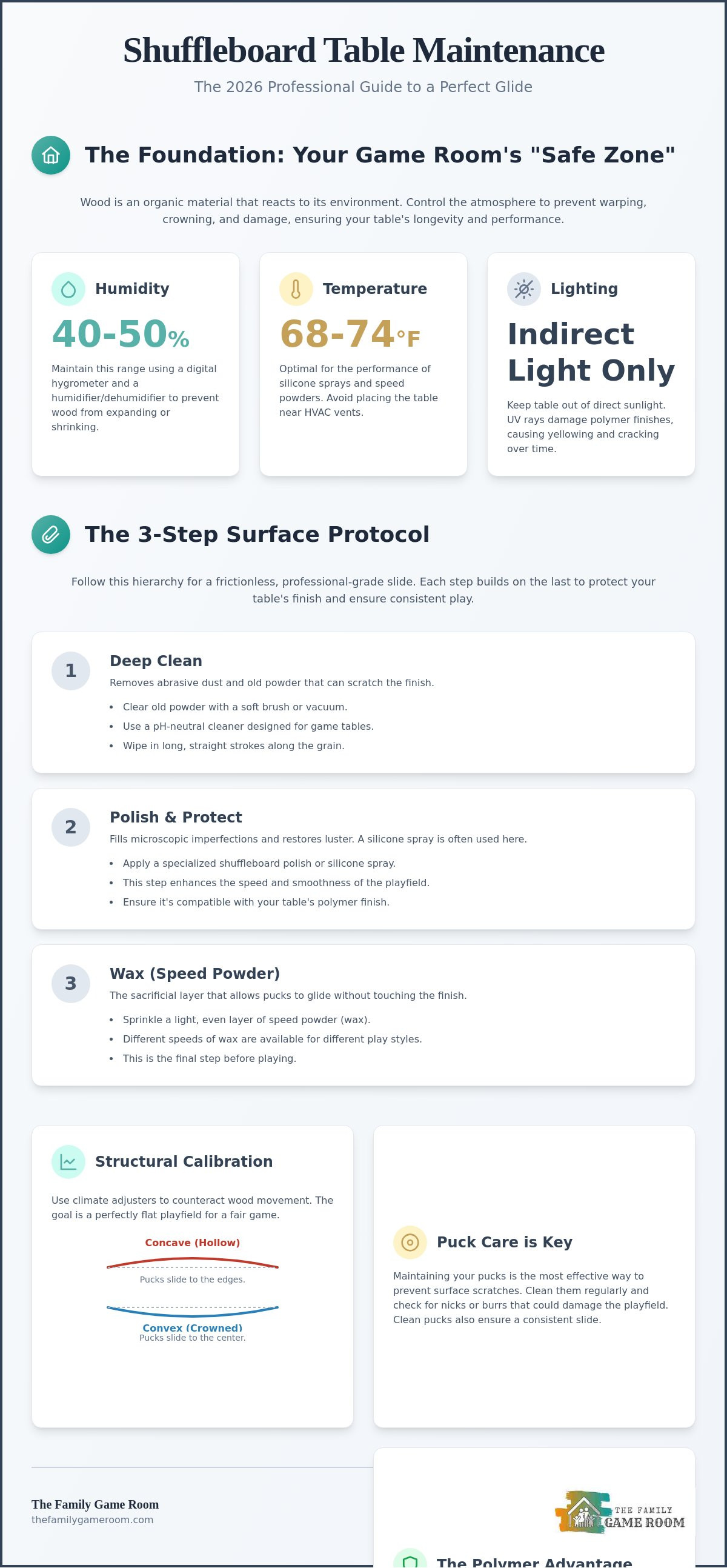
Your shuffleboard table isn't just a heavy piece of equipment. It's a living, breathing assembly of premium hard rock maple. Because wood is organic, it constantly reacts to the air in your game room. Professional shuffleboard table maintenance begins long before you pick up a bottle of wax; it starts with controlling the atmosphere. When humidity levels spike, the wood fibers absorb moisture and expand, often causing the playfield to "crown" or arch upward. Conversely, dry air causes the wood to shrink. These micro-movements can ruin a perfect slide and, over time, lead to permanent structural damage.
Temperature plays a secondary but equally vital role in performance. Fluctuations in your room's climate change the viscosity of your silicone spray and the behavior of your speed powder. A cold room makes the surface feel sluggish, while a hot room can cause the silicone to thin out too quickly. To maintain professional speed, you must define a "Safe Zone" for your table. This environmental foundation ensures that the mechanical adjustments you make later actually stick.
Maintain these ambient conditions to protect your investment:
- Humidity: 40% to 50% relative humidity.
- Temperature: 68°F to 74°F for optimal chemical performance.
- Lighting: Indirect or UV-filtered light only.
Managing Humidity and Temperature with Precision
In 2026, a simple thermometer isn't enough. Every serious game room needs a dedicated digital hygrometer. This small device provides real-time data on moisture levels, allowing you to react before the wood does. For a solid maple playfield, the ideal humidity range is strictly 40-50%. If your home falls outside this window, use a humidifier or dehumidifier to stabilize the moisture content. Consistency is the goal. Rapid changes are far more dangerous to the Table shuffleboard than a slightly higher, but stable, humidity level.
Strategic Placement: Avoiding Environmental Hazards
Where you place your table is just as important as how you clean it. Follow the "Window Rule" and keep your table out of direct sunlight. UV rays are the primary enemy of modern polymer finishes and traditional lacquers, causing them to yellow, crack, or lose their slickness. Position your table at least several feet away from HVAC vents. Localized blasts of hot or cold air create "dry spots" that lead to uneven play and potential cracking. Finally, ensure your floor is perfectly level before installation. A slight tilt puts uneven stress on the cabinet and legs, compromising long-term shuffleboard table maintenance and structural integrity.
The Surface Protocol: Cleaning and Waxing for Professional Speed
Professional shuffleboard table maintenance requires a clear understanding of the three-step surface hierarchy: cleaning, polishing, and waxing. These aren't interchangeable tasks. Cleaning removes the abrasive dust and old speed powder that act like sandpaper against your finish. Polishing fills in microscopic imperfections to restore the table's original luster. Finally, waxing provides the sacrificial layer that allows the puck to glide without actually touching the wood's finish. Most Premium shuffleboard tables today feature a thick polymer coating rather than old-fashioned lacquer, which changes how you must approach these steps.
The "Buffing Secret" for a friction-free surface lies in the final pass. After applying your wax, don't just wipe it off. Use a high-quality microfiber towel or a dedicated buffing tool to work in circular motions until the surface is completely clear and slick. If you can feel any resistance when you run a finger across the board, it isn't buffed enough. A properly buffed table creates a consistent slide that rewards skill over luck. If you're looking to upgrade your setup, exploring new Indoor Shuffleboard Tables can show you just how responsive a modern, well-maintained finish should feel.
The Deep Clean: Removing Dust and Grime
Always start by removing every grain of old speed powder. Use a soft brush or a vacuum with a padded attachment to clear the gutters first, then move to the playfield. Select a pH-neutral cleaner specifically formulated for game tables; harsh household chemicals can cloud or strip a polymer finish. Wipe in long, straight strokes from one end of the table to the other to ensure you aren't just swirling debris around. A tack cloth is a specialized resin-treated fabric designed to lift and trap micro-particles that traditional microfiber cloths often leave behind.
Waxing and Silicone: The Physics of Slide
Modern polymer tops respond best to liquid wax because it spreads more evenly than heavy pastes. Apply the liquid wax in thin, consistent layers. Let it haze over before you begin the buffing process. Once the wax is set, many professionals use a silicone spray as a "speed booster." This spray acts as a primer for your speed powder, helping the granules stay in place rather than clumping. If you're preparing for a party or a long tournament, apply a fresh coat of silicone spray thirty minutes before play begins. This ensures the table stays fast and the pucks don't slow down as the evening progresses.
Structural Calibration: Mastering Climate Adjusters and Leveling
Even with perfect environmental control, your playfield will eventually shift. This is where structural shuffleboard table maintenance becomes your most valuable skill. Underneath every professional-grade table, you'll find a series of metal brackets known as climate adjusters. These mechanical systems allow you to counteract the natural expansion and contraction of the wood. Without them, even the finest hard rock maple would eventually become unplayable due to seasonal changes in your home's humidity.
Before making any changes, you must identify how the board has shifted. Place a carpenter’s level across the width of the playfield at each adjuster location. A "Convex" board arches upward in the center, causing pucks to drift toward the gutters. A "Concave" board dips in the middle, pulling pucks toward the center line. To verify this with precision, use the "Penny Test." Place your level across the board and try to slide a penny under it in the center. If the penny slides through easily, your board is concave. If the level rocks back and forth on the center point, the board is convex. For more detailed technical specifications, refer to the Shuffleboard Federation Maintenance Guide to ensure your measurements align with tournament standards.
Patience is the secret to successful calibration. Wood is a slow-moving material that requires time to respond to mechanical pressure. Never turn the adjustment bolts more than a quarter-turn at a single time. After each adjustment, wait at least 24 hours for the wood to settle before checking the level again. Rushing this process can lead to over-correction or, in extreme cases, damage to the internal structure of the playfield.
Tuning the Climate Adjusters
To flatten a concave board, loosen the nuts on the adjuster bars to allow the wood to relax. For a convex board, tighten the bolts to pull the edges upward and flatten the crown. Perform this check every six months to coincide with seasonal shifts in your HVAC usage. While most minor crowning is a simple DIY fix, call a professional if you notice severe warping or if the climate adjusters are at the end of their threading. Premium tables respond more predictably to these tweaks, making the job much easier for the homeowner.
Leg Leveling for a Fair Game
While climate adjusters fix the shape of the board, leg levelers ensure the entire unit is horizontal. A table that isn't level from end to end will cause pucks to accelerate or decelerate unnaturally. Use a digital level for 2026-standard precision, checking both the playfield and the cradle. Adjust the heavy-duty levelers at the base of each leg until "drift" is completely eliminated during a slow test slide. A stable, level cradle is the only way to ensure your shuffleboard table maintenance efforts aren't wasted on a wobbly foundation.
Beyond the Board: Puck Care and Accessory Management
True mastery of shuffleboard table maintenance extends past the playfield itself. Your accessories are the primary touchpoints of the game, and their condition directly impacts the longevity of your table's finish. While many owners focus solely on the wood, the interaction between the puck and the surface is where the most wear occurs. Neglecting your pucks or using the wrong maintenance tools can undo hours of careful waxing and leveling. Professional play requires every component to be in peak condition.
A pristine cradle and clean gutters are also essential for a professional experience. Dust and debris that accumulate in the gutters don't just look untidy; they can migrate back onto the playfield during play. Use a dedicated shuffleboard brush with soft, natural bristles to sweep the gutters after every session. Never use your hands to clear the powder, as skin oils can create sticky spots on the wood. Maintaining these peripheral areas ensures your game room remains a polished centerpiece. If you're looking to complete your setup with professional-grade equipment, explore our curated selection of Indoor Shuffleboard Tables to see how quality accessories complement a high-end build.
Puck Maintenance and Storage
Dirty pucks are the leading cause of playfield scratches. Every time a puck slides, it picks up microscopic particles. If these aren't removed, they act like a diamond-tipped stylus against your polymer finish. Clean the stainless steel bottoms of your pucks with a soft microfiber cloth before every game. Inspect each one for burrs or nicks. A single sharp edge can gouge your hard rock maple playfield in seconds. When the game ends, store your pucks in their dedicated case. Never leave them on the playfield overnight, as the weight can cause localized pressure points or trap moisture against the finish.
The Science of Speed Powder
Shuffleboard waxes use a numbering system from 1 to 6 to indicate speed. A #1 wax is the fastest, typically reserved for professional 22-foot tables, while a #6 offers more control for shorter home models. Match your powder to your table length and your skill level. Applying a "perfect sprinkle" requires a steady hand and even distribution. Avoid clumps, as these create "speed bumps" that deflect the puck. Proper Billiard Light Fixtures are vital here, as they provide the overhead clarity needed to see the powder distribution across the entire surface. This visibility allows you to spot thin areas before they affect your score.
Investing in Quality: Why Premium Tables Require Less Effort
Choosing a high-end table is the most effective strategy for simplifying your long-term shuffleboard table maintenance. While entry-level models often use softwoods or thin veneers that warp at the first sign of humidity, premium tables are engineered for stability. When you invest in a table built from kiln-dried hard rock maple, you are buying a playfield that reacts predictably to its environment. These dense wood fibers resist the deep moisture absorption that causes cheaper boards to twist or "crown" beyond repair. A well-constructed table doesn't just play better; it respects your time by requiring fewer mechanical adjustments over its lifetime.
The Family Game Room is dedicated to sourcing only new, top-tier equipment because we believe your home deserves furniture that performs as a professional instrument. A well-maintained, luxury shuffleboard table adds significant value to your home's entertainment space, serving as a functional piece of art that lasts for generations. When the foundation is solid, maintenance stops being a battle against gravity and starts being a simple preservation of excellence. High-quality materials ensure that every minute you spend cleaning or waxing translates directly into a faster, more consistent game.
Comparing Finishes: Polymer vs. Lacquer
Modern polymer finishes represent a massive leap forward in durability. Unlike traditional lacquer, which is thin and prone to cracking or "checking" as the wood moves, polymer is a thick, flexible shield. A professional-grade polymer top never needs resurfacing if you follow a basic shuffleboard table maintenance routine. This is a hallmark of the American Heritage Billiards Pool Tables and shuffleboards we curate. When inspecting a playfield, look for a minimum thickness of 3 inches; this mass provides the structural integrity needed to support a lifetime of professional-grade polymer coating.
Building Your Ultimate Game Room
A premium shuffleboard table often serves as the anchor for a complete home entertainment suite. Coordinating your shuffleboard with other high-end pieces creates a cohesive aesthetic that feels like a private club. For instance, the care principles you've mastered here apply across your entire collection. You might find our guide on choosing an air hockey table for home helpful for understanding how different surface materials require specific care. Ultimately, maintenance isn't a chore. It's the ritual of a true player who honors the craftsmanship of their equipment. Treat your table with the respect it deserves, and it will provide decades of flawless, high-speed play.
Elevate Your Game with Timeless Craftsmanship
Mastering shuffleboard table maintenance is the ultimate way to honor the premium materials in your home. By controlling your game room's environment and following a precise surface protocol, you protect the organic beauty of your hard rock maple playfield. These simple habits transform a piece of furniture into a professional-grade instrument that responds to every skill-based shot. Whether you're calibrating your climate adjusters for seasonal shifts or perfecting your speed powder application, these rituals ensure your table remains a high-performance centerpiece for decades.
As a family-owned and operated business since 2022, we're dedicated to providing the highest level of excellence for your home. We focus exclusively on brand-new, luxury equipment that doubles as sophisticated decor. Ready to bring professional-grade play into your living space? Upgrade your home with a premium Indoor Shuffleboard Table from The Family Game Room. We offer a curated selection of masterpieces from industry leaders like American Heritage and Nixon Billiards. Invest in a legacy of quality and enjoy a lifetime of perfect slides with your family and friends.
Frequently Asked Questions
How often should I clean my shuffleboard table?
Clean your table playfield at least once a week if you play regularly. You should also brush away old speed powder after every single gaming session to prevent dust accumulation. A deep clean with a pH-neutral solution is recommended once a month to remove any residual silicone buildup that might interfere with your shuffleboard table maintenance routine and puck speed.
What is the difference between shuffleboard wax and speed powder?
There is no difference; they are two names for the same essential product. While "wax" is the traditional industry term, modern players usually call it speed powder or sand. It consists of dried cornmeal and silicone beads designed to act as ball bearings. This allows the puck to glide across the playfield without actually touching the wood's finish.
Can I use furniture polish like Pledge on my shuffleboard table?
Never use household furniture polishes on a professional playfield. These products often contain oils and scents that leave a greasy residue, which can gum up your speed powder and create inconsistent slides. Stick to specialized, table-specific cleaners and liquid waxes. These are formulated to protect the polymer coating without compromising the friction-free environment required for high-level play.
My pucks are slowing down—what is the most likely cause?
Dirty puck bottoms or high humidity are the two most common culprits for sluggish play. Check the stainless steel base of your pucks for grime or wax buildup and wipe them with a microfiber cloth. If the pucks are clean, check your room's hygrometer. Humidity levels above 50% create a "sticky" surface that significantly reduces puck velocity regardless of how much powder you apply.
How do I know if my shuffleboard table needs a climate adjuster adjustment?
Perform a level check if you notice your pucks consistently drifting toward the gutters or the center line. Use a carpenter's level or a digital level across the width of the board at several points. If the board shows a convex or concave shape that deviates from a very slight "trough," it's time to use the climate adjusters to recalibrate the tension.
Can I leave the speed powder on the table when I'm not playing?
Clear the board of all powder once your session ends. Speed powder is hygroscopic, meaning it absorbs moisture from the air over time. If left on the table for days, it can clump and stick to the finish, making your next shuffleboard table maintenance session much more difficult. Wiping the board clean ensures the polymer stays pristine and ready for a fresh application.
Is it normal for a shuffleboard table to have a slight curve?
Yes, a professional shuffleboard table is designed with a very slight concave curve, often called a "trough." This subtle dip helps keep the pucks on the playfield during high-speed shots rather than letting them slide immediately into the gutters. However, if the curve becomes pronounced enough to pull every shot to the center, you likely need to loosen your climate adjusters.
How do I remove a scratch from my shuffleboard's playfield?
Minor surface scratches in a polymer finish can usually be buffed out using a high-quality liquid wax and a microfiber towel. Apply the wax to the area and use firm, circular motions to blend the scratch into the surrounding finish. If the scratch is deep enough to reach the hard rock maple wood, you should consult a professional to prevent moisture from entering the timber.