


What if the difference between a frustratingly slow game and a professional-grade slide is just ten minutes of ritualized care? You've invested in a premium centerpiece for your home, likely from a master crafter like American Heritage Billiards, but the fear of clouding that beautiful polymer finish with the wrong product can be paralyzing. Proper shuffleboard table maintenance shouldn't feel like a chemistry experiment. Whether you're confused by the choice between liquid silicone and powder wax or struggling with inconsistent puck speed across the board, you aren't alone in wanting your investment to last a lifetime.
We agree that a high-end game room deserves a surface that plays as perfectly as it did on day one. This guide promises to transform you into a confident curator of your playfield, ensuring every slide is lightning-fast and perfectly predictable. You'll master the essential Clean, Protect, and Accelerate layers while learning exactly which 2026-certified products are safe for luxury finishes. We're diving into the specifics of climatic adjusters, the latest Sun-Glo safety standards, and the pro-level secrets to maintaining that heirloom-quality shine for decades to come.
Key Takeaways
- Protect your premium polymer finish by prioritizing strategic table placement and managing environmental factors like UV exposure.
- Master the distinction between daily play prep and deep monthly rituals to ensure your shuffleboard table maintenance routine preserves the playfield's integrity.
- Learn the professional layering technique of using silicone spray as a primer to maximize the speed and performance of your dry powder wax.
- Maintain tournament-level accuracy by learning to tune climatic adjusters, creating the ideal concave curve for consistent puck travel.
- Safeguard your heirloom-quality investment from dust and wood damage by utilizing high-quality table covers and specialized cabinet care.
The Foundation: Ideal Placement and Environmental Control
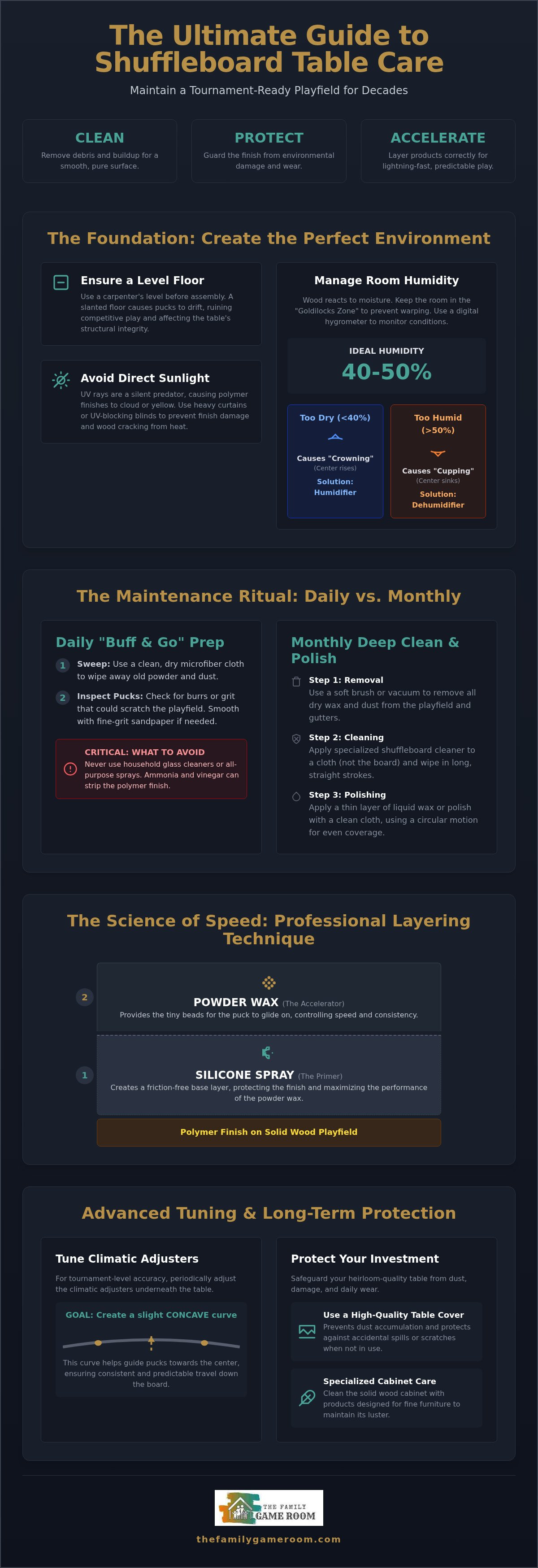
Effective shuffleboard table maintenance starts the moment you decide where your new investment will live. While premium brands like American Heritage Billiards build tables to endure, even the toughest polymer finishes cannot fight a poorly chosen environment. A level floor is your first priority. If your floor has a slight slope, your pucks will drift toward the gutter, ruining the competitive balance of Table shuffleboard. Check the site with a carpenter’s level before assembly to ensure a true, flat start. Proper placement protects the table's structural integrity and ensures every game is won by skill, not a slanted floor.
Sunlight and Temperature Fluctuations
Direct sunlight is a silent predator for high-end game room furniture. UV rays break down the chemical bonds in polymer and lacquer finishes, leading to unsightly clouding or yellowing over time. Windows are effectively a shuffleboard table’s worst enemy. Beyond the finish, heat from the sun causes thermal expansion. This means the wood beneath the finish expands and contracts at different rates than the coating, which can eventually lead to hairline cracks or delamination. Use heavy curtains or UV-blocking blinds to shield your table during peak daylight hours. This simple step preserves the rich color of your solid wood cabinet for decades.
Humidity Management for Solid Wood
Wood is a living material that reacts to the air around it. To keep your playfield in peak condition, aim for the "Goldilocks Zone" of 40-50% humidity. When the air gets too dry, usually in the winter, the wood loses moisture and can "crown," where the center of the board rises higher than the edges. Conversely, high summer humidity causes "cupping," making the center sink. Both conditions make the table unplayable and can lead to permanent warping if left unaddressed.
Don't guess the status of your room. Invest in a digital hygrometer to monitor the environment 24/7. If you notice the humidity dipping below 40%, a small humidifier can prevent the wood from shrinking. If it climbs above 50%, a dehumidifier is essential. These seasonal adjustments are the backbone of professional shuffleboard table maintenance, ensuring your heirloom-quality table remains a fast, flat, and fair playing surface through every change in weather.
The Cleaning and Waxing Ritual: A Step-by-Step Guide
Mastering the cleaning ritual is what separates a casual owner from a professional. While the solid wood cabinet of your table is built for durability, the high-gloss polymer playfield requires a specific touch. Effective shuffleboard table maintenance relies on three primary tools: high-quality microfiber cloths, a dedicated surface cleaner, and a premium liquid wax or polish. This process ensures your surface remains friction-free and visually stunning for years.
Daily Playfield Preparation
Casual play doesn't require a deep scrub every time you pick up a puck. For daily enjoyment, use the "Buff and Go" method. Simply take a clean, dry microfiber cloth and sweep away the old speed powder and any settled dust. This prevents debris from being ground into the finish during play. Don't reach for household glass cleaners or all-purpose sprays. These often contain ammonia or vinegar, which can strip the protective layers of a luxury polymer finish and leave the surface "grabby" or dull.
Before you begin a game, take five seconds to inspect your pucks. Look for burrs, scratches, or grit on the bottom of the weights. A single damaged puck can leave permanent tracks on your board. If you find a rough edge, use a fine-grit sandpaper to smooth it out before it touches the playfield. If you're looking to upgrade your setup, explore our collection of premium indoor shuffleboard tables to find a board built for high-performance play.
Monthly Deep Cleaning and Polishing
Once a month, or whenever you notice the pucks slowing down despite fresh powder, it's time for a deep clean. Follow these steps to restore that mirror-like shine:
- Step 1: Removal. Use a soft-bristled brush or a vacuum with a soft brush attachment to remove all dry wax and dust. Ensure the gutters are clear of debris.
- Step 2: Cleaning. Apply a specialized shuffleboard cleaner to a cloth, not directly to the board. Wipe the surface in long, straight strokes to remove skin oils and silicone buildup.
- Step 3: Polishing. Apply a thin layer of liquid wax or polish. Use a circular motion to ensure even coverage across the entire length of the board.
Let the liquid wax haze over for a few minutes before buffing it out with a fresh microfiber cloth. This creates a hard, slick barrier that protects the polymer. This level of care isn't just for the playfield. High-end American Heritage Billiards Pool Tables require similar cabinet care to maintain their heirloom quality. By treating the wood cradle with the same respect as the playing surface, you ensure the entire piece remains a centerpiece of your home for decades. Consistent shuffleboard table maintenance isn't just about speed. It's about protecting the value of your recreational investment.
The Science of Speed: Silicone Sprays and Shuffleboard Wax
Achieving a professional-grade slide requires understanding the specific chemistry of your playfield. In the world of shuffleboard table maintenance, terminology often trips up new owners. When enthusiasts talk about "wax," they aren't referring to a liquid floor polish. They mean the dry, sand-like powder or silicone beads that act as microscopic ball bearings for your pucks. To make this powder perform effectively on a premium polymer surface, you must first apply a primer: silicone spray.
Silicone spray is not an optional luxury. It creates a tension-reducing barrier that prevents your speed powder from clumping or migrating into the gutters. Without this base layer, the powder sits directly on the finish, leading to "dry spots" that kill momentum mid-slide. The golden rule for application is simplicity. Over-applying spray leads to a gummy buildup that eventually requires a full strip-and-clean. A light, uniform mist is all you need to keep the game moving.
Applying Silicone Spray Correctly
Consistency is the secret to a fair game. To apply the spray, use the "Sweep" method. Hold the can about 12 to 15 inches above the board and move in a steady, continuous motion from one end to the other. Avoid stopping or hovering over one spot. Once the mist settles, wait at least three to five minutes. This allows the silicone to bond with the polymer surface. If you add powder too early, the moisture will turn your speed beads into a sticky paste. As of the latest June 2026 safety updates for industry-standard lubricants, always ensure your game room has basic ventilation when applying these aerosols.
Choosing and Spreading Speed Powder
Speed powder comes in ratings from 1 to 9. A #1 rating is the fastest, typically reserved for professional 22-foot tournament tables. For the 9 to 14-foot tables often found in home game rooms, a #4 or #5 rating offers a more controlled, enjoyable pace. Matching the powder to your table length and skill level prevents pucks from flying off the end of the board on every shot.
To spread the powder, use a dedicated shaker. Don't simply pour it out. Aim for a uniform "salt and pepper" look across the entire playfield. If you notice "slow spots" during a game, resist the urge to dump more powder on that specific area. Instead, use a shuffleboard brush to redistribute the existing beads. This keeps the friction levels consistent across the board. Proper shuffleboard table maintenance ensures that your skill, not a patchy board, determines the winner of every frame.
Tuning for Accuracy: Mastering Climatic Adjusters
Mastering the physical geometry of your playfield is the hallmark of professional shuffleboard table maintenance. Beneath the solid wood of tables from brands like Nixon Billiards, you'll find climatic adjusters. These are heavy-duty metal bars designed to counteract the natural movement of the maple. Your ultimate goal isn't a perfectly flat board. Instead, you want a very slight "concave" curve. This subtle inward dip keeps pucks from drifting into the gutters on long shots, ensuring the game remains fair and competitive.
To test your level, place a machinist’s straight-edge across the width of the playfield at various points along the table. Use the "Paper Test" for precision. Slide a standard piece of paper under the center of the straight-edge. If it slides through with just a bit of resistance while the ends of the tool touch the board, your tuning is perfect. If you're ready to bring this level of precision to your home, browse our premium indoor shuffleboard tables today to find a professional-grade centerpiece.
Correcting a Convex (Crowned) Board
A crowned board is a player's nightmare. You'll know it's happening when pucks consistently drift toward the gutters regardless of your aim. This means the center of the wood has risen higher than the edges. To fix this, locate the bolts on your climatic adjusters found under the cradle. Tighten the nuts to pull the center of the playfield downward. Always use small, incremental changes. One-quarter rotations are the pro standard. Give the wood at least 24 hours to settle before testing again with your straight-edge. Wood reacts slowly to mechanical pressure, so patience is your best tool here.
Correcting a Concave (Cupped) Board
If your pucks seem to "hang" or get stuck in the center of the board, you likely have a cupped surface. This happens when the edges are higher than the middle, creating a valley effect. In this scenario, you need to relieve the tension that is pulling the board inward. Loosen the adjuster bolts slightly to allow the wood to flatten out naturally. Tuning a board requires a delicate touch. If the wood doesn't respond to moderate adjustments after several days, or if you see signs of structural cracking in the wood, it's time to consult a professional. Most home owners find that regular monitoring with a straight-edge prevents these issues from ever becoming permanent. Consistent shuffleboard table maintenance ensures your heirloom investment stays as accurate as the day it was installed.
Protecting Your Investment: Long-Term Table Care
Long-term shuffleboard table maintenance extends beyond the polymer playfield to the very structure of the furniture itself. Your table is a high-end centerpiece designed to last for decades, but its longevity depends on how you shield it from the daily environment. While the playfield is the star of the show, the solid wood cradle, the gutters, and even the pucks require dedicated attention to ensure the game remains as fluid as the day you installed it. By adopting a "protection-first" mindset, you preserve both the aesthetic beauty and the resale value of your heirloom-quality investment.
The Role of Table Covers
Table covers are your first line of defense against the invisible enemies of speed: dust and airborne oils. Even in a clean home, microscopic debris settles on the playfield and mixes with your speed powder, creating a gritty "sludge" that slows down shots. A high-quality cover prevents this buildup and protects the finish from accidental spills during social gatherings. Choose a fitted vinyl cover for maximum liquid protection or a premium fabric cover for a softer, luxury look that breathes. Regardless of the material, get into the habit of covering the table immediately after every session to keep the surface pristine.
Cabinet and Cradle Upkeep
The solid wood cabinets found on Nixon or American Heritage tables deserve pro-level care. Use a premium wood polish specifically formulated for high-end furniture to maintain the luster of the legs and cradle. Avoid generic aerosol sprays that contain silicone or wax buildup, as these can cloud the wood’s natural grain over time. Additionally, pay close attention to the gutters, also known as the alleys. These areas collect discarded speed powder, dust, and pet hair. Vacuum the gutters weekly with a soft brush attachment to prevent this debris from migrating back onto the playfield during play.
Floor settling is a natural occurrence in any home. Check your leg levelers every six months with a carpenter’s level to ensure the table hasn't shifted. A table that is even slightly off-kilter will ruin the accuracy of your shots. While you're refining your game room, coordinate your space with professional Billiard Light Fixtures to ensure even visibility across the board. Proper lighting also helps you avoid the localized heat damage caused by outdated, high-temperature bulbs. Finally, don't forget your weights. Wipe down your pucks with a damp cloth and a touch of shuffleboard cleaner after use to remove skin oils. This simple step in your shuffleboard table maintenance routine ensures a consistent, predictable flight every time you step up to the board.
Master the Art of the Perfect Slide
Consistency is the secret to protecting your heirloom-quality investment. By mastering shuffleboard table maintenance, you ensure that every frame played in your home feels like a professional tournament match. These simple rituals, from managing the "Goldilocks Zone" of humidity to the precise tuning of climatic adjusters, preserve the lightning-fast performance of your polymer playfield for decades. You've learned how to shield your board from UV damage and how the strategic layering of silicone and speed powder creates that perfect, friction-free glide.
Ready to elevate your home entertainment with a new centerpiece? The Family Game Room is here to help you curate the ultimate recreational space. As an authorized dealer for Nixon Billiards and American Heritage Billiards, we bring decades of family-owned expertise to every luxury setup. We prioritize your satisfaction with free shipping on all premium table orders, ensuring your new board arrives ready for action. Your dream game room is just one decision away. Browse our collection of premium Indoor Shuffleboard Tables and start your journey toward game room excellence today.
Frequently Asked Questions
What is the difference between shuffleboard wax and silicone spray?
Silicone spray acts as a liquid primer that reduces surface tension and prevents clumping. Shuffleboard "wax" actually refers to the dry, salt-like beads that allow pucks to glide. You apply the spray first, let it bond to the polymer for several minutes, and then sprinkle the powder over the top. This two-step process is essential for professional-level shuffleboard table maintenance on high-end boards from brands like American Heritage Billiards.
How often should I clean my shuffleboard table?
Perform a light "buff and go" sweep with a microfiber cloth before every game session to remove dust. For comprehensive shuffleboard table maintenance, aim for a full cleaning and liquid re-polishing once a month if you play regularly. If you notice pucks slowing down or the surface looking dull, it's time to strip the old powder and apply a fresh layer of specialized cleaner and liquid wax to restore the speed.
Can I use regular furniture polish on my shuffleboard playfield?
Don't use standard household furniture polish on your playfield. These products often contain oils or silicones not designed for high-speed play, which can leave the surface "grabby" and inconsistent. While you can use premium wood polish on the solid wood cradle and legs of your Nixon Billiards table, the playfield itself requires specialized shuffleboard liquid wax or polish to maintain its friction-free, high-performance polymer coating.
Why do my shuffleboard pucks always drift to the side?
Side-drifting usually indicates that your table isn't level or the playfield has "crowned" due to humidity changes. First, check the leg levelers with a carpenter's level to ensure the cabinet is true. If the table is level but pucks still drift toward the gutters, you likely need to tighten the climatic adjusters. This pulls the center of the board down, correcting the convex shape and restoring a fair, accurate slide.
How do I know which speed powder (wax) to buy?
Choose your speed powder based on your table's length and your skill level. Powders are rated from 1 to 9, where #1 is the fastest. For home tables between 9 and 14 feet, a #4 or #5 powder offers the best balance of speed and control. Professional 22-foot regulation tables typically use #1 or #2. Using a powder that is too fast for your board length often results in pucks flying off the end.
Is it normal for a shuffleboard table to warp slightly with the seasons?
Seasonal movement is completely normal for solid wood furniture. Maple playfields expand in humid summers and contract in dry winters, which can cause the board to cup or crown. Monitor your game room with a hygrometer to stay within the 40-50% humidity range. If the board shape shifts despite your environmental controls, use the climatic adjusters to make small, 1/4-turn corrections to keep the surface concave and playable.
How do I remove a scratch from my polymer shuffleboard finish?
Address superficial scratches on a polymer finish with a high-quality shuffleboard liquid polish and a microfiber cloth. Buff the area in a circular motion to blend the mark into the surrounding gloss. For deeper scratches that you can feel with a fingernail, avoid aggressive DIY sanding which can ruin the factory seal. If polishing doesn't resolve the issue, consult a specialist to discuss professional resurfacing for your premium playfield.