


A self-healing sisal dartboard doesn’t heal by getting wet. Its dry plant fibers part around a dart, then settle back after the dart is removed. Keeping the board dry helps preserve this recovery, so avoid liquids when caring for a self-healing sisal fiber dartboard.
A board made for repeated play may seem able to withstand some neglect, but moisture, heat and concentrated wear can all affect its fibers. This guide explains how sisal recovers, why a dry environment matters and how rotating the number ring helps distribute wear. It also compares Kenyan, Brazilian and Chinese sisal, so you can consider fiber origin alongside your playing habits and home setup.
Key Takeaways
- Keep sisal dry and clear debris with a soft, dry brush to support the fibers’ ability to settle after play.
- Remove darts with a gentle twist, then rotate the number ring to help spread wear across the board.
- Compare Kenyan, Brazilian and Chinese sisal by fiber choice and intended use to find a fit for your playing habits.
- Explore how a dartboard cabinet can complement a dedicated home game space.
Why is it so important to keep your sisal dartboard dry?
Sisal boards recover because their fibers part around a dart and settle after it is removed. Moisture can disrupt this dry-fiber action, while heat and direct sunlight can dry the fibers excessively. Keep the board away from heat sources, avoid liquids and brush away dust with a soft, dry brush. Remove darts after play rather than leaving them embedded.
Fiber density can also affect bounce-outs. Higher-density Kenyan or Brazilian sisal may grip darts more effectively, helping reduce bounce-outs. A dart that strikes loose or damaged fibers may not hold, so use darts with rounded tips and no burrs. Remove each dart with a gentle twist rather than yanking it, to reduce stress on the sisal.
Paper, cork and electronic boards differ in surface and playing experience. Sisal uses packed plant fibers that can settle after darts are removed. Paper and cork have different physical surfaces, while electronic boards register darts electronically. Choose a surface based on the feel and playing format you want.
| Board type | Surface | Wear consideration | Best fit |
|---|---|---|---|
| Sisal | Packed plant fibers | Dry care and rotation support even wear | Traditional steel-tip play |
| Paper | Paper-based surface | Surface wear depends on use | Simple recreational play |
| Cork | Cork surface | Repeated impacts affect the surface | Players who prefer cork |
| Electronic | Electronic scoring segments | Uses a different board and dart setup | Electronic scoring formats |
Choose sisal for traditional steel-tip play and fiber recovery, or choose another surface for its distinct playing format.
Use steel-tip darts with a sisal board, and keep the tips rounded and free of burrs. This helps reduce stress on the fibers and supports a cleaner hold.
Board-face dimensions and mounting height are separate measurements. Follow the board maker’s installation instructions and the rules for your chosen format rather than estimating from the room layout.
Water, chemical cleaners, direct sunlight and nearby heat can harm sisal. Keep the board indoors in a stable location, brush it dry and remove darts after each session.
A sisal board can suit a home game area when securely mounted and used with a clear throwing space. Keep people, pets and breakable objects out of the dart path.
Rotating a sisal dartboard to distribute wear
Repeated throws concentrate impact around the most-used scoring segments, especially the 20. A detachable, rotatable number ring lets you shift the scoring layout over the sisal face, spreading play across less-worn areas. Rotation won’t remove existing wear, but it can help prevent one segment from taking every session’s impact. For casual home play, use the ring to share that wear instead of leaving the same segment at the top indefinitely.
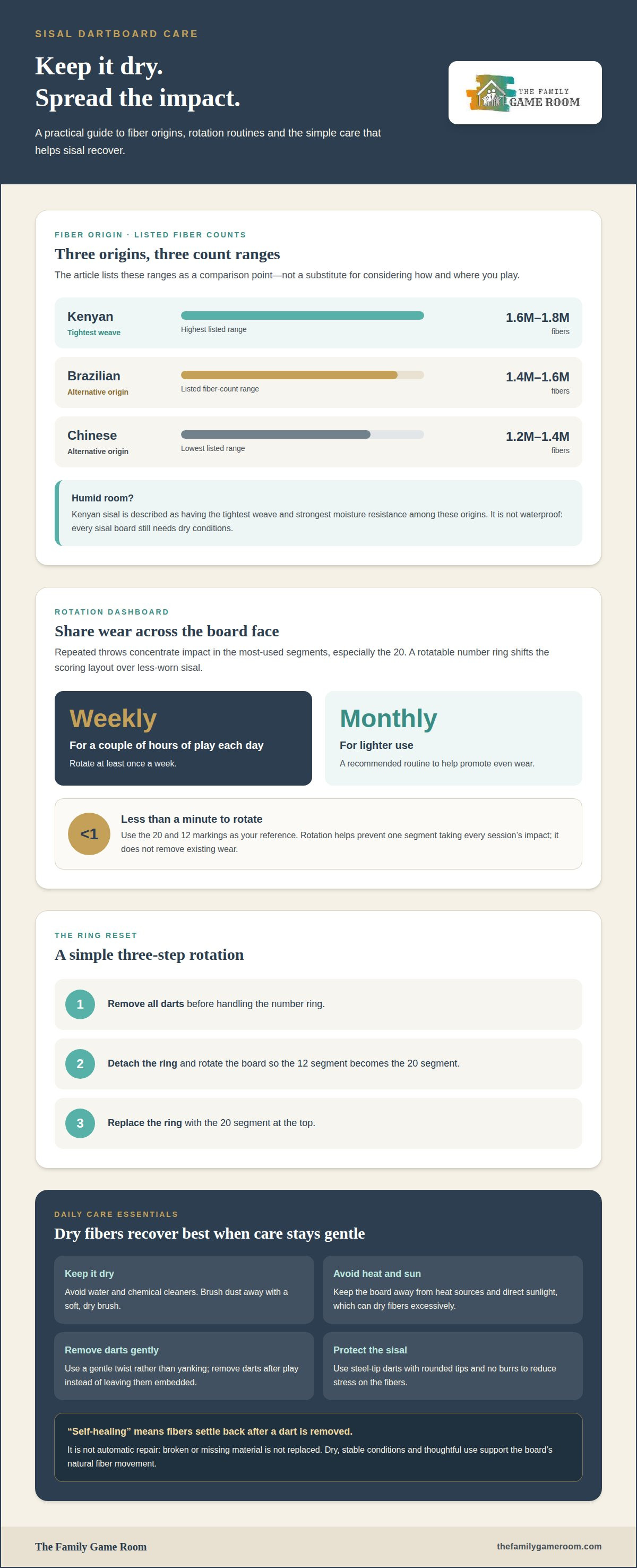
Set a rotation schedule based on how often you play. If you play for a couple of hours each day, rotate the board at least once a week. For lighter use, monthly rotation is another recommended routine to promote even wear. These are practical schedules, not a reason to turn the board after every game. Choose a regular time, such as a weekly playing session, and stick to it.
- Remove darts from the board before handling the number ring.
- Detach the ring and rotate the board so the 12 segment becomes the 20 segment.
- Set the ring back in place, with the 20 segment at the top.
The rotation takes less than a minute. Use the 20 and 12 markings as your reference, rather than guessing how far to turn the board. The key is shifting the scoring segments over the sisal while keeping the 20 at the top after each adjustment. If your board has a detachable ring, this small routine makes the change straightforward.
Keep to your schedule, while paying attention to the segments you use most. A board played on for a couple of hours daily needs more frequent rotation than one used casually. Monthly rotation is a simple reminder for lighter use; heavier daily sessions call for a weekly schedule. Shifting the ring regularly helps distribute repeated impacts across the board face.
Sisal origin and moisture resistance
Dartboard sisal comes from the agave plant, specifically Agave sisalana. The fibers are dried, packed tightly into a circular block and held together by a metal band. The finished board is dry plant material, not a living surface. Sisal dartboards originated in East Africa, particularly Kenya, a name often used when comparing fiber origin and board construction.
Kenyan sisal is described as having the tightest weave and strongest moisture resistance among these origins. This may make it suitable for a humid room, but moisture resistance doesn’t make the board waterproof. Its fibers still need dry conditions to function as intended. A tighter weave may resist humidity better, but direct wetting still exposes dry plant fibers to unwanted moisture.
Fiber-count comparisons offer another way to understand the options. Kenyan sisal boards are listed with 1.6M-1.8M fibers, Brazilian boards with 1.4M-1.6M, and Chinese boards with 1.2M-1.4M. These ranges distinguish the fiber choices, but they don’t replace checking how a board will be used. Origin and weave are useful comparison points, especially when room humidity is a concern.
For a humid game room, Kenyan sisal stands out for its tight weave and moisture resistance. Brazilian and Chinese sisal are alternatives with their own listed fiber-count ranges. Whichever origin you consider, keep the board in a room with stable humidity and away from extreme temperatures. Seasonal humidity changes can affect dry fibers, so consider the room’s conditions when choosing. A dry, stable setting supports the material, while fiber origin helps explain differences between boards.
Self-healing dartboard fibers
“Self-healing” describes how sisal fibers respond after a dart is removed. A dart pushes fibers aside as it enters; afterward, they settle toward their earlier position. In practical terms, a self-healing sisal fiber dartboard relies on this movement, not automatic repair. The board may show fewer visible punctures, but it can’t replace broken or missing material. Wear still depends on use and care.
Remove darts after each game. Leaving one embedded can hold fibers apart and make it harder for them to settle. Twist each dart gently as you withdraw it rather than yanking. Keep the face dry and clear debris with a soft, dry brush. These habits help protect the board’s surface between sessions and support its recovery after darts are removed.
Fiber origin can influence how recovery appears over time. Kenyan sisal is associated with stronger self-healing and fewer visible holes after prolonged use. Brazilian and Chinese sisal offer alternatives for different playing needs, but origin alone doesn’t guarantee a pristine surface. Throw frequency and placement, along with care, also affect visible wear.
For US buyers, the right board depends on how it will be used. Kenyan sisal suits professional play and high-traffic settings; Brazilian sisal suits league or casual play, while Chinese sisal suits home practice. A self-healing sisal fiber dartboard, explained through its construction, is a board whose fibers settle after removal, not one that repairs all damage. Choose by origin and intended use rather than assuming price predicts recovery.
Sisal boards can withstand thousands of hits without breaking, but that doesn’t mean every mark disappears. Rotate the number ring to distribute repeated impacts, and remove darts when play ends. These routines support fiber recovery and help spread wear across the board face.
Want a polished setting for regular play? Explore game-room setup options to complement your board.
The Family Game Room: Dartboard Cabinets
The Family Game Room offers Dartboard Cabinets for creating a dedicated, polished place to play at home. After choosing and caring for a sisal board, a cabinet can help give your setup a defined place in the room and keep the game area organized. Consider one when you’re planning a permanent dart-playing spot or bringing a game room together. For a broader entertainment space, Pool Table Dining Tops, Indoor Shuffleboard Tables and Air Hockey Tables can complement the room’s play options. Choose the setup that suits your home and how you like to gather. Contact The Family Game Room to explore Dartboard Cabinets for your game room.
Shape your next game-room move
The self-healing sisal fiber dartboard explained in this guide can be one part of a considered game-room plan. Think about how you want the room to work beyond dart play: as a welcoming place for guests, a flexible space for everyday use or a dedicated home entertainment area. The right addition depends on how you gather and what fits your home.
The Family Game Room offers American Heritage Billiards Pool Tables and Nixon Billiards Pool Tables for a dedicated playing space. A Pool Table Dining Top can also add dining functionality to a pool table setup. Choose the option that suits your room, then make the space your own.
Contact The Family Game Room to explore options for your home. Your next great game night can start with a thoughtful room plan.
Frequently Asked Questions
What Is a Bristle Dartboard?
A bristle dartboard is a traditional board made from tightly packed fibers, commonly sisal today. “Bristle” is a traditional term for this type of dartboard, even when modern boards use other fibers. Sisal later replaced those bristles because it has useful characteristics for making boards. The historic name remains, even though modern bristle dartboards generally use plant fibers rather than animal bristles.
What is sisal anyway?
Sisal is a natural fiber from the Agave sisalana plant. Dartboard makers dry the fibers, pack them into a circular block and hold the block with a metal band. This creates a dense surface for darts to enter. Sisal dartboards originated in East Africa, particularly Kenya, and boards can also use sisal from other origins.
What is a self-healing sisal fiber dartboard?
In simple terms, a self-healing sisal fiber dartboard is a sisal board whose fibers settle after a dart is removed. This movement can make puncture marks less visible than on a surface that stays split or torn. “Self-healing” doesn’t mean the board repairs broken material or stays like new indefinitely. Construction, fiber origin and use all affect its condition.
How does sisal fiber make a dartboard self-healing?
The construction behind a self-healing sisal fiber dartboard is straightforward: a dart separates the fibers as it enters, and they settle back after removal. This is a physical response, not a repair process. Leaving a dart embedded can hold fibers apart. Remove darts after play and twist them gently as you pull them out to avoid stressing the surface.
How long do sisal dartboards last, and what affects their lifespan?
Sisal boards can withstand thousands of hits, but that doesn’t establish a fixed lifespan for every board. Concentrated play, frequency of use, care and dart-tip condition all affect visible wear. Distributing play across the face can help. Fiber origin is another point of comparison: Kenyan sisal is associated with fewer visible holes after prolonged use.
How should you rotate and maintain a sisal dartboard?
Rotate the board so the 12 segment takes the 20 position, then reset the number ring with 20 at the top. For play lasting a couple of hours daily, rotate at least weekly; monthly rotation is another suggested routine. Brush the surface weekly with a soft, dry brush, inspect it quarterly, and avoid water or chemical cleaners.