


Why settle for the gritty atmosphere of a basement dive bar when your home entertainment space could rival a professional tournament stage? When exploring dartboard cabinet setup ideas, many homeowners worry that adding a dartboard will clash with their high-end pool table or leave their drywall riddled with unsightly holes. You want the thrill of the game without sacrificing the sophisticated aesthetic of your carefully curated living space. It's a common concern; nobody wants a "cheap" look to ruin a room filled with premium furniture.
We promise to help you bridge the gap between tournament-ready precision and luxury home design. You'll discover how to integrate a furniture-grade cabinet that protects your walls while serving as a stunning focal point. This guide walks through the exact World Darts Federation specs, including the 5 foot 8 inch bullseye height and the 7 foot 9.25 inch throwing distance. From integrated LED lighting to sleek wall-protection strategies, we provide everything you need for a setup that's as functional as it is beautiful. Let's transform your game room into an expert-level arena today.
Key Takeaways
- Elevate your entertainment space by choosing furniture-grade cabinetry that serves as both a protective barrier and a sophisticated focal point.
- Implement professional dartboard cabinet setup ideas to ensure your bullseye and throw line distances meet exact World Darts Federation standards.
- Eliminate distracting shadows and protect your drywall using advanced 360-degree LED lighting and integrated wall-protection strategies.
- Create a cohesive look by matching your cabinet's premium wood finish to your existing bar stools and billiard furniture.
The Anatomy of a Professional Dartboard Cabinet Setup
Transform your space from a simple room into a high-end entertainment hub. A professional dartboard cabinet acts as a sophisticated focal point while serving as a critical protective barrier. While some might consider a bare board sufficient, the reality of stray darts and drywall damage quickly changes that perspective. Choosing high-quality cabinetry ensures your walls remain pristine and your game room maintains a polished, cohesive look. Before diving into specific dartboard cabinet setup ideas, it helps to understand the game's standards. For a comprehensive Darts overview and history, you'll see that the sport has evolved from a casual pub pastime to a global competitive phenomenon requiring precise equipment.
Regarding the luxury home standard, your cabinet should never look like an afterthought. It should echo the finish of your pool table or bar furniture. If you have a dark walnut pool table, your dartboard cabinet should follow suit. This creates a curated environment where every piece of equipment feels intentional. We believe your home deserves the same quality found in professional venues, blending domestic warmth with high-end industry descriptors like superior craftsmanship and furniture-grade joinery.
Why Cabinets Outperform Open-Board Setups
Avoid the common mistake of using flimsy DIY setups. These often lack the density needed for sound dampening and can eventually warp. Professional cabinetry uses kiln-dried hardwoods and heavy-duty construction to absorb the impact of every throw. This significantly reduces the "thud" sound that can travel through walls into other rooms. Additionally, the closed-door aesthetic allows you to hide the game when it's not in use. This provides a clean, organized look for your room while protecting the board from dust. Your dartboard cabinet setup ideas should prioritize this dual-purpose functionality. A well-designed cabinet also offers dedicated slots for weighted darts, flights, and shafts, ensuring your gear stays organized and ready for the next match.
Essential Components for a Pro-Level Experience
Success in the game room starts with the right equipment inside the cabinet. Choose a self-healing sisal (bristle) board over electronic alternatives for a truly traditional feel. Sisal fibers part when the dart enters and close back up once it's removed, ensuring your board lasts for years. To complete the professional setup, look for these features:
- Integrated Scoring: Dual dry-erase or chalkboard scorecards mounted on the inside of the doors for easy tracking.
- Heavy-Duty Hardware: Look for reinforced mounting brackets that prevent the cabinet from wobbling during intense play.
- Precision Fit: The board should fit snugly within the cabinet to prevent vibration and ensure a quiet gaming experience.
By focusing on these structural details, you ensure your setup isn't just a game; it's a permanent piece of your home's luxury architecture.
Choosing a Cabinet Style to Match Your Game Room Decor
Selecting the right finish is where your role as a "Trusted Curator" of your home begins. You aren't just buying a box; you're choosing a piece of furniture that must harmonize with your existing environment. To achieve a seamless look, consider industry-standard finishes like Coffee, Suede, or Peppercorn. These specific tones are designed to complement high-end billiard tables and bar cabinetry, ensuring your dartboard cabinet setup ideas feel like an integrated part of the room's architecture rather than a late addition. This level of intentionality is what separates a professional-grade game room from a casual basement setup.
Quality is found in the details of construction. When evaluating a cabinet, look for solid wood components and superior joinery. High-quality cabinets often feature mortise-and-tenon or dovetail joints, which provide the structural integrity needed to withstand years of door cycles. A flush-mount design with recessed doors is essential for a sleek, low-profile appearance. This ensures the cabinet doesn't protrude awkwardly into your playing space, maintaining the room's flow while providing a clean, built-in look. While you focus on aesthetics, always keep Official PDC dartboard regulations in mind to ensure your stylish choice doesn't compromise the technical accuracy of your play.
Hardware selection provides the final touch of polish. Coordinate the hinges and handles with the existing metal accents in your room. If your bar stools or cue racks feature brushed chrome, select cabinet hardware to match. Bronze or matte black finishes often pair well with traditional wood stains, while polished chrome suits contemporary spaces. These small, consistent details create a sense of "approachable excellence" that guests will notice the moment they walk in.
Classic and Traditional Aesthetics
For those who prefer a timeless library or upscale pub atmosphere, rich wood grains are the gold standard. Look for cabinets featuring crown molding and hand-carved accents that add depth and character. These pieces pair exceptionally well with American Heritage Billiards Pool Tables, creating a unified look of luxury. Darker stains like espresso or cherry evoke a sense of history and permanence, making the dartboard a dignified part of your home's social life.
Modern and Industrial Design Trends
Contemporary lofts and minimalist game rooms benefit from clean lines and matte finishes. Gray or "driftwood" stains are currently trending, offering a neutral palette that coordinates beautifully with modern billiard lighting. Consider a "stealth" setup where the cabinet doors feature a minimalist face or even a decorative art panel. When closed, the unit looks like a piece of contemporary wall art, hiding the competition until you're ready to play. If you're ready to elevate your space, you can browse our curated collection of dartboard cabinets to find your perfect match.
Advanced Lighting and Wall Protection Strategies
Lighting is more than just a matter of visibility; it's a critical component of precision. In a professional environment, every millimeter counts. If you've spent time researching dartboard cabinet setup ideas, you know that standard room lighting rarely suffices. Traditional overhead bulbs often create frustrating "drop shadows" that obscure the wire spider, making precise scoring a challenge. To achieve a tournament-ready glow, you must eliminate these shadows through 360-degree illumination. This ensures the target is perfectly clear from every throwing angle, allowing you to focus entirely on your form and release. While you refine your lighting, always cross-reference your layout with the Official PDC Dartboard Setup Regulations to ensure your technical specs remain accurate.
Beyond the board itself, protecting your home's infrastructure is paramount. Even the most skilled players experience occasional "bounce-outs" where a dart hits the wire and deflects. Without proper protection, these stray darts can damage expensive hardwood floors or leave unsightly marks on your drywall. A high-quality dart mat serves as a dual-purpose solution. It provides a clear, professional-grade throw line while acting as a shock-absorbing barrier for your flooring. This proactive approach to protection preserves the long-term value of your game room while maintaining a polished, expert aesthetic.
Eliminating Shadows with LED Integration
Modern LED ring lights have revolutionized home play. These systems fit snugly within the cabinet or around the board, casting light from all directions to vanish shadows instantly. We recommend using USB-powered LED strips for a clean, wire-free look that doesn't clutter your cabinetry. Many of these systems offer adjustable brightness levels. You can dim the lights for a relaxed evening match or turn them to full power for a serious competitive session. This flexibility ensures your setup remains functional at any time of day.
Managing the 'Stray Dart' Factor
While a premium cabinet acts as your primary defense, secondary wall protection adds an extra layer of security and style. Consider creating a "safety zone" around your cabinet using materials that complement your decor. Some effective dartboard cabinet setup ideas for wall protection include:
- Decorative Cork Tiles: These offer a classic look and self-healing properties that hide dart holes.
- Luxurious Felt Panels: High-density felt provides a modern, textured appearance while effectively stopping stray points.
- Reclaimed Wood Surrounds: For a rustic or industrial vibe, a backboard of reclaimed timber adds character and rugged durability.
These additions don't just protect your drywall; they expand the visual footprint of your setup, making the dartboard a more significant architectural feature in your room. By treating wall protection as a design opportunity, you create a space that is both resilient and remarkably beautiful.
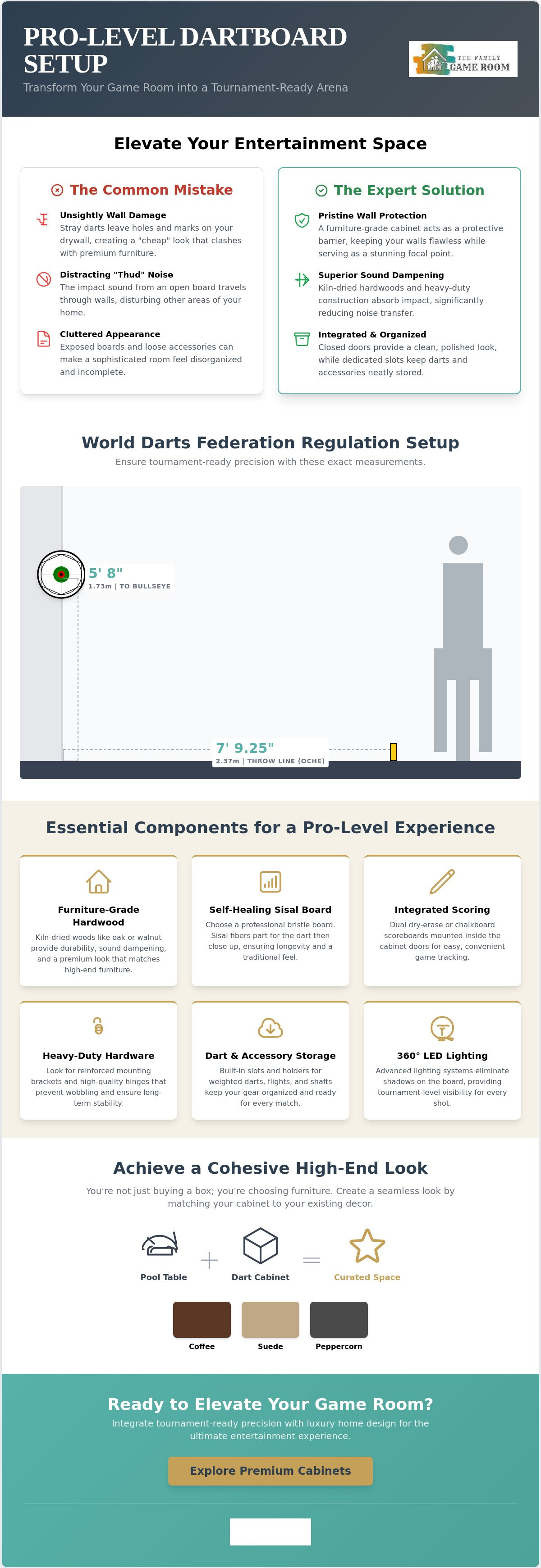
Regulation Measurements: The Foundation of a Pro Setup
Precision is the hallmark of a professional setup. If your measurements are off by even an inch, you're training your brain with incorrect data. While many casual players simply hang a board at eye level, a high-end game room requires adherence to strict tournament standards. These dartboard cabinet setup ideas focus on creating a tournament-ready environment that builds proper muscle memory. Consistency is key; you want your home practice to translate perfectly to any competitive venue. Accuracy, after all, is what separates the enthusiast from the amateur.
The universal standard for bullseye height is exactly 5 feet 8 inches from the floor. This measurement must be taken to the very center of the bullseye, not the top of the board or the cabinet. Once the height is set, measure your throwing distance. For steel-tip play, the front of the throw line, or oche, must be 7 feet 9.25 inches from the face of the board. It's a common mistake to measure from the wall. You must account for the depth of the cabinet and the board itself to ensure the distance is true. To verify your accuracy, perform the "Diagonal Test." A measurement from the center of the bullseye to the back of the throw line should equal exactly 9 feet 7.5 inches.
Physical clearance is equally vital for a comfortable gaming experience. Players need room to breathe and move during their throw. Ensure you have at least 2 feet of unobstructed space on either side of the cabinet. This prevents elbows from hitting walls and allows spectators to watch safely without interfering with the thrower's rhythm. A cramped space leads to a cramped throw, which is the enemy of a high score.
Step-by-Step Cabinet Mounting
Mounting a heavy, solid wood cabinet requires more than just a few screws and luck. Always locate the wall studs; never trust a luxury cabinet to drywall anchors alone. Use a high-quality level to ensure the scoreboards on the interior doors are perfectly vertical. An unlevel cabinet isn't just an eyesore. It can subtly throw off a player's perception of the board's center. Once the cabinet is secure, center the board within the housing to maintain perfect symmetry for every match.
Marking the Throw Line (The Oche)
Your throw line defines the boundary of the game. You might choose a professional dart mat for its portability or a permanent wood floor marker for a built-in look. Whatever you select, it must be perfectly parallel to the face of the dartboard. For late-night sessions, consider a dedicated floor light to keep the oche visible without flooding the room with glare. Ready to start your installation? Explore our professional dartboard cabinets to find the perfect centerpiece for your room.
Integrating Darts into Your Game Room Ecosystem
Your game room is more than a collection of tables; it's a social ecosystem where every piece of equipment must work in harmony. When implementing your dartboard cabinet setup ideas, safety and spatial flow take center stage. Avoid placing your cabinet near high-traffic walkways or swinging doors where a sudden entrance could lead to an accident. Instead, treat the dart lane as a dedicated zone, much like the area surrounding a pool table. To enhance the spectator experience, consider placing premium bar stools along the side of the throwing lane. This gives guests a comfortable vantage point without putting them in the line of fire.
Managing the "Billiards & Darts" layout requires careful planning of cue swing and dart throw overlap. You don't want a player's backswing on the pool table to interfere with someone lining up a double-top. A pub table or a dedicated drink ledge placed near the throw line provides a convenient spot for refreshments. This keeps glasses off your expensive billiard rails and ensures the social energy remains focused around the competition. These small architectural choices transform a simple wall into a professional-grade arena.
Spatial Flow and Safety Zoning
Establish a clear "5-foot rule" to keep your darting territory separate from the pool table's stroke zone. This buffer ensures that a player using a bridge or a long cue doesn't accidentally bump into the dart thrower. Area rugs are excellent tools for defining these boundaries visually. A long, narrow rug can delineate the dart lane, signaling to guests that this area is active. Positioning the setup near the bar or refreshment area keeps the energy high, but you must ensure there's enough room for people to move comfortably between the two zones without crossing the line of play.
Completing the Look with Accessories
Consistency in design creates a sense of approachable excellence throughout your home. Match your dart cabinet's wood finish to your pool cue racks or shuffleboard table for a unified aesthetic. For the serious player, adding a dedicated "dartist" station for tuning and maintenance adds a professional touch. This small area can house extra flights, sharpening stones, and a wax cube for grip. It's these final, expert-level details that prove your commitment to quality. Ready to elevate your home entertainment? Browse our curated collection of furniture-grade dartboard cabinets to find the final piece for your ultimate game room.
Transform Your Game Room into a Professional Arena
As a family-owned business with years of expertise in luxury game room furniture, we pride ourselves on being a "Trusted Curator" for your home. We're an authorized dealer for American Heritage Billiards, offering a curated selection of solid wood cabinets that match the superior craftsmanship of your pool table or bar. Don't settle for a setup that feels like an afterthought when you can achieve approachable excellence with ease. Elevate your game room with a premium Dartboard Cabinet from The Family Game Room. We look forward to helping you build a space where memories are made and every throw feels like a pro-level match.
Frequently Asked Questions
How high should a dartboard cabinet be mounted?
Mount your cabinet so the center of the bullseye sits exactly 5 feet 8 inches (1.73 meters) from the floor. This is the universal regulation height for both steel-tip and soft-tip boards. Ensure you measure from the floor to the bullseye itself, not the top of the wooden cabinet. This precision ensures your home practice translates perfectly to professional tournament environments.
What is the best way to protect the wall around a dartboard?
Utilize secondary protection like high-density foam surrounds, decorative cork tiles, or luxurious felt panels to safeguard your drywall. These materials absorb the impact of stray darts and prevent unsightly holes. Integrating these into your dartboard cabinet setup ideas expands the visual footprint of your gaming area while maintaining a polished, architectural look that complements your existing furniture.
Do I need a specific type of lighting for my dartboard cabinet?
Opt for 360-degree LED lighting to eliminate distracting shadows on the board's surface. Modern LED ring lights cast light from every angle, ensuring the wire spider doesn't obscure the scoring segments. This provides a professional glow and improves accuracy during late-night matches. USB-powered strips offer a clean, wire-free aesthetic that keeps your cabinetry looking sleek and organized.
Should I choose a wood or electronic dartboard cabinet for my home?
Select a solid wood cabinet if you prioritize a timeless, furniture-grade aesthetic that matches your pool table or bar stools. Wood cabinets offer superior sound dampening and a "closed-door" look that hides the game when not in use. Electronic cabinets are excellent for those who prefer automatic scoring and a wider variety of game modes, though they often lack the luxury finish of handcrafted wood.
How much space do I need for a dartboard setup in my game room?
Dedicate a clear lane approximately 5 feet wide and at least 11 feet long for a comfortable and safe setup. This allows for the regulation throwing distance while providing enough room for the player's stance and spectator safety. Ensure the lane remains clear of high-traffic walkways or the stroke zone of your pool table to prevent accidents and maintain a smooth room flow.
Can I mount a dartboard cabinet on a brick or masonry wall?
Mount your cabinet to masonry or brick walls using specialized masonry anchors or wall plugs for a secure fit. Never rely on standard screws for these surfaces. A heavy, solid wood cabinet requires a robust connection to prevent wobble during play. Using a hammer drill and the correct anchors ensures your setup remains stable and professional for years to come.
How do I stop my dartboard from making a loud thud on the wall?
Install a dense, furniture-grade wooden cabinet to act as a natural sound barrier between the board and the wall. The mass of the wood absorbs the vibration of the dart's impact, significantly reducing the noise that travels through your home. For additional dampening, place a thin layer of felt behind the board itself to further isolate the sound and ensure a quiet gaming experience.
What is the regulation distance for the dart throw line?
Set your throw line, or oche, at a horizontal distance of 7 feet 9.25 inches (2.37 meters) for steel-tip play. If you utilize soft-tip darts, the regulation distance increases slightly to 8 feet (2.44 meters). Measure this distance from the face of the dartboard rather than the wall to account for the depth of your cabinet and board, ensuring total accuracy.