


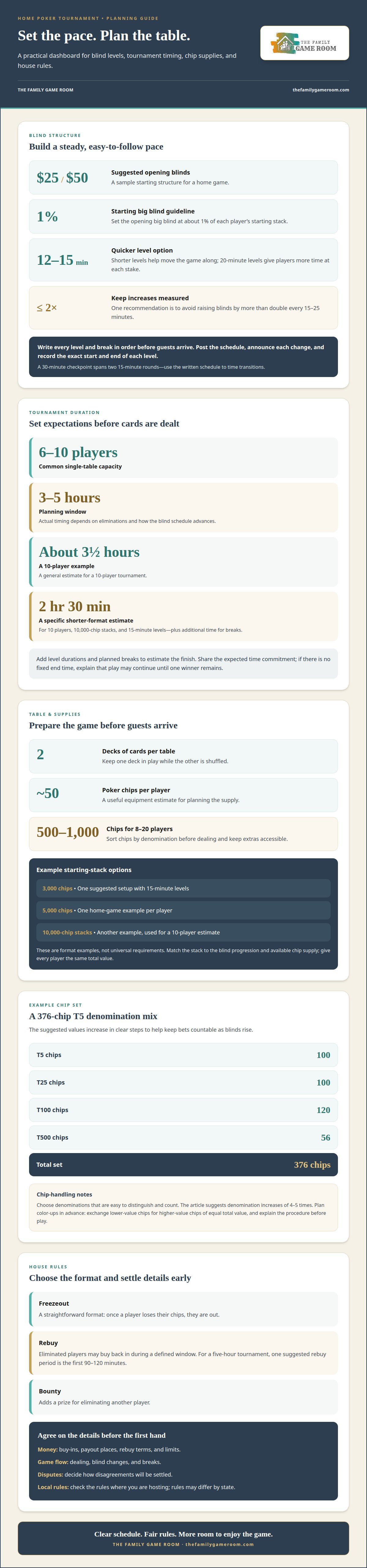
A smooth home poker tournament starts with a blind schedule that keeps the game moving without forcing players to rush. For setting up a home poker tournament, try opening blinds of $25/$50 and increasing them at regular intervals; a useful starting point is a big blind equal to 1% of each player’s starting stack. Choose shorter levels for a quicker finish, or longer ones for more room to play.
Blinds matter, but clear house rules can make or break the evening. Decide in advance how rebuys, breaks, payouts, dealing, and disputes will work, then share the rules before the first hand. This guide covers choosing blinds, estimating how long the tournament may run, setting starting stacks, and agreeing on rules that keep play fair and enjoyable. With the details settled ahead of time, you can focus on the cards and the company.
Key Takeaways
- Map out the blind increases and breaks in advance so players can follow the pace and anticipate the finish.
- Plan table capacity and supplies together; a standard setup allows 6-10 players and uses two decks of cards.
- Choose a starting stack and chip denominations that make bets easy to count as blinds rise.
- Agree on rebuys, payouts, dealing, and dispute handling before the first hand to keep expectations clear.
How should I set up the blind structure?
For setting up a home poker tournament, start with $25/$50 blinds and 12-15-minute levels for a quicker game. A starting big blind equal to 1% of each player’s chip stack helps set the opening stakes and pace.
Plan food and drinks before dealing. Keep drinks away from cards and chips, and leave walkways clear. Offer water alongside refreshments so players stay comfortable throughout the scheduled levels.
-
Create a Blind Schedule
Write every blind level and break time in order before guests arrive. For a quicker format, use 12-15-minute levels; a 20-minute level gives players more time at each stake. Estimate the finish by adding all level durations and planned breaks. Keep the schedule consistent, since irregular increases make the tournament harder to follow.
-
Set Starting Stacks and Blind Levels
Choose a stack that gives players room to act at the opening blinds. One suggested setup uses 3,000 chips with 15-minute levels; another approach sets the starting big blind at 1% of each stack. For example, $25/$50 is one opening structure. Keep increases measured: one recommendation is to avoid raising blinds by more than double every 15-25 minutes.
-
Track Blind Levels
Post the schedule where every player can see it, and assign one person to announce each change. Set a timer for 30-minute intervals as a checkpoint, while recording the exact start and end of each level. For 15-minute rounds, that checkpoint spans two levels, so use the written schedule to make each transition on time. Mark breaks clearly to avoid confusion.
How long will a home tournament last?
- Set the player count before estimating the finish. A single-table game commonly seats 6-10 players, while a 10-player tournament may run about 3 1/2 hours. For planning, allow a broader 3-5-hour window. The actual pace depends on how quickly players are eliminated and how the blind schedule advances. Share the expected time commitment before play begins, especially if guests need to plan their evening.
- Match the table setup to the group. A poker table gives players a dedicated surface for cards, chips, and drinks; arrange seating so each player can reach the center comfortably. Keep walkways clear, with refreshments set away from the playing area. For a permanent game-room setup, consider a dedicated Poker Table that suits your space.
- Prepare cards and chips before guests arrive. Plan on two decks of playing cards per table, so one deck can be shuffled while the other is in play. A useful equipment estimate is about 50 poker chips per player. For a larger group, 500-1,000 chips can serve 8-20 players. Sort chips by denomination before dealing, then keep extras accessible for organized play.
- Use the schedule to set realistic expectations. A 10-player tournament with 10,000-chip stacks and 15-minute levels is estimated at 2 hours 30 minutes, plus breaks. That shorter estimate depends on the stated format, so breaks add time to the evening. Compare your guest count, starting chips, level lengths, and break plan before announcing a finish time. If the game has no fixed end time, tell players it may continue until one winner remains.
What’s a good starting stack?
Agree on stack sizes and chip denominations before play. The total stack matters, but chips should also be easy to count as the blinds rise.
-
Choose Starting Chip Stacks
Set each player’s starting stack before dividing chips. One home-game example uses 5,000 chips per player; another setup uses 10,000-chip stacks for ten players and allows one rebuy each. Treat these as format examples, not universal requirements. Match the stack to your blind progression and available chip supply, then make sure every player begins with the same total value.
-
Set Chip Denominations
Choose denominations that are easy to distinguish and count during betting. One suggested rule increases each denomination by 4-5 times, creating clear jumps without too many chip values. A proposed 376-chip T5 set contains 100 T5 chips, 100 T25 chips, 120 T100 chips, and 56 T500 chips. Add the values before play to confirm the set supports your planned stacks.
- Allocate enough chips in the smallest denomination for opening bets, then reserve higher values for later levels. Moving from T5 to T25, T100, and T500 gives the example set a structured progression. Avoid giving players so many denominations that pot totals become difficult to track. Count out one sample stack first, record its total, then use that same distribution for each seat.
- Plan color-ups before the smallest chips become awkward to use. At a scheduled point, exchange lower-denomination chips for higher-value chips of equal total value, then remove the retired chips from play. For example, exchange lower chips only when their combined value matches the replacement chip. Explain the procedure before dealing, and keep a written record of chip values so each player receives a fair exchange.
Poker tournament rules and house rules
Write house rules before play, covering the format, dealing, breaks, and disputes. Clear decisions help everyone understand how the tournament will run.
-
Choose a Tournament Format
Choose freezeout for a straightforward event: once a player loses their chips, they’re out. A rebuy format lets eliminated players buy back in during a defined window; for a five-hour tournament, one suggested rebuy period is the first 90-120 minutes. A bounty format adds a prize for eliminating another player. State the format and any rebuy limits before dealing.
-
Set House Rules and Legal Guidelines
Write down how buy-ins will be handled, which places will receive payouts, the terms for rebuys, and how disputes will be settled. Check local rules before hosting: poker isn’t legal in every state, according to the Board of Governors of the Federal Reserve System. The same organization states that California prohibits card games in which the house plays or takes a percentage of the pot. Don’t assume the rules in one state apply elsewhere.
-
Arrange Seating and Dealing
Assign seats before the first hand, identify the dealer button, and explain how it moves after each hand. In Texas Hold’em, the small and big blinds are mandatory wagers made before cards are dealt. Use a standard deck with jokers removed, and agree that the dealer burns a card before the flop, turn, and river. Rotate dealing duties consistently or designate one dealer for the event.
-
Schedule Antes, Breaks, and Late Registration
Decide when antes begin and announce the amount before that level starts. An individual ante is commonly set at 10-20% of the big blind. Put break times on the schedule; one example takes breaks after Levels 5 and 9. If late registration is allowed, state its closing point and whether late arrivals receive a full starting stack. Apply the same entry rules to every player.
The Family Game Room: Poker Tables
The Family Game Room offers poker tables for hosts planning a dedicated place to play. Once your tournament format, seating plan, and house rules are set, consider whether a poker table suits your room and the gatherings you want to host.
A dedicated playing surface helps keep cards and chips together and gives the tournament a clear center. Consider where players will sit, how the table fits in the room, and whether guests can move around it comfortably. If your game room serves several purposes, think about how a poker table fits alongside its other activities.
For a home poker setup that feels considered and ready for future game nights, explore Poker Tables as part of your planning. Contact The Family Game Room to discuss your game-room needs.
Make Your Game Room Ready for the Next Gathering
Once your plans for setting up a home poker tournament are in place, consider how the room can support other gatherings, too. A well-planned game space can welcome poker nights, casual play, and time with family and friends.
The Family Game Room offers American Heritage Billiards and Nixon Billiards pool tables for a dedicated play area. A pool table dining top can also give the table another purpose when the game is over. Choose the setup that suits how you want to use your home, then plan the room around it.
Contact The Family Game Room to explore options for your game room. Here’s to good company, confident play, and many memorable nights at home.
Frequently Asked Questions
How many players can I have in my poker tournament?
A single-table tournament is suited to 6-10 players. Set your headcount before inviting guests, then keep the seating plan within that range so players have room to participate comfortably. If your gathering is larger, decide whether to organize separate games rather than crowding one table. Make the format clear in the invitation so everyone knows what kind of tournament to expect.
The Setup - What do you need to get started?
Start with a poker table, playing cards, chips, and a written tournament schedule. For Texas Hold’em, use a standard deck with the jokers removed, and keep a second deck ready to prepare the next hand promptly. Add a timer, a visible blind schedule, and a dealer button. Organize everything before guests arrive so the opening hand can begin smoothly.
How many chips and what denominations should each player get for a home poker tournament?
Plan for roughly 50 chips per player, then choose the stack’s total value to suit your blind schedule. Give every player an equal-value stack, with enough small-denomination chips for early betting and larger values available as play advances. A set’s denominations should be easy to tell apart and count. Lay out one sample stack first, then use the same distribution for everyone.
How many players can a home poker tournament host with a standard poker table?
Plan for 6-10 players at one standard poker table. The number seated comfortably depends on the table and the room around it, so arrange chairs before the event and leave space for players to enter and exit. If your guest list exceeds the table’s capacity, don’t add seats at the expense of comfortable play. Decide on a separate format for extra guests.
What equipment is needed to set up a home poker tournament?
Gather a poker table, chips in usable denominations, two decks of cards, a dealer button, and a timer. Keep the blind schedule and house rules visible so players can follow changes without interrupting a hand. A written record of chip values can also help settle questions about stacks. For Texas Hold’em, remove the jokers from the playing deck before dealing.
How should a home poker tournament distribute the prize pool?
Agree on the payout split before play starts and explain it to every entrant. For a tournament with 8-10 players, one example awards 65% to first place and 35% to second. Treat that as a sample structure, not a universal rule. State which finishing places receive prizes and how ties will be handled, so the final payout doesn’t become a surprise.