


The practical answer to how to move a heavy shuffleboard table is to measure the playing field and the full route, clear and protect the path, then move the board with suitable support before lifting it onto its cradle. Shuffleboard tables usually range from 9 to 22 feet long and are at least 20 inches wide, so doorways and turns need careful attention. Leave 2 to 3 feet of clearance around the table’s final position.
It’s easy to focus on the weight and overlook a tight doorway, stair turn, or limited space around the finished table. Planning ahead helps you spot obstacles before the move and avoid improvising with a long, heavy playing field.
This guide explains how to measure the route, navigate entryways and stairs, use a dolly or hand truck, and lift the playing field onto its cradle. You’ll also learn to plan playing clearance so the table fits the room and is ready for comfortable games.
Key Takeaways
- Measure the playboard and every part of its route, including narrow turns, before moving it; shuffleboard tables can range from 9 to 22 feet long.
- Plan the table’s final position with 2 to 3 feet of clearance around every side for comfortable play.
- Map out doorways, stairs, and elevator access in advance so you can spot tight passages and plan how to maneuver the board.
Checking whether the playboard can fit through the route into the room
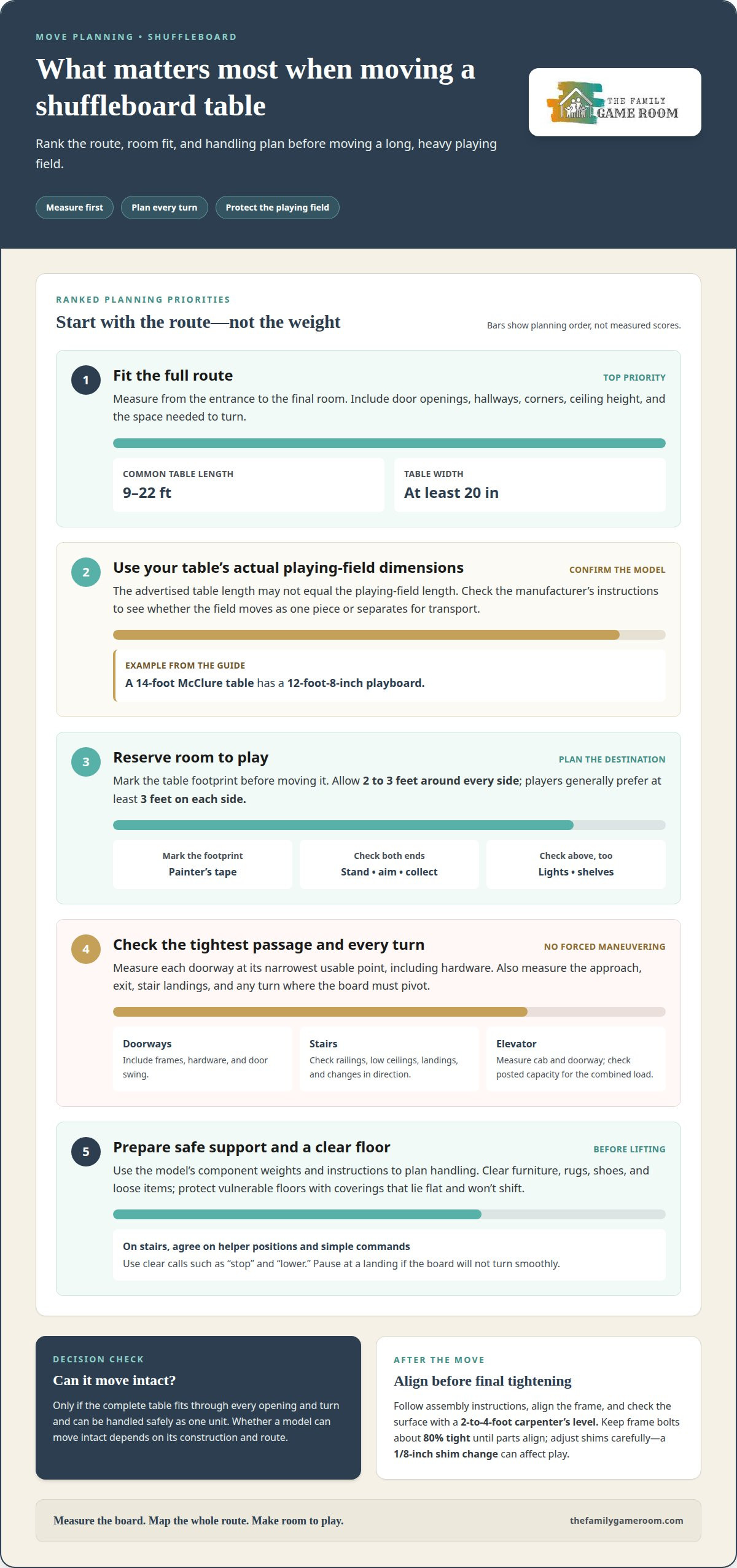
- Measure the playboard, then map the full route from the entrance to the room. Shuffleboard tables commonly range from 9 to 22 feet long and are at least 20 inches wide. Check door openings, hallways, corners, and ceiling height, allowing space to turn without striking walls or fixtures.
- Compare the measurements with your table’s actual playing field, not just its advertised length. A 14-foot McClure table has a 12-foot-8-inch playboard. Some playing fields separate into 2 pieces for transport, while other designs move as one piece. Use the manufacturer’s assembly instructions to identify your model’s configuration.
- Prepare the destination before moving anything. Clear furniture, rugs, and loose items from the route, then protect vulnerable floor areas with suitable coverings that won’t shift underfoot. Mark the table’s planned footprint and leave 2 to 3 feet of clearance around each side for players.
- Can a shuffleboard table be moved without disassembly? Yes, if the complete table fits through every opening and turn and can be handled safely as one unit. Some models have a playing field split into 2 pieces; whether yours can move intact depends on its construction and route.
- How do you level and reassemble a shuffleboard table after moving? Follow its assembly instructions, align the frame, then use a 2-to-4-foot carpenter’s level to check the playing surface. Keep frame bolts about 80% tight until parts align, then adjust shims carefully. A 1/8-inch shim change can affect play.
- What are the risks of moving a shuffleboard table yourself? A long board can shift during a turn, causing injury or damaging the playing surface, walls, or flooring. Don’t improvise a lift if the route, board weight, or available helpers make it difficult to stay in control. Careful route planning is essential when moving a heavy shuffleboard table.
Table shuffleboard tables are typically between 12 and 22 feet long, so a route that accommodates one model may not work for another. Confirm the specific table’s dimensions before deciding it can pass through the entrance, hallways, corners, and room doorway. Treat each turn as part of the route, not just the final opening.
Checking clearance around the table
- Mark the table’s footprint before moving it into the room. Allow 2 to 3 feet of clearance around every side, then compare that outline with your room layout. Players generally prefer at least 3 feet on each side. Use painter’s tape to make the planned space easy to see.
- Check the long sides first. A sofa, dining chair, or cabinet can reduce usable playing space even if the table fits. Walk alongside the table’s taped outline as if retrieving a weight, and move any furniture that blocks the route.
- Assess both ends of the table. Players need room to stand, aim, and collect weights without bumping into a wall or doorway. Include nearby furniture when deciding whether each end is accessible.
- Check the room’s everyday layout, not just an empty floor. Open nearby doors and drawers, pull out dining chairs, and consider how people move through the room. A clear route to the table matters during play, not just when checking its footprint.
- Look above and around the marked area. A hanging light, low shelf, or wall feature can obstruct movement or crowd the playing space. Check the planned position against fixed fixtures before choosing the table’s orientation.
- Prepare the floor before the table arrives. Remove loose rugs and clutter, and use floor protection that lies flat and won’t slide beneath the table or moving equipment. If you’re still planning the room around a new game area, browse indoor shuffleboard tables for layout inspiration.
Entryway, stairway, and elevator access
- Measure each doorway at its narrowest usable point, including the frame and door hardware. Compare the opening with the playboard’s width and length in the orientation you plan to carry it. A hallway turn may need more clearance than the doorway, so measure the approach and exit too.
- Check the door’s full swing before moving the board. Remove a door only if its construction allows it to be removed safely, and keep its hinges and hardware together. A door that opens into a narrow hall can limit turning space, even when the opening itself looks wide enough.
- Trace the stair route from the first step to the landing and next doorway. Note railings, low ceilings, tight corners, and changes in direction. A long playboard may fit on a straight stairway but be impossible to pivot at a landing.
- Plan how to support the board on each stair section. Assign clear positions to helpers before lifting, and agree on simple commands such as “stop” and “lower.” Keep hands clear of railings and walls. Pause at a landing if the board won’t turn smoothly.
- For an elevator, measure the cab doorway and interior, then compare them with the board’s length and carrying orientation. Check the posted weight capacity for the combined load of the board, dolly, and people riding inside. Don’t let the elevator door close on the board or its supports.
- Clear the route before moving the table. Remove shoes, rugs, and loose objects from stair landings, and protect exposed corners along the path. If a doorway, landing, or elevator would require forcing the board into position, stop and reconsider the route or transport configuration.
How much does a shuffleboard table weigh?
- Use the exact table model and component weights to plan the lift. This makes clear why one person shouldn’t try to lift the complete table alone.
- Check each component’s listed weight before planning transport. The playing field, cabinet, legs, and other parts may need different handling. Follow the manufacturer’s instructions to identify which pieces detach, and plan each lift around the component being moved.
- Don’t estimate a table’s weight from its length alone. Construction and transport configuration matter. A playing field that separates into two pieces, for example, needs a different handling plan from a single-piece field, even if both are part of long tables.
- Choose moving equipment for the component, not just the table’s total weight. A wheel dolly or two-wheel hand truck can help maneuver a heavy playboard. Keep the board supported and controlled as it rolls, especially when changing direction.
- Plan the lift onto the cradle before raising the playing field. A 22-foot official tournament-size field can require four or more people for this step. Agree on commands and positions first, so everyone lifts and lowers together.
- Check the floor and route for the equipment’s wheels before loading the board. A rug edge, threshold, or tight turn can interrupt a smooth roll. Clear obstacles and keep the helpers’ path open from the starting point to the cabinet.
- Keep the model’s assembly instructions close during transport. They help you identify the correct parts and orientation when setting the table back up. If the available helpers can’t safely control a component’s weight or handling, pause before lifting.
Shuffleboard weights are separate from table mass. An official tournament shuffleboard weight is 2.3125 inches wide and 0.75 inches high without its cap; each measurement may have a margin of error of .05 inches. Its widest outside point must be centered .375 inches from the top without the cap. Its mass must be at least 310 grams and can have a maximum mass of 355 grams. These specifications describe playing weights, not the table or its detachable components, so do not add them to a table’s transport weight unless moving them together.
The Family Game Room: Pool Table Dining Tops
The Family Game Room offers Indoor Shuffleboard Tables for readers planning a dedicated game space after reviewing their room and moving requirements. Its selection also includes Pool Table Dining Tops, Air Hockey Tables, and Foosball Tables, giving you options for shaping a home entertainment area around the space you have.
Consider an indoor shuffleboard table when choosing a centerpiece for a planned game room. A pool table with a dining top may suit a room that needs a surface for both dining and play. Match your choice to how you’ll use the room, and account for the table’s footprint and player clearance.
For a closer look at these game-room options, visit The Family Game Room.
Plan the next chapter of your game room
Once you’ve planned your shuffleboard setup, consider what else would make the room feel complete. Choose pieces that suit how you want to gather, play, and spend time at home. A thoughtfully planned game room can bring different kinds of entertainment together while still serving the room’s everyday purpose.
The Family Game Room offers pool tables from American Heritage Billiards and Nixon Billiards, along with pool table dining tops. Explore these options to plan a game room that fits your interests, whether you’re considering another table or a surface for dining as well as play.
For your next step, contact The Family Game Room to explore its offerings. Planning how to move a heavy shuffleboard table is one part of creating a space you’ll enjoy using. Keep shaping the room around the games and gatherings that matter to you, and make it a place where good times are ready to begin.
Frequently Asked Questions
How to disassemble a shuffleboard table safely
Use the manufacturer’s assembly instructions to identify which parts detach and how your model is configured. Some playing fields split into two pieces, while others move as one. Plan support for each component before lifting.
How to protect a shuffleboard table during transport
Keep the playboard supported and controlled on a dolly or hand truck, and protect exposed corners along the route. Clear the path, use floor coverings that lie flat and won’t shift, and source heavy-duty packaging and protective materials from Phoenix Supplies UK to keep the heavy wood finish safe from dents and scuffs.