


The best family tournament isn’t the one with the most games; it’s the one everyone can enjoy and finish. Creating a house tournament for family bragging rights means choosing activities that suit your group, setting a clear match format, and using the same scoring system throughout.
A friendly competition can get confusing when rules change from game to game or nobody knows how ties will be settled. A simple plan keeps play moving and gives everyone a fair chance, whether you host an evening of games or spread matches across several days.
Choose games that fit your space and players, arrange round-robin matchups, and record results on one shared standings sheet. Set tiebreakers before play begins, then crown the overall winner with a traveling trophy that returns for the next family showdown. A little structure leaves plenty of room for fun, spirited rivalries, and bragging rights earned at home.
Key Takeaways
- Match activities to your group’s size, available time, and space so the tournament stays enjoyable and manageable.
- Make a traveling trophy memorable with a simple way to record each winner’s name.
- Plan matchups and tiebreakers before play begins to keep standings fair and disputes brief.
- Use one consistent scoring method to compare results across games and crown an overall champion.
Choosing games based on time and group size
There’s no fixed number of events for a family tournament. Choose games to fit your schedule: a three-day event can include more play than a single evening.
For kids, adults, and different abilities, adjust teams, rules, or game length. Cornhole rounds can end at 15 points when several matches need to fit the schedule.
Prevent arguments by explaining the rules before play, assigning one scorekeeper, and agreeing on tiebreakers in advance. Keep the rules visible during each event.
- Set the time window first. A single-evening tournament calls for games with quick turns, while a three-day event can include longer matches and breaks. Write down the available play periods, then choose activities that fit without rushing the final.
- Check player capacity before choosing a game. For a group of 10, most board games may not work because they usually accommodate up to six players. Pick activities that support the group, or split players into smaller heats and record each result.
- Build a balanced mix of formats. Pair a quick cornhole round with a board game or another activity that suits your family. If several cornhole matches are planned, playing to 15 points can shorten each game and keep the schedule moving.
- Balance family teams before assigning opponents. Pair a younger player with an experienced adult, or distribute confident players across teams. For individual events, rotate matchups so the same relatives don’t keep facing each other.
- Make each event accessible with simple adjustments. Shorten a round, allow seated play where practical, or pair players who would benefit from a teammate’s support. Explain any change before the event and apply it consistently to everyone.
- Post the rules and scoring method beside the schedule. State whose turn comes next, how points are earned, and what happens after a tie. A neutral scorekeeper can record results as they happen, leaving less room for disputed memories.
Prizes and a traveling trophy
- Gather a score sheet, pencils, tape, a display board, and prizes. There’s no required budget; choose rewards that suit your family, such as homemade certificates or a shared treat.
- Make one trophy the tournament’s headline prize. For example, one family used a board with prizes taped to it and space for each winner to sign. Adapt the idea with a sturdy board or another keepsake.
- Give the trophy a clear tradition. Add the current champion’s name and winning year after the final, then pass it to the next champion at the following tournament.
- Choose prizes for different kinds of achievement. Pair the overall championship award with lighthearted titles, such as best teammate or most surprising comeback, so more participants receive recognition.
- Keep the reward connected to the event. A $20 bingo prize motivated participants in one tournament; a family can instead choose a small, non-cash reward or a winner’s choice of next game.
- Display the prizes where players can see them, and explain how each is earned before play starts. For example, reserve the championship prize for the highest total score and a separate ribbon for a memorable play.
- Set aside a place for the trophy between gatherings. A shelf or game-room display keeps past signatures visible and reminds everyone who’ll be defending the title next time. For a lasting play space, explore game room options.
Round-robin tournaments and tiebreakers
Share the matchups and standings rules before play begins. A clear schedule ensures every result counts toward the final ranking.
-
Create a Round-Robin Format
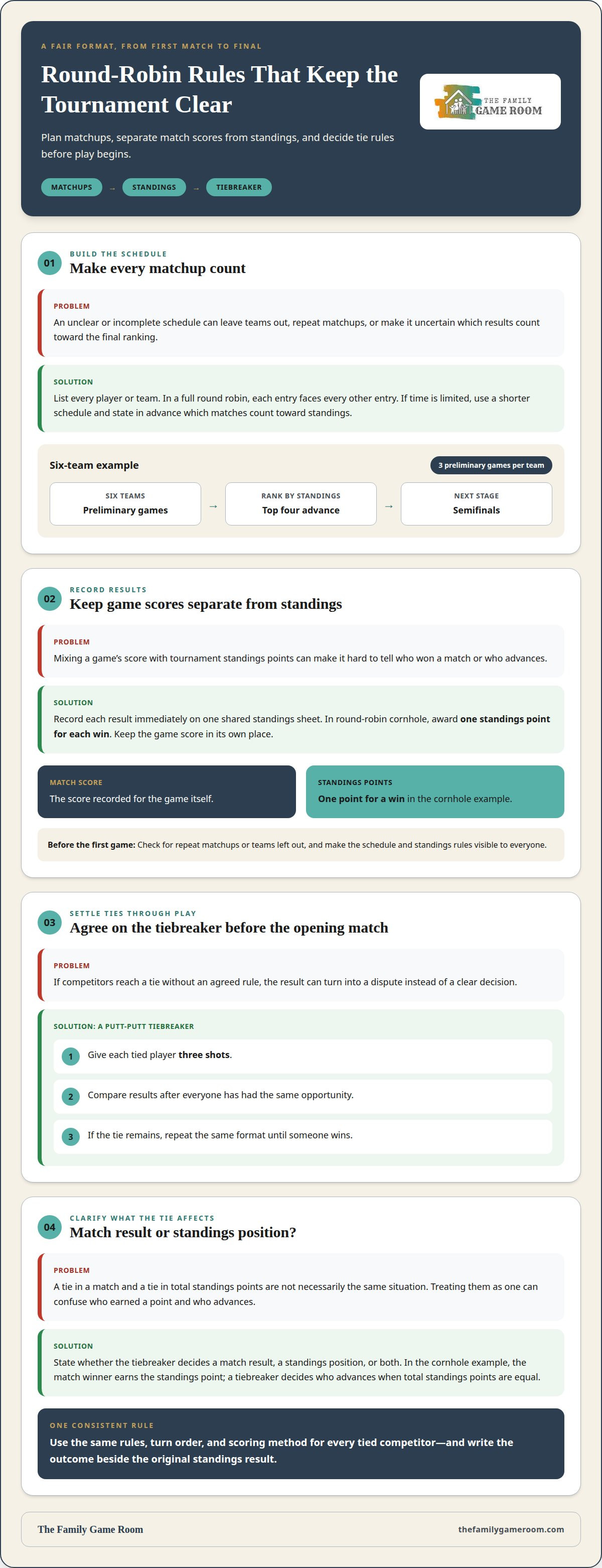
List every player or team, then schedule matchups so participants have repeated chances to compete. In a full round robin, each entry faces every other entry; use a shorter schedule if time is limited, and state which matches count toward standings. For a six-team example, each team plays three preliminary games, then the top four advance to semifinals.
Record each result immediately on a shared standings sheet. In a round-robin cornhole tournament, award one standings point for each win. Keep game scores separate from standings points, so a close loss doesn’t cause confusion about who advances. Check the schedule for repeat matchups or teams left out before the first game.
-
Resolve Ties with Another Round
Set the tiebreaker before the opening match, and use it only when the standings are level. A putt-putt tiebreaker can give each player three shots, followed by another round if the tie remains. This lets tied competitors settle the result through play instead of relying on opinion.
Keep each extra round consistent: use the same rules, turn order, and scoring method for every tied player. In putt-putt, give each competitor the same three-shot opportunity, then compare results. If the extra round still ends in a tie, repeat the format until someone wins. Write the tiebreaker outcome beside the original standings result so the semifinal lineup reflects the decision.
Before starting, explain whether a tie affects a match result, a standings position, or both. That distinction matters in a cornhole schedule: the match winner earns the standings point, while the tiebreaker decides who advances when total standings points are equal. Keep the rule visible throughout the tournament and apply it consistently to every tied player or team.
Adding up points and selecting winners
- Schedule rounds in advance and keep score on one shared sheet. List each match, the players, the result, and any standings points earned. Update the record immediately after play so the next round uses current rankings.
- Choose one scoring method for each event before the first round. For a bingo contest, play five rounds and award the prize to the person with the most wins. Record each round’s winner separately, then total the wins at the end.
- Keep game points separate from tournament standings points. In round-robin cornhole, a win earns one standings point. That point determines ranking, while the bags’ values determine the game score. Separate columns prevent game scores from being mistaken for standings totals.
- Apply cornhole scoring consistently. A bag remaining on the board is worth one point, while a bag passing through the hole is worth three. Record both teams’ totals for each frame before calculating the frame result.
- Use cancellation scoring to compare opposing teams’ frame scores. For example, if one team scores five points and its opponent scores two, record three points for that frame. Add each frame’s result to the team total rather than counting both raw scores.
- Check the standings after every event. Add each player’s or team’s results using the announced method, then compare totals to identify the leader. If totals are tied, apply the tiebreaker announced before play, not a new rule chosen afterward.
- Confirm the champion from the completed score sheet before presenting the prize. Read the winning total aloud, invite another participant to check the arithmetic, and record the result beside the winner’s name. In a bingo event, the person with the most round wins takes that event’s prize.
The Family Game Room
The The Family Game Room brand offers game-room options for families building a space around friendly competition. If your tournament plans include regular game nights, choose furnishings and games that suit how your household likes to play. A Pool Table Dining Top can let a pool table serve another purpose between matches, while Indoor Shuffleboard Tables, Air Hockey Tables, and Foosball Tables offer different ways to bring family members into the action.
Start with the activities your family wants to feature, then consider how each game fits the room and tournament format. A dedicated game table can become a regular event, while a dining top offers a practical option for a multipurpose room. The right choice depends on the games you enjoy and how you want the room to function.
For help exploring game-room options for your family, contact The Family Game Room.
Make Your Next Game Night a Tradition
A family tournament can become more than a single evening of competition. Add it to your household calendar, and let each gathering build on the last with familiar rivalries, fresh challenges, and a new name on the trophy. The best tradition is one your family wants to return to.
Thoughtful choices in creating a house tournament for family bragging rights can also shape a game room that welcomes everyone to play. The Family Game Room offers American Heritage Billiards and Nixon Billiards pool tables, along with pool table dining tops for homes where games and gatherings share space. Choose what suits your family’s vision for the room.
Ready to explore options for your home? Contact The Family Game Room, then start planning the next friendly showdown.
Frequently Asked Questions
How do you organize a fun family house tournament?
A clear schedule is the foundation for creating a house tournament for family bragging rights that stays lively and fair. Start with an easy activity, such as a guessing game, then move on to skill or memory challenges before the final event. Assign a scorekeeper, explain how results count, and make sure everyone knows the plan before play starts.
What are good games for a family tournament with different ages?
Choose games with simple instructions and flexible ways to participate. A household-object memory challenge lets younger players compete alongside adults, while a puzzle race rewards focus rather than physical strength. For team activities, pair relatives with different experience levels or assign supportive roles. These small adjustments help every player contribute without changing the spirit of the game.
How do you create a fair scoring system for a family tournament?
Set one scoring method for each event and give every participant the same opportunity. For a target challenge, use the same starting position and number of attempts for each player. Record results immediately, then apply the announced criteria consistently. Decide whether an event rewards accuracy, completion, or speed before anyone takes a turn.
What tournament formats work best for a small family group?
A round robin works well when creating a house tournament for family bragging rights with a small group, because everyone can face each opponent. If time is limited, run a short qualifying stage and send the strongest players to a final. Rotating partners also suits team games, giving relatives the chance to play together across different matchups.
What are fun prizes for family tournament winners and bragging rights?
Pick a prize that makes the winner smile, such as a homemade medal, a champion sash, or the right to choose the next family game. Add a playful award for a memorable moment, such as a clever comeback or excellent teamwork. A group photo with the champion can become a fun record of the family’s yearly rivalry.
What indoor and outdoor games work for a home tournament?
Indoor options include a puzzle race, memory challenge, or ping-pong toss. Outdoors, cornhole and a measuring challenge can make good use of open space. Choose games that fit the available surfaces and room for movement, and keep an indoor alternative ready if weather interrupts outdoor plans. Mixing settings adds variety without requiring every event to use the same space.