


What if your brand-new tournament table fits perfectly in the corner, but your opponent can't actually pull the rods back without hitting your SUV? It's a common frustration for homeowners who focus on the cabinet size rather than the "dynamic footprint" required for real action. You want a high-end game space that doesn't sacrifice your parking or your equipment's longevity. We understand the anxiety of balancing a premium lifestyle with the practical constraints of a multi-use garage.
In this guide, you'll master the specific foosball table dimensions for garage environments to ensure professional playability and long-term durability. We'll provide a clear blueprint for table placement, accounting for the 70 inches of width needed for full through-rod extension and the 1/4-inch concrete slope common in residential builds. You'll also learn how to protect furniture-quality cabinets from humidity spikes that can warp even the finest craftsmanship. From understanding the 9-by-8-foot minimum play zone to selecting the right leg levelers, we'll ensure your garage conversion remains a source of family pride for years to come. This blueprint covers everything from spatial clearance to the environmental factors that safeguard your investment.
Key Takeaways
- Master the standard foosball table dimensions for garage setups to ensure your new centerpiece fits both your floor plan and your lifestyle.
- Calculate the "Dynamic Play Zone" required for full rod extension so you never have to choose between a power shot and your car's paint job.
- Learn the essential techniques for neutralizing garage floor slopes and humidity spikes to protect your investment from long-term damage.
- Discover layout strategies that allow you to position your table for maximum flow, whether you're working with a single bay or a luxury multi-car conversion.
- Identify the specific cabinet materials and player features that distinguish a professional-grade table from a basic recreational model.
Understanding Standard Foosball Table Dimensions
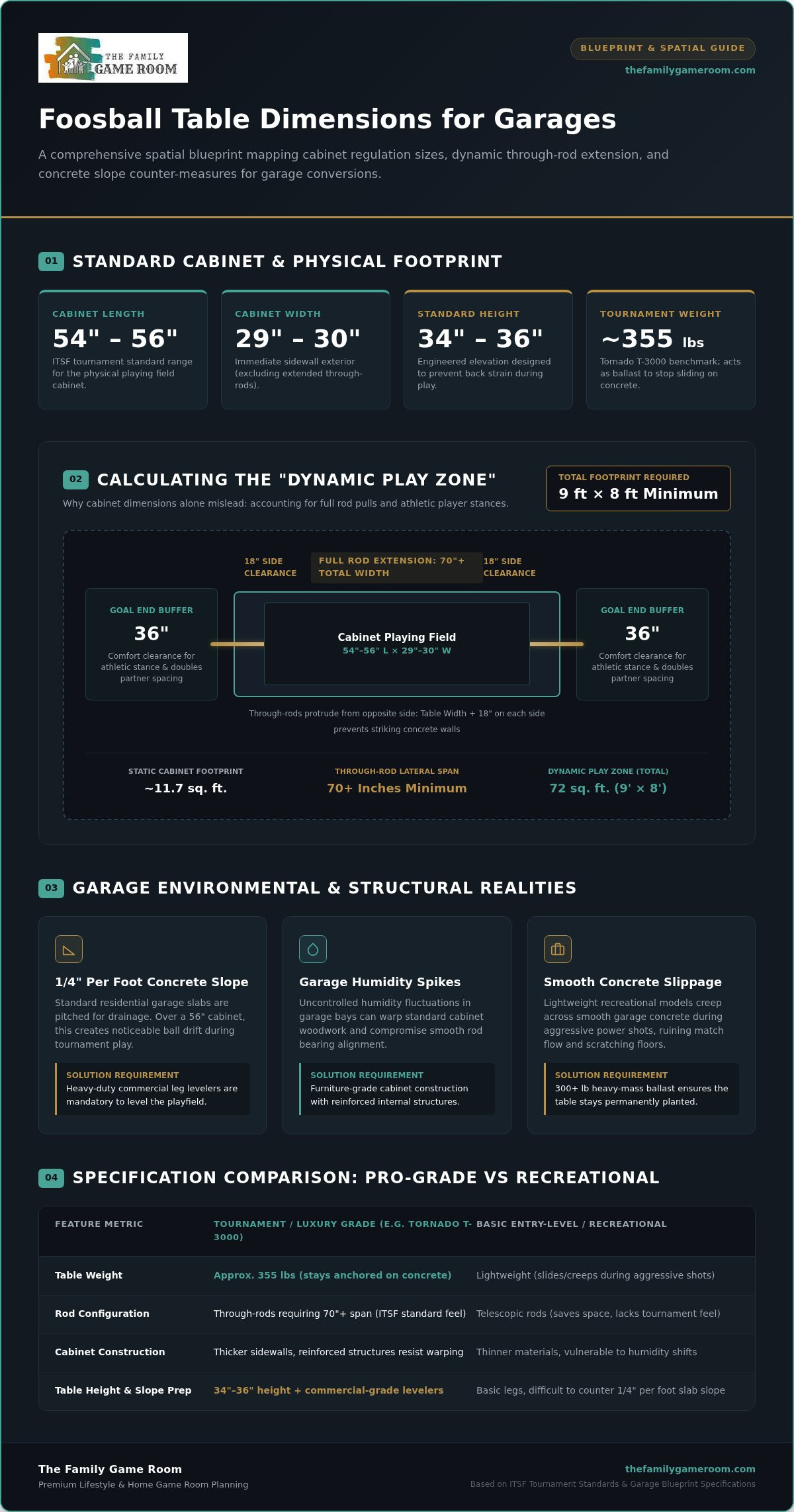
Selecting the right piece for your home starts with measuring the physical footprint, but the numbers on the box rarely tell the full story. When you're calculating the foosball table dimensions for garage planning, you're looking at a standard cabinet length of 54 to 56 inches and a width of 29 to 30 inches. These core measurements represent the playing field and the immediate cabinet walls. However, luxury furniture-grade tables often feature thicker side walls for enhanced stability, which can add several inches to the total exterior width before you even consider the rods. You aren't just buying a game; you're placing a substantial piece of furniture that requires precise spatial awareness.
Regulation vs. Home-Style Dimensions
The International Table Soccer Federation (ITSF) sets rigorous standard foosball table dimensions to ensure consistency during tournament play. While a regulation cabinet stays within that 56-inch length, premium brands like American Heritage Billiards prioritize a wider, more robust profile to accommodate high-end aesthetic finishes and reinforced internal structures. Entry-level tables often use thinner materials that shrink the overall footprint, but these lightweight models lack the professional feel and durability required for a high-traffic garage game room. Standard heights range from 34 to 36 inches. This elevation is designed to prevent back strain during long sessions, ensuring the table feels substantial and plays true every time. Investing in a regulation-sized cabinet ensures that your muscle memory translates to professional play, while the added cabinet thickness provides the structural integrity needed to withstand environmental shifts.
Weight and Its Impact on Garage Placement
Weight is a silent indicator of quality. A professional-grade table, such as a Tornado T-3000, weighs approximately 355 lbs. This mass is essential for ballast on a smooth garage floor. Lighter, recreational models often creep or slide across the concrete during aggressive matches, ruining the flow of the game and potentially scratching your flooring. A heavy cabinet stays planted, but it also demands a perfectly level surface. Because garage floors are engineered with a slight pitch for drainage, usually about 1/4 inch per foot, a heavy table without commercial-grade leg levelers will suffer from a persistent ball drift. When you're finalizing your foosball table dimensions for garage layouts, remember that the table's weight makes it a permanent fixture. You'll want to get the placement right the first time to avoid the physical strain of repositioning a 300-pound piece of furniture. High-quality construction ensures that once your table is leveled, it remains a stable centerpiece for years of competitive entertainment.
Calculating the 'Play Zone': Clearance for Your Garage
Measuring a static cabinet is only the first step in your design process. You must plan for the "Dynamic Play Zone," which represents the total area occupied during peak competitive action. While the foosball table dimensions for garage planning usually start with a 56-inch by 30-inch footprint, the space required for an aggressive doubles match is significantly larger. If you fail to account for the full range of motion, you risk damaging your garage walls or, worse, your premium table's rods. Planning for the movement of the players is just as vital as planning for the table itself.
The Rod Extension Factor
Most high-end American-style tables utilize through-rods that protrude from the opposite side of the cabinet during play. While the cabinet itself is roughly 30 inches wide, these rods can extend the total width to 70 inches or more when pushed to their limit. The Rod Zone is defined as the table width plus 18 inches of clearance on each side. This extension is critical for safety; a rod striking a concrete garage wall can bend the steel or strip the bearings. To play by ITSF official tournament standards, you need enough lateral room to execute pull shots and bank shots without any physical obstruction. Telescopic rods can save space, but they lack the professional feel found in top-tier tournament models.
Player Movement and Stance
Vertical clearance behind the goals is just as vital as horizontal width. Players need a "Comfort Buffer" of 36 inches behind each goal to assume an athletic stance and move freely. This is the gold standard for luxury game rooms. For a doubles match, this space allows two players to stand side-by-side without bumping elbows during a fast-paced transition. If your garage also houses a pool table or shuffleboard, ensure these play zones don't overlap. A cramped environment leads to cautious, subpar play that diminishes the excitement of the game. You want your guests to focus on the match, not the proximity of the lawnmower or the workbench.
To find your total required square footage, use this simple formula: (Table Length + 72 inches) x (Table Width + 40 inches). For a standard regulation table, this results in a recommended play zone of approximately 10 feet by 8 feet, or 80 square feet. This blueprint ensures every participant has the freedom to compete at their best. If you're ready to elevate your home entertainment, explore our collection of professional foosball tables designed for high-end residential spaces.
Garage-Specific Considerations: Flooring and Climate
While the foosball table dimensions for garage setups focus on floor space, the environment below and around the table is equally critical. A garage presents unique challenges that a climate-controlled basement does not. You're placing a high-end piece of furniture on an industrial surface, which requires specific adjustments to maintain professional playability. From the pitch of the concrete to the moisture in the air, every environmental factor influences how your table performs over time. Understanding these variables ensures your investment remains a source of excitement rather than a maintenance burden.
Leveling on Sloped Garage Floors
Garage floors aren't as level as they look. Most residential concrete slabs feature a pitch of 1/8 to 1/4 inch per linear foot to facilitate liquid drainage toward the main door. Over a 5-foot span, this creates a slope of up to 1.25 inches. This tilt is the enemy of a fair match. If you don't correct it, the ball will drift toward the "low" goal, ruining the competitive integrity of your game. Correcting for this slope is a vital part of managing foosball table dimensions for garage layouts. High-end tables feature heavy-duty, threaded leg levelers that compensate for this pitch. Use a carpenter's level during assembly to ensure your table is perfectly horizontal. A true playfield allows for the precision bank shots and controlled passing that define expert play.
Managing Humidity and Dust
Climate control is your next priority. A premium table is often a masterpiece of woodworking, and wood reacts to its environment. Unconditioned garages experience massive humidity swings. Following EPA moisture and humidity guidelines helps preserve the structural integrity of your cabinet. Aim for a relative humidity between 30% and 50%. Moisture levels above 60% cause composite playfields to swell and bare steel rods to develop surface rust. Concrete is porous; it wicks moisture from the ground directly into anything touching it. If your table legs sit directly on bare concrete, they can absorb this dampness, leading to delamination over time. Place your table on an area rug or a specialized moisture-barrier mat. This doesn't just protect the wood; it also adds a layer of grip to prevent table creep during aggressive matches. Finally, keep a fitted, breathable cover on the table. This keeps abrasive garage dust out of the bearings and off the playfield, ensuring a smooth glide every time you play.
Layout Strategies: Fitting Foosball into a Multi-Car Garage
When you're mapping out the foosball table dimensions for garage conversions, you're often negotiating with a vehicle for every square foot of floor space. You don't have to sacrifice your parking to enjoy a professional-grade match. By strategically planning your foosball table dimensions for garage layouts, you can create a high-end retreat that coexists with your daily driver. The key lies in choosing an orientation that respects both the "Dynamic Play Zone" and the practical needs of a working garage.
In a single-car conversion, the table often becomes the room's centerpiece, allowing for a perpendicular layout that provides easy access to all four sides. However, in a double-car garage, you're likely carving out a "recreation zone" in a back corner or a third bay. If you're looking to build a complete arcade experience, consider how your foosball setup pairs with an air hockey table. These tables share similar footprints, making them ideal partners for a tandem layout along a side wall. This arrangement keeps the center of the garage open for vehicle traffic while keeping the action concentrated in a dedicated entertainment wing.
The Parallel Wall Placement
Placing the long side of the cabinet parallel to a wall is the most common space-saving tactic for multi-use garages. This layout keeps the center of the bay clear, but it introduces the challenge of the "dead side." While this works well for solo practice or casual one-on-one play, it limits your ability to host doubles matches unless you move the table. To keep your options open, place the table on a heavy-duty area rug. This allows you to slide the cabinet out into the center of the floor when guests arrive, providing the full 36-inch player clearance required for competitive play. Once the game ends, simply slide it back against the wall to reclaim your parking spot.
Zoning with Lighting and Accessories
Lighting is the most effective way to define your game room territory within a utilitarian space. Installing dedicated billiard light fixtures over your foosball table instantly elevates the ambiance and provides a visual boundary between the "shop" and the "game room." These fixtures provide focused, downward illumination that eliminates shadows on the playfield, which is essential for tracking a fast-moving ball. Aim for a mounting height of 30 to 32 inches above the playfield. This height provides optimal light spread without obstructing the players' view or being struck by a stray rod handle during an aggressive match. Proper lighting transforms a concrete bay into a curated destination for home entertainment.
Ready to finalize your layout? You can shop our premium game table collections to find a cabinet that matches your garage's aesthetic and your family's competitive spirit.
Selecting the Right High-End Table for Your Space
Choosing the right hardware is the final step in your garage conversion. While you've already mastered the foosball table dimensions for garage layouts, the build quality of the table itself determines if it survives the unique garage climate. High-end tables utilize superior craftsmanship to ensure the playfield stays flat and the rods stay fast. Investing in a new, premium model avoids the hidden maintenance headaches of used equipment, such as warped cabinets or worn-out bearings that compromise playability. A new table comes with the assurance of structural integrity and a manufacturer's commitment to quality.
If you're deciding between different high-speed entertainment options, it helps to compare play styles and spatial requirements. Many homeowners find that foosball offers a tactical depth that differs from the frantic pace of other games. You can explore the nuances in our comparison of air hockey vs. foosball to determine which better suits your family's competitive rhythm and your available floor space.
Furniture-Grade Aesthetics
A luxury garage conversion deserves a centerpiece that matches the rest of your home's design. If you already own one of the American Heritage Billiards pool tables, you can select a foosball cabinet with a matching finish to create a cohesive, curated look. Selecting a table with a furniture-grade finish doesn't just improve the room's visual appeal; it also ensures better long-term durability. High-density materials and solid wood legs provide the ballast needed to keep the foosball table dimensions for garage footprints firmly in place. This stability is vital when matches get heated and players begin to exert more force on the cabinet.
Professional Hardware Features
Focus on the specific components that elevate your game from recreational to professional. Counterbalanced players are essential; they stay in whatever position you leave them, which is critical for clearing the path for a long-distance shot. Rod choice also matters for performance. Hollow steel rods are the preference for tournament play because their lighter weight allows for faster rotation and significantly less wrist fatigue. Pair these with high-performance split bearings for a frictionless glide that feels smooth even after hours of action. These professional features are worth the investment for any enthusiast who values precision and wants a table that performs as well as it looks.
Elevate Your Home Entertainment Strategy
Transforming your garage into a high-end recreation suite requires more than just a free corner; it demands a precise understanding of spatial dynamics. You've learned that mastering the foosball table dimensions for garage planning means accounting for the full 70-inch rod extension and correcting for the inevitable pitch of a concrete floor. By selecting furniture-grade equipment and managing your local climate, you ensure your game room remains a durable centerpiece for years of competitive play. These technical details provide the foundation for an elite gaming environment.
As a family-owned and operated business since 2022, we pride ourselves on being a trusted curator for your home entertainment needs. We're an authorized American Heritage Billiards dealer, offering the craftsmanship and reliability your family deserves. Experience the thrill of professional-grade play with the added benefit of free shipping on select high-end tables. Don't let a cramped layout or poor equipment hold back your next tournament. Take the final step in your home conversion and Shop Our Premium Foosball Table Collection today. Your perfect match is just a few clicks away.
Frequently Asked Questions
What is the minimum room size for a standard foosball table?
A dedicated play zone of 10 feet by 8 feet is the recommended minimum for a standard setup. This footprint accounts for the 56-inch cabinet length and provides the 36 inches of clearance needed behind each goal for an athletic stance. When you're calculating the foosball table dimensions for garage conversions, remember that players need room to move laterally without striking walls or workbenches. Proper spacing ensures a professional environment for competitive matches.
Do I need a special floor for a foosball table in my garage?
You don't need a specialized floor, but protecting your table from bare concrete is essential. Concrete is porous and wicks moisture directly into wood legs, which can cause delamination over time. We recommend placing your table on a moisture-barrier mat or a high-quality area rug. This setup also provides extra grip to prevent the cabinet from creeping across the smooth garage floor during aggressive shots or fast-paced doubles matches.
How much space should I leave for foosball rods to extend?
Plan for at least 18 inches of clearance on each side of the cabinet for full rod extension. While a standard table is 30 inches wide, through-rods can expand the total width to 70 inches during play. If you're working with tight foosball table dimensions for garage layouts, this "Rod Zone" is non-negotiable. Failing to provide this space risks bending the steel rods or damaging nearby walls if the table is placed too close to the boundary.
Can I keep a foosball table in an unheated garage?
You can keep a table in an unheated garage, but you must control the humidity levels. Temperature fluctuations are less damaging than moisture swings, which cause wood cabinets to swell or warp. Aim to maintain a relative humidity between 30% and 50% using a garage-grade dehumidifier. High-end tables from brands like American Heritage Billiards are built for durability, but consistent environmental control is the best way to safeguard your investment from long-term seasonal damage.
How do I level a foosball table on a sloped garage floor?
Use the heavy-duty threaded leg levelers included with your premium table to compensate for the floor's natural pitch. Most garage slabs are sloped at 1/4 inch per foot for drainage, which can cause the ball to drift toward one goal. Place a carpenter's level on the playfield and adjust each leg until the bubble stays centered. A perfectly level table is vital for fair competition and ensures that every bank shot remains accurate.
Is a 5-foot foosball table too big for a one-car garage?
A 5-foot table fits in a standard one-car garage, provided you treat the space as a dedicated game room. Since a one-car bay is typically 12 feet wide, you'll have enough room for the 70-inch rod extension and player stances. However, you won't be able to park a vehicle inside while the table is in use. If you need to share the space, consider a parallel layout that allows you to move the table when parking.
What are the dimensions of a professional tournament foosball table?
Professional tournament tables sanctioned by the ITSF typically measure 56 inches in length, 30 inches in width, and 36 inches in height. The playing surface itself is approximately 47 inches by 27 inches. These standard dimensions ensure that your skills translate to any competitive environment. When purchasing a new table, look for these specific measurements to guarantee you're getting a regulation-grade experience that matches the quality of our high-end furniture collections.
How do I protect my foosball table from garage dust and humidity?
Protect your table by using a fitted, breathable cover and maintaining a stable environment. A cover prevents abrasive garage dust from settling in the bearings, which can grind down the rods over time. For humidity, a simple dehumidifier keeps the air within the recommended 30% to 50% range. These steps prevent playfield warping and rod oxidation, ensuring your table looks and performs like new for years. Regular maintenance is a small price for professional longevity.