


Choosing what size shuffleboard you should buy starts with the room, not just the table. Shuffleboard tables typically range from 9 to 22 feet long, while a regulation-size table is 22 feet long and 20 inches wide. For a home game room, the right fit depends on how much space you can dedicate to the table and play around it.
A longer table may seem like the obvious choice, but it can leave too little room to stand, shoot, or move comfortably. A compact table can suit a smaller layout and casual play, while a longer model offers more playing space when the room can accommodate it.
This guide explains how to weigh table size, end clearance, room dimensions, and the route into your home. Use these practical checks to narrow your options and choose a table that fits your layout and is ready for game night.
Key Takeaways
- Compare compact, mid-size, and regulation-length tables against how you plan to play, not just how impressive the table looks.
- Think beyond the room itself: the doorway and route to the final location can affect which table will fit.
- Leave working space at both ends so players can stand and take their shots comfortably.
- Use your room’s clear dimensions and layout to narrow the options before settling on a table length.
What size do shuffleboard tables come in?
Shuffleboard tables typically range from 9 to 22 feet long. A useful starting question is, “What size shuffleboard should I buy?” The answer depends on your room, the kind of play you want, and the route into your home.
Common Table Lengths and Dimensions
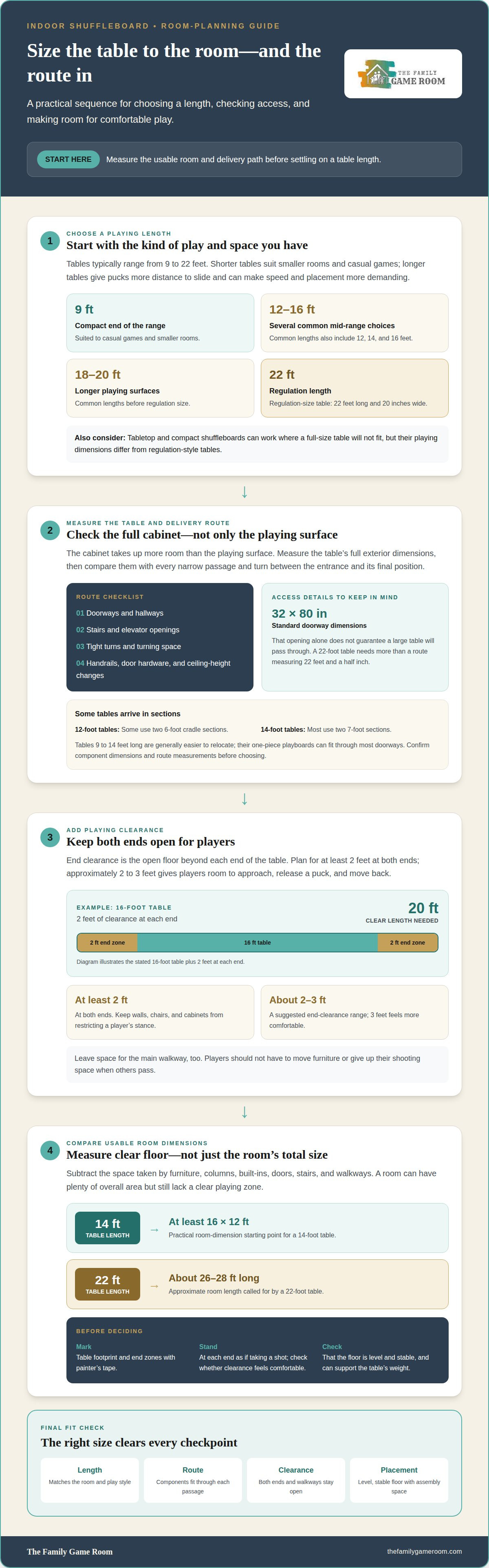
Common lengths include 9, 12, 14, 16, 18, 20, and 22 feet. A regulation-size table measures 22 feet long and 20 inches wide. Entry-level tables can have playing surfaces 16 inches wide and 1.5 to 1.75 inches thick. Compare the playing surface with the full table footprint when measuring spaces, since the cabinet takes up more room.
Compact Alternatives for Small Spaces
Tabletop and compact shuffleboards can work when a full-size table won’t fit. They suit smaller spaces and offer casual play without dedicating a room to a long cabinet. If you’re asking, “What size shuffleboard should I buy for this room?” start with where the table will go and how you plan to use it. Compact models have different playing dimensions from regulation-style tables.
Table Length and Gameplay Difficulty
Length affects the distance a puck travels and the control players need. A 9-foot table suits casual games and smaller rooms, while an 18-to-22-foot table gives pucks a longer slide. Shorter surfaces may feel more approachable for new players. Longer tables can make speed and placement more demanding, so match the length to your group’s experience and preferred style of play.
Table prices vary by construction, materials, finish, and features. Compare specifications and intended use rather than judging by length alone. Outdoor tables are a separate category; this guide focuses on indoor layouts and does not assess outdoor materials or weather suitability.
Plan the delivery route, too. Tables 9 to 14 feet long are generally easier to relocate, and their one-piece playboards can fit through most doorways. Some 12-foot tables have two 6-foot cradle sections, while most 14-foot tables use two 7-foot sections. Measure stairs, elevator openings, and tight turns before choosing.
Room access and installation considerations
Room dimensions matter, but the route into your home can rule out a table before it reaches the room. Measure the destination and every doorway, stairway, elevator, and turn along the delivery path.
Delivery and assembly depend on the dimensions of the table components and the route to its final position. Leave enough clear floor space for assembly, and place the table on a level, stable surface that can support its weight.
Measuring Rooms and Access Routes
Measure the narrowest point at each doorway, hallway, stairwell, and elevator, then note the turning space at corners. A standard doorway is 32 inches by 80 inches, but that opening alone doesn’t guarantee a large table can pass through. Include handrails, door hardware, and changes in ceiling height in your route measurements. A 22-foot table needs more than a route measuring 22 feet and a half inch.
Measure the table’s full exterior dimensions, not just the playing surface. Compare them with each narrow passage and turn: a straight hallway and a tight corner pose different access challenges.
Recommended Room Dimensions
Room size should account for the table and the standing space needed for play. Choose a room that leaves enough space around the table for players to stand and play comfortably. For a 14-foot table, allow at least 16 by 12 feet. These measurements provide a practical starting point for comparing layouts.
Longer tables generally need more room to allow comfortable play. A 22-foot table calls for a room approximately 26 to 28 feet long. Compare clear floor dimensions, excluding space occupied by fixed furniture, columns, or built-ins. Tournament-style play may favor a regulation-length table, but a compact room can make a shorter playfield more workable.
A shuffleboard table concentrates its weight across its base, so the floor needs to be level and stable. Avoid uneven transitions that could affect the table’s position or playing surface. A well-set table supports smooth play; fitting its footprint into the room is only part of the plan.
Clearance at each end
End clearance is the open floor beyond each end of a shuffleboard table. Plan for at least 2 feet at both ends; approximately 2 to 3 feet gives players standing room to approach, release a puck, and move back. That space is part of the playing layout, not spare room to fill with furniture.
Two feet at each end can provide room to stand and shoot, while 3 feet feels more comfortable. For example, a 16-foot table needs 20 feet of clear length with the recommended 2-foot end clearance. Allow more length if your game rooms need easier movement around players or frequent access past the table.
A 22-foot table needs a longer playing zone than a shorter model. The room-length estimate for that table is approximately 26 to 28 feet, allowing end space beyond its length. For a purchase, compare the table’s full length with the usable floor area, then account for end clearance before deciding whether 22 feet suits your layout.
Picture how people will move during a game. Players stand at the ends to shoot, so a wall, chair, or cabinet directly behind them can restrict their stance. Leave both ends clear of fixed obstacles and consider where players will wait between turns. A clear approach means less need to move furniture during game night.
Tables of different lengths need different room plans, even when their widths are similar. Mark the footprint and end zones with painter’s tape, then stand at each end as if taking a shot. This simple test shows whether the clearance feels comfortable before you choose a size. Keep the main walkway open, too, so people can pass without crossing a player’s shooting space.
Room layout and available space
Usable floor area matters more than a game room’s total square footage. Measure the open area after accounting for doors, stairs, support posts, furniture, and walkways. A basement may have plenty of length but lose usable space to a column or low overhead fixture.
For comfortable play, leave at least 2 feet around the table. That clearance gives players room beside the cabinet and helps keep the main walkway usable. A table about 20 inches wide needs more than its own footprint; include standing space and nearby furniture when mapping the layout.
Plan the table around how people move through the room. Keep both playing ends accessible, and leave space for players to stand rather than placing a sofa or storage unit there. In a narrow room, setting the table along the longer wall may preserve a route past it. Mark the footprint and clearance before moving heavy furniture.
For reference, a 12-foot table needs a room roughly 16 to 18 feet long. A 22-foot table needs approximately 26 to 28 feet of room length. Those estimates help compare table size with room proportions, but door swings and fixed surfaces can reduce the genuinely usable area. Check the width, too, rather than assuming length alone determines fit.
Leave overhead space for lighting and any electronic scorekeeper features, such as fans. Climatic adjusters sit beneath some tables, so avoid layouts that block access to the underside. Their placement can be approximately every 3 or 4 feet. Keep enough working room around the base for adjustment and maintenance.
The key is to choose a table that fits the playing area and traffic pattern, not just the room’s bare dimensions. A shorter table may make a compact basement more comfortable; a longer model suits a layout with enough room for its footprint and clear approaches.
The Family Game Room: Indoor Shuffleboard Tables
The Family Game Room offers indoor shuffleboard tables for home game rooms and entertainment spaces. After measuring the room, planning end clearance, and mapping the delivery route, compare table dimensions with the layout you want to preserve. The right size leaves room to play without making everyday movement awkward.
If shuffleboard won’t fit your available space, consider other home entertainment options, such as pool tables with dining tops, air hockey tables, or foosball tables. Choose a game that suits both your room and how you plan to use it.
Contact The Family Game Room to discuss your shuffleboard table selection.
Make the Room Your Next Move
Choose a table that works with the way you want your room to function, not just the game you want to play. If you’re still weighing what size shuffleboard to buy, picture a typical game night: where players gather, how people move through the room, and whether the space needs to serve another purpose. Thinking through those details can make the decision clearer.
A game room can bring different kinds of entertainment together. The Family Game Room also offers American Heritage Billiards and Nixon Billiards pool tables, as well as pool table dining tops, if you want to balance play with everyday use.
Ready to take the next step? Ask The Family Game Room for help as you plan a welcoming space for game night.
Frequently Asked Questions
If I plan to move in the future, which size is easiest to relocate?
A 9-foot table is generally easier to relocate than a longer model because tables this length are almost always made as one piece. Moving still depends on the route, not just table length. Before purchase, consider tight stair turns, elevator openings, and whether the assembled table can be maneuvered into its intended room without obstructing other spaces.
What Affects the Price?
Shuffleboard table price can vary with length, materials, construction, finish, and optional features. A longer table requires a larger playing surface, while design and build details can also affect its overall value. Compare models by their specifications and intended use, such as casual family games or more competitive play. A custom finish or configuration may also change the final price.
What are standard shuffleboard table lengths and widths?
Shuffleboard tables typically range from 9 to 22 feet long, and a regulation-size table measures 22 feet long and 20 inches wide. Width can vary by model: playing surfaces are commonly 18 to 20 inches wide, while the full table may be wider. Check whether a listed width describes the playfield or the outside edges of the table.
How much room do you need for a shuffleboard table, including player clearance?
Plan for at least 2 feet of clearance around the table, including its ends, so players can approach and shoot. Add the table’s full outside dimensions to the open space needed around it, then account for furniture and walkways. For example, a room may meet the length requirement but still feel cramped if a doorway or seating area blocks an end.
What shuffleboard table size is best for a home game room?
A 9- to 12-foot table is a practical starting point for most home game rooms. A 9-foot model can suit casual play and compact spaces; a 12-foot table offers more playing length. If your room supports a larger footprint and you want more challenging games, consider a longer option. Match the choice to both available space and play style.
How do 9-foot, 12-foot, 14-foot, 16-foot, and 22-foot shuffleboard tables compare?
A 9-foot table suits smaller rooms and casual play; 12 feet is popular for home game rooms. A 14-foot table fits larger spaces or a more competitive experience. A 16-foot model can suit competitive play, while 22 feet is regulation length. As length increases, the playfield gives pucks more distance to travel and requires more room for comfortable play.