


You don’t always have to pay for a game room all at once. Financing a game room purchase usually means applying for a consumer loan or credit option and reviewing the lender’s approval terms, required documents, down payment, and funding timeline. The options available depend on your finances and what you plan to buy.
Look beyond the monthly payment: borrowing costs, repayment period, and timing all affect whether an option fits your household budget. A clear plan also helps you compare financing with the full purchase, from the main game table to finishing touches such as televisions and appliances found at ninostrading.com.
This guide explains how applications work, what paperwork lenders may request, how down payments and loan terms can vary, and which financing products may suit a home purchase. You’ll also learn what can affect approval and how to plan the next steps, so you can make room for game-night excitement with a practical financing decision.
Key Takeaways
- Get your purchase details and financial documents organized so you can move through a lender’s application with fewer delays.
- Compare the down payment and annual interest rate together to understand how each offer may affect your budget.
- Match the repayment term and funding timeline to your plans before committing to a financing option.
- Review the factors lenders weigh, including credit history, revenue, and the equipment being financed.
- Explore game room options such as a pool table dining top, indoor shuffleboard table, air hockey table, or foosball table as you shape your purchase.
Business documentation and application steps
In the United States, the cost to build or furnish a game room depends on its size, selected equipment, and any room improvements. Start with an itemized plan, then compare financing payments with your household budget before choosing what to buy.
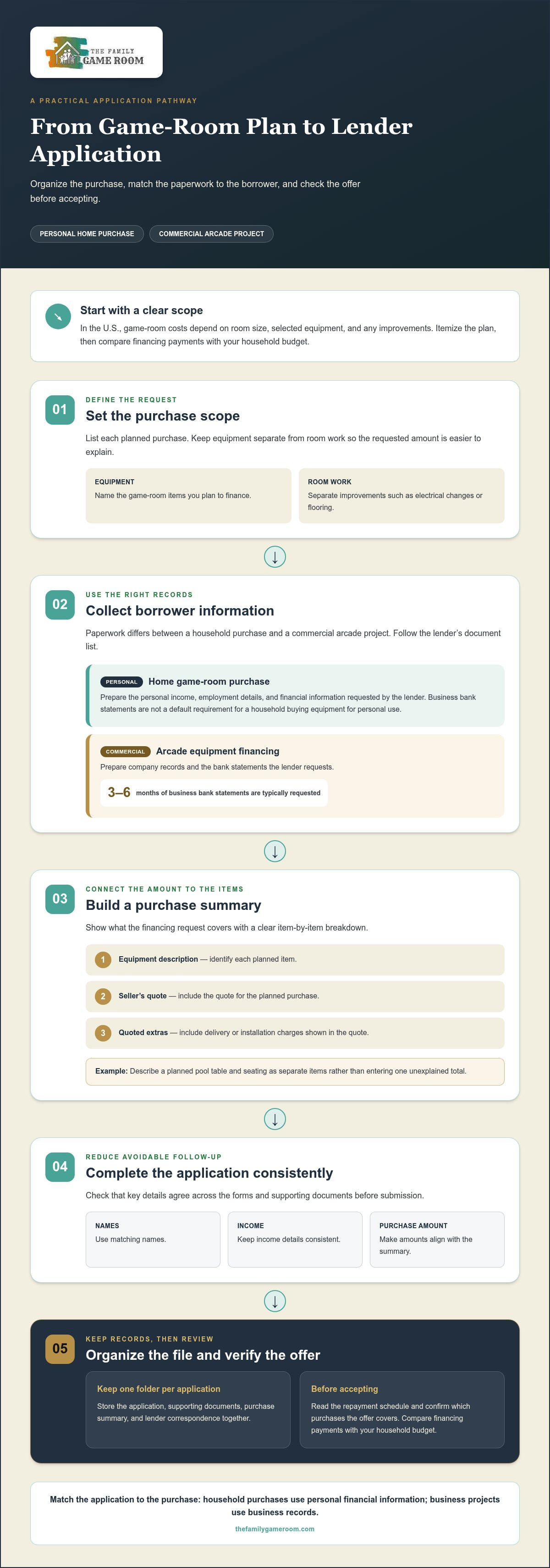
Paperwork differs between a personal purchase and a commercial arcade project. Home buyers generally prepare information about income, monthly obligations, and the items they plan to finance. Lenders use these details to assess repayment ability and determine their offers. Business borrowers provide company records, so keep the two application types separate.
For arcade equipment financing applications, lenders typically request 3 to 6 months of business bank statements. Those statements help show cash flow and account activity. They are business documentation, not a default requirement for a household buying equipment for personal use. A residential applicant should follow the lender’s document list and provide personal financial information relevant to the application.
Organize your application in a few practical steps:
- Set the scope. List each planned purchase and separate equipment from room work, such as electrical changes or flooring. This makes the amount requested easier to explain.
- Collect income records. Gather the personal income and employment details requested by the lender. If applying through a business, prepare business records and the requested bank statements.
- Build a purchase summary. Include the equipment description, seller’s quote, and any delivery or installation charges shown in the quote. A clear breakdown helps connect the requested financing to specific purchases.
- Complete the application consistently. Use matching names, income details, and purchase amounts across forms and supporting documents. Resolve differences before submission to reduce follow-up.
Keep a separate folder for each financing application, including the application, supporting documents, purchase summary, and lender correspondence. If the lender requests an updated statement or clearer quote, you can respond using organized records. For example, describe a planned pool table, seating, or audio-visual gear from HDTV Supply as separate line items rather than entering one unexplained total.
Before accepting an offer, read its repayment schedule and confirm which purchases it covers. A loan for business arcade equipment may use business financial records and underwriting criteria. A household purchase follows a personal application process. Matching the application to the purchase keeps the documentation relevant and gives the lender a clear picture of your request.
Costs vary with the room’s size, the equipment, and any improvements needed. Separate equipment from room work in your itemized plan to estimate the amount and compare financing payments with your household budget.
Down payments and interest rates
For arcade equipment financing, down payments can range from 0% to 20%, depending on credit and deal size. Qualified borrowers typically see annual interest rates from 6% to 24%; compare fees and payment schedules alongside the rate.
Down Payment Requirements
A down payment reduces the amount financed, but the required share depends on the financing arrangement. For arcade equipment financing, the stated range is 0% to 20%, with credit and deal size influencing the requirement. That range describes commercial equipment financing, not a guaranteed down payment for a household purchase.
Compare the amount due upfront with the balance left to repay. A larger initial payment may reduce the amount financed, while keeping cash available may matter more for other expenses. Check whether the down payment applies to the equipment alone or includes other financed charges.
Rates, Fees, and Monthly Payments
Arcade equipment financing interest rates for qualified borrowers typically range from 6% to 24% annually. Personal financing options for a home game room can use different terms, so don't assume the commercial range applies. Compare each offer using its stated annual rate, repayment period, fees, and total repayment amount.
Monthly payments depend on the amount borrowed, interest rate, repayment term, and any financed fees. A lower payment may mean a longer repayment period, not a lower total cost. Review the payment schedule and fees together before deciding.
Use this comparison process for each offer:
- Confirm the down payment. Record the amount due upfront and the remaining balance financed.
- Compare annual rates. For commercial arcade equipment, check whether the quoted rate falls within the 6% to 24% typical range for qualified borrowers.
- List fees separately. Note application, origination, or other charges only when they appear in the offer, and determine whether they are paid upfront or added to the balance.
- Review total repayment. Compare scheduled payments and total repayment, not just the monthly figure.
If two offers finance the same equipment, compare the upfront amount, annual rate, and each scheduled payment. Then check how fees affect the total. Comparing the same costs makes it easier to assess offers presented in different ways.
Separate a home purchase from a business investment before comparing terms. Commercial arcade financing may involve equipment-focused underwriting, while personal options assess household finances and have their own pricing. Match each quote to its purpose, then choose a payment schedule that fits your budget. Don’t assume the lowest monthly payment is the cheapest option.
Loan terms and funding timelines
Commercial equipment financing terms and funding speed depend on the product and agreement. For a home game room, keep those business timelines distinct from personal financing.
Loan Term Options
Arcade equipment financing terms typically run 24 to 72 months. These figures describe commercial financing, not a standard term or amount for a household game room loan.
Compare the repayment period with the equipment’s intended use and the project’s scale. A longer term spreads payments over more months, while a shorter term means repaying sooner. That example illustrates a commercial structure, not a recommendation for home buyers.
Before signing, review the payment schedule, total repayment, and any early repayment conditions in the written agreement. Confirm the amount financed and number of scheduled payments. For personal borrowing, compare the lender’s actual offer; commercial arcade examples don’t establish household loan conditions.
Funding Timelines
Equipment financing funds are typically disbursed within 1 to 5 business days after the agreement is signed. SBA loans for arcade businesses typically take 30 to 90 days to process. These timelines concern commercial financing, and the stated equipment-funding period begins after signing, not when an application is first submitted.
Plan purchases around the agreement’s funding stage. Application review, document requests, approval, signing, and disbursement are separate steps. If the lender requests more information, the application may take longer to reach an agreement. Don’t treat an approval or unsigned offer as funded money.
For a home purchase, ask how the selected financing route pays the seller and when funds become available. Keep the purchase quote and planned order timing aligned with the lender’s process. A commercial equipment loan’s 1 to 5 business-day disbursement window doesn’t automatically apply to personal financing.
Use this sequence to plan responsibly:
- Compare terms. Record the repayment period and payment schedule for each written offer.
- Map milestones. Note application, approval, signing, and expected disbursement separately.
- Coordinate the purchase. Schedule the order after understanding the funding step that makes payment available.
These distinctions matter: a 60-month commercial example and an equipment loan’s post-signing disbursement period provide context, not a promised personal-loan timeline. Match the agreement to the purchase type, then plan around its stated terms.
Financing eligibility and product exceptions
For arcade financing, a 600+ credit score is a general benchmark, while $100,000+ annual revenue is preferred for standard programs. Home buyers should budget from itemized quotes and compare personal financing terms separately.
A home equity loan or HELOC can finance a game room. Both borrow against home equity, so weigh the repayment terms and risk to your home before choosing this route.
Eligibility Criteria
Commercial arcade financing and household borrowing use different eligibility measures. For standard arcade programs, annual revenue of $100,000 or more is preferred, and a credit score of 600 or higher is a general benchmark. These figures describe business financing, not a guaranteed threshold for personal loans.
For a home purchase, lenders assess your financial situation and requested borrowing amount. Prepare an itemized budget that separates equipment, delivery, installation, and room changes. This helps you compare the amount requested with your monthly budget instead of relying on one broad estimate.
Use the same purchase list to compare quotes. Record the financed amount, down payment, interest rate, fees, repayment term, and total scheduled payments. If one quote includes delivery and another doesn’t, adjust the comparison so both reflect the same planned purchase.
- Separate personal and business use. State whether the equipment serves a household or commercial arcade.
- Compare equivalent totals. Include the same equipment and related charges in each quote.
- Review repayment fit. Check how each scheduled payment fits alongside existing household obligations.
Recreational Equipment Financing Risks
The main risks are repayments that strain your household budget and borrowing against home equity. A home equity loan or HELOC uses your home as security, so missed payments can put it at risk. Consider this exposure alongside the amount borrowed and repayment plan.
Recreational equipment may lose practical value if your plans change, while loan payments continue under the agreement. Don’t base affordability only on expected use or future income. Build your budget around current finances and the full repayment schedule.
Check the agreement for the interest rate, fees, payment dates, and consequences of missed payments. For a HELOC, understand how variable borrowing affects the amount owed over time. For a fixed loan, review the scheduled payments and total repayment. Either way, leave room in your household budget for regular expenses and unexpected costs.
Use a simple decision check before accepting an offer:
- Confirm the purpose. Match personal financing to household purchases, not business benchmarks.
- Compare the complete cost. Review the balance, fees, payment schedule, and repayment terms.
- Protect household flexibility. Consider whether payments remain manageable if other expenses rise.
Choose an option that fits both the purchase and your household’s ability to repay. A favorable monthly payment doesn’t reveal the full cost or the risk attached to home equity. Read all the terms before committing.
Financing partner options
Home buyers can compare personal loans, credit cards, and home equity borrowing for game room equipment. Each has a different repayment structure, so compare the written terms against the same purchase plan.
Yes. A personal loan or credit card can finance game room equipment, subject to approval and the account’s terms. A personal loan provides a set amount to repay under its agreement, while a credit card lets you charge purchases against available credit.
Start with an itemized quote, then identify the financing option that can cover your planned purchase. A bank or credit union may offer a personal loan; a card issuer sets credit card terms. If checkout presents a financing option, review it separately rather than assuming it matches a bank loan.
Compare options using a consistent checklist:
- Amount available: Confirm the approved borrowing limit covers the intended equipment and eligible charges.
- Repayment structure: Note whether payments follow a fixed schedule or depend on card balance and payment activity.
- Rate and fees: Read the agreement for the interest rate, fees, and how charges affect the amount owed.
- Purchase coverage: Check whether the financing covers equipment only or also listed delivery and installation charges.
- Payment timing: Understand when repayment begins and when each payment is due.
For example, compare a pool table quote against both a personal loan and a credit card offer. Record the amount borrowed, repayment schedule, interest terms, and fees. A card’s available credit alone doesn’t show whether carrying the balance fits your household budget.
Home equity borrowing is another distinct option. A home equity loan or HELOC uses home equity, while a personal loan or credit card doesn’t use your home as collateral. Compare the agreements carefully, including repayment terms and consequences of missed payments. The easiest application may not be the best fit for your budget.
Keep business financing separate from household options. Arcade equipment loans and SBA loans serve business purposes and use commercial underwriting. Home buyers furnishing a personal game room should compare consumer products, not treat business program examples as household offers.
Before accepting an offer, match its terms to the equipment quote and your household cash flow. Choose a financing option with a repayment structure you understand and can manage. Keep the offer, purchase list, and payment schedule together so the plan stays clear from approval through the final payment.
The Family Game Room: Pool Table Dining Tops
The Family Game Room offers Pool Table Dining Tops for homeowners who want a game room that can also serve as a dining space. Consider one when planning how the room will support everyday activities as well as game nights.
As you finalize your purchase plan, consider the space and intended use of each item. Indoor Shuffleboard Tables, Air Hockey Tables, and Foosball Tables offer different ways to shape a room around the games your household enjoys. A focused list helps align your financing plan with the equipment you want, rather than extras that don’t fit your priorities.
Once you’ve compared financing terms and settled on a room plan, explore the options at The Family Game Room and contact the team with your questions.
Shape a game room plan you can feel good about
A thoughtful approach to financing a game room purchase starts with a clear idea of how you want the room to work. Decide which centerpiece will anchor gatherings, how much open space to preserve, and whether the room should serve more than one purpose. A well-planned purchase feels considered, not crowded into the budget.
The Family Game Room offers American Heritage Billiards Pool Tables, Nixon Billiards Pool Tables, and Pool Table Dining Tops. These options can shape a room around classic play or add dining functionality. Compare your preferred setup with your budget and financing terms, then focus on the pieces that best suit your household.
Ready to explore pool table options for your home? Contact The Family Game Room to discuss your game room plans. Make room for great gatherings, one thoughtful choice at a time.
Frequently Asked Questions
How Does The Process Work?
Choose the equipment and decide whether to include related purchase charges in the loan. If you’re considering a pool table and accessories, check whether the quote lists each item separately and how payment will reach the seller. Compare the financing agreement with the purchase details before accepting, so the order, amount borrowed, and repayment plan align from the start.
What financing options are available for a game room purchase?
Common options include a personal loan, a credit card, or home equity borrowing. A personal loan provides an agreed borrowing amount, while a credit card uses available credit for purchases. A home equity loan or HELOC borrows against home equity. For financing a game room purchase, compare how each option handles the planned transaction and repayment, not just the payment amount.
Are there retailers that offer financing for game room equipment?
Yes. The Family Game Room lists flexible financing options and sells game room equipment, including American Heritage Billiards Pool Tables and Nixon Billiards Pool Tables. Review the financing terms for your purchase alongside the itemized product details. Arrangements, repayment structures, and eligibility depend on the financing option, so base your decision on its actual agreement.
What credit score and income are typically needed to finance a game room purchase?
For standard arcade business financing, a credit score of 600 or higher is a general benchmark, and annual revenue of $100,000 or more is preferred. Those figures apply to business programs, not personal household borrowing. Home buyers’ eligibility depends on the lender’s assessment of their finances and application. Keep business revenue requirements separate from personal income when comparing options for a home game room.