


A premium nine-foot slate pool table can weigh up to 1,200 pounds, yet it rests on just four small legs. It's natural to feel a bit of trepidation before placing that much weight in a second-story game room or over a crawlspace. The good news is that most modern homes are built with a live load capacity of 40 pounds per square foot, meaning your dream setup is likely perfectly safe. Success starts with ensuring your floor can support a slate table by verifying the structural layout of your joists and understanding how weight distribution works in a residential setting.
You want the confidence that your floor won't sag or warp over time, ruining both your home's value and your table's levelness. We understand that a luxury investment deserves a solid foundation. This guide provides the exact structural requirements and engineering checks you need to move forward with total peace of mind. We'll walk through building code standards, weight distribution math, and a simple checklist to confirm your space is ready for professional installation. You'll learn how to check your floor's integrity so you can focus on choosing the perfect finish for your new centerpiece.
Key Takeaways
- Understand the physics of premium slate and why its 700 to 1,200-pound weight is the industry standard for professional-grade play.
- Learn the residential building code requirements for ensuring your floor can support a slate table without risking long-term warping or structural sag.
- Compare concrete slabs and wood joist systems to find the ideal foundation for your game room's specific architectural layout.
- Follow a step-by-step process to locate support beams and position table legs for maximum structural stability and lasting levelness.
- Prepare your home with confidence for high-end collections from American Heritage Billiards and Nixon Billiards, knowing your space is engineered for excellence.
The Physics of Slate: Why Weight Equals Superior Play
Slate is the heart of a professional game room. Its natural density and rigidity provide a perfectly flat surface that never warps, unlike synthetic alternatives. Three-piece slate is the industry standard because it allows professional installers to level each section with microscopic precision. This creates a seamless field of play that remains true for decades. When you choose a premium table, you aren't just buying furniture; you're investing in a piece of engineering designed for consistent performance.
The massive weight of these tables is actually their greatest asset. It provides the inertia needed to keep the table stationary during aggressive play. When you are ensuring your floor can support a slate table, you are accounting for a significant structural load that remains constant. Unlike MDF (Medium Density Fiberboard) tables that are light enough to shift when bumped, a slate table stays exactly where it's placed. This stability is a hallmark of high-end brands, ensuring that the levelness you set on day one is the levelness you have ten years later.
Weight Breakdown by Table Size
Understanding the specific weight of your chosen table size helps you plan your room's layout effectively. Here is how the numbers typically break down for premium slate models:
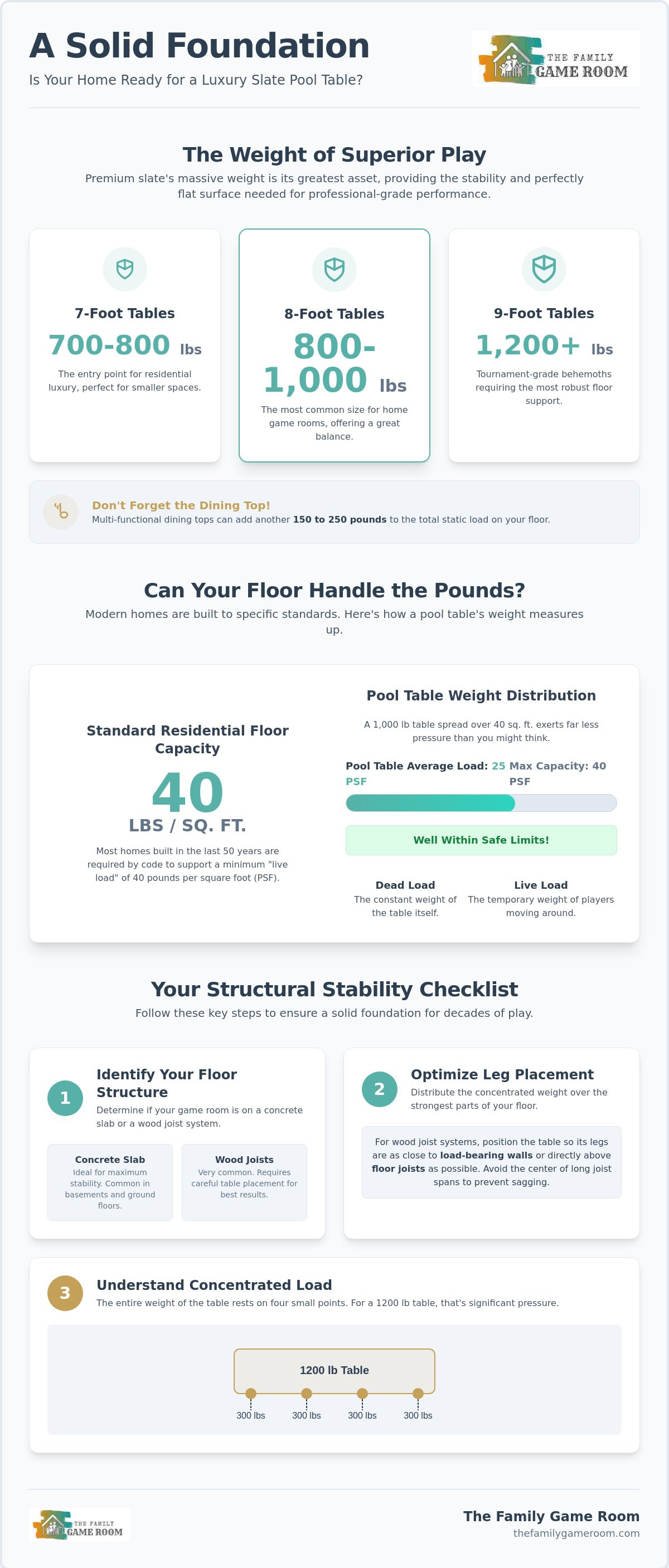
- 7-Foot Tables: Often considered the entry point for residential luxury, these typically weigh between 700 and 800 pounds.
- 8-Foot Tables: This is the standard size for most home game rooms. Expect a weight range of 800 to 1,000 pounds once fully assembled.
- 9-Foot Tables: These are tournament-grade behemoths. They frequently exceed 1,200 pounds and require the most robust floor support.
The Added Load of Multi-Functional Tables
Modern game rooms often prioritize versatility, leading many homeowners to choose Pool Table Dining Tops. While these additions transform your table into a stunning focal point for hosting, they also add a significant amount of weight. A solid wood or glass dining top can add another 150 to 250 pounds to the total footprint. This increases the permanent static load on your flooring system. Additionally, high-end frame construction using solid hardwoods or reinforced steel adds to the overall pressure. Always calculate the combined weight of the slate, the frame, and the dining top to ensure your subfloor can handle the concentrated pressure at the leg points.
Calculating Floor Load: Can Your Joists Handle 1,000 Pounds?
Most modern residential structures are designed to handle more weight than you might realize. The foundation of ensuring your floor can support a slate table begins with the International Residential Code (IRC) floor standards. These codes typically require a minimum live load capacity of 40 pounds per square foot (psf) for main living areas. While a 1,000-pound table sounds intimidating, it usually occupies about 32 to 40 square feet of floor space. This means the average weight is only 25 to 30 psf, which is well within the safety limits of most homes built in the last 50 years.
Dead load is the permanent weight of the table itself, while live load represents the people moving around it. Because players lean on the rails or move around the perimeter, you must account for this shifting weight during a match. The "footprint" of the table is where the real engineering happens. Since the weight isn't distributed evenly across the entire floor, it's concentrated into four specific points through the legs. If you have any lingering doubts about your space, our team at The Family Game Room can help you select a model that fits your home's structural profile perfectly.
Static vs. Dynamic Load Calculations
A static load is the weight of the table sitting still. A dynamic load includes the force of players leaning against the frame or the movement of a group of people watching the game. For a professional 9-foot table weighing 1,200 pounds, each leg exerts roughly 300 pounds of pressure. However, the center of a room is often the most flexible part of a wood-joist system. Placing a heavy table directly in the middle of a long joist span can lead to minor floor deflection. You should always aim to position the table near load-bearing walls or over shorter joist spans to maintain a perfectly level playing surface.
Comparing Table Types to Floor Capacity
It's helpful to visualize a slate table's weight against common household items. A large, side-by-side refrigerator full of food can weigh 400 pounds and rests on a much smaller footprint than a pool table. Similarly, a group of six adults standing together in a kitchen exerts more concentrated pressure than an 8-foot slate table spread across its larger frame. Modern US homes are over-engineered for safety, often capable of supporting loads far beyond the 40 psf minimum. Unless you're in a very old home with compromised timber, your floor is likely ready for a premium slate centerpiece.
Evaluating Floor Structures: Concrete Slabs vs. Wood Joists
Every home has a unique structural DNA that dictates how it handles heavy objects. Before your delivery team arrives, you must look beneath the surface of your flooring. Identifying whether you are dealing with a rigid concrete slab or a flexible wooden joist system is the most critical step in ensuring your floor can support a slate table without long-term damage. While both surfaces can safely house a premium table, the preparation and positioning requirements differ significantly.
Before moving forward, check for existing signs of floor fatigue. If you notice cracked floor tiles, sticking door frames, or a "bouncy" sensation when walking through the center of the room, your subfloor may already be under stress. Addressing these minor structural issues now prevents the table's weight from turning a small sag into a permanent structural dip.
Maintaining the structural integrity of your home often involves looking at more than just the floor joists; for instance, Fire Protection Parts highlights the importance of seismic bracing and safety compliance for internal systems that can be affected by structural shifts.
Concrete and Ground-Level Flooring
Concrete slabs, typically found in basements or modern ranch-style homes, offer the "Basement Advantage." These foundations are virtually immune to sagging or deflection under the weight of a 1,000-pound table. However, concrete is rarely perfectly flat. Small humps or dips in the slab can create uneven pressure on the table's legs, potentially stressing the joints where the three pieces of slate meet. Installers often use shims to correct these variations, but a significantly unlevel slab may require a self-leveling compound before installation. Additionally, always use a moisture barrier or high-quality area rug between the concrete and a hardwood table frame to prevent moisture from wicking into the wood over time.
Wood Joists and Crawl Spaces
Wooden joist systems require more careful evaluation, especially on second stories or over crawl spaces. Start by determining which way your joists run using a high-quality stud finder or by inspecting the ceiling from the floor below. You should follow the "Perpendicular Rule" whenever possible. By positioning the length of the table across the joists rather than parallel to them, you distribute the weight across a greater number of structural members. This reduces the load on any single timber and minimizes the risk of the floor bowing over time.
Joist spacing also plays a major role in stability. Homes built with joists 16 inches on center are significantly more rigid than those with 24-inch spacing. The thickness of your subfloor is the final variable. A standard 3/4-inch plywood subfloor provides excellent rigidity for the leg points. If your home features older plank flooring or thinner subfloor material, you might consider adding a layer of plywood or placing the table legs directly over a supporting beam or load-bearing wall to ensure a rock-solid foundation for your game room.
Practical Steps for Ensuring Structural Stability
Once you have evaluated your floor's construction, it is time to take active measures to prepare the space. Moving from theory to practice requires a few precise adjustments to your room's layout. By following these steps, you are ensuring your floor can support a slate table while protecting your home's long-term structural health. These actions go beyond simple leveling; they create a foundation that accounts for the unique pressure points of a 1,000-pound piece of furniture.
- Step 1: Identify the exact location of your support beams and joists. Use a high-quality stud finder or a professional inspection to map out the strongest points in your subfloor.
- Step 2: Position the table legs as close to supporting walls or primary beams as possible. Minimizing the distance between the table's weight and a vertical support structure reduces the leverage exerted on the floor joists.
- Step 3: Use specialized furniture cups or high-density area rugs to distribute the "point load." This spreads the hundreds of pounds of pressure at each leg over a wider surface area.
- Step 4: Monitor for deflection. If you notice more than 1/4 inch of dip in the floor after the table is positioned, consult a structural engineer immediately to discuss reinforcement options.
- Step 5: Schedule a Professional Billiard Table Setup that includes a mandatory level check 48 hours after installation. This allows the floor to "settle" under the new load before the final fine-tuning of the slate.
When and How to Reinforce a Floor
If your floor feels "bouncy" or your home is an older build, reinforcement might be necessary. Sistering joists is a common solution where a second beam is bolted to the existing one, effectively doubling the load capacity. For homes with crawl spaces or basements, installing a support jack or Lally column directly beneath the table's center point provides a direct path for the weight to reach the ground. You can also use the "bridge" method by installing solid blocking between joists. This prevents the beams from twisting or rolling under the concentrated pressure of the table's legs.
Load Distribution Techniques
Protecting your aesthetic flooring is just as important as the subfloor. Using oversized leg levelers increases the surface area where the table meets the floor, which prevents hardwood from crushing or tiles from cracking. A high-density rug pad placed under a decorative carpet serves a dual purpose: it dampens vibration and acts as a buffer for the subfloor. Interestingly, choosing the right Billiard Light Fixtures can help you center your table over the strongest joists by defining the room's focal point early in the design process. If you are ready to find the perfect centerpiece for your reinforced space, explore our curated selection at The Family Game Room today.
Investing in Excellence: High-End Slate Tables for Your Space
You have mapped your joists, checked your load capacities, and prepared your subfloor. Now comes the most rewarding part of the process: selecting the centerpiece for your luxury game room. By ensuring your floor can support a slate table, you have created a foundation worthy of the world's finest equipment. This preparation allows you to invest in brands like American Heritage Billiards Pool Tables, which are designed to provide a lifetime of accurate play when paired with a stable environment. These tables aren't just recreational equipment; they are heirloom-quality furniture pieces that demand the structural integrity you've worked to confirm.
The durability of Nixon Billiards is another excellent choice for homeowners who prioritize modern engineering. Their tables feature robust construction that matches the integrity of a well-prepared home. When you choose a premium manufacturer, you're ensuring that the table's frame and slate work in harmony to resist the minor vibrations and shifts that can occur in residential settings. This synergy is what separates a professional-grade experience from a standard home setup. A well-supported table provides the consistent, true roll that serious players crave and casual players admire.
Why Brand Construction Matters
Premium manufacturers use a sophisticated frame-to-slate integration system that entry-level models simply can't match. High-quality cabinetry prevents the heavy slate from shifting or sagging over time, which is essential for maintaining a level playing surface. While a used table might seem like a bargain, new equipment from industry leaders comes with significant value through manufacturer warranties and guaranteed material quality. These brands use kiln-dried hardwoods and precision-honed slate to ensure that the table remains as beautiful and functional in twenty years as it is on the day of installation.
Final Checklist Before Your Table Arrives
As you move toward the final stages of ensuring your floor can support a slate table, keep these practical requirements in mind to ensure a frictionless delivery day:
- Verify Room Dimensions: Ensure you have at least 5 feet of clearance around the entire perimeter of the table to allow for comfortable cue movement.
- Check Floor Readiness: If you are installing in a new construction home, confirm that the subfloor is completely cured and dry to prevent moisture from affecting the wooden frame.
- Schedule Professional Installation: Never attempt to move or assemble a slate table yourself. A professional team experienced in heavy slate handling will ensure the table is perfectly leveled and the felt is stretched to tournament standards.
Your commitment to structural excellence has paved the way for a spectacular home entertainment space. With the right foundation and a premium table, your game room will serve as a hub for family connection and refined play for decades to come.
If you're looking to extend that same level of quality to your outdoor living space, consulting with experts like Marlin Exteriors, Inc. can help you decide on the best structural options for a custom pool that complements your home's value.
Your Foundation for a Lifetime of Play
Building a luxury game room is an exciting journey that begins with a solid foundation. You now understand that most modern homes are well-equipped to handle the weight of a premium slate table, provided you respect the 40 psf standard and position your equipment strategically over load-bearing structures. By ensuring your floor can support a slate table through joist mapping and load distribution, you've protected both your home's integrity and your table's long-term levelness. Professional installation remains the final, essential step to guarantee the tournament-grade performance you deserve.
As a family-owned and operated business, we provide the expert guidance needed to make these high-end additions with total confidence. We are an authorized retailer of Nixon and American Heritage Billiards, focusing exclusively on premium, brand-new equipment that meets the highest standards of craftsmanship. Ready to transform your space into a premier entertainment hub? Browse our curated collection of American Heritage Billiards Pool Tables to find the perfect centerpiece for your home. We look forward to helping you create a space where your family can gather for decades to come.
Frequently Asked Questions
Will a slate pool table fall through my floor?
No, a slate pool table will not fall through a floor that is built to modern residential codes. While a 1,000-pound table sounds massive, its weight is distributed across four or more legs. This prevents the concentrated pressure required to cause a catastrophic structural failure. Unless your home has significant existing termite damage or rotted support timbers, your floor is perfectly capable of holding the weight.
How much weight can a standard residential floor hold for a pool table?
Standard residential floors are engineered to support a minimum live load of 40 pounds per square foot (psf) in living areas. A typical 8-foot slate table exerts an average pressure of only 25 to 30 psf over its entire footprint. This makes the process of ensuring your floor can support a slate table quite simple for most homeowners, as the load remains well within safety margins.
Do I need to reinforce my floor for an 8-foot slate table?
Reinforcement is generally unnecessary for an 8-foot table in homes with standard 16-inch on-center joists. You only need to consider extra support if you are installing the table in a much older home with thin, antique joists or if the floor already shows signs of sagging. Most modern subfloors handle the 800 to 1,000 pounds of an 8-foot model without needing any structural modifications or additional beams.
Can I put a slate pool table on the second floor of my house?
Yes, you can safely place a slate pool table on the second floor of a modern home. Building codes require upper floors to meet similar load-bearing standards as the ground level. The primary concern for second-story installations isn't the weight capacity but the logistics of moving heavy slate pieces through hallways and up stairs. Professional installers handle this by moving the table in sections to protect your home.
How do I check if my floor joists are strong enough for a pool table?
You can check your joist strength by measuring their spacing and identifying their direction. Use a stud finder to see if your joists are 16 inches or 24 inches apart. Joists spaced 16 inches on center are more rigid and ideal for heavy furniture. If you have access to a crawlspace or basement, inspect the wood for cracks or bowing. Healthy, dry timber is usually more than enough for a premium table.
What happens if my floor sags after the pool table is installed?
If your floor sags, it will cause the table to go out of level, which ruins the accuracy of your shots. This minor deflection can usually be fixed by adding a support jack or sistering the joists from below. It's important to address any sagging immediately to prevent permanent warping of the subfloor. Once the floor is stabilized, a professional can easily re-level the slate to restore tournament-quality play.
Is a one-piece slate table heavier than a three-piece slate table?
The total weight of the slate is roughly the same whether it's one piece or three pieces. However, a three-piece slate set is much safer for your floor and your installers because the weight is moved into the house in manageable increments. This prevents a massive, concentrated load from being moved across a single point of your floor during the delivery process. Three-piece slate is the standard for high-end residential tables.
Does a pool table dining top make the table too heavy for most floors?
A dining top adds about 150 to 250 pounds, but this rarely exceeds the floor's capacity. Even with the extra weight of a dining top and several guests, the total load usually stays below the 40 psf limit. Ensuring your floor can support a slate table with a dining top simply means verifying that your joists are in good condition. Most modern homes handle these convertible designs with ease and elegance.