


Most home dart setups are technically "wrong" before the first dart is even thrown. You’ve likely invested in a premium dartboard cabinet to protect your walls, yet that nagging doubt remains about whether your measurements are actually tournament-legal. It's a common frustration; even a tiny error in your dartboard mounting height and distance can throw off your muscle memory and ruin the professional feel of your entertainment space.
You deserve a game room that balances high-end aesthetics with competitive precision. This guide provides the exact 2026 regulation measurements and professional installation steps to ensure your setup is flawless. We'll cover the critical plumb-line rule for steel-tip boards, the specific 8-foot distance for soft-tip play, and how to securely mount heavy cabinets to create a sophisticated, tournament-ready environment. You'll gain the confidence to host your next match in a space that mirrors the world's most prestigious darting arenas.
Key Takeaways
- Learn the precise dartboard mounting height and distance required for tournament play to ensure your practice translates to professional performance.
- Identify critical throwing distance variations between soft-tip and steel-tip setups to avoid common installation errors.
- Discover how to securely mount premium cabinets to wall studs, which protects your home’s interior while creating a polished look.
- Optimize your floor plan using the "Luxury Triangle" concept to integrate your dart arena seamlessly with pool tables and bar areas.
- Master the diagonal verification technique to confirm your setup's accuracy with total certainty before you take your first throw.
Why Precision Matters: The Impact of Proper Dartboard Regulation
Precision is the hallmark of a luxury game room. While it's tempting to think a few inches don't matter, your brain disagrees. Every throw builds muscle memory. If your home setup deviates from the standard playing dimensions and regulations, you're training yourself to fail in a competitive environment. Achieving the perfect dartboard mounting height and distance ensures that the skills you hone on a Tuesday night translate perfectly to a tournament bracket or a high-stakes match with friends. Playing on a professional-grade setup provides a psychological edge; it shifts the experience from a casual hobby to a serious pursuit of excellence.
Professional standards also protect your long-term investment. High-end equipment, such as the sophisticated dartboard cabinets used to anchor a room's decor, maintains its prestige and resale value when integrated into a regulation-perfect arena. A sophisticated game room isn't just about the hardware you buy. It's about the discipline of the installation. When your equipment is mounted with professional accuracy, it signals a commitment to quality that guests and fellow enthusiasts will immediately recognize.
Standardizing the Game for Consistency
The World Darts Federation (WDF) and the Professional Darts Corporation (PDC) establish these rigorous metrics to ensure a level playing field across the globe. When you host guests, a "close enough" approach feels amateurish and can frustrate experienced players who rely on standardized distances. Consistency also aids equipment longevity. Darts hitting the board at the intended angle and force, which are dictated by precise distancing, minimize unnecessary wear on the sisal fibers and reduce the frequency of bounce-outs that can damage your flooring.
Avoiding Common Installation Pitfalls
Installing a heavy cabinet or a professional board requires more than a steady hand. Precision starts with avoiding these frequent errors:
- The Eyeball Trap: Never trust your line of sight. Always use a laser level or a traditional spirit level to ensure the board isn't tilted, which can distort the scoring segments.
- Measuring from the Top: A common amateur mistake is measuring from the top of the board or the cabinet frame. Regulation height is always measured to the center of the bullseye.
- Ignoring the Floor: If you're setting up on a plush carpet or an uneven basement floor, your vertical measurement will be skewed. Always measure from the exact surface where the player stands to maintain the correct dartboard mounting height and distance.
Precision creates a sense of approachable excellence. It tells your guests that you value the sport as much as the social experience. By mastering these foundational measurements, you turn a simple wall into a professional-grade arena that looks as good as it plays.
The Gold Standard: Official Dartboard Height and Distance Measurements
Establishing a professional arena requires adhering to exact specifications. In the world of competitive play, there's no room for estimation. Achieving the correct dartboard mounting height and distance is the fundamental difference between a casual basement hobby and a legitimate home training ground. These measurements are strictly defined by the official Darts Regulation Authority rules to ensure that every player, whether in a London pub or a luxury home game room, faces the same physical challenge.
Measuring the Bullseye Height (5' 8")
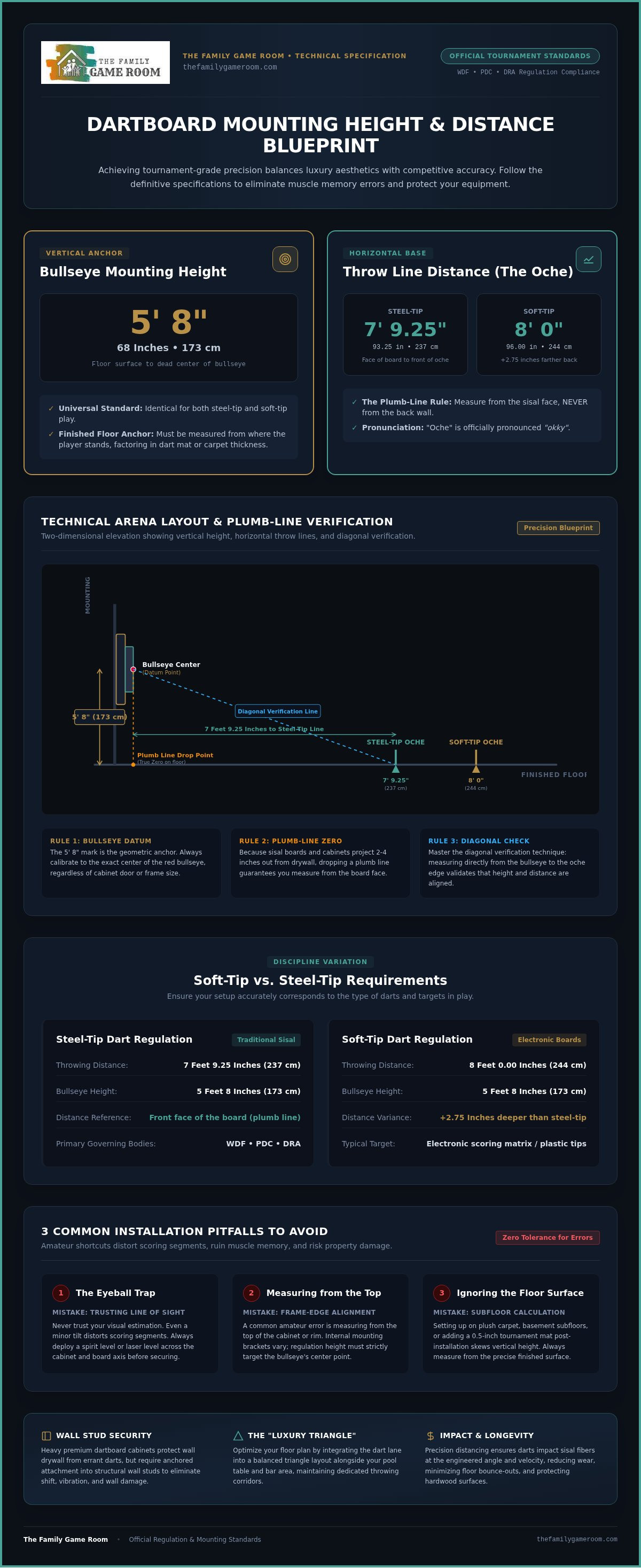
The universal standard for dartboard height is exactly 5 feet 8 inches (173 cm) from the floor to the dead center of the bullseye. This measurement must be taken from the finished floor surface where the player will actually stand. If you plan to add a professional dart mat or a plush area rug after installation, you must account for that thickness. Measuring from a bare subfloor only to add a half-inch mat later will leave your board too low. The bullseye height serves as the absolute anchor of the game.
To mark this accurately, use a high-quality tape measure and a pencil to notch the 68-inch mark on your wall. If you are installing a premium dartboard cabinet, remember that the mounting bracket inside the cabinet might not align perfectly with the bullseye's center. Always measure from the floor to the intended center point of the board itself rather than the top of the cabinet frame.
Calculating the Throwing Distance (The Oche)
The throw line, or "Oche" (pronounced "okky"), for steel-tip darts is set at 7 feet 9.25 inches (237 cm). A frequent mistake is measuring this distance from the wall. Because professional boards have depth and often sit inside protective cabinets, you must measure from the front face of the dartboard. If your board protrudes two inches from the wall, your floor mark must move two inches further back into the room. This ensures the player is exactly 7' 9.25" away from the scoring surface, not the drywall.
To guarantee 100% accuracy and eliminate any doubt, use the diagonal measurement check. This is the hypotenuse of the throwing triangle. Run your tape measure from the center of the bullseye down to the front edge of the throw line. For a regulation steel-tip setup, this diagonal distance should be exactly 9 feet 7.5 inches (293.4 cm). If this number is off, your horizontal distance or vertical height needs adjustment. Using this "plumb-line" logic creates a sophisticated, tournament-ready setup that rewards precision and builds genuine skill.
Soft-Tip vs. Steel-Tip: Adjusting Your Setup for Different Darts
Deciding between traditional sisal and modern electronic boards changes the geometry of your entertainment space. While the vertical bullseye height remains a constant 5 feet 8 inches for both styles, the horizontal dartboard mounting height and distance requirements shift depending on the equipment you choose. This 2.75-inch variation might seem minor. However, it's the difference between a regulation-perfect arena and a setup that feels slightly "off" to an experienced player.
The Steel-Tip Throwing Distance (7' 9.25")
Traditionalists favor the bristle board, constructed from high-quality East African sisal. This material self-heals as the fibers close up after a dart is removed. For these setups, you must adhere to the official dartboard height and distance measurements which mandate a throwing distance of 7 feet 9.25 inches. This specific number became the global gold standard because it balances the difficulty of the throw with the physical properties of steel-tipped darts. To maintain professional performance, remember to rotate your board's number ring regularly. This ensures even wear across the sisal fibers and prevents soft spots in frequently targeted segments like the treble twenty.
The Soft-Tip Variation (8' 0")
Electronic boards, often found in high-end bars and modern residential game rooms, utilize a plastic honeycomb matrix. These boards require an official throwing distance of exactly 8 feet 0 inches. The additional space accounts for the slightly different flight path of lighter plastic darts and the sensitivity of the electronic scoring sensors. A common misconception is that home electronic boards follow the steel-tip distance. They don't. If you're mounting an electronic board within a luxury cabinet, ensure your floor markings reflect this 8-foot standard to mirror tournament conditions.
For households with children or frequent guests, soft-tip setups offer a significant safety advantage. They provide the same competitive thrill without the risk of damaging your wall finishes or causing accidental injury. If you switch between both board types, consider a dual-marker system on your floor or a programmable laser oche to keep your dartboard mounting height and distance accurate for every match. This flexibility allows you to enjoy the best of both worlds while maintaining the professional integrity of your game room.
Step-by-Step Installation: Hanging Your Dartboard Like a Pro
Professional installation transforms a simple game into a centerpiece of home entertainment. While the dartboard mounting height and distance measurements are now clear, the physical act of hanging a heavy, high-end cabinet requires a strategic approach. You aren't just putting up a board. You're anchoring a piece of furniture that must withstand years of impact and frequent use.
Securing a Premium Dartboard Cabinet
Most luxury cabinets weigh significantly more than a standalone bristle board. Never rely on drywall anchors alone for these installations. Locate your wall studs using a reliable stud finder and mark their centers clearly. If your wall studs don't align perfectly with your desired board location, mount a finished plywood backer board to the studs first, then attach your cabinet to that stable surface. This ensures absolute stability and prevents the cabinet from loosening over time.
Pay close attention to the internal mounting bracket. In many premium designs, the bracket sits higher than the bullseye center. Calculate the offset carefully so that once the board is hung, the bullseye rests exactly 5 feet 8 inches from the floor. You also need to ensure the cabinet doors have at least 18 to 24 inches of lateral clearance. This allows them to open fully without striking adjacent game room furniture or obstructing the view of the scoreboards.
Floor Protection and Throw Line Markers
Protecting your flooring is a non-negotiable step in a sophisticated game room. Steel-tip darts easily pierce hardwood or snag high-end carpeting during a mechanical bounce-out. A heavy-duty rubber dart mat serves a dual purpose. It cushions falling darts and provides a clear, integrated throw line. This simple addition maintains the professional polish of your space while extending the life of your equipment.
For a cleaner look, consider a flush-mounted brass oche or a laser throw line projector. These options maintain the room's aesthetic when the game isn't in play. If you're using a raised oche, ensure it's securely fastened to prevent tripping during a match. Your throw line should be a deliberate design choice that complements your sophisticated dartboard cabinet and existing decor. Taking these extra steps to verify your dartboard mounting height and distance ensures your game room looks as professional as it performs.
Elevating Your Experience: Integrating Darts into a Luxury Game Room
A professional game room is more than a list of equipment. It's a curated environment where every element works in harmony. After you've finalized the dartboard mounting height and distance, the next step is spatial integration. The "Luxury Triangle" layout places the dart lane, the pool table, and the bar in a configuration that maximizes social interaction while preventing physical overlap. This strategic planning ensures that a player's follow-through doesn't collide with someone lining up a bank shot. It creates a frictionless experience for your guests and family alike.
Acoustic considerations are equally vital in a modern home. High-density felt or cork panels placed behind your cabinet can dampen the impact vibrations that travel through drywall. This small adjustment preserves the domestic warmth of your home while allowing the game to proceed without disturbing others in adjacent rooms. A well-planned layout anchored by precision measurements transforms your game room into a world-class entertainment suite.
Coordinating with Pool Tables and Shuffleboards
If you own an American Heritage Billiards table, look for dartboard cabinets with matching wood grains and stains. This visual continuity creates a sophisticated, cohesive atmosphere. Aim for at least five to six feet of lateral clearance between your dart lane and other large furniture pieces. This space provides safety for spectators and room for players to move comfortably between throws. For overall room ambiance, we suggest reading our Ultimate Guide to Billiard Light Fixtures to ensure your lighting scheme is as professional as your equipment.
Lighting Your Board for Professional Play
Lighting is where many amateur setups fail. Traditional spotlights cast harsh directional shadows that can obscure the wire spider and scoring segments. Professional play requires 360-degree illumination. Circular LED light rings that mount directly to the board provide shadowless lumen distribution. This setup reduces eye strain during long sessions and allows for clearer visibility of the double and triple rings. Whether you choose recessed ceiling lights or a dedicated ring, ensure the light is bright enough to highlight the sisal's texture without washing out the colors. Proper lighting confirms your commitment to a professional dartboard mounting height and distance setup by making every segment of the board clearly visible from the oche.
Step Into Your Professional Arena
Achieving the perfect dartboard mounting height and distance is the final step in transitioning from a casual hobbyist to a serious enthusiast. By adhering to the 5'8" bullseye standard and verifying your throw line with a precise diagonal measurement, you ensure every practice session builds authentic skill. Integrating these metrics into a well-planned layout allows your dart lane to coexist beautifully with your luxury billiards table and bar area.
Since 2022, our family-owned and operated business has focused on the expert curation of high-end game room furniture. We specialize in premium brands like American Heritage Billiards and offer sophisticated cabinets that protect your home while enhancing its aesthetic. It's our mission to help you create a space where quality and long-term satisfaction are guaranteed.
Shop our collection of premium Dartboard Cabinets to find the perfect anchor for your new professional setup. Your tournament-ready game room is just one installation away. It's time to take your first throw in a space designed for excellence.
Frequently Asked Questions
What is the official height of a dartboard from the floor?
The official height for a dartboard is 5 feet 8 inches (173 cm) measured vertically from the floor to the exact center of the bullseye. This standard applies to both steel-tip and soft-tip boards. Always measure from the surface you stand on, so if you use a thick mat or a raised platform, take the measurement from the top of that surface. This ensures your dartboard mounting height and distance remains tournament-compliant.
Is the dartboard distance measured from the wall or the board face?
Throwing distance is strictly measured from the front face of the dartboard, not the wall behind it. Since most professional boards sit 1.5 to 2 inches away from the drywall, measuring from the baseboard creates an immediate error. Drop a plumb line from the board's front edge to the floor before pulling your tape measure. This precision ensures your oche is at the regulation 7 feet 9.25 inches.
How do I measure the diagonal distance for a dartboard setup?
You measure the diagonal distance, or hypotenuse, by running a tape measure from the center of the bullseye to the front edge of the throw line. For steel-tip play, this should be exactly 9 feet 7.5 inches (293.4 cm). This check is the most reliable way to confirm your setup is accurate. If this number is off, your vertical height or horizontal floor distance needs a quick adjustment.
What is the throwing distance for soft-tip electronic dartboards?
The official throwing distance for soft-tip electronic dartboards is exactly 8 feet 0 inches (243.8 cm). This is 2.75 inches farther back than the steel-tip requirement. While the bullseye height remains the same at 5 feet 8 inches, the extra floor space accommodates the different flight dynamics of plastic-tipped darts. Always verify the specific rules of your league, as the National Dart Association (NDA) strictly enforces this 8-foot standard.
How much space do I need on the sides of a dartboard?
A professional dart lane requires a lateral width of 5 to 6 feet to ensure player safety and comfort. This provides at least 2 to 3 feet of clear space on either side of the board. This envelope prevents throwers from interfering with nearby furniture or other games, such as pool tables. Maintaining this clearance also allows spectators to watch the match without entering the thrower's line of sight or follow-through.
Can I hang a dartboard on a door?
Hanging a dartboard on a door is generally discouraged for safety and stability reasons. Doors often lack the structural integrity to hold heavy cabinets securely, and the constant movement can loosen mounting hardware. Additionally, a swinging door creates a significant safety risk for anyone walking through during a throw. If you must use a door, ensure it's locked and use a specialized over-the-door hanger designed for acoustic dampening.
How do I protect my wall from darts without a cabinet?
You can protect your walls using high-density foam surround rings or custom-built backboards if you prefer not to use a cabinet. Surround rings fit snugly around the board and catch stray darts before they reach the drywall. For a more sophisticated look, large cork panels or felt-covered wood backings provide a wide safety zone. These options help maintain your room's professional polish while you finalize your dartboard mounting height and distance setup.
What is the official dartboard height for wheelchair players?
The official dartboard height for wheelchair players is 4 feet 6 inches (137 cm) from the floor to the center of the bullseye. This standard is sanctioned by the World Disability Darts Association (WDDA) to ensure the game remains accessible and competitive. While the vertical height is lowered, the horizontal throwing distance remains identical to the standing standard at 7 feet 9.25 inches for steel-tip play.