


Could the easiest spot to reach be the wrong place for your pool cue rack? A rack near the table may seem convenient, but it can crowd a walkway or interfere with a player’s stroke. The best cue rack placement ideas balance quick access with clear movement and a room that feels thoughtfully arranged.
When cues and accessories don’t have a designated home, even a carefully furnished game room can feel cluttered. A well-placed rack keeps equipment organized and gives the space a more finished look. The key is to plan around how people move, where they wait between turns, and whether the room has other uses. This guide compares wall-mounted and floor-standing options, then shows how to test a location before committing to it. A wall-mounted option, such as the Bryant Wall Cue Rack, can be part of a coordinated setup. With a few practical checks, you can keep cues close without compromising circulation or play.
Key Takeaways
- Start your cue rack placement ideas by mapping the table, door swings, furniture, and everyday walking routes.
- Compare wall-mounted and floor-standing racks by footprint, flexibility, and how each will look in your room.
- Adapt the location to your layout, whether the game room is dedicated to play, shared with other activities, or compact.
- Mock up a possible spot before installing, then test reach, obstacles, and circulation during normal room use.
Cue Rack Placement Ideas Start With Your Room’s Flow
A cue rack should make equipment easy to grab, not turn a clear route into an obstacle course. The tempting spot beside the table may sit in a player’s stroke path or where guests naturally pass. Start with the room as it’s used, then choose a location that supports comfortable movement and an uninterrupted game.
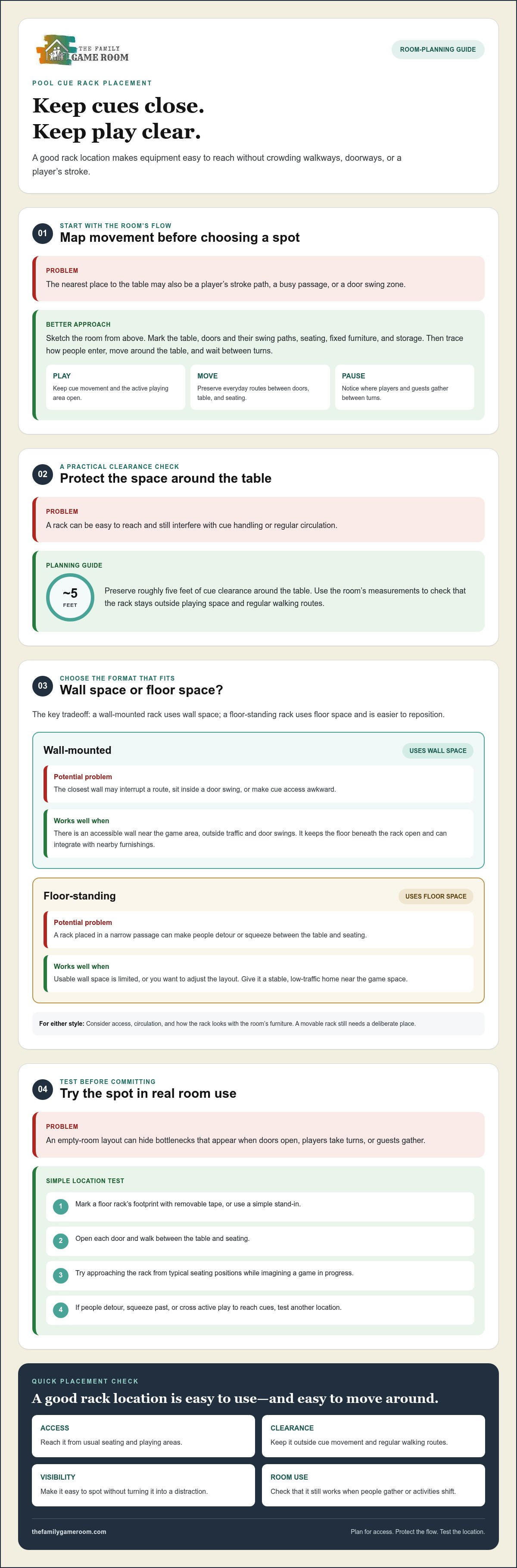
Before settling on a wall or floor location, consider the table, entrances, seating, other furniture, and the routes people take between them. Keep the playing area open, including the space needed to handle a cue. A practical planning rule is to preserve roughly five feet of cue clearance around the table. Use the pool table dimensions guide to put your room measurements and playing space in context.
Map the pool table, entrances, and everyday pathways
Sketch the room from above before choosing a wall. Mark the table, doors and their swing paths, seating, storage, and furniture that stays in place. Then trace how people enter, walk around the table, and reach a seat. Note where players gather between turns and where guests tend to wait. These informal gathering points can become crowded even when the room looks open on paper.
Think of the layout as a series of zones: the active playing area, circulation paths, and places to pause. Billiard room design principles also draw attention to practical conditions such as lighting and clearance, as described in this overview of billiard rooms. A rack should support the room’s function without intruding on those zones.
- Access: Can players reach the rack from usual seating and playing areas?
- Clearance: Does the location stay outside cue movement and regular walking routes?
- Visibility: Is the rack easy to spot without becoming a visual distraction?
- Room use: Will the spot still work when people gather or the space serves another purpose?
Choose a spot that makes cues easy to reach
Convenience means a player can retrieve a cue without crossing active play or asking others to move. Look for a position accessible from the usual waiting or seating area, but outside the space where someone is lining up a shot. A nearby wall can work if it isn’t part of a busy passage. A quieter wall may be a better choice if it keeps people moving around the table safely.
Check the route with the room in use, not just when it’s empty. Open each door, walk between the table and seating, and imagine someone carrying a cue while another person takes a turn. Avoid blocking doors, frequently used storage, or the path guests naturally follow. The right location feels obvious during play and unobtrusive the rest of the time.
Wall or Floor Cue Rack? Match the Placement to Your Space
The right rack format depends on what your room can comfortably accommodate. A clear stretch of wall may make wall-mounted storage a natural fit, while limited usable wall space may call for a floor-standing option placed carefully out of the way. Neither suits every layout. Compare how each affects access, circulation, and the room’s overall composition before deciding.
The main distinction is straightforward: a wall-mounted rack uses wall space, while a floor-standing rack uses floor space and can be repositioned more easily. That tradeoff matters in a shared game room, where even a small change in footprint can affect how people move between activities.
| Consideration | Wall-mounted rack | Floor-standing rack |
|---|---|---|
| Space needs | Needs a suitable, accessible wall area; keeps the floor area beneath it open. | Needs a stable spot on the floor that won’t narrow a walkway. |
| Placement flexibility | Placement depends on available wall space and the chosen installation location. | Can be moved to test different locations as the room arrangement changes. |
| Visual effect | Can make cue storage feel integrated with the wall and surrounding furnishings. | Can read as a distinct furnishing, so its position matters to the room’s balance. |
When a wall-mounted cue rack makes sense
Consider a wall-mounted rack if you have an accessible wall near the game area that sits outside door swings and regular traffic. A clear section beside the seating zone, for example, may keep cues within reach without putting storage in the path of active play. Check that players can approach it comfortably, and consider how it looks alongside nearby lighting and furniture. The Bryant Wall Cue Rack is an option for a wall-based setup.
This format can suit a room where preserving open floor space is a priority. But the nearest wall isn’t automatically the right wall. Avoid locations that interrupt a route, compete with another frequently used area, or make cue access awkward.
Where a floor-standing rack can fit naturally
A floor-standing rack may suit a room with limited available wall space, or one where you want flexibility to adjust the arrangement. Look for a stable, low-traffic area near the game space, rather than a narrow passage between the table and seating. Even a movable rack needs a deliberate home so it doesn’t end up in a busy route.
Test the proposed spot before settling the room arrangement. Mark its footprint with removable tape or use a simple stand-in, then walk through the room and try approaching it from typical seating positions. If people have to detour, squeeze past it, or cross active play to reach cues, try another location. Once you know which format and placement suit your space, explore pool cue rack options.
Cue Rack Placement Ideas for Different Game Room Layouts
The best storage zone depends on the room’s purpose. A dedicated billiard room can give cues a permanent place near the play area, while a shared room needs storage that stays out of the way when furniture or activities shift. In a compact layout, every corner and route has a job. Use these examples as starting points, then check them against your own measurements.
Dedicated game room: keep storage close to the play zone
In a room arranged primarily for pool, look for a wall near the game area that players can reach between turns without crossing the main playing route. Consider the rack alongside the usual seating, doorways, and game-night setup. A simple overhead plan might look like this: door → clear route → seating | table and play zone | rack on an accessible wall. The exact arrangement depends on the room, but planning the game area with billiard light fixtures in mind can help the storage feel coordinated rather than like an afterthought.
Shared or compact room: protect flexible floor space
A shared-use room has to work beyond game night. Identify furnishings that move, open, or change the shape of the room, such as a chair pulled out for conversation or a cabinet door that needs clearance. Don’t assign the rack a spot that only works when those furnishings are tucked away. In a compact room, a wall location may preserve useful floor area if an appropriate section is available. If not, consider whether a floor-standing rack can fit without interrupting everyday use.
Picture the layout in its different modes: pool setup: table + seating + rack | everyday use: clear route + flexible furniture. If the room also serves as a dining space, plan storage around the table’s regular use and the space needed to move around it. A convertible table can be part of a flexible game-room plan. The American Heritage Billiards buyer’s guide offers inspiration for considering that kind of setup.
Let the room’s regular routine guide the final spot
Before choosing a location, consider where people sit, pass through, and set things down during a typical visit. A rack near the game area may be convenient in a dedicated room but disruptive beside a frequently used doorway in a multipurpose space. In a narrow room, compare end-wall and side-wall possibilities on a sketch. Furniture placement may make one route feel much more natural than the other.
These cue rack placement ideas aren’t fixed templates. Measure your room, note how furniture moves, and adapt the layout to the way your household uses the space. A thoughtful position should work both when the room is ready for a game and during everyday use.
Plan and Test Your Cue Rack Location Before Installing
A location that looks right on a room sketch can feel awkward once people start moving around it. Testing first helps catch reach problems, blocked access, and conflicts with everyday furniture before you commit to an installation. Use this final check for your cue rack placement ideas: map the spot, try it in real use, and install only when the layout works.
Use this sequence to assess a proposed location:
- Measure. Note the intended rack area and nearby doors, furniture, switches, and other features that affect access.
- Mock it up. Mark the proposed location with removable markers or a paper outline so you can judge how it fits.
- Test access. Walk over as if retrieving and returning a cue. Check whether the approach feels natural from where players usually sit or wait.
- Review circulation. Move through the room as you normally would, including around furniture and between the game area and seating.
- Install. Once the placement works, follow the rack maker’s instructions for the specific product and location.
Measure and mock up the proposed location
Record the space you’re considering and note what sits around it. Include door swings and furniture that shifts during regular use, not just the room’s fixed features. A paper outline or removable markers can represent the rack’s proposed position, helping you judge whether it crowds the wall or overlaps with a route.
Then simulate a game-night routine. Approach the marked spot, reach for an imaginary cue, and return to the table. Try from more than one direction if players use different seating areas. Notice whether someone else would need to move or wait for you to pass.
Check the wall and installation plan
For a wall-mounted rack, review the maker’s product-specific instructions before installation. Keep the planned position clear of doors, switches, and access points you use regularly. Confirm that the location and installation plan suit the rack rather than guessing at hardware or wall requirements.
If your mock-up reveals a problem, revise the location and repeat the movement test. A rack that forces a detour or conflicts with a door’s path isn’t in the right place yet. It’s easier to shift a marker than rethink a finished arrangement, so take time to test.
Once your layout feels comfortable, explore pool cue rack options to find a rack that suits your plan.
Finish Your Game Room With a Cue Rack That Fits the Plan
A well-chosen rack starts with a well-chosen location. Once you know where cues will be accessible without disrupting play or everyday movement, select a rack that suits the available wall or floor space. This order keeps the decision practical: the rack serves the layout, rather than forcing the room to accommodate it. Bring your cue rack placement ideas together with a final check of function and visual balance.
Use a simple checklist to make the final choice
Before settling on a rack, revisit the room with these questions. They help turn a promising location into a considered choice:
- Is it easy to reach? Players should be able to access cues naturally from the areas where they gather or wait.
- Does it preserve movement? Check that the spot doesn’t interfere with play, walkways, doors, or regular access points.
- Does the format fit? Compare the rack’s placement needs with your usable wall and floor space.
- Does it suit the room? Consider how its position and appearance relate to the pool table and surrounding furnishings.
If you’re considering wall-mounted storage, the Bryant Wall Cue Rack is one product option. Choose the rack after confirming that the location works for your room, rather than selecting a style first and trying to make it fit later.
Create a coordinated home entertainment space
Cue storage is practical, but it also contributes to the room’s overall composition. Look at the table, lighting, seating, and rack together. A rack near the game area, for example, may feel intentional when it relates visually to nearby furnishings while staying separate from the action and main routes through the room. Coordination doesn’t require every piece to match exactly. Aim for a balanced arrangement that feels considered.
Think about function as well as appearance. Billiard lighting helps define the area around the table, while seating shapes where guests gather between turns. A cue rack should complement those zones, not compete with them or make the room feel crowded. In a shared-use space, consider how the arrangement looks and works when the room shifts back to its everyday purpose.
Make the final choice with comfortable play and time together in mind. A thoughtfully placed rack gives cues a designated home and helps the game room feel organized and welcoming. Explore game-room furnishings to bring the rest of your entertainment space into the picture.
Make Room for More Great Games
Once your cue rack is in place, notice how people use the space over the next few game nights. If cues are consistently left on a chair or players keep adjusting their route, use that as a signal to refine the setup. Small habits, such as returning cues to the rack between turns, help keep the room ready for the next friendly challenge.
The best cue rack placement ideas support more than tidy storage. They help create a welcoming setting where the details feel considered and the focus stays on enjoying time together. The Family Game Room offers pool cue racks, pool tables, and furnishings to help bring a complete game-room experience together.
Ready to shape a space that feels right for your home? Explore game-room furnishings and take the next step toward a room made for memorable play.
Frequently Asked Questions
How high should a pool cue rack be mounted?
Mount a wall rack at a height that lets the people using it reach cues comfortably, and follow the rack maker’s installation instructions. There isn’t one height that suits every rack, wall, and household. Before mounting, use a temporary paper outline to picture the rack on the wall, then check the reach from the floor and nearby seating. Make sure the position won’t interfere with switches, décor, or other items you use regularly.
Can I put a cue rack behind the pool table?
You can place a cue rack on a wall behind the table if the location stays outside the space players need to move and take shots. “Behind” can mean different things depending on how the table sits in the room, so assess the actual playing position rather than relying on the wall’s label. If players or guests would pass close to the rack during a game, choose another spot.
How many cues can a pool cue rack hold?
The number of cues a rack can hold depends on the specific model, so check its product details rather than estimating from its appearance. Think about how many cues you want stored at once, including spares used by guests. If your collection changes, leave room for convenient access instead of filling every available slot with accessories or other items. A rack should keep cues organized and easy to select.
Is a wall-mounted cue rack better than a floor rack?
Neither option is automatically better. The right choice depends on your room and preferred use. A wall-mounted rack may suit a room with appropriate wall space and a desire to keep the floor open. A floor rack may offer more flexibility if wall space is limited, provided there’s a stable location that won’t interrupt movement. Compare both options in your actual layout, then decide which feels more natural for players.
Can a cue rack go in a room without a pool table?
Yes, a cue rack can store or display cues in a room without a pool table. It may suit a home entertainment area where cues are kept together between visits to another playing space, or where they’re part of a game-room display. Choose a location that fits the room’s purpose and keeps the cues orderly. If they’re stored for occasional use, avoid placing them somewhere they’ll be easily knocked or forgotten.
What happens if my game room has no clear wall space?
If you don’t have a clear wall, consider whether a floor-standing rack can fit in a stable spot without crowding the room. You could also review whether movable furniture or a rarely used wall section offers an alternative. Don’t squeeze storage into a doorway, narrow passage, or area needed for another activity. Compare possible locations during normal room use, then choose the one that preserves comfortable access and keeps cues from being left loose.
Can I store pool cues beside other game-room accessories?
Yes, you can keep cues near other game-room accessories if each item has a clear, convenient place. For example, store cues in their rack and keep smaller accessories in a nearby drawer, cabinet, or designated container. Avoid leaning items against the cues or crowding the rack’s access area. This gives equipment a shared storage zone while making it easier to find what you need before a game begins.