


The truest roll in billiards doesn't come from premium cues or expensive chalk; it comes from eliminating seams entirely. If you're building a dedicated entertainment space, understanding the distinct benefits of a one-piece slate pool table is essential before choosing the centerpiece of your room. While standard multi-piece beds dominate home delivery trucks, a single, uninterrupted slab of rock offers structural advantages that serious players have relied on for decades.
You want a gorgeous table that brings family and friends together without worrying about shifting joints, cracked wax seams, or balls veering off course over time. We understand that concern completely. This guide cuts through the confusion by breaking down the mechanical differences between slate styles, showing how a seamless bed prevents roll deviation, and helping you evaluate whether your doorways and stairwells can accommodate a monolithic stone slab.
From playing physics and leveling maintenance to room dimensions and access logistics, here is everything you need to know to choose the right foundation for your home.
Key Takeaways
- Explore the core benefits of a one-piece slate pool table, including how an unyielding, single-slab surface permanently eliminates joint separation and ball roll deviation.
- Compare single-piece and three-piece slate designs side by side to evaluate long-term leveling maintenance, seam stability, and playing dynamics.
- Assess your home's architectural access points, from doorway clearances to stairwell turns, to ensure a monolithic stone bed can be safely delivered.
- Discover how table apron height and cabinet design determine whether your game room can accommodate multi-functional additions like pool table dining tops.
What Is a One-Piece Slate Pool Table?
A one-piece slate pool table utilizes a single, uninterrupted slab of solid stone as its playing surface. Unlike sectional tables assembled from multiple stone pieces, this design spans the entire length and width of the playing field without a single break. Historic coin-operated bar tables popularized this build because tavern environments require unyielding durability against rough play and continuous use. Today, the core benefits of a one-piece slate pool table attract discerning homeowners who prioritize permanent playing precision over modular delivery convenience.
The Geology and Engineering of Slate Playbeds
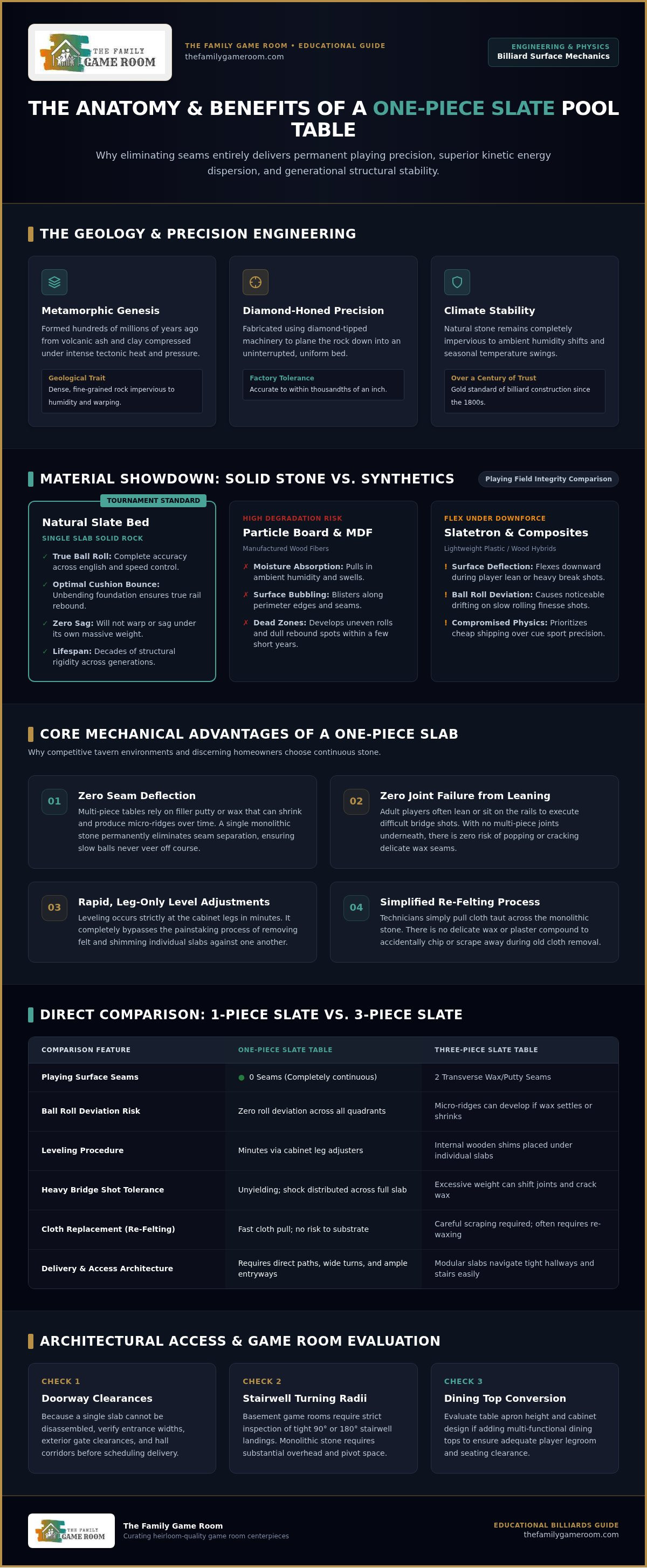
Quality slate begins hundreds of millions of years ago. Ancient volcanic ash and fine clay settle under intense tectonic pressure and heat, creating a dense, fine-grained metamorphic rock. Once quarried, master fabricators use diamond-tipped machinery to plane and diamond-hone the rock down to a uniform plane accurate within thousandths of an inch. Because natural stone forms under high pressure, it remains impervious to ambient humidity shifts, seasonal temperature swings, and mechanical warping. This geological permanence explains why billiard table bed construction has relied on natural quarried rock for well over a century.
One-Piece vs. Non-Slate Manufactured Alternatives
Synthetic alternatives frequently disguise themselves under proprietary trade names, but they cannot replicate genuine stone. Comparing solid rock to manufactured substitutes highlights stark performance differences:
- Natural Slate: Delivers true ball roll, optimal cushion bounce, and decades of structural rigidity. It will not sag under its own weight.
- Particle Board and MDF: Absorb atmospheric moisture, leading to swollen edges, surface bubbling, and dead zones within a few short years.
- Slatetron and Honeycomb Composites: Lightweight plastic or wood-core hybrids that flex under downforce, introducing noticeable ball roll deviation across slow shots.
Non-slate surfaces offer cheap manufacturing and easy moving, but they compromise ball physics immediately. Investing in solid stone provides an unbending foundation that keeps your cue ball tracking straight for a lifetime of family tournaments.
Key Benefits of a One-Piece Slate Pool Table
Precision defines great cue sports. While multi-piece surfaces dominate modern furniture tables to ease shipping constraints, the mechanical benefits of a one-piece slate pool table center on absolute continuity. Removing modular joints creates an uninterrupted playing field that withstands intense play without shifting, sagging, or degrading over the years.
Flawless Ball Roll and Complete Seam Elimination
Segmented beds rely on leveling screws and joint fillers to bridge the gaps between slabs. Even with precise installation, temperature fluctuations can cause filler putty to shrink, creating micro-ridges that pull a slow-rolling object off target. A solid slab eliminates this variable entirely. Balls travel across the cloth with uniform resistance, ensuring your english and speed control produce identical results in every quadrant of the table.
Simplified Long-Term Maintenance and Re-Felting
Re-felting a three-piece table requires extreme caution. Technicians must scrape off old cloth without chipping the wax or plaster securing the joints, often forcing a full re-waxing and scraping cycle before installing fresh wool. Single-piece beds avoid this step altogether. Recovering the bed involves simply pulling the cloth taut across the monolithic stone without disturbing any delicate compound underneath.
Exceptional Structural Rigidity and Shot Stability
Aggressive break shots transfer immense kinetic energy through the cue ball down into the table bed. Single slabs excel here by dispersing that shock across a massive, unified mass. Scientific research into natural dimension stone characteristics confirms that dense metamorphic slate resists localized stress fractures and retains planar stability far better than layered alternatives. Key performance advantages include:
- Zero Joint Failure: No risk of cracked seams if an adult leans or sits on the rail during a difficult bridge shot.
- Rapid Level Adjustments: Leveling happens entirely at the cabinet legs, taking minutes rather than requiring painstaking shimming between internal slabs.
- Lifetime Flatness: The stone's sheer mass resists warping, preserving factory tolerances across generations of play.
If you appreciate heavy-duty craftsmanship paired with heirloom styling, explore the tournament-grade builds found in American Heritage Billiards Pool Tables. Homeowners seeking uncompromising home entertainment can also browse our full lineup at The Family Game Room to find curated designs that anchor your space with timeless style.
One-Piece Slate vs. Three-Piece Slate: Direct Comparison
While evaluating the benefits of a one-piece slate pool table, homeowners quickly encounter an engineering trade-off: playing surface continuity versus delivery practicality. Segmented three-piece beds solve tight architectural challenges, but single-piece designs eliminate joints entirely.
| Feature | One-Piece Slate | Three-Piece Slate |
|---|---|---|
| Seam Failure Risk | None; completely seamless playing field | Moderate; seams can shift or crack over time |
| Leveling Method | Cabinet and leg adjustments only | Individual slab shimming plus joint waxing |
| Weight Handling | 400 to 500 lbs in a single solid sheet | Three modular slabs of 150 to 200 lbs each |
| Staircase Access | Extremely difficult; requires wide, straight paths | Excellent; navigates turns and stairs easily |
Leveling Precision and Adjustability Over Time
Installers calibrate three-piece systems by inserting thin wooden or composite shims underneath each individual slab. Once the sections align, the technician melts beeswax or applies specialized resin across the two seams, scraping the filler flush with the stone. If the subfloor settles or someone jostles the cabinet during a party, those seams can pop. Single-slab tables bypass internal joints completely. Because the stone never splits, leveling adjustments happen strictly at the frame or legs. You can true the entire table using threaded corner levelers in minutes without touching the cloth or re-plastering stone joints.
Weight, Logistics, and Home Navigation Challenges
The main obstacle to enjoying the benefits of a one-piece slate pool table comes down to moving day. A 7-foot single-slab stone sheet weighs roughly 400 to 500 pounds, requiring multiple professional movers and specialized carrying equipment. Monolithic slabs cannot bend around tight corners, clear narrow spiral staircases, or pivot past 90-degree basement landings. Modular three-piece slate divides that overall mass into three manageable cartons, making it the practical choice for second-floor lofts, finished attics, and homes with complex entryways.
Is a One-Piece Slate Table Right for Your Home?
Reaping the benefits of a one-piece slate pool table requires more than enthusiasm for cue sports; it requires a realistic audit of your home's floor plan. Before falling in love with a monolithic build, walk the physical path the delivery team must take. A table cannot enhance your weekends if it cannot clear the front hallway.
Architectural Clearance and Delivery Route Planning
Rigid slate slabs cannot flex around tight corners. Delivery teams must carry them either flat or tilted on specialized dollies, demanding broad turning radii and generous vertical clearance. Evaluate these specific access checkpoints before finalizing your selection:
- Stairwells and Landings: Single slabs generally cannot negotiate 90-degree turns on standard interior stairs. If your game room sits in an enclosed basement or an attic loft, multi-piece construction is often the safer reality.
- Doorway Clearances: Measure interior door frames with the trim included. Walkout basements, wide patio sliders, and straight main-floor entryways provide ideal delivery conditions.
- Floor Load Ratings: Solid stone tables concentrate substantial mass onto four or six contact points. Ground-level concrete slabs support this easily, but upper-level wood joists should be verified for dead-load capacity.
Always hire experienced billiard technicians for installation. Maneuvering several hundred pounds of quarried metamorphic rock without professional gear risks serious personal injury, table frame warping, or structural damage to your home's drywall and door frames.
Complementing Your Billiard Setup for Maximum Enjoyment
Once you confirm your architectural access, focus on curating the surrounding environment. True ball roll deserves proper lighting. Eliminating sightline glare and pocket shadows starts with dedicated Billiard Light Fixtures, which cast balanced, even illumination across the full playing bed.
Leave at least five feet of clear perimeter around the outer rails to ensure players can execute long, level cue strokes without hitting drywall or furniture. If you're building a multi-generational hangout space, consider rounding out your room by comparing fast-action entertainment options like air hockey vs foosball.
Ready to build the ultimate entertainment space for your family? Explore premium game room furnishings at The Family Game Room to find master-crafted tables and accessories tailored perfectly to your floor plan.
Curating the Ultimate Game Room: Premium Tables and Dining Tops
Modern living spaces increasingly blend recreation with refined entertaining. While serious cue enthusiasts appreciate the mechanical benefits of a one-piece slate pool table for true ball roll, domestic environments often demand greater adaptability. Today's premier game rooms effortlessly transition from competitive evening breaks to formal holiday dinners. Achieving that versatility requires purposeful curation, matching high-performance engineering with furniture-grade hardwoods.
The Functional Beauty of Pool Table Dining Tops
Entertaining at home shouldn't mean choosing between a tournament-ready playbed and a spacious dining room. Modular pool table dining tops solve this spatial dilemma by converting your playing surface into a grand banquet table within moments.
Key advantages of integrating dining conversions include:
- Surface Defense: Precision-fitted hardwood leaves completely enclose the cabinet, protecting fine billiard cloth and rubber cushion rails from accidental spills and dinnerware scratches.
- Spatial Efficiency: Open-concept floor plans gain dual utility from a single footprint, eliminating the need for a separate formal dining room.
- Cohesive Aesthetics: Premium dining leaves coordinate seamlessly with matching hardwood bar stools, wall-mounted pool cue racks, and game table sets.
Keep in mind that commercial-style coin-operated tables often feature deep aprons and internal ball returns that restrict seated legroom. Furniture-style slate tables designed with slimmer perimeter profiles provide the necessary knee clearance for comfortable family dining.
Selecting Your Centerpiece with The Family Game Room
A luxury pool table serves as both an athletic arena and a family heirloom. Understanding the structural benefits of a one-piece slate pool table helps clarify what kind of foundation you need, whether you prioritize a single-slab powerhouse or an adaptable furniture-style dining hybrid.
At The Family Game Room, we proudly curate distinguished models from celebrated makers like American Heritage Billiards and Nixon Billiards. These centerpieces combine solid hardwood construction, precision-honed slate beds, and timeless hand-rubbed finishes that elevate your interior architecture. Our family-owned team works directly with you to evaluate doorway clearances, subfloor requirements, and design preferences, ensuring your home entertainment investment brings loved ones together for generations to come.
Building Your Ideal Game Room Foundation
Weighing the distinct benefits of a one-piece slate pool table comes down to your home's layout and how you love to play. If straight-shot ground-floor or walkout access permits, a monolithic slab rewards you with zero seam shifts, effortless leg leveling, and a permanently true roll. If stairs or multi-purpose entertaining require flexible layouts, precision three-piece hardwood designs and convertible tops deliver outstanding play alongside family dining utility.
Whatever your space demands, quality craftsmanship makes all the difference. As a family-owned US retailer and authorized dealer for American Heritage Billiards and Nixon Billiards, we curate brand-new, heirloom-quality pieces built to last. Our catalog pairs tournament-grade slate beds with solid hardwood construction, matching light fixtures, and coordinated game room seating.
Ready to anchor your home with a show-stopping centerpiece? Explore Luxury Slate Pool Tables at The Family Game Room to find the perfect table for a lifetime of memories.
Frequently Asked Questions
Why do professional tournaments and commercial pool halls use one-piece slate?
Commercial pool halls favor one-piece slate because it withstands heavy public abuse without shifting out of alignment. While official WPA 9-foot tournament play requires standard three-piece slate, competitive 7-foot league championships rely heavily on single-slab bar boxes. The main benefits of a one-piece slate pool table in commercial venues are unbroken surface durability and the complete absence of seam pop when players lean on the cabinet.
How much heavier is a one-piece slate table than a three-piece slate table?
The total slate weight remains fairly comparable, but the distribution is vastly different. A complete 7-foot slate bed weighs roughly 400 to 500 pounds regardless of format. A three-piece system splits that total into three modular pieces weighing around 150 to 200 pounds each. With a single-piece setup, movers must transport all 450 pounds in a single rigid, unbroken slab.
Can a one-piece slate pool table be taken upstairs or into a basement?
Navigating stairs with a single-piece slate slab is rarely feasible unless you have straight, wide stairways or an exterior walkout entrance. The solid stone cannot pivot around 90-degree landings, tight hallway bends, or narrow cellar entries. For second-floor game rooms and finished basements with standard staircases, three-piece slate tables provide the necessary modular access.
What happens if a three-piece slate table shifts over time?
When subfloors settle or tables endure accidental bumps, the beeswax or resin filler sealing three-piece slate seams can crack. This separation creates subtle ridges in the cloth, causing slow-moving billiard balls to veer off course. Correcting shifted seams requires stripping the existing felt, re-shimming each stone section, melting new wax across the joints, and reinstalling the cloth.
Is a one-piece slate pool table more difficult to level initially?
A single-piece slate table is actually simpler to level on the frame because there are zero internal joints to adjust. Installers don't need to match individual stone planes or scrape joint compound. One of the top benefits of a one-piece slate pool table is that you level the entire playing field in minutes simply by adjusting the cabinet leg levelers.
Can you put a pool table dining top on a slate pool table?
Yes, pool table dining tops fit beautifully over slate pool tables, provided the cabinet design allows adequate leg clearance. Furniture-style slate tables with slim perimeter aprons work best for seated dining comfort. Deep commercial-style bar tables often feature internal ball return tracks that limit knee room, making shallow-apron slate designs the preferred choice for dining conversion.
How long does a natural slate pool table bed last?
Natural diamond-honed metamorphic slate easily lasts a lifetime without deteriorating. Because the quarried stone formed under immense heat and subterranean pressure over millions of years, it will never warp, rot, or buckle from indoor humidity swings. While felt, cushions, and pockets eventually require routine maintenance, the underlying slate bed remains permanently flat across generations of play.