


A full-size table isn’t the only way to bring pool into a smaller room. Alternatives to a full size pool table include a compact 6-foot table, a smaller 7-foot model, a multi-game table, or a mini or portable version. The right fit depends on the table’s dimensions and the room you have for cueing, not just whether the table itself fits.
Choosing a non-slate table can also involve trade-offs, so start with the space and the kind of play you want. Room-size guidelines commonly allow for a 58-inch cue, and a 7-foot table is generally recommended for a room about 13 × 16 feet. This guide compares compact, multi-game, mini, and portable options, explains how to measure for comfortable play, and helps you weigh a smaller footprint against a more traditional pool-table experience.
Key Takeaways
- Measure the table and the cueing area separately; a useful room estimate adds 116 inches to each table dimension.
- Compare compact, standard, and tournament-size tables by footprint and intended style of play before deciding what fits.
- For a multipurpose room, weigh a dining-top or multi-game option against the benefit of a dedicated playing surface.
- Mini tables are typically less than 5 feet long; consider whether their smaller scale suits the way you want to play.
1. Playing-surface dimensions and recommended room dimensions
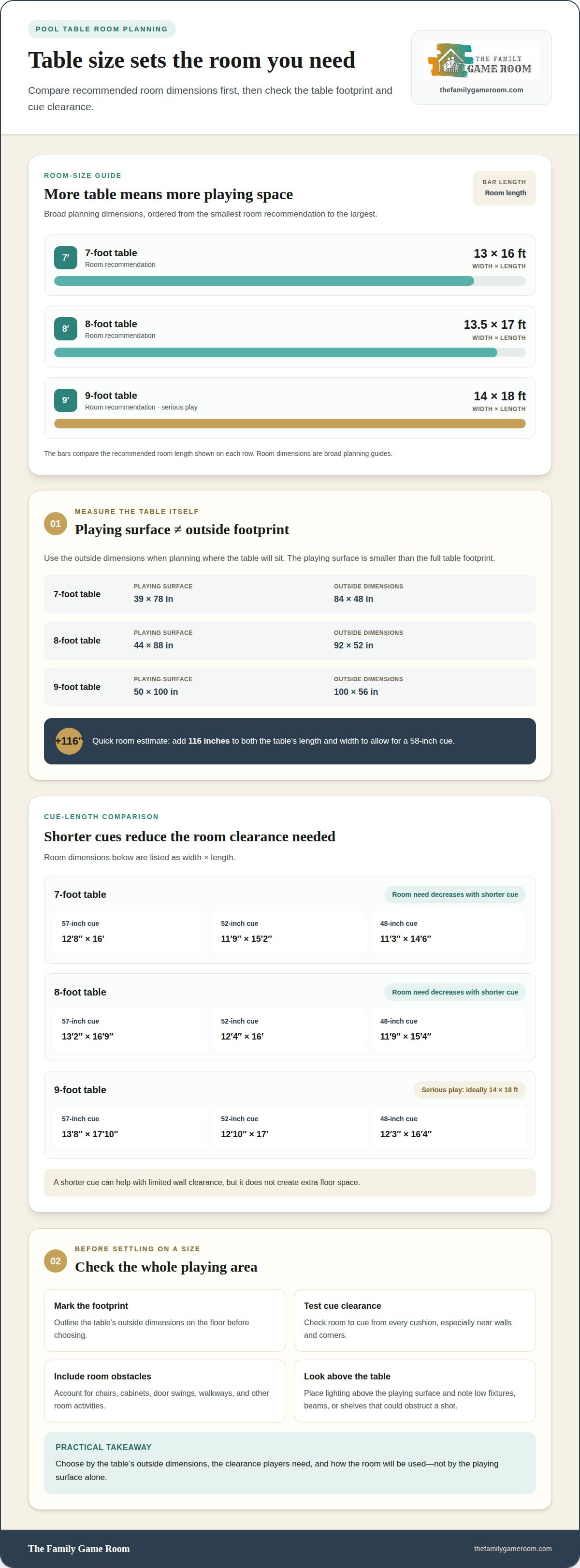
Measure the playing surface and the room separately. A 7-foot table has a 39 × 78-inch playing surface and outside dimensions of 84 × 48 inches. An 8-foot table’s playing surface is 44 × 88 inches, while its outside dimensions are 92 × 52 inches. A 9-foot table has a 50 × 100-inch playing surface and outside dimensions of 100 × 56 inches. The surface is smaller than the full table footprint, so use outside dimensions when planning placement.
Room guidelines generally allow for a 58-inch cue. For a quick estimate, add 116 inches to both the table’s length and width. Cue length changes the room needed, especially near walls or corners. These recommendations show how much a shorter cue can reduce the required clearance:
- A 7-foot table needs 12 feet 8 inches by 16 feet with a 57-inch cue, 11 feet 9 inches by 15 feet 2 inches with a 52-inch cue, or 11 feet 3 inches by 14 feet 6 inches with a 48-inch cue.
- An 8-foot table needs 13 feet 2 inches by 16 feet 9 inches with a 57-inch cue, 12 feet 4 inches by 16 feet with a 52-inch cue, or 11 feet 9 inches by 15 feet 4 inches with a 48-inch cue.
- A 9-foot table needs 13 feet 8 inches by 17 feet 10 inches with a 57-inch cue, 12 feet 10 inches by 17 feet with a 52-inch cue, or 12 feet 3 inches by 16 feet 4 inches with a 48-inch cue.
As broad planning guides, allow about 13 × 16 feet for a 7-foot table, 13.5 × 17 feet for an 8-foot table, and 14 × 18 feet for a 9-foot table. For serious play, a 9-foot table ideally needs 14 × 18 feet. Before choosing, mark the table footprint on the floor, then test cue clearance from every cushion. Include chairs, cabinets, door swings, and walkways in your measurements. Place lighting above the playing surface, and account for low fixtures, beams, or shelves that could obstruct a shot. A table’s weight matters during placement, too, so plan its location before moving it into a tight game room.
2. Choosing a table for limited or multipurpose spaces
Match table size to both the room and the way players want to use it. A 6-foot table is described as compact, while 7-foot tables are commonly called bar-size. The Billiard Congress of America recognizes 8-foot, 7-foot, and smaller tables, including 6-foot and mini tables, for home play. These dimensions make smaller tables practical options for casual billiards, but room for cueing still matters.
For a tight or shared room, compare the full footprint with the space needed for comfortable shots. A 6-foot table takes less floor area than a 7-foot table, leaving more room for furniture or another activity. Choose 7 feet if you want a larger playing area and can preserve useful clearance around the rails. A 52-inch short cue can help players manage limited wall clearance, though it doesn’t create extra floor space.
Player experience should guide the choice, too. Casual players may value a table that fits the room and invites regular games over tournament dimensions. Players who practice on larger tables may prefer a 7-foot or 8-foot surface to keep familiar shot distances. An 8-foot table is described as standard; a 9-foot table is tournament-size and needs more room. Pick based on the play you expect, not size alone.
In a multipurpose game room, sketch the table dimensions on the floor before deciding. Mark the location of chairs, doors, storage, and the other activities the room must support. Then test whether players can move around the table and take shots without shifting furniture each game. If 8 feet leaves little usable space, compare 7-foot and 6-foot options. If a 9-foot table is your preference, make sure the room can accommodate its larger footprint and playing clearance.
3. Compact and multi-game table alternatives
A compact pool table preserves billiards as the main attraction while reducing the furniture footprint. Six-foot tables are classed as compact, and 7-foot tables are commonly called bar-size. Compared with a full-size table, either can suit a smaller recreation area, but shorter dimensions also change shot distances. Choose a compact table if regular casual play matters more than matching tournament conditions.
Bar-size tables can be a practical middle ground for home entertainment. A 7-foot table keeps pool as the focus while freeing space for seating, storage, or other accessories. Before buying, compare the table’s outside dimensions with the clear floor area, then consider whether players can reach all sides without moving furniture. A compact footprint is only useful if the room remains enjoyable to use.
Multi-game tables offer another option: one piece of furniture can support several kinds of recreation. Bumper pool and air hockey suit households that want variety rather than billiards alone. A dedicated air hockey table changes the activity entirely, while a multi-game format can make shared space more flexible. Compare the games included and the room each mode needs before choosing.
For a compact table, inspect the frame, leg stability, level playing surface, and secure fittings. Check that the edges are smooth and the table does not wobble during play. These practical checks help you judge whether it suits the players and the room.
In the United States, compact pool tables are available through game-room furniture retailers; showroom displays can help you assess scale and finish in person. If you can’t try a model, compare its listed dimensions with a floor outline at home, and review what accessories and game modes are included. That buying step helps distinguish a genuinely space-conscious option from a table that simply looks smaller in a product image.
4. Mini and portable pool tables
Mini pool tables are typically less than 5 feet long, making them a smaller option for a bedroom, apartment, or shared family room. Their compact playing surface supports casual play, not the same gameplay as a standard-size or tournament table. Choose one when convenience and easy storage matter more than practicing full-size shots. A medium table may offer a middle ground, but compare its actual dimensions rather than relying on labels.
Portable tables suit spaces that need to change function between games. Before choosing one, consider where it will be set up and stored, and how often it needs to move. Measure both the play area and storage spot; even a small table needs room around its edges for players to reach shots. Check the stated dimensions and setup requirements to see how it will fit your home.
Treat mini and folding tables as recreational furniture. Their smaller scale can make a quick game possible where a full-size table would dominate the room, but it changes shot distances and the feel of play. If tournament practice is your priority, a mini model will not recreate that experience. For family fun or occasional games, its accessible size can make pool easier to enjoy.
The price of mini and folding pool tables depends on their dimensions, materials, construction, and folding features. Compare the full product details and included accessories to understand what you are getting and how the table suits your space.
Before buying, check that the frame feels stable, the playing surface is level, and folding parts lock securely when opened. Review the stated weight and setup instructions, especially if you plan to move the table between rooms. A level surface and steady support help keep gameplay consistent, while secure fittings matter during setup and storage.
For a more substantial home-game setup, explore pool table options and compare their dimensions with your available space. A smaller portable model prioritizes flexibility; a larger table gives players more room for familiar shots.
The Family Game Room: American Heritage Billiards Pool Tables
The Family Game Room can help you compare pool-table options with the room and style of play you have in mind. Its American Heritage Billiards and Nixon Billiards Pool Tables suit readers who want a dedicated billiards centerpiece; Pool Table Dining Tops offer a way to make a pool table serve another room function. For a different game-room focus, Indoor Shuffleboard Tables provide another home entertainment option.
Start by measuring the available space and deciding whether pool or multipurpose use matters most. A dining top may suit a room that needs to do double duty, while a dedicated pool table keeps playing at the center. If shuffleboard better fits your household’s interests, consider how it would work in the room.
Contact The Family Game Room to discuss your game-room plans.
Make your game room work for the way you live
The best alternatives to a full size pool table are the ones that suit the room’s everyday purpose, not just game night. Before settling on a setup, picture how people will move through the space, where seating belongs, and whether the room needs another function. A simple floor plan helps you make these choices before furniture arrives. Leave room to move comfortably so the table does not turn a shared area into an obstacle course.
Think beyond the first game, too. Consider who will play, how often the room will be used, and whether your household prefers focused billiards or a flexible entertainment space. Those priorities can guide a choice that feels considered long after the excitement of buying fades. If you’re ready to explore your options, connect with The Family Game Room and take the next step toward a game room that feels right at home.
Frequently Asked Questions
How do you select the perfect non-slate pool table?
Choose a non-slate table by weighing play quality, durability, placement, and budget. Slate offers the best play quality, but it adds cost and weight. For a non-slate option, look for a sealed MDF playing panel; quality models use a 3/4-inch panel sealed for added protection against warping. Also consider the support frame, since stable support helps keep the surface level during play.
What are the best alternatives to a full-size pool table for home use?
The best fit depends on whether pool needs to remain the main activity. A compact pool table suits households that want billiards in a smaller footprint, while a multi-game table adds variety in a shared space. If the room also needs to serve as a dining area, a pool table with a dining top can accommodate both play and meals. Air hockey is another option if you prefer a different game.
What are the dimensions of mini, tabletop, and folding pool tables?
Mini pool tables are typically less than 5 feet long. Tabletop and folding models vary, so compare each model’s stated length, width, and height rather than assuming one standard dimension. For a tabletop game, measure the surface it will sit on, too. For a folding model, consider its footprint both open for play and folded for storage.
How much space does a smaller pool table need, including cue clearance?
Follow the room recommendation for your chosen table and cue length, then account for obstacles that could restrict a shot. Check clearance beside walls, in corners, and near furniture, radiators, or doorways. Mark the table’s position and rehearse a full cue stroke from each side. If a shot is blocked, reconsider the layout or table size.
Are 6-foot pool tables a good alternative to full-size 7-, 8-, or 9-foot tables?
Yes, a 6-foot table can work well for casual home play when a larger model would overwhelm the room. The Billiard Congress of America recognizes 6-foot and mini tables for home play. A smaller table won’t provide the same playing scale as 7-, 8-, or 9-foot models, so it’s less suited to players seeking practice that closely matches larger-table games.
What are the pros and cons of tabletop pool games and mini pool tables?
Tabletop games need less dedicated floor space and can be put away after play, but their smaller scale changes how shots feel. Mini tables provide a more substantial setup, though they still differ from standard-size gameplay and need a stable place to stand. Choose tabletop play for occasional, easy-to-store fun, or a mini table when you want a more permanent game-room feature.