


Air hockey is a two-player game, but table size can change how fast and demanding each rally feels. Air hockey game variations range from compact home tables to full-size tables about 7 to 8 feet long, while standard games typically play to 7 points.
The basic idea is simple: use a hand-held mallet to send the puck into your opponent’s goal. Each goal counts as one point, though house rules can change the target score, pace, or team format.
Learn how table size affects play, how scoring and possession work, and what to expect during a game. These familiar air hockey game variations can suit anything from a relaxed family match to a more competitive session.
Key Takeaways
- Choose a table size with the room and the kind of play you want in mind; more playing space can change the pace and reach of each rally.
- Know what happens after a goal so players can restart smoothly and keep possession rules clear.
- Set a target score and agree on any house rules before play to make casual games or team matches easier to follow.
- Use trick shots and skill challenges to add a fresh test of accuracy and control to a regular game.
Air hockey table sizes and playing differences
Full-size air hockey tables commonly measure about 7 to 8 feet long. Tournament play uses an 8-foot table, approximately 2.44 meters long. That longer surface gives the puck more distance to travel between goals. Players need to cover more space and respond quickly as rallies move across the table.
A shorter table changes the feel of a match. With less surface to cross, the puck reaches the opposite end sooner, leaving players less time to react. A compact setup can suit casual home play, while a full-size table offers a larger playing area. Choose based on your available room and preferred style of play.
What equipment is needed for different air hockey game variations? Standard air hockey needs a table, two player-held mallets, and a puck. A typical table has a smooth playing surface, a surrounding rail, and goal slots at either end. Singles uses one player at each end; a 2v2 house format adds partners without changing the basic equipment.
Other hockey-style tabletop games use different equipment and movement. In bubble hockey, players push, pull, and rotate rods to control skaters and shoot past the opposing goalie. Two or four people can play. In finger hockey, players use their fingers as sticks to flick an object. Options include fold-out surfaces, tabletop versions, and digital games.
Match the format to the players and space. For example, choose a full-size, 8-foot table when you want tournament dimensions. A smaller surface can make rallies feel quicker and fit a more compact play area. Before starting, confirm that the table, mallets, and puck suit the game format. Equipment shapes how players move, but the playing surface remains central to standard air hockey.
Scoring and possession after goals
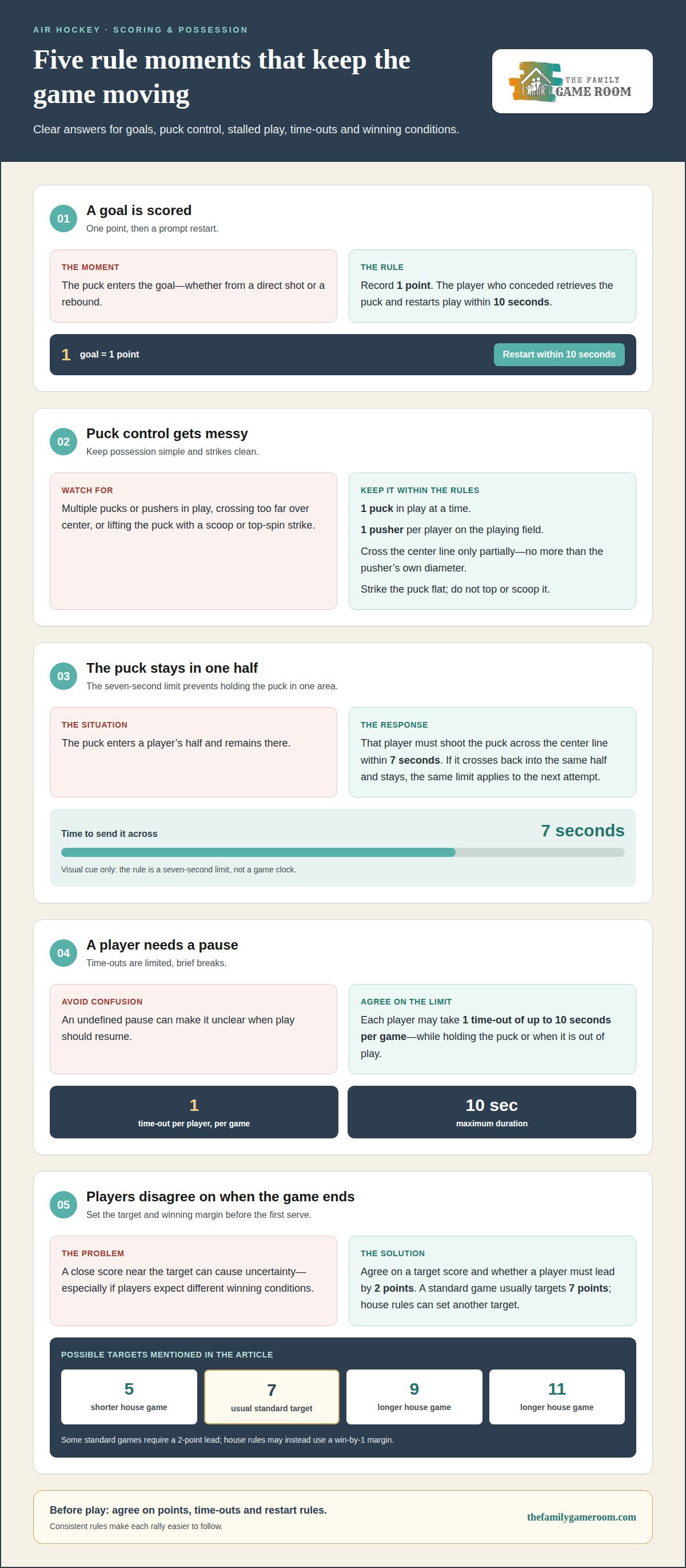
Every air hockey goal is worth one point, whether the puck goes in on a direct shot or a rebound. Record the point as soon as the puck enters the goal, then restart play. The consistent scoring value makes different shots easy to track, even when a rally ends unexpectedly.
After conceding a goal, a player has ten seconds to retrieve the puck and return it to play. For example, after a score, the player who conceded gets the puck and restarts within the ten-second limit. This clear next step helps keep the game moving.
Possession during a rally has a few limits: only one puck may be in play, and each player may use only one pusher on the playing field. A pusher may cross the center line only partially, by no more than its own diameter. Strike the puck flat, without topping or scooping it.
The seven-second rule applies when the puck enters and stays in a player’s half. That player must shoot the puck across the center line within seven seconds. The limit discourages holding the puck in one area. If the puck crosses back into that player’s half and stays there, the same timing rule applies to the next attempt.
Time-outs are brief pauses, not unlimited breaks. Each player may take one time-out of up to ten seconds per game, either while holding the puck or when it’s out of play. Before starting, agree on how to track points and time-outs. Then apply the same restart and possession rules throughout the match.
Air hockey gameplay
A standard air hockey game usually pits two players against each other, with a target of 7 points. Players use hand-held mallets to move a puck across the low-friction surface and defend their goals. A game normally ends when someone reaches the agreed score, rather than when a clock runs out. That format keeps the focus on scoring and saves timekeeping for house rules.
Set the winning conditions before the first serve. Some standard games require a player to lead by 2 points, so a tied score near the target can extend the match. For a shorter session, house rules may set the target at 5 points or use a win-by-1 margin. Other groups choose 9 or 11 points for longer play. Agreeing on the target and margin prevents confusion as the score climbs.
Team play changes the rhythm without changing the table. In a common 2v2 variation, partners can alternate shots or rotate after each goal. Alternating shots gives both teammates a turn during a rally. Rotating after a goal creates a clear switch point. Decide which approach to use before play, then keep the same pattern throughout the game.
For a group, a winner-stays-on format can keep matches moving: the next player replaces the loser. Events may also use best-of-3, best-of-5, or best-of-7 game series. Official matches switch sides after each game, while casual players can adopt that rule to balance any side advantage.
Air hockey game variations can also change timing. Some house rules use timed rounds and a buzzer; coin-operated tables may use a time limit or fixed puck count instead of a 7-point target. A tied score can lead to sudden-death overtime if players agree. For solo practice, hit the puck against a side cushion and catch its return with the mallet. These formats let players tailor a session, from focused practice to a rotating group match.
What are air hockey trick-shot and skill challenge games?
Trick shots and skill challenges turn a regular air hockey rally into a focused test of control. Rather than simply trying to score, players set a specific goal, such as banking the puck off a side cushion before aiming at the goal. Agree on the challenge beforehand, then use the same condition for every attempt.
A control challenge can focus on keeping shots flat and deliberate. Since air hockey rules prohibit topping or scooping the puck, reward clean strikes along the playing surface. Tilting a pusher more than approximately forty degrees when striking may be considered topping. For practice, aim for accurate, low shots without lifting the puck.
You can also turn the seven-second shot rule into a timed skill test. When the puck enters and stays in a player’s half, that player must shoot across the center line within seven seconds. The challenge is to respond promptly while staying in control. Keep the standard rule intact: this is practice, not a change to how points are awarded.
For a solo drill, send the puck off a side cushion and catch its return with a pusher. Repeat, focusing on a steady return and controlled catch. In a group, players can take turns trying the same rebound or accuracy challenge. Keep one puck in play and don’t hit it off the table.
Some groups allow controlled lifts as a house rule, while others require a rebound before a goal counts. Those options change the challenge, so agree on the rule first. Keep any lift controlled, and preserve flat strikes as the default. Explore air hockey tables to find a dedicated surface for rally practice and friendly skill challenges.
The Family Game Room: Air Hockey Tables
The Family Game Room offers Air Hockey Tables for home play, practice, and friendly challenges. When choosing a table for regular matches, consider its size, the room available, and the style of play you enjoy, from casual rallies and skill drills to games with family and friends.
For a broader entertainment space, pair air hockey with Foosball Tables or Indoor Shuffleboard Tables. A Pool Table Dining Top can also help a game room serve more than one purpose. Choose a combination that fits your space and the ways you want to play.
Contact The Family Game Room to discuss Air Hockey Tables for your home.
Make room for your next game-night favorite
Let the way you gather guide your game-room plans. A dedicated air hockey setup can create a spot for friendly competition, practice, and new challenges. Explore air hockey game variations as your household’s interests change, and build a welcoming space for players with different experience levels.
If you’re planning a room for more than one kind of play, The Family Game Room also offers American Heritage Billiards Pool Tables, Nixon Billiards Pool Tables, and Pool Table Dining Tops. These options can help you create a game room for both entertainment and everyday use.
Ready to plan your space? Contact The Family Game Room to discuss the right fit for your home. Make your next game night one everyone looks forward to.
Frequently Asked Questions
What are common air hockey game variations?
Common air hockey game variations change team size, scoring format, or challenge rules. Players might form pairs, play timed rounds, or require a rebound before a goal counts. In winner-stays-on play, the next person takes the losing player’s place. Change one rule at a time so everyone can follow its effect on each turn.
How do you play four-player air hockey?
Four people can play as two pairs, taking turns according to an agreed rotation. Partners might alternate shots so both players take part in a rally. Another option is to switch players after each goal, creating a clear reset point. Decide the rotation before starting, and make sure waiting players know who goes next.
What are popular air hockey variations for kids and parties?
For kids or parties, try short timed rounds, rotating players, or a simple rebound challenge. A buzzer can mark the end of a round, while winner-stays-on play gives the next person an easy entry point. Keep the rules easy to remember, use safe, flat strikes, and agree whether a rebound counts as a special challenge.
How do air hockey rules differ for singles and doubles?
Singles means one player defends each end; doubles adds a partner to each side. In a common doubles house format, teammates alternate shots or rotate after a goal. The partner arrangement changes who takes each turn, while the puck still moves between opposing sides. Set the rotation clearly so teammates don’t crowd each other.
How can you adapt air hockey for smaller tables or limited space?
On a smaller table, keep play simple and adjust the session instead of adding complicated rules. Short rallies and a lower agreed target score may suit a compact setup. In a tight room, leave enough space for players to stand and move around the table, and keep walkways clear. On a shorter surface, the puck can reach the opposite end faster.
What are official air hockey scoring rules and match formats?
A standard game commonly targets 7 points, and many standard games require a 2-point lead. That describes a single game, while a match series groups games together. Events may use best-of-3, best-of-5, or best-of-7 series; one described official set is won by the player who wins four games. Side changes after each game apply in official matches.