


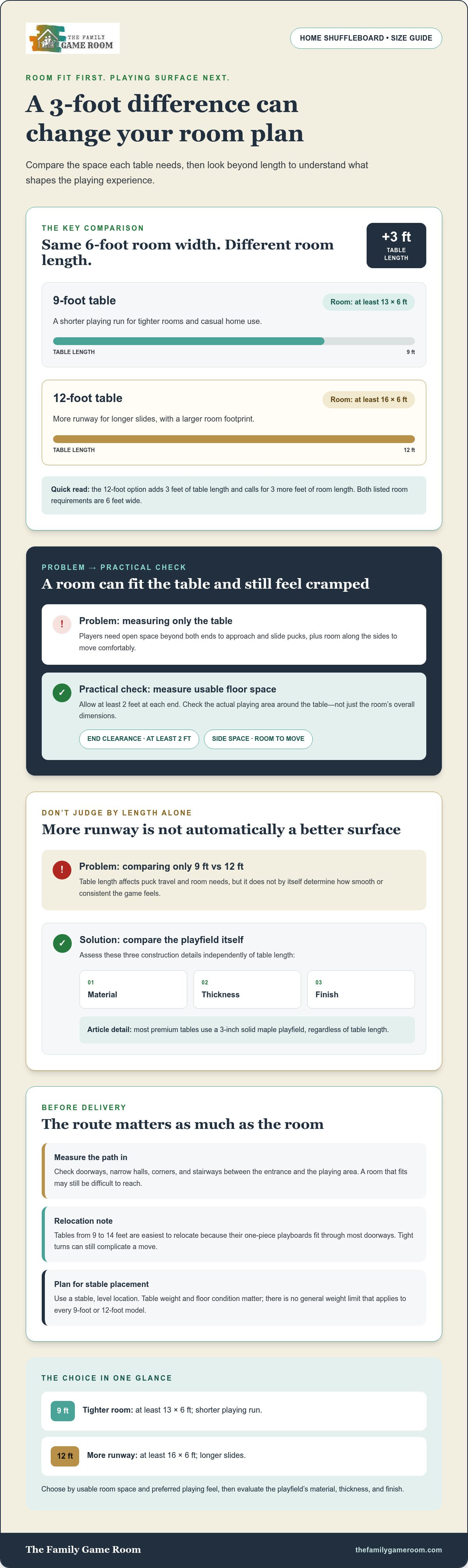
A longer shuffleboard table changes the room you need, but it doesn’t automatically mean a better playing surface. In a 9ft shuffleboard vs 12ft shuffleboard comparison, the practical difference is three feet of table length: a 9-foot table requires a room of at least 13 by 6 feet, while a 12-foot table requires at least 16 by 6 feet. Both can suit a home game room, depending on the space available and the feel you want.
It makes sense to focus on size first. You need room to play comfortably, and the longer table offers more runway for each shot. But length alone doesn’t tell you how a table will play; the playfield’s material, thickness, and finish matter, too.
This comparison explains standard table dimensions, the clearance each size needs, and how to assess playing-surface quality beyond the table’s length. You’ll come away with a clearer way to weigh the compact convenience of a 9-foot table against the longer play of a 12-foot option, so your choice fits both your room and your game.
Key Takeaways
- Shuffleboard tables come in several lengths, and regulation size is longer than either home-friendly option.
- Compare the room dimensions needed for each table size, including space for players at the ends and along the sides.
- A longer table gives pucks more runway, but table length alone doesn’t determine how the game feels.
- Assess the playfield’s material, thickness, and finish to understand what contributes to a smooth, consistent game.
- Use your room layout and playing preferences together to narrow down the right size for your home.
What Are the Standard Shuffleboard Table Dimensions?
Shuffleboard table lengths range from 9 to 22 feet, with several sizes between them. Regulation tables are 22 feet long and 20 inches wide.
Common Table Length Options
Common shuffleboard table lengths are 9, 12, 14, 16, 18, 20, and 22 feet. The range lets you compare compact home tables with longer options designed for a fuller-length game.
Tables are typically 20 inches wide, though cabinet dimensions can vary. An 11-foot table is uncommon and appears in only a couple of models, so shoppers will encounter more choices among the standard lengths.
Length and Playing Experience
Table length affects the distance pucks travel and the room needed for play. A 9-foot table offers a shorter playing run than a 12-foot table, while lengths beyond 16 feet can feel closer to full-length play.
The longest option is 22 feet, the regulation length used in professional tournaments. That extra distance changes the challenge of aiming and sliding pucks. An 18-foot table provides a longer slide, while a 20-foot table is closer to regulation length.
Choosing a Table Length
Choosing a table length means balancing the playing experience against the space available. A 9- or 12-foot table may suit a smaller room; a 14- or 16-foot model offers a middle ground.
Consider who will play and how closely you want the experience to resemble regulation play. A 22-foot table is regulation size, while a 12-foot table is described as suitable for most homes, small offices, and crowded commercial spaces.
For commercial venues, 18- and 20-foot tables are described by the Shuffleboard Federation as full-length options suited to most commercial settings. They offer more runway than compact models without reaching the 22-foot regulation length. The right fit still depends on whether the venue can accommodate both the table and players.
Length is only one dimension to compare. A table’s width also affects its footprint, and 20 inches is the typical table width. The playing surface may be narrower than the full table, so its dimensions matter when assessing usable play area.
Compare the exact listed table length with the room layout, not just the label “small” or “full-length.” A 14-foot table, for example, sits between the 12- and 16-foot options. That makes it a practical comparison point for readers who want more length than a compact model offers.
Think of the size range as a progression: 9 and 12 feet for compact spaces, 14 and 16 feet for mid-size choices, and 18, 20, and 22 feet for longer play. This helps narrow the options before comparing clearance and playing-surface construction.
Comparing 9-foot and 12-foot shuffleboard tables
For casual home use, either size can work: a 9-foot table suits tighter rooms, while 12 feet gives players a longer playing run. Delivery and installation depend on the table’s dimensions, the route into the room, and the floor’s condition; measure doorways and turns, and plan for a stable, level location.
Playing Surface and Table Size
A 12-foot table provides more length for puck travel, but length alone doesn’t determine surface quality. Most premium tables use a 3-inch solid maple playfield regardless of table length. Compare the material, thickness, and finish of each model, since those details influence the playing surface independently of whether the table measures 9 or 12 feet.
Skill Level and Size Choice
Skill level can shape how challenging each table feels, because a longer playing run gives pucks more distance to travel. A 9-foot table offers a compact game that can feel approachable for new players. A 12-foot table adds room for longer slides, giving experienced players more runway to judge aim and speed.
Choosing for Smaller or Larger Rooms
Room size helps narrow the shuffleboard table size before you compare models. A 9-foot table requires a room at least 13 by 6 feet; a 12-foot table requires at least 16 by 6 feet. Measure usable floor space, including clearance for players, rather than relying on the room’s overall dimensions.
Also measure the delivery route, not just the final room. Tables from 9 to 14 feet are easiest to relocate because their one-piece playboards fit through most doorways. Corners, narrow halls, and stairways can still complicate a move, so note each tight turn between the entrance and playing area.
Casual Home Use
For relaxed games with family or guests, the 9-foot option can make sense when floor space is limited. The 12-foot option suits homes that can accommodate its larger footprint and want a longer playing surface. A 12-foot table is also described as less intimidating to new players, offering an inviting middle ground for mixed skill levels.
For floor support, focus on the table’s weight and the condition of the intended floor. Keep the table on a stable, level surface; no general weight limit applies to every 9-foot or 12-foot model. Delivery and installation arrangements are separate from table dimensions, so plan the route and placement before the table arrives.
Leveling matters after placement, too. Some shuffleboard tables use cradle adjusters to correct the board’s crown as humidity changes the wood. For a model with adjusters, use them to maintain a level, accurate playing surface. Compare shuffleboard table options alongside your room measurements and playing preferences.
Space and clearance requirements
Measure the usable room around the table, not just the table itself. Players need clearance at the ends to approach and slide pucks, as well as along the sides to move comfortably.
Room and End Clearance
End clearance is the open space beyond each end of the table for players to stand and play. Allow at least 2 feet at both ends, so a 9-foot table needs a room at least 13 feet long. A 12-foot table needs a room at least 16 feet long under the same minimum clearance.
Those are minimum room lengths, not a promise of spacious play. A 12-foot table may need a room roughly 16 to 18 feet long, depending on the clearance you want. For comparison, a 22-foot table needs a room approximately 26 to 28 feet long.
Standing and Playing Space
Side clearance is the space beside the table where players stand, move, and take turns. Allow at least 2 to 3 feet on each side. Tables are approximately 2 feet wide, so a room 6 feet wide allows 2 feet beside each long edge.
Clearance matters even in a compact room. Players need space to stand beside the playing surface, and others may need to pass without interrupting a shot. If the room contains furniture, measure the open area between obstacles rather than relying on the wall-to-wall dimensions.
For a practical comparison, a 9-foot table requires a room at least 13 by 6 feet. A 12-foot table requires a room at least 16 by 6 feet. These dimensions use minimum clearances; allowing 3 feet along the sides increases the width needed beyond 6 feet.
Map out the full room before choosing either table length. A sofa, doorway, or built-in cabinet can reduce the space available for players. Mark the proposed table position, then check clearance at both ends and along both sides. This shows whether players can approach without squeezing past furniture.
Shorter tables can suit rooms where the available length is fixed, but side access still matters. A narrow room may not provide enough space even if its length fits the table and end clearance. Conversely, a longer room does not solve tight side clearance. Check both dimensions independently.
As a final planning check, compare the clear floor area with the table footprint and player space. Keep at least 2 feet at each end and 2 to 3 feet along each side. That distinction helps prevent a common mismatch: choosing a table that fits the room on paper but leaves too little space for comfortable play.
Playing-surface quality
Table length doesn’t determine playing-surface quality. A 9-foot and a 12-foot table can differ in construction, wood, thickness, and finish, so compare those specifications separately. The playfield is where pucks travel; its material and finish shape the glide. A longer table adds playing distance, but it doesn’t automatically provide a smoother or more consistent surface.
Hardwood is a common playfield material, with maple often used beneath a smooth polyurethane coating. Premium shuffleboard tables commonly use a 3-inch solid maple playfield, regardless of length. That means a compact table can share this construction detail with a longer one. Compare the listed playfield material and thickness instead of using length as a proxy for craftsmanship.
Finish matters because it forms the puck’s contact surface. A hard, smooth coating supports puck movement across the board, while the underlying slab provides the playing surface’s structure. Serious tables are described as using kiln-dried hardwood beneath a hard poured finish. Those details tell you more about construction than the difference between 9 feet and 12 feet.
Width is another specification to separate from length. Shuffleboard tables are typically 20 inches wide, while playing surfaces can range from 18 to 20 inches. A narrower playing surface changes the usable lane, even when two tables have the same length. Compare the actual playfield dimensions on each table, not only the overall cabinet measurements.
Look at the full construction description for each model. Check whether it names hardwood, maple, or another material; then compare playfield thickness and finish. For example, a 3-inch solid maple playfield is a different construction description from a thinner, veneered playfield. The material and finish help explain the surface, while length mainly describes the available playing run.
Level also affects play. Some shuffleboard tables have adjusters built into the cradle, which can correct the board crown as humidity changes the wood over the year. A level surface supports accurate play. When comparing models, check whether adjusters are included and consider how they relate to the table’s construction.
A 22-foot regulation table shows why length and quality are separate questions: regulation describes its size, not a guaranteed material or finish. Apply the same distinction to 9-foot and 12-foot choices. Compare their playfield material, thickness, coating, width, and leveling features; then choose the surface construction that suits your expectations for home play.
How much playing surface do 9-foot and 12-foot shuffleboard tables provide?
A table’s labeled length and its usable playing-surface length aren’t necessarily identical. Cabinet edges, scoring areas, and the playfield’s own dimensions all affect how much room pucks have to travel. A 12-foot table offers three feet more overall length than a 9-foot table, but that difference doesn’t establish the exact playfield length of either model.
The Legacy Classic provides a concrete 9-foot example. Its playfield measures 92-1/4 inches long by 16 inches wide, with a thickness of 1-1/2 inches. Those are model-specific playfield dimensions, not a specification for every 9-foot table. Compare a model’s playfield measurements rather than assuming its entire listed length is available for puck travel.
For a 12-foot table, use the same distinction: the overall table length describes the table, while its published playfield dimensions describe the playing area. A model’s usable run depends on its design and how the playfield sits within the cabinet. Compare those details directly when assessing how much distance a player has for each slide.
Width matters alongside length. The Legacy Classic’s playfield is 16 inches wide, so that figure describes its playing lane, not the cabinet width. A narrower or wider lane can affect how players aim and position pucks. Check both playfield dimensions, since a table can offer a longer run without a wider surface.
Play also depends on surface preparation and level. Legacy shuffleboard wax beads must be applied to the playing surface to help pucks slide. Legacy shuffleboards include climate adjusters to help keep play level and accurate. These features affect glide and board adjustment, not the length of the playing surface.
The Legacy Classic includes eight pucks, four in each of two colors; each puck measures 2-5/16 inches in diameter and weighs 13.1 ounces. These model details show why playfield length is only one part of the comparison. Puck size, surface width, wax, and level adjustment all contribute to the playing experience.
Compare the listed playfield length and width for each 9-foot and 12-foot model, then consider its surface construction and adjustment features. That gives a more useful picture than table length alone. Explore indoor shuffleboard tables to compare options and their playing-surface specifications.
The Family Game Room: Pool Table Dining Tops
The Family Game Room offers Indoor Shuffleboard Tables for homes where room dimensions and playing preferences guide the choice. After comparing a 9-foot and 12-foot table, use those measurements to narrow down a size that fits your space and the kind of play you want.
If a shuffleboard table won’t fit your room, consider other ways to create a home game space, such as a pool table with a dining top, an air hockey table, or a foosball table. Each option suits different activities, so base your decision on your available space and how you want to use it.
Explore The Family Game Room’s indoor shuffleboard tables and other game-room options to find a fit for your space.
Shape a Game Room That Fits Your Home
Let the 9-foot versus 12-foot shuffleboard decision start a wider design conversation. Picture how people will move through the room, where seating belongs, and whether you want the space to serve more than one purpose. A game room should feel inviting during play and work naturally with the rest of your home.
The Family Game Room offers American Heritage Billiards and Nixon Billiards pool tables, along with pool table dining tops. These options can help you plan a room that works for games and everyday needs. Choose the setup that suits your home, then make space for the activities and gatherings you want to enjoy.
Contact The Family Game Room to explore options for your game room. Your next great home gathering can start with a thoughtful choice.
Frequently Asked Questions
How do I know what size shuffleboard to get?
For the 9ft shuffleboard vs 12ft shuffleboard decision, start with the clear floor area and how you expect to play. Measure the room around furniture, doorways, and walking routes, then compare those usable dimensions with the table footprint. Also compare each model’s playfield specifications: the cabinet’s overall length doesn’t tell you exactly how much surface pucks can travel across.
If I plan to move in the future, which size is easiest to relocate?
A 9-foot table is the shorter option, but the playboard’s construction and your moving route matter too. Shuffleboard tables from 9 to 14 feet are described as easiest to relocate because their one-piece playboards fit through most doorways. Measure door openings, hallways, stairs, and corners before moving day. A doorway may be wide enough while a tight turn still limits maneuvering.
What are the most poplar size tables?
Common shuffleboard table lengths are 9, 12, 14, 16, 18, 20, and 22 feet. The 11-foot size is uncommon and available in only a couple of models. These standard options span compact home tables through regulation-length tables. Narrow your choices by room layout and preferred playing distance, then compare models at the closest suitable lengths.
What are the dimensions of a 9-foot shuffleboard table compared with a 12-foot table?
The shorter table measures 9 feet long; the longer measures 12 feet long. Shuffleboard tables are typically 20 inches wide, although cabinet dimensions vary by model. The playfield may not match the cabinet’s full length or width. Compare both measurements in each model’s specifications to understand its footprint and usable playing area, rather than assuming the stated length is entirely playfield.
What room size is recommended for a 9-foot shuffleboard table?
A 9-foot table requires a room at least 13 feet long by 6 feet wide. Treat that as a minimum planning dimension, then account for furniture and player movement. For example, a sofa or cabinet can narrow the usable width even if the room’s wall-to-wall measurement meets the minimum. Measure the clear space where the table will sit and players will stand.
What room size is recommended for a 12-foot shuffleboard table?
A 12-foot table requires a room at least 16 feet long by 6 feet wide. A room roughly 16 to 18 feet long is also suggested for this length. Check the actual open floor area, especially if furniture or doorways affect the layout. A room’s total dimensions can overstate the available playing space when fixed objects occupy the ends or sides.
How do 9-foot and 12-foot shuffleboard tables compare in price?
There’s no single price difference that applies to every model. Cost depends on construction, materials, finish, adjusters, and included accessories, not just table length. Compare specific models and their listed features to understand what each offers. A longer table provides more playing distance, while a shorter one may fit your room better; weigh those practical differences against the price of each model.
Does table length affect shuffleboard gameplay, shot difficulty, or scoring?
Yes. Table length changes the distance pucks travel and can affect how players judge speed and aim. More runway creates a different shot challenge, while a shorter playing surface makes for a more compact game. Length alone doesn’t determine scoring; the scoring zones and rules of the table’s layout matter, too. Compare those features alongside playfield dimensions when choosing a model.