


What if the biggest threat to your break isn't your technique, but the distance between your leather tip and the drywall? Many homeowners assume a larger table is always better, yet the most common regret in game room design is choosing a professional 8ft model that forces you to use "shorty" cues for every rail shot. You want a space that invites competition and relaxation, not a layout that feels like a crowded obstacle course. Deciding between a 7ft vs 8ft pool table for home use is the single most important choice you'll make for your entertainment area.
We understand that you want a centerpiece that balances heirloom quality with practical playability. This guide provides a definitive breakdown of the differences between these two standard sizes to ensure your investment fits your lifestyle. You'll learn how playfield geometry affects your strategy, why the 7ft "bar box" is the standard for 80% of amateur leagues, and how premium Nixon Billiards dining tops can transform your spatial calculations. By the end, you'll have the confidence to select a table that offers a professional challenge without compromising your home's flow.
Key Takeaways
- Calculate your precise room requirements using the Golden Rule to ensure every shot has enough backswing clearance without hitting walls.
- Compare the tactical differences of a 7ft vs 8ft pool table for home use to decide between a compact "Bar Box" or the "Home Professional" regulation standard.
- Explore how 7ft tables provide the perfect "Goldilocks" size for families who want to maximize space for additional games like indoor shuffleboard.
- Evaluate the long-term heirloom value and superior playability of 8ft tables for players seeking a true billiard hall experience at home.
- Discover how multi-functional dining tops from premium brands like Nixon Billiards allow you to integrate a full-sized table into shared living spaces.
7Ft vs 8ft Pool Table: Understanding the Core Differences
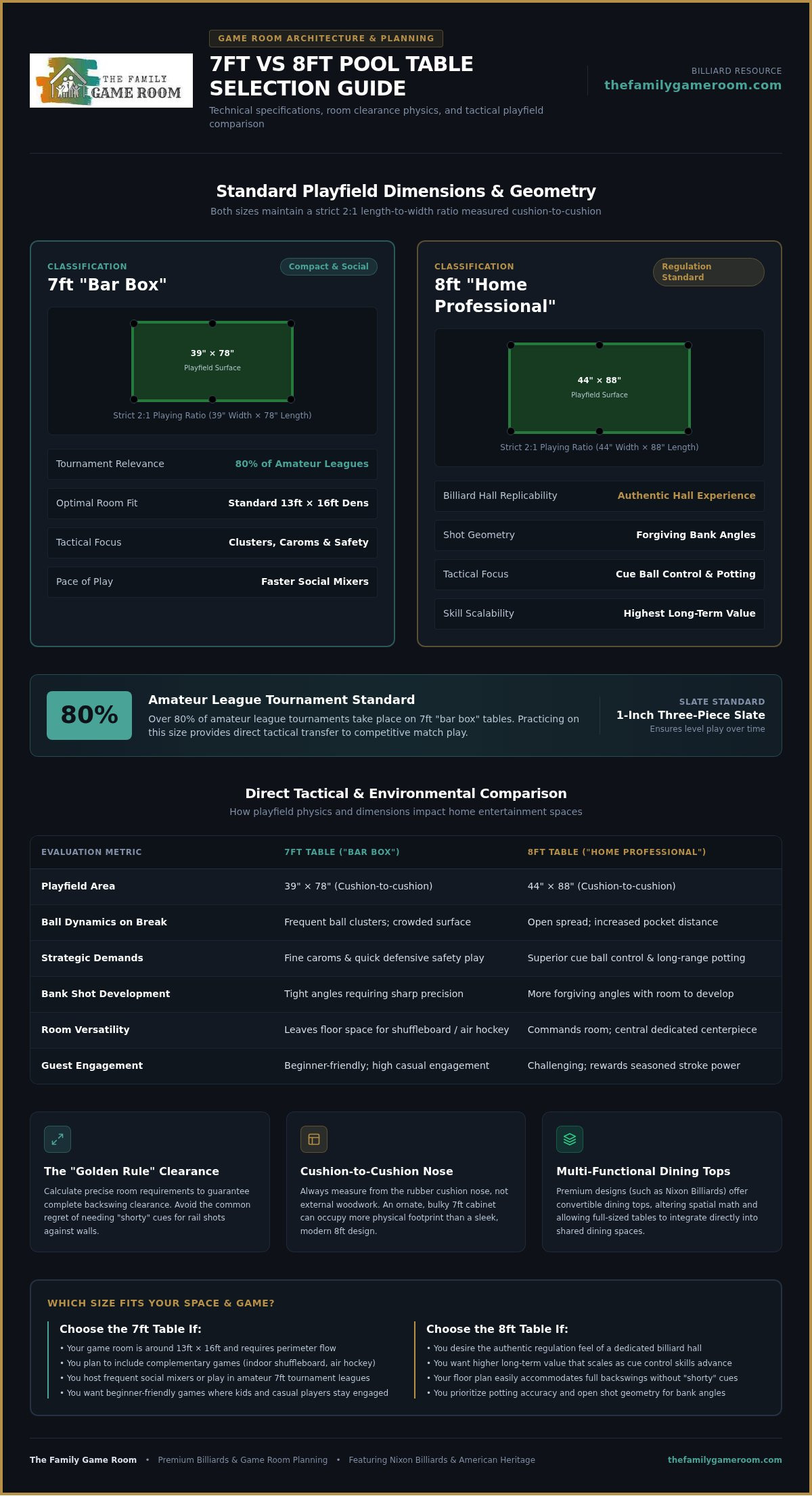
Selecting a 7ft vs 8ft pool table for home use depends on more than just available floor space; it's about the technical specifications of the slate bed. Most buyers focus on the outer cabinet style, but the true game happens within the standard pool table dimensions of the playfield. This internal area always maintains a strict 2:1 ratio, ensuring that the length is exactly twice the width. While a 7ft table is often called a "Bar Box" due to its prevalence in local pubs, the 8ft model is recognized as the "Home Professional" standard. This extra foot of length fundamentally alters the physics of your game, shifting the focus from tight cluster management to long-range potting accuracy.
Understanding the difference between the outer frame and the cushion-to-cushion measurement is vital for a successful installation. A bulky, ornate frame on a 7ft table can actually take up more room than a slim, modern 8ft design. Always measure from the nose of the rubber cushions to determine the actual play area. This distinction prevents the common mistake of buying a table that looks right in a showroom but feels "small" or, conversely, one that overwhelms the room because of its decorative cabinetry. Brands like American Heritage Billiards often utilize 1-inch thick three-piece slate to ensure these dimensions remain perfectly level over time.
The 7ft Table: Compact and Social
A 7ft table typically features a playfield measuring 39 inches by 78 inches. It's the ideal choice for casual family gatherings or players who compete in amateur leagues. Because the balls are confined to a smaller surface, they tend to cluster more frequently during the break. This crowded environment forces you to master fine caroms and defensive safety play. It's a faster game that rewards quick thinking over pure stroke power. If your goal is to host social mixers where games move quickly and players of all skill levels can participate, this size is your best bet.
The 8ft Table: The Professional Home Experience
For the serious enthusiast, the 8ft table is the gold standard. With a playfield of 44 inches by 88 inches, it offers a significantly more challenging experience. The increased distance between pockets demands superior cue ball control and higher potting accuracy. You'll find that the "Shot Geometry" is more forgiving for complex bank shots because the angles have more room to develop. Most high-end residential designs, including those from Nixon Billiards, prioritize this footprint because it replicates the professional feel of a dedicated billiard hall. Choosing an 8ft model often provides the best long-term value for a 7ft vs 8ft pool table for home use comparison, as it scales with your skill level.
The Case for a 7ft Pool Table in Modern Game Rooms
Modern game rooms are increasingly designed for multi-functional entertainment rather than a single purpose. Choosing a 7ft vs 8ft pool table for home use often comes down to how much variety you want in your space. A 7ft model leaves valuable square footage for other high-end additions like indoor shuffleboard or air hockey tables. This "Goldilocks" size provides enough challenge for adults while remaining accessible for younger players. It's also a strategic choice for competitive enthusiasts. Since over 80% of amateur league tournaments are played on 7ft "bar box" tables, practicing on this size at home ensures your skills translate directly to the tournament floor. Premium brands like Nixon Billiards provide the sophisticated finishes needed to ensure a 7ft table looks like a luxury furniture piece rather than a pub relic.
Space Optimization for Smaller Dens
Fitting a pool table into a standard 13ft x 16ft room requires precision. While an 8ft table might feel cramped, a 7ft model allows for a comfortable perimeter for players to move. Maintaining a healthy "Room Flow" is essential in open-concept basements where the gaming area might bleed into a lounge or bar. You can further maximize your footprint by pairing your table with matching Pool Cue Racks to keep equipment organized and off the floor. To ensure you have enough backswing clearance for every shot, consult professional pool table room size calculations before finalizing your floor plan. If you're ready to transform your space, you can browse our curated billiard collections to find a model that fits your dimensions perfectly.
Casual Play and Beginner Friendliness
Shorter shots naturally lead to higher engagement for casual guests who may not play regularly. The psychological benefit of a "reachable" table cannot be overstated; it encourages beginners to try difficult banks and caroms without feeling overwhelmed by the vastness of a professional slate. This accessibility ensures that your table remains a centerpiece of activity rather than a dusty furniture piece. A 7ft table acts as the ultimate social catalyst for compact homes by providing professional-grade play in a footprint that welcomes every guest to join the game.
Why the 8ft Table Remains the Premium Home Standard
While the 7ft table dominates the league circuit, the 8-foot model represents approximately 65 to 70 percent of residential billiard sales in the United States. It's the undisputed "Home Standard" for a reason. When debating a 7ft vs 8ft pool table for home use, many enthusiasts prioritize the 8ft footprint because it provides a visual and physical weight that anchors a room, transforming a basement or den into a sophisticated entertainment hub. Choosing a American Heritage Billiards Pool Tables setup ensures you're investing in a piece of equipment designed for longevity and professional-grade performance. This size is often viewed as a permanent heirloom, offering a sense of stability and prestige that smaller models can't quite match.
Advanced Gameplay and Skill Development
The transition from a 7ft to an 8ft playfield introduces 3,872 square inches of playable surface, which is roughly 27.3 percent more area than the compact bar size. This extra space fundamentally changes your approach to the game. Long-table shots require absolute precision in your cue stroke and a deeper understanding of tangent lines. If you're comparing a 7ft vs 8ft pool table for home use, consider that serious players rarely size down if their room dimensions allow for the larger footprint. The 8ft table accommodates 1-inch thick, three-piece matched slate beds that provide the consistent, vibration-free roll necessary for high-level practice. Mastering cue ball control on this larger surface makes you a far more formidable opponent when you step back onto a smaller league table.
The 8ft Table as High-End Furniture
Beyond the game, an 8ft table serves as a primary architectural anchor for your home. The larger frame allows manufacturers like Nixon Billiards to incorporate more intricate design elements, such as hand-carved legs and detailed rail sights. These tables often weigh between 750 and 1,050 pounds, a testament to the solid wood construction and heavy slate used in premium models. To complete the professional aesthetic, you must pair the table with appropriate Billiard Light Fixtures. Proper illumination eliminates shadows in the pockets and highlights the craftsmanship of the wood grain. When you invest in this size, you're not just buying a game; you're curating a luxury environment that balances competitive play with domestic elegance.
The Room Fit Test: Calculating Your Clearance
Calculating the perfect 7ft vs 8ft pool table for home use involves a simple yet non-negotiable formula known as the Golden Rule. To ensure a frictionless playing experience, you must take the length and width of the playing surface and add twice the length of your cue to each dimension. For a standard 58 inch cue, a 7ft table requires a room of at least 13 feet by 16 feet. An 8ft table demands a larger footprint, typically starting at 13.5 feet by 17 feet. If you ignore these baseline numbers, you'll likely find yourself "wall-bumping," a frustrating scenario where the back of your cue strikes the drywall during a critical shot.
Professional installers recommend adding an extra 6 inches of buffer per side to account for a full backswing. This "stroke room" is what separates a cramped basement from a luxury home billiard room. While the slate play area is the focus, you must also identify permanent architectural obstructions like support pillars, fireplaces, or built-in bar counters. If a specific corner is tight, using a 48 inch or 52 inch "trouble cue" can save up to 10 inches of clearance. However, billiard experts caution that if more than 20% of your shots require a short cue, the table is likely too large for the space. You can view our room-sized billiard collections to see which models fit your specific floor plan.
Step-by-Step Measuring Guide
Start by measuring the clear floor space, excluding any furniture that cannot be moved. Use painter's tape to mark the outer corners of your desired table size directly on the floor. This allows you to visualize the physical footprint and check for "dead spots" where player movement might be restricted. Once the tape is down, stand at the most narrow points of the room and simulate a bridge and stroke. If your elbow or the cue butt hits a wall, you'll know immediately if you need to size down or shift the table's orientation.
Accounting for Game Room Furniture
A functional game room needs more than just a table; it requires space for social interaction. Plan for at least 3 to 4 feet of "walk-around" space beyond the playing area to accommodate spectators and movement. High-top bar stools and spectator chairs add significant depth to your room's perimeter, often eating into the clearance needed for a full stroke. Don't forget to account for wall-mounted cue racks, which require their own clearance for pulling cues in and out. By prioritizing room flow, you ensure that your premium Nixon or American Heritage table remains an inviting centerpiece rather than a crowded obstacle.
The Ultimate Compromise: Multi-Functional Luxury Tables
Urban square footage is at a premium, leading many homeowners to struggle with the 7ft vs 8ft pool table for home use debate. If you have a dedicated formal dining room that sits empty for most of the year, a convertible billiard table offers the perfect resolution. By adding a professional-grade Pool Table Dining Top, you can justify the larger 8ft footprint in a space that would otherwise be underutilized. These multi-functional designs allow you to host a sophisticated dinner party and then transition to a competitive break in under 60 seconds. It's a lifestyle upgrade that removes the "either/or" mentality of home entertainment design.
Why Dining Tops Change the Size Equation
Traditional room planning often forces you to choose between a dining area and a game room. However, using the "Dining Room Footprint" as your guide allows an 8ft table to exist comfortably in a shared living space. This setup solves the common problem of the "unused room" by giving every square foot a dual purpose. High-end convertible tables are engineered with slimline aprons to ensure diners have ample legroom while maintaining the structural integrity required for a 1-inch slate bed. These hybrids represent a seamless blend of social dining and competitive play, ensuring your home remains the primary destination for hosting.
Choosing Your Aesthetic: Nixon vs. American Heritage
Your choice of brand should reflect the architectural language of your home. Nixon Billiards specializes in minimalist, modern lines that complement contemporary open-concept floor plans. Their rigid subframes and sleek finishes appeal to those who value a "less is more" aesthetic. Conversely, American Heritage Billiards focuses on traditional, heirloom-quality craftsmanship. These tables often feature ornate leg carvings and rich wood stains that suit classic interior designs. Both brands offer 7ft and 8ft configurations that accommodate multi-piece dining leaves, ensuring your table looks like a high-end furniture piece when the game is over.
The decision between a 7ft vs 8ft pool table for home use should align with your long-term lifestyle goals. If you crave the professional challenge of a billiard hall, the 8ft table with a dining conversion is the superior choice. If you prefer a faster, social game that leaves room for other activities, the 7ft model is your best fit. Regardless of the size, choosing a premium brand ensures your game room offers professional playability without compromising your home's warmth and elegance.
Take the Next Step Toward Your Ultimate Game Room
Deciding on a 7ft vs 8ft pool table for home use requires looking beyond the floor plan to your long-term lifestyle. You've seen how the 7ft "bar box" maximizes multi-game versatility while the 8ft "home professional" standard offers unmatched shot geometry. Whether you opt for the social ease of a compact model or the regulation challenge of a larger table, your choice should anchor your space with both style and substance. Don't let spatial concerns hold you back; remember that dining tops can transform a formal room into a competitive arena in seconds.
Since 2022, our family-owned business has focused on helping homeowners curate spaces that blend domestic warmth with professional polish. As an authorized dealer for industry leaders, we guarantee heirloom-quality construction that provides lasting satisfaction. We're here to ensure your game room becomes the primary destination for making memories. Explore our curated collection of Premium Nixon and American Heritage Billiards Tables and discover the centerpiece your home deserves. Your dream entertainment space is just one precise measurement away from becoming a reality.
Frequently Asked Questions
What is the actual playing surface difference between a 7ft and 8ft table?
The playing surface of a 7ft table measures 39 inches by 78 inches, while an 8ft table provides 44 inches by 88 inches. This means the 8ft model offers roughly 27 percent more playable area. When choosing a 7ft vs 8ft pool table for home use, remember that this extra foot of length significantly expands the distance between pockets. This change forces you to develop more precise potting skills and deeper cue ball control.
Can I comfortably play on an 8ft table in a 12ft x 15ft room?
You cannot comfortably play on an 8ft table in a 12ft by 15ft room. An 8ft table requires a minimum area of 13.5 feet by 17 feet to accommodate standard 58 inch cues. If you attempt this setup, you'll constantly strike the walls during your backswing. Even a 7ft table is tight in that footprint. We recommend a 7ft model with 52 inch cues for that specific room size to maintain playability.
Do professional pool players prefer 7ft or 8ft tables for home practice?
Professional and league players often choose their home table based on their primary competitive environment. Since over 80 percent of amateur league tournaments use 7ft "bar box" tables, many players practice on that size to master tight ball clusters. However, serious enthusiasts seeking a "Home Professional" experience typically prefer 8ft models. The larger surface replicates the conditions found in dedicated billiard halls and offers a greater challenge for long-range shot accuracy.
Will a 7ft pool table negatively affect my skill level on larger tables?
Practicing on a 7ft table won't negatively affect your skill, but it will shift your focus toward different tactical elements. A 7ft surface rewards precision in navigating crowded clusters and executing fine caroms. While you won't get as much practice with long-distance potting, the safety play skills you develop are invaluable. Transitioning to an 8ft table later simply requires adjusting your stroke for the increased distance and steeper tangent lines of the larger playfield.
How much extra space do I need for a pool table with a dining top?
A pool table with a dining top doesn't require extra floor space for the table itself, but you must account for seating clearance. Plan for at least 3 to 4 feet of additional room around the perimeter to accommodate dining chairs or benches. This ensures guests can sit comfortably without being pinned against the wall. Because the table height increases slightly with the top installed, choosing custom-height seating from brands like Nixon Billiards ensures proper lap clearance.
Is it better to have a 7ft table with full cues or an 8ft table with short cues?
It's almost always better to choose a 7ft table that allows for full 58 inch cues. Using short cues on an 8ft table frequently disrupts your natural stroke mechanics and limits your ability to generate power or spin. If more than 20 percent of your shots require a "trouble cue" due to wall obstructions, your enjoyment will suffer. A 7ft vs 8ft pool table for home use decision should prioritize a full, unobstructed range of motion.
What are the most common mistakes people make when measuring for a pool table?
The most frequent error is measuring the outer cabinet dimensions instead of the actual playfield. You must calculate clearance based on the nose of the cushions where the ball strikes. Another common mistake is forgetting to add 6 inches of buffer for the player's backswing. Homeowners often identify the floor space for the table but overlook permanent obstructions like support pillars, low-hanging light fixtures, or built-in bar counters that interfere with the cue butt.
Which brands offer the best 8ft pool tables for a luxury home game room?
For a luxury home game room, Nixon Billiards and American Heritage Billiards are the premier choices. Nixon Billiards is the go-to brand for minimalist, architectural designs that fit modern interiors. If you prefer a traditional look with hand-carved details and rich wood stains, American Heritage Billiards offers heirloom-quality construction. Both brands utilize three-piece matched slate to ensure a professional-grade roll, making them the gold standard for high-end residential installations across the United States.