


That stunning mahogany finish you're eyeing might actually be hiding a particle board core that will warp before your first tournament. Many homeowners focus on the exterior aesthetics while ignoring the structural integrity hidden underneath the felt. It's easy to get swept up in the excitement of a new game room; however, overlooking technical details is one of the most common mistakes when buying a pool table. You deserve a centerpiece that remains perfectly level for decades, not a piece of furniture that starts to sag after a single season of play.
We know you want a game room that impresses your guests and provides a professional experience for your family. It's often confusing to distinguish between a basic furniture style table and a genuine professional grade instrument. This guide will show you how to identify high-quality materials like premium slate and solid hardwoods. We'll also help you navigate room sizing requirements so you never have to worry about a cue hitting a wall during a critical shot. A table that fits your life and your home perfectly, we will help you find.
Key Takeaways
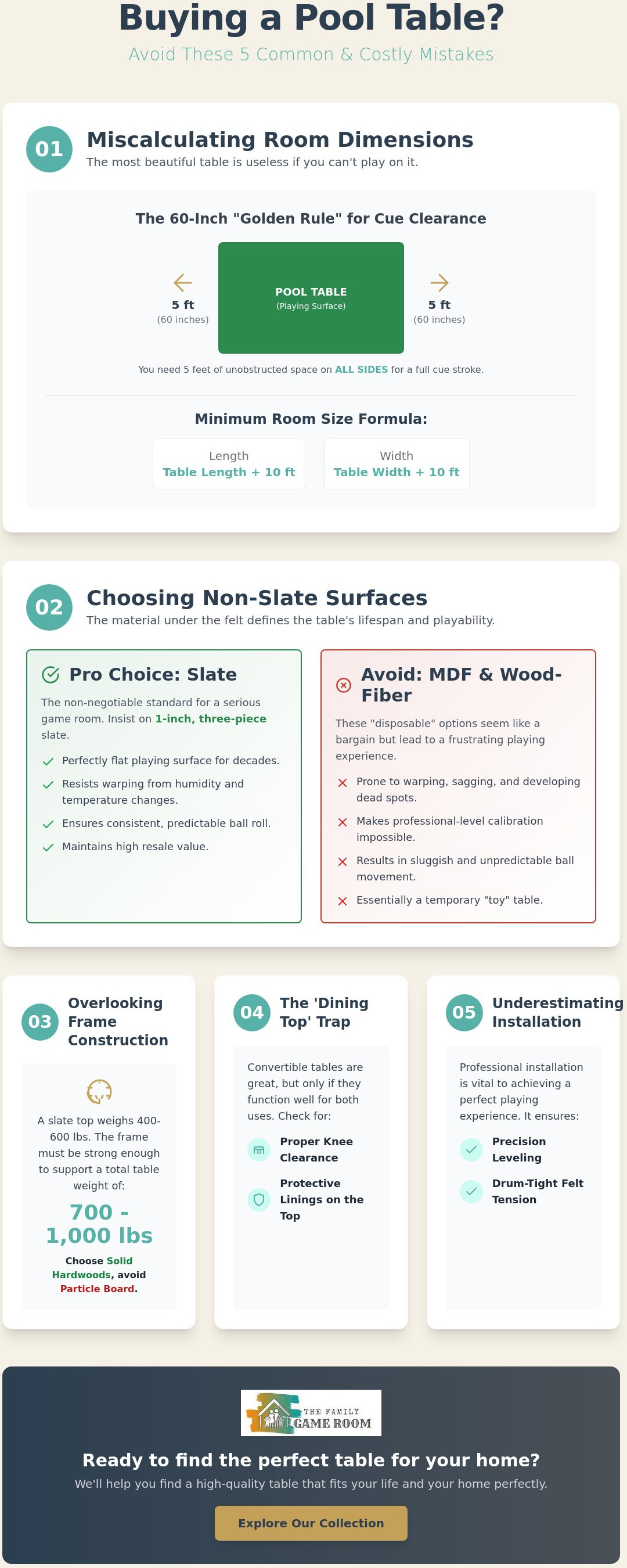
- Master the 60-inch rule to ensure your game room provides enough clearance for every shot without damaging your walls.
- Prioritize 1-inch three-piece slate surfaces to guarantee a perfectly flat playing area that remains durable for decades.
- Avoid common mistakes when buying a pool table by verifying the frame construction can support the 700 to 1,000 lbs required for a professional experience.
- Evaluate convertible dining tops for proper knee clearance and protective linings to ensure your table functions beautifully for both dinner and play.
- Understand why professional installation is vital for achieving the drum-tight felt and precision leveling your home setup deserves.
Miscalculating Room Dimensions and Cue Clearance
Selecting your dream table brings a surge of excitement. You've picked the finish and the felt color; however, the most beautiful table becomes a source of frustration if you can't actually play a game on it. Miscalculating space is one of the most frequent and common mistakes when buying a pool table. Many homeowners look at the footprint of the table cabinet and assume they're ready. In reality, the playing area is just the beginning. You must account for the physical space required for a player to stand, lean, and swing a cue with confidence. Avoiding common mistakes when buying a pool table starts with accurate measurements before you ever place an order.
Standard cues measure 57 or 58 inches in length. If your table sits too close to a wall, you'll find yourself poking at the ball rather than following through with a smooth stroke. This is why the 60-inch rule is the industry gold standard. You need five feet of clear, unobstructed space on every single side of the table. This ensures that even the most difficult shots along the rail remain playable. Understanding Billiard table construction helps you realize that the outer dimensions of the cabinet are always larger than the designated playing surface. Beyond walls, keep an eye out for support pillars, fireplaces, and low-hanging light fixtures that can snag a cue during a high-arched jump shot.
The Golden Rule of Cue Level Clearance
Calculate your required room size by taking the dimensions of the slate and adding 10 feet to both the length and the width. This simple math provides the necessary five feet of clearance on all sides. Since 57-inch cues are the standard for adult play, this buffer allows for a full stroke zone. Before the delivery truck arrives, use painter's tape to mark the table's footprint on your floor. Stand outside that tape and mimic a full shooting motion. If your knuckles hit a wall or a fireplace mantle, you might consider using short cues for those specific tight spots, though they are a compromise that can slightly alter the game's feel.
Accounting for Game Room Furniture
Your room isn't just for the table; it's a social hub. You must plan for seating and storage alongside the table itself. While Bar Stools and spectator chairs add to the luxury of the space, they also eat up valuable floor area. If a guest is sitting behind a player, the 60-inch rule may need to expand to 72 inches to avoid accidental collisions. Wall-mounted cue racks and dartboard cabinets also require their own clearance; you can find out more about how custom cabinetry can streamline your game room storage. Don't fall for the sideways cue mistake where you assume you can just tilt the stick up for tight spots. This ruins the game's mechanics and eventually leads to scuffed walls and broken tips.
Choosing Non-Slate Surfaces for Permanent Home Tables
The surface beneath your felt determines the trajectory of every shot you take. While a wooden table cabinet might look impressive in a showroom, the material hiding under the cloth defines the table's actual lifespan. Slate is a fine-grained, foliated metamorphic rock that provides a perfectly flat playing surface, and it remains the only material that truly resists the test of time. Opting for wood-fiber or MDF (Medium Density Fiberboard) surfaces is one of the most frequent and common mistakes when buying a pool table. These materials are essentially "disposable" options that lack the structural integrity required for a serious game room setup.
A wood-fiber table might seem like a bargain initially; however, it often becomes a leveling nightmare within just a few years. Unlike stone, wood reacts to the humidity and temperature shifts in your home. This leads to warping that makes a true calibration impossible to achieve. If you want a table that functions as a family heirloom rather than a temporary toy, slate is the non-negotiable standard. Investing in quality stone ensures that your table maintains its resale value and provides a professional experience for decades to come.
Slate vs. Slatron and MDF
The physics of a ball roll depends entirely on surface density. Slate offers a consistent, heavy base that allows for predictable speed and accuracy, which is essential for anyone trying to master the geometry of pool. Slatron and MDF are far less dense, often causing the balls to feel "sluggish" or move in unpredictable paths as the board develops micro-warps. Thermal stability is another critical factor; slate does not expand or contract with the seasons. Be cautious of "fake" slate or thin 1/2-inch alternatives that some retailers use to cut costs. To ensure you are getting a professional-grade surface, you can explore the premium slate options at thefamilygameroom.com for your home.
The 3-Piece Slate Advantage
Professional installers and tournament organizers prefer 1-inch three-piece slate for luxury tables. This configuration allows for the most precise leveling possible. Each of the three sections can be adjusted independently to account for slight imperfections in your flooring. During installation, experts use specialized wax to fill the seams, creating a surface that is entirely seamless to the touch. This setup also offers significant transportation benefits. Moving a solid one-piece slate is a massive logistical liability that often results in cracked stone; three-piece slate is safer to handle and fits much easier into basement game rooms or upstairs lofts.
Overlooking Frame Construction and Cushion Quality
A pool table is a massive investment in both finance and physical weight. While the slate provides the level playing surface, the frame and cushions provide the playability and longevity. Many buyers spend hours choosing a wood stain but only minutes investigating the frame's skeleton. This lack of scrutiny is one of the most common mistakes when buying a pool table. A high-quality slate table typically weighs between 700 and 1,000 lbs. If the legs and frame are made of pressed wood or thin veneers, the structural integrity will eventually fail under the constant pressure. You want solid wood legs that act as pillars of stability, ensuring your table remains a permanent fixture in your home.
The difference between a professional grade instrument and a piece of discount furniture often lies in the materials used for the frame. Solid wood construction provides the density needed to absorb the vibrations of a heavy break shot. Pressed wood, on the other hand, can crumble or warp when exposed to the weight of the slate or minor changes in household humidity. Avoiding common mistakes when buying a pool table means looking past the surface aesthetics to confirm that the legs and cabinet are built for endurance.
Internal Support Systems
Quality craftsmanship is found where you can't see it. Look for interlocking cross-beams that support the center of the slate. These beams prevent the heavy stone from bowing or shifting over time. Additionally, the best manufacturers utilize metal-to-metal hardware. Unlike wood screws that can strip or loosen, metal bolts ensure a tight, permanent bond that prevents the table from wobbling during a match. This is why American Heritage Billiards Pool Tables are so highly regarded; they utilize superior cabinetry techniques that prioritize this internal architecture for a wobble-free experience.
Rail and Cushion Engineering
The rails are the engine of your bank shots. If the cushions are made of synthetic fillers rather than natural gum rubber, they will eventually lose their elasticity. This leads to the frustrating "dead rail" syndrome, where the ball simply thumps against the rail instead of bouncing back with precision. To ensure professional play, check that the cushions meet the BCA official equipment specifications for the K-66 profile. This specific shape and density provide the most consistent rebound in the industry. You can test for quality by tapping the rail with your fist. A solid, deep sound indicates a well-attached rail, while a hollow "thump" suggests a loose or inferior component that will ruin your game.
The 'Dining Top' Trap: Form vs. Function Errors
Choosing a dual-purpose table is a brilliant way to maximize your home's square footage. It allows a single room to transition from a formal dining area to a high-energy game space in seconds. Despite the appeal, failing to account for physical ergonomics is one of the most common mistakes when buying a pool table. Most buyers overlook the "apron" height. Because a billiard table must house heavy slate and often a ball-return system, the frame is significantly deeper than a traditional dining table. If you don't measure carefully, you'll end up with a beautiful piece of furniture that is physically uncomfortable to sit at for a full meal.
Protection for your investment should be a top priority. A common error is buying a dining top that lacks a felt-lined underside. Every time you slide the top into place, you risk scuffing the wood rails or snagging the billiard cloth. A quality top acts as a protective shield, not just a lid. You also have to think about the logistics of the transition. These tops are heavy and usually come in three pieces to make them manageable. You need a dedicated, safe storage solution nearby so the transition from dinner to "break" doesn't become a chore that discourages play.
Ergonomics of Convertible Tables
The math of comfort is precise. A standard dining surface sits 30 inches off the floor, while billiard tables are typically 32 inches high. This slight elevation requires careful chair selection. You must ensure there is enough clearance between the chair seat and the bottom of the table apron for your guests' legs. High-quality Pool Table Dining Tops often require specific chair pairings to maintain a natural seating position. Brands like Nixon Billiards have mastered this balance, creating sleek designs that feel like a professional table and a luxury dining set simultaneously; to find the perfect seating to match, you can discover ReModern Living for contemporary European home furnishings.
Spill and Heat Protection
Accidents happen during dinner parties. A spilled drink shouldn't be a catastrophe for your billiard felt. Look for tops that include an integrated liquid-resistant seal and leaf-gaskets. These gaskets sit between the sections of the top to prevent moisture and crumbs from migrating down to the playing surface. Heat protection is also vital if you plan to serve hot dishes. Always check the manufacturer's rating for heat resistance to avoid clouding the wood finish. When you're ready to switch to game mode, store the pieces in a padded rack to prevent warping or corner damage.
Finding the perfect balance between a professional game and a comfortable meal is easy when you have the right guidance. Explore the versatile and elegant options available at thefamilygameroom.com to complete your home.
Underestimating the Importance of Professional Installation
Thinking you can assemble a 900-lb precision instrument with a few friends and a standard toolbox is among the most costly and common mistakes when buying a pool table. Many homeowners view delivery as a simple drop-off; however, a table that is out of level by even 1/10th of an inch will cause balls to drift, ruining the integrity of every match. Professional installers don't use the same levels you find at a local hardware store. They utilize specialized machinist levels that are accurate to within .005 inches per foot. This level of precision is impossible to replicate with DIY methods and is essential for a true tournament-grade experience.
Stretching the felt is another area where amateur attempts fail. Achieving a drum-tight cloth installation requires specific techniques to ensure there are no bunches, ripples, or loose spots that interfere with ball speed. Beyond playability, there is the matter of your investment's protection. Most high-end manufacturers require certified assembly to maintain the integrity of their warranties. If you attempt a self-installation and crack the slate or strip a bolt, you may find your manufacturer's guarantee is void. Avoiding common mistakes when buying a pool table means recognizing that the final setup is just as important as the table's construction.
The Leveling Process
Professional leveling is a meticulous two-step process that accounts for the fact that no home floor is perfectly flat. First, the installer levels the heavy wooden frame to create a stable foundation. Once the slate is placed, they level each individual slab of the three-piece slate using thin shims. They then seal the seams with specialized wax to create a single, monolithic surface. It's also normal for a 1,000-lb table to settle into your flooring over the first few weeks. A professional team understands this settling period and can provide guidance on when a follow-up adjustment might be necessary to keep the surface perfectly true.
Completing the Atmosphere
Your installation isn't finished until the environment supports the game. Poor lighting creates distracting shadows that make it difficult to judge the edge of the ball. Installing dedicated Billiard Light Fixtures ensures shadow-free play and adds a polished, professional aesthetic to your room. You should also consider the organization of your equipment. Utilizing Pool Cue Racks prevents cues from leaning against walls, which causes them to warp over time. A professional installer will often do a final check of these elements, ensuring your rails have the correct bounce and your accessories are safely stored for the long term.
Secure Your Legacy of Home Entertainment
Your journey to the perfect game room starts with prioritizing precision over simple aesthetics. By insisting on 1-inch three-piece slate and strictly adhering to the 60-inch clearance rule, you protect your home from cramped play and warped surfaces. These choices distinguish a professional grade setup from a temporary fixture. Avoiding common mistakes when buying a pool table is the only way to ensure your investment remains a level, beautiful centerpiece for generations. Quality craftsmanship and professional installation aren't just luxuries; they are the foundation of every great shot.
As specialists in luxury home entertainment since 2022, we understand that long-term satisfaction is non-negotiable. We are proud authorized dealers for industry leaders like American Heritage and Nixon Billiards, bringing elite standards directly to your door. With national shipping available on all our premium game tables, high-end quality is accessible regardless of your location. We're here to help you curate a space where family memories are made and guests are always impressed.
Browse our curated collection of Premium Slate Pool Tables and start building a space that truly reflects your style. Your ultimate home billiards experience is just one smart decision away.
Frequently Asked Questions
Is an 8-foot pool table too big for a standard room?
An 8-foot table fits comfortably in a room that is at least 14 feet wide by 18 feet long. This follows the 60-inch rule, providing five feet of clearance on all sides for a full 57-inch cue stroke. If your room is smaller, you might experience the common mistakes when buying a pool table related to poor cue clearance, forcing you to use shorter cues that can disrupt your natural rhythm.
Can I move a slate pool table myself if I buy it used?
Moving a slate table yourself is highly discouraged due to the risk of cracking the stone or warping the frame. A three-piece slate set weighs nearly 1,000 lbs and requires precise disassembly and reassembly. Professional movers use specialized equipment to ensure the slate sections remain flat and the frame stays square. Self-moving often leads to permanent structural damage that is far more expensive to repair than hiring experts.
What is the difference between woolen and worsted pool table felt?
Woolen felt is thick and fuzzy, often found on recreational tables where speed is less critical. Worsted felt is a high-performance, flat-weave cloth used in professional tournaments for its consistent ball speed and accuracy. While woolen felt is more affordable, worsted felt offers superior durability and doesn't pill over time. Choosing the wrong texture is one of the common mistakes when buying a pool table if you desire a professional-grade experience.
Does the color of the felt affect how the pool table plays?
Felt color is purely an aesthetic choice and has no impact on the physics of ball roll or speed. Traditional green is classic, but modern shades like tournament blue or charcoal are increasingly popular for high-end home game rooms. Keep in mind that lighter colors may show chalk dust and stains more readily than darker tones. Focus on the quality of the material weave rather than the pigment itself for the best playability.
How much should I expect to spend on a high-quality home pool table?
High-quality slate tables generally start in the mid-range price bracket, with premium models often reaching into the luxury category. You should also budget for professional installation and essential accessories like cues and balls. While budget-friendly MDF tables exist, they lack the longevity of slate. Investing in a solid wood frame and genuine slate ensures your table remains a durable heirloom rather than a temporary purchase that requires early replacement.
How do I know if the cushions on a pool table are 'dead'?
You can identify dead cushions by performing a simple thump test along the rails. If the ball hits the rail and drops immediately without a lively rebound, the rubber has lost its elasticity. High-quality natural gum rubber cushions should provide a crisp, predictable bounce. Dead rails often occur in older tables or those using synthetic fillers that have hardened over time, making bank shots and standard play frustratingly inconsistent.
Is it worth buying a pool table with a dining top?
A dining top is an excellent investment for homeowners who need a multi-functional space without sacrificing luxury. These tops allow your game room to serve as a formal dining area, provided you've checked for proper knee clearance and apron height. It's a practical way to enjoy professional-grade billiards while maintaining a sophisticated home environment. Just ensure the top is felt-lined to protect the cloth during the transition from dinner to play.
What accessories are absolutely necessary for a new pool table?
Every new setup requires a set of high-quality billiard balls, at least four cues, and a sturdy triangle rack. You'll also need a brush to maintain the felt and a wall-mounted cue rack to prevent your sticks from warping. Investing in a dedicated light fixture is equally important to eliminate shadows on the playing surface. With these essentials in place, a professional match you shall be ready for.