


A foosball table should be a permanent addition to your lifestyle, not a disposable toy that warps after a few months of intense play. Many homeowners worry that a game table will either break under pressure or look completely out of place in a carefully curated luxury room. You don't have to choose between professional performance and a beautiful aesthetic. This 2026 foosball table buying guide bridges the gap between elite tournament playability and high-end furniture design.
We understand that comparing technical specs like rod types and player configurations can feel overwhelming. You're looking for an investment that provides decades of entertainment while remaining a sophisticated focal point in your game room. We'll break down the essential features of premium tables, from high-speed playing surfaces to the superior craftsmanship of solid wood cabinets. You'll learn exactly how to select a table that delivers a professional experience and enhances your home's unique style.
Key Takeaways
- Distinguish between disposable toy-grade models and heirloom-quality furniture that provides decades of elite playability.
- Master the technical specifications of professional rods and levelers to ensure consistent speed and fair competition.
- Consult this foosball table buying guide to accurately plan your room layout and define the essential "Active Play Zone."
- Identify premium materials like solid wood and high-pressure laminates that match your luxury game room's aesthetic.
- Ensure a frictionless experience by opting for professional delivery services that protect your investment from day one.
Understanding the Tiers: Why Quality Matters in 2026
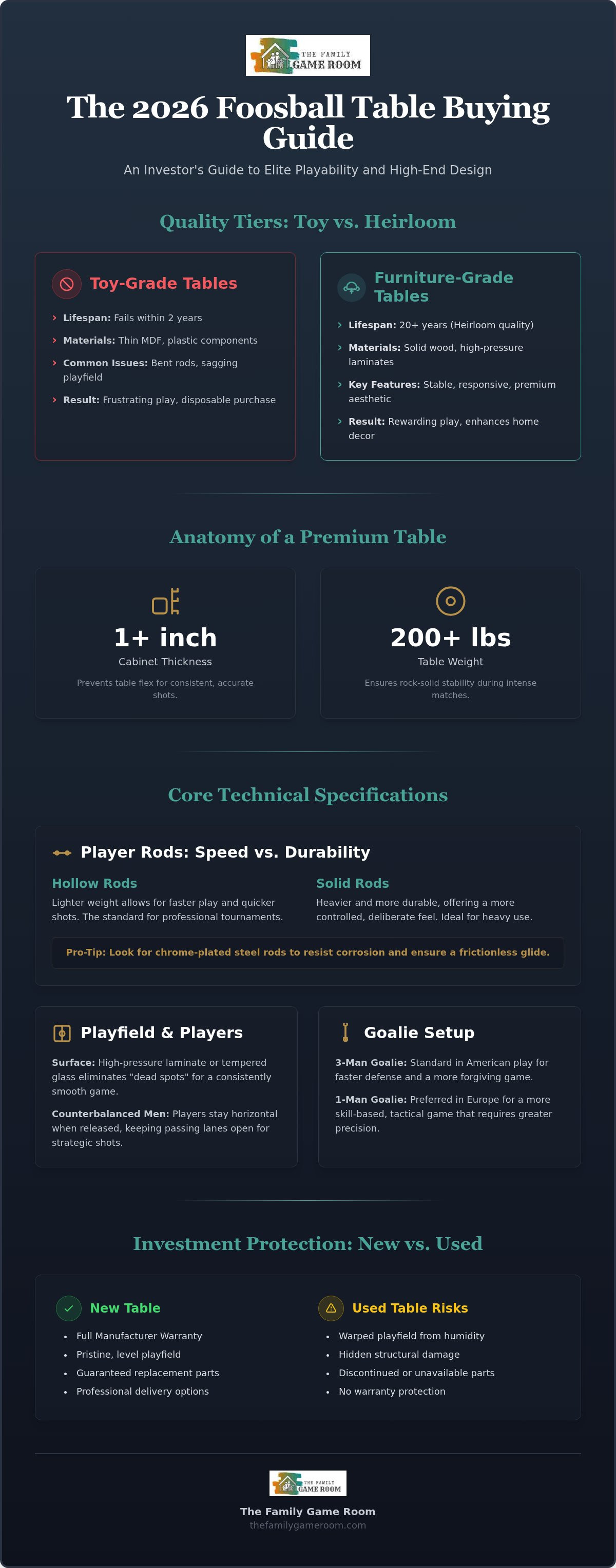
Choosing a foosball table is an investment in your home's social life. Most shoppers start by looking at price tags, but the real distinction lies in the build quality. A "toy-grade" table from a big-box retailer typically relies on thin MDF and plastic components. These tables often fail within two years as the rods bend and the playfield sags. In contrast, a "furniture-grade" table is a 20-year heirloom designed to withstand aggressive play while complementing high-end decor. This foosball table buying guide helps you navigate these tiers to find a piece that truly lasts.
High-quality play creates a psychological feedback loop. When a table responds perfectly to a player’s touch, the game becomes more addictive and rewarding for everyone in the house. Cheap tables lead to frustration; balls get stuck in dead spots and rods bind up. Understanding the History of foosball helps you appreciate the evolution from simple pub games to professional-grade equipment. Today, you'll choose between "Tournament-style" play, which focuses on speed and power, and "European" styles that prioritize ball control and finesse. Professional tables use high-pressure laminates to eliminate the dead spots found on cheaper, paper-laminate alternatives.
The Anatomy of a Premium Table
Structural integrity starts with the cabinet. You should look for a cabinet thickness of at least one inch. Thinner walls allow the table to flex, which ruins the accuracy of your shots. Weight is equally critical. A table weighing over 200 pounds remains stationary even during the most intense matches. The cabinet housing serves as the foundation for table stability, securing the playfield and rods in a perfectly aligned frame.
New vs. Used: The Hidden Risks of Second-Hand Tables
Buying a used table might seem like a bargain, but it carries significant risks. Playfields can warp over time due to humidity or poor storage, creating permanent "hills" and "valleys" on the surface that are impossible to level. Finding replacement parts for discontinued models is often difficult, turning a small repair into a total loss. Investing in a new table ensures you receive a full manufacturer warranty. This protection covers high-end components and guarantees your table remains in peak condition for years to come. By prioritizing a new, premium model, you avoid the structural compromises common in second-hand equipment.
Technical Specifications: The Mechanics of Play
Precision engineering separates a luxury table from a standard game. When you use this foosball table buying guide, you'll see that the materials used in the playfield and rods directly dictate the speed and style of your matches. High-pressure laminate surfaces provide a balanced feel, while tempered or sandblasted glass offers a faster, European-style experience. These technical nuances ensure your game room provides a professional-level challenge for guests and family members alike.
A perfectly level playfield is the most critical technical specification for any high-end table. Without it, the ball will drift, ruining the integrity of the match. Premium tables feature heavy-duty leg levelers that allow you to compensate for uneven flooring. This ensures a fair game every time. For those seeking a truly elite experience, consult the standards set by the International Table Soccer Federation. Their technical requirements for component tolerances serve as the gold standard for quality and performance.
Rods and Bearings: The Engine of the Game
Rods are the primary point of contact between the player and the game. You must choose between solid and hollow rods. Hollow rods are lighter and allow for the "fast" play found in professional tournaments. Solid steel rods offer extreme durability and a heavier feel. Chrome-plated steel is the industry standard for premium tables because it resists corrosion and provides a frictionless surface. High-quality bushings and bearings are equally vital; they allow the rods to spin and slide with zero resistance. If you want to see these mechanics in action, explore our collection of professional foosball tables designed for the modern home.
The Playfield Surface and Player Specs
The playfield design must eliminate "dead spots" where the ball becomes unreachable. Premium manufacturers solve this by slightly curving the corners or using specific ramp designs to keep the ball in constant motion. Beyond the surface, look for counterbalanced men. These players stay in a horizontal position when rotated, keeping the lanes clear for your shots during one-on-one play. You'll also need to decide between a 1-man and 3-man goalie setup. A 3-man goalie is standard in American play for faster defense, while a 1-man goalie is preferred in Europe for a more skill-based, tactical game. Choosing the right configuration depends on your preferred pace and style of play.
Size, Space, and Room Planning
Planning your room layout is just as important as selecting the table itself. A standard professional foosball table typically measures 56 inches in length and 30 inches in width. However, these figures only represent the static footprint. This foosball table buying guide emphasizes the "Active Play Zone," which includes the space required for players to move freely and rods to extend fully without hitting walls or furniture. A cramped environment leads to cautious play and accidental damage to your home's interior.
The Rod Clearance Zone
Measuring for maximum rod extension is a non-negotiable step in your planning process. When a player pulls a rod all the way out, it can extend an additional 15 inches beyond the cabinet. You should maintain at least 3 feet of clearance on both long sides of the table. This allows players to move their arms and bodies comfortably during intense matches. Proper lighting is also essential for high-speed play. Integrating billiard light fixtures directly above the table reduces shadows on the playfield, ensuring every fast-moving ball remains visible from every angle.
Multi-Game Room Flow
Creating a cohesive entertainment space requires careful positioning of your equipment. If you're placing your table near pool tables, ensure there's enough room for cue strokes and foosball rod extensions to happen simultaneously. Walkways must remain clear to prevent spectators from bumping into active players. You can balance the room's energy by placing vertical elements, such as dartboard cabinets, on nearby walls. This utilizes vertical space while keeping the floor open for larger furniture pieces. For smaller rooms, consider positioning the table diagonally. This often provides extra rod clearance in the corners without sacrificing the professional play quality you expect from a premium investment. Following this foosball table buying guide ensures your game room remains functional and inviting for every guest.
Materials and Aesthetics: Matching Your Decor
Your game room is a reflection of your personal style. A foosball table shouldn't look like a plastic afterthought in a room filled with high-end finishes. Modern designs in 2026 have shifted toward minimalist silhouettes that blend seamlessly into luxury interiors. While solid wood cabinets made of oak or maple offer the ultimate in heirloom-quality durability, high-grade MDF with premium veneers can provide a similar look with excellent stability. This foosball table buying guide encourages you to look beyond the playfield and consider the table as a centerpiece of your home's architecture.
Leg design plays a dual role in both aesthetics and performance. Tapered legs offer a sleek, mid-century modern profile that lightens the visual weight of the table. However, if your matches tend to be aggressive, block legs provide superior grounding and weight. Choosing a finish that complements your existing furniture ensures the room feels cohesive rather than cluttered. Whether you prefer a dark espresso stain or a natural light wood grain, the material choice dictates how the table ages over decades of use.
Furniture-Grade Finishes
Creating a unified look is simple when you match your table to established styles like Nixon Billiards or American Heritage. These manufacturers often use consistent stains across their product lines, allowing you to pair your foosball table with matching pool tables or bar stools. In high-traffic areas, high-pressure laminates are an excellent choice. They resist scratches and moisture while mimicking the texture of real wood. Don't forget to coordinate your hardware; selecting brushed nickel or antique brass for your score counters and rod ends provides a polished, professional touch.
The Details: Handles and Men
The smallest details often define the playing experience. Wooden handles are the preferred choice for serious players because they offer superior grip and absorb moisture during long sessions. In contrast, high-end plastic handles are durable and easy to clean but can become slippery. The "men" or players also come in various styles. Robotic players with square toes allow for advanced ball pinning and control, while classic rounded figures offer a nostalgic feel. Custom player colors can personalize a game room, allowing you to represent your favorite teams or match the room's specific color palette. To find the perfect balance of style and substance, browse our curated selection of luxury foosball tables today.
Finalizing Your Purchase: Delivery and Assembly
Selecting your table is only half the journey. This foosball table buying guide concludes with the logistical reality of bringing a 300-pound piece of furniture into your home. High-end tables require more than just a standard delivery drop-off. We recommend professional "White Glove" delivery to ensure your investment arrives in pristine condition. This service typically includes transportation to your room of choice and the removal of all heavy packaging materials, saving you the physical strain of moving a massive cabinet.
Before the delivery team leaves, perform a thorough inspection. Check the cabinet for any hairline fractures or scuffs in the finish. Slide every rod to ensure they move freely without catching or grinding. Confirm that the playfield is perfectly flat and free of any debris that could have settled during transit. Identifying these issues immediately prevents the headache of return shipping later. You should also stock up on essential accessories to maintain peak performance. You'll need 100% pure silicone spray to keep the rods gliding smoothly. Avoid petroleum-based lubricants; they can damage the bushings over time. Keep a variety of balls on hand, including cork for control and high-density plastic for speed, to cater to different playing styles.
Professional Assembly vs. DIY
While DIY assembly might seem tempting, it carries significant risks for premium equipment. Precision leveling is difficult for amateurs to master without specialized tools. One slight tilt can ruin the fair play we've emphasized throughout this guide. You also risk damaging the rods or stripping the cabinet housing during improper installation. Most manufacturers offer more robust support when you choose professional setup. This ensures the longevity of your warranty and the structural integrity of the table from the very first match.
Completing the Social Space
A foosball table thrives when it's surrounded by a lively atmosphere. Adding bar stools provides comfortable seating for spectators and waiting players. This turns a single game into a social event rather than just a quick match. Ensure your room lighting remains focused on the playfield to eliminate glare and shadows. By combining professional installation with the right accessories, you create a social hub that lasts for decades. Browse our curated collection of premium foosball tables to start your home transformation.
Elevate Your Home Entertainment with Professional Play
Investing in a professional-grade table transforms a simple game room into a sophisticated social hub. You now understand that structural integrity, technical precision, and aesthetic harmony are the pillars of a wise purchase. By prioritizing cabinet thickness and rod quality, you ensure your table remains an heirloom-quality centerpiece for decades. This foosball table buying guide has provided the blueprint for selecting a model that balances tournament-level performance with your home's luxury decor.
We're an authorized retailer for industry leaders like American Heritage and Nixon Billiards, and we provide the expert national support needed to plan your perfect space. From calculating your Active Play Zone to coordinating White Glove delivery, our team ensures a seamless experience from browsing to the first goal. Don't settle for less than elite playability and timeless craftsmanship. It's time to create the ultimate gathering spot for family and friends.
View Our Premium Foosball Table Collection and start building a legacy of home entertainment today.
Frequently Asked Questions
How much space do I really need for a foosball table?
You should plan for a space approximately 10 feet long by 10 feet wide. While the table cabinet is roughly 56 inches long, you must account for the rods extending fully on both sides. This foosball table buying guide recommends at least 3 feet of clearance on the long sides for player movement. This ensures guests don't hit walls or furniture during intense matches. Proper planning prevents damage to your home and keeps the game comfortable.
What is the difference between a 1-man and 3-man goalie?
A 3-man goalie setup is the American standard, featuring three players on the rod closest to the goal to eliminate dead spots in the corners. This design promotes a faster, more aggressive pace of play. The 1-man goalie is the traditional European configuration, requiring slanted corners on the playfield to keep the ball moving. It emphasizes precision and defensive skill. Your choice depends on whether you prefer high-speed action or tactical finesse.
Are hollow rods better than solid rods for foosball?
Hollow rods are the superior choice for professional-level speed and responsiveness. Their lighter weight allows you to move the men quickly with less wrist fatigue during long sessions. Solid steel rods are heavier and offer extreme durability in high-traffic environments, but they lack the "fast" feel of tournament-grade equipment. Most premium tables for the home utilize chrome-plated hollow steel to provide a professional experience without sacrificing the structural integrity of the rods.
How do I maintain my foosball table to make it last?
Longevity depends on regular lubrication and keeping the cabinet free from dust. Apply a few drops of 100% silicone lubricant to the rods every few months to ensure they glide smoothly through the bearings. Periodically check and tighten the bolts on the legs and players, as aggressive play can loosen them over time. Use a protective cover when the table is not in use to prevent UV damage and dust accumulation on the playfield surface.
Can I put a foosball table on a carpeted floor?
You can certainly place your table on carpet, but you must use the leg levelers to compensate for the uneven surface. A heavy, furniture-grade table weighing over 200 pounds is ideal for carpeted rooms because its mass prevents it from shifting during play. If the carpet is exceptionally plush, you might find that the table requires frequent re-leveling. Ensuring a perfectly flat playfield is the most critical step for maintaining a fair and competitive game.
What are counterbalanced foosball men and do I need them?
Counterbalanced men are designed with extra weight in the head so they stay in a horizontal position when you rotate them up. This is a must-have feature for anyone following a foosball table buying guide for serious play. It allows you to clear the lanes during one-on-one matches so your own players don't block your shots. Without this feature, the men will always fall back to a vertical position, obstructing the playfield and limiting your tactical options.
How much should I expect to spend on a high-quality foosball table?
High-quality, furniture-grade tables generally range from $1,500 to $4,000 depending on the materials and technical specifications. Tables at the lower end of this range often use high-pressure laminates, while the most expensive models feature solid wood cabinets and professional tournament-grade rods. Investing in this tier ensures you receive a piece of equipment that lasts for decades rather than a disposable toy. Higher prices reflect superior craftsmanship, better ball control, and a more refined aesthetic for your home.
What is the best way to clean foosball rods and the playfield?
Use a soft, lint-free cloth slightly dampened with water or a very mild soap solution to wipe down the playfield. For the rods, a dry cloth is usually sufficient to remove dust and oils from your hands. After cleaning the rods, always reapply a small amount of silicone lubricant to keep them moving freely. Avoid using glass cleaners or harsh chemicals on the playfield or cabinet, as these can strip the finish or damage the laminate surface over time.