


Did you know that 34% of new residential projects in metro cities now feature dedicated leisure areas? This surge in home entertainment means more homeowners are currently facing the same high-stakes decision you are. Buying a billiards table is an investment in your home's social life, but it's easy to feel overwhelmed by technical specs. Understanding what to look for in a quality pool table is the difference between a centerpiece that lasts generations and a bulky piece of furniture that loses its level within a year.
You want a playing surface that remains perfectly consistent and a design that enhances your interior aesthetic. We understand the fear of choosing a table that warps or fails to meet professional standards. This 2026 guide helps you master the technical details of premium billiards, from BCA-standard slate thickness to furniture-grade cabinetry. We will explore the essential components found in American Heritage and Nixon Billiards collections to ensure your choice delivers professional play and lifetime durability. From cushion rebound to solid wood construction, get the confidence to build a game room that truly performs.
Key Takeaways
- Understand why 1-inch slate is the non-negotiable standard for a level, warp-proof playing surface that outperforms synthetic alternatives.
- Learn how kiln-dried hardwoods and the "Mass Principle" create a stable foundation that prevents table shifting and moisture damage.
- Discover what to look for in a quality pool table regarding rail construction and natural gum rubber cushions for consistent ball rebound.
- Explore how modern dining tops transform professional tables into functional furniture without sacrificing game performance or felt protection.
- Identify the specific quality benchmarks used by elite manufacturers like American Heritage and Nixon Billiards to ensure lifetime durability and parts availability.
The Foundation of Precision: Why Slate is Non-Negotiable
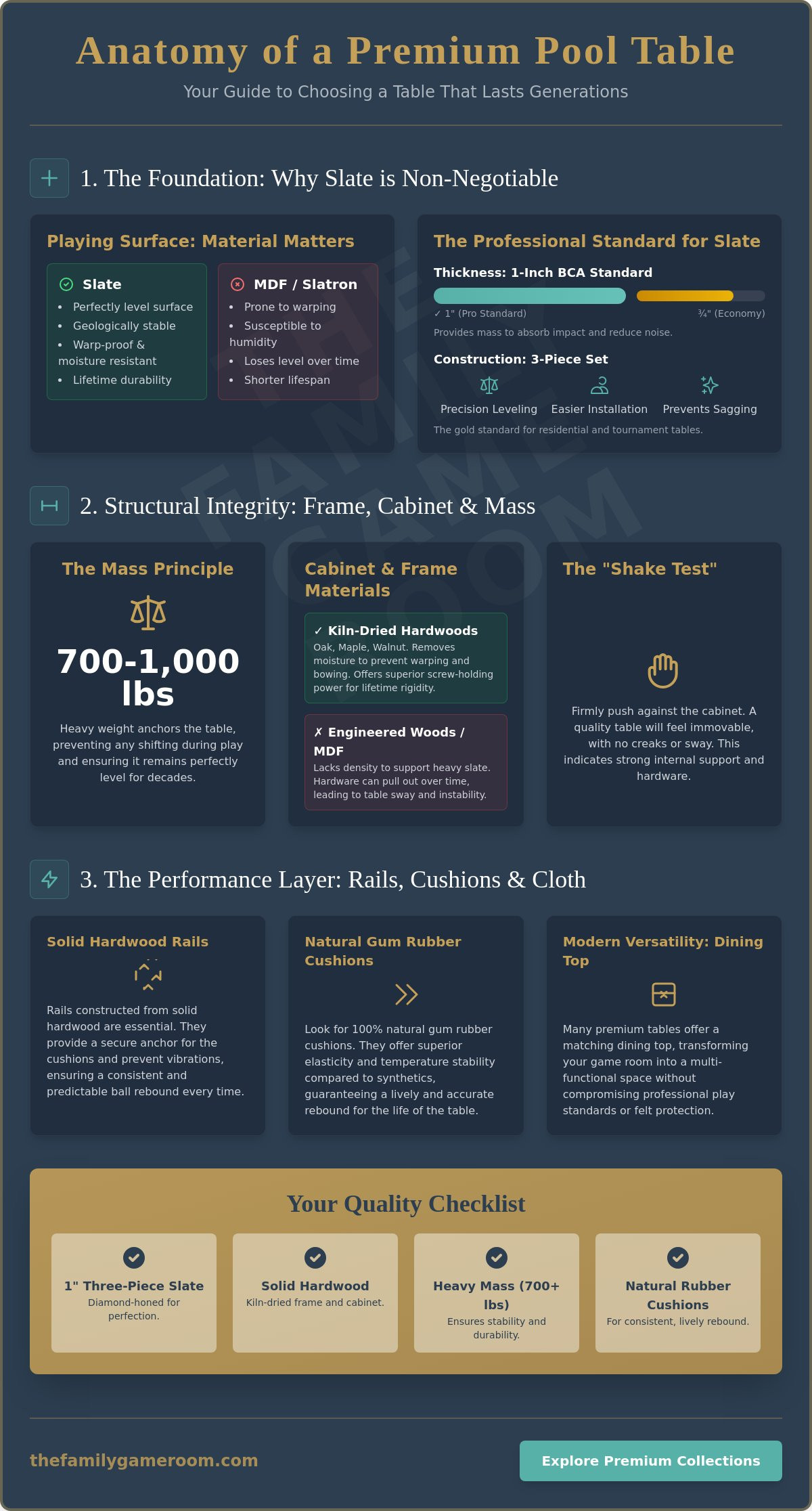
The heart of every professional game isn't the wood or the felt; it's the rock underneath. When you're researching what to look for in a quality pool table, the playing surface is your most critical decision. Slate is the only acceptable material for a table intended to last a lifetime. This metamorphic rock provides a level of geological stability that synthetic materials like MDF (medium-density fiberboard) or Slatron simply cannot match. While cheaper alternatives might look fine in a showroom, they inevitably warp when exposed to humidity or the weight of regular play.
Precision matters when you're aiming for a game-winning shot. Premium manufacturers like American Heritage and Nixon Billiards utilize diamond-honed slate to ensure a perfectly flat, friction-free surface. This industrial process grinds the stone to a microscopic level of smoothness, removing any imperfections that could deflect a slow-rolling ball. Without a diamond-honed finish, your table is just an expensive piece of furniture with an inconsistent game.
Three-Piece vs. One-Piece Slate
Don't be misled by the idea that a single slab of stone is better. Three-piece slate sets are the gold standard for high-end residential tables for several practical reasons:
- Precision Leveling: Installers can adjust each piece independently to account for floors that aren't perfectly flat.
- Structural Integrity: Segmented slate prevents the sagging that often occurs in the center of large, unsupported one-piece slabs.
- Installation Ease: Three manageable pieces are far easier to transport into basements or upstairs game rooms without risking structural damage to your home.
Professional installers use specialized wax to fill the seams between the segments, creating a seamless, monolithic joint that is undetectable through the felt. This ensures the ball rolls as smoothly across the joints as it does in the center of the table.
The 1-Inch Thickness Standard
Weight is your friend in the world of billiards. While economy tables often use 3/4-inch slate to save on shipping costs, the Billiard Congress of America (BCA) recommends a minimum thickness of 1 inch for tournament-grade play. Thicker slate provides more mass, which effectively absorbs the impact of the balls and reduces distracting surface noise. It's the difference between a hollow "thud" and a solid, satisfying "click." Slate leveling is the meticulous process of adjusting the frame to meet a 0.01-inch tolerance across the entire playing area. This level of precision is only achievable when you have the mass and stability of a full 1-inch slate bed supporting your game.
Structural Integrity: Cabinets, Legs, and Frame Mass
Stability is the invisible engine of a great game. While the slate provides the surface, the frame ensures that surface never moves. When you're evaluating what to look for in a quality pool table, start with the "Mass Principle." A premium table typically weighs between 700 and 1,000 pounds. This significant mass anchors the table to your floor, preventing the playing surface from shifting during a heavy break or an accidental bump. Without this weight, your table will eventually lose its level, regardless of the slate quality.
Material choice is the primary battleground against warping. Quality manufacturers use kiln-dried hardwoods like oak, maple, or walnut. This drying process removes deep-seated moisture, ensuring the wood won't twist or bow as your home's humidity fluctuates. Engineered woods or MDF might look identical on the surface, but they lack the structural density required to support three slabs of heavy slate for decades. Leg design also plays a role; while tapered legs offer a classic look, pedestal legs provide a broader footprint for superior weight distribution. Both must be bolted directly into the frame with heavy-duty hardware to prevent "table sway."
The Role of Solid Hardwood Cabinetry
High-end brands like American Heritage Billiards Pool Tables treat their cabinets as fine furniture. Beyond aesthetics, solid wood offers superior screw-holding power. In cheaper tables, hardware can pull out of soft composite materials over time as the table is used. Hardwood fibers grip bolts and screws tightly, maintaining a rigid connection for a lifetime. Perform a "shake test" by firmly pushing against the cabinet side. A quality table won't creak or sway; it should feel like a permanent, immovable part of the room.
Internal Support and Cross-Beaming
The internal skeleton determines if your slate will stay flat forever. Look for "quad-beam" construction, which utilizes two long center beams and two cross-beams to create a robust support grid. This configuration distributes the weight of the slate evenly across the legs, preventing the stone from cracking or sagging. Quality frames also feature slate liners, which are wood strips attached to the bottom of the slate. These liners allow the cloth to be stapled securely rather than glued, which is vital for future re-felting. Finally, insist on metal-to-metal bolt connections. Threaded inserts allow for a vibration-resistant bond that stays tight, ensuring your investment remains level and playable for the next generation. If you're ready to see these standards in person, explore our collection of premium pool tables to find the perfect match for your home.
The Performance Layer: Rails, Cushions, and Cloth
Once you've secured a solid slate and frame, focus shifts to the components that directly touch the ball. Understanding what to look for in a quality pool table involves looking beyond the frame to the performance layer. The rails and cushions determine how energy is transferred during every shot. If the rails are made of soft wood or the cushions contain synthetic fillers, the ball will lose speed and bounce inconsistently. This leads to a frustrating experience where the table feels "dead." Energy transfer is everything. High-end tables use solid hardwood rails that act as a firm backstop for the cushions, ensuring that the ball's momentum isn't absorbed by the table itself.
Pocket materials also signal the difference between a budget build and a furniture-grade investment. Professional tables feature genuine leather pockets reinforced with iron internal brackets. Unlike plastic pockets that crack over time and create a loud, hollow clatter, leather pockets are quiet and durable. They age gracefully, developing a patina that complements the hardwood cabinet. When deciding what to look for in a quality pool table, check the pocket shielding; it should be securely fastened to the rail to prevent ball snags or surface wear.
K-66 Profile Cushions: The Gold Standard
The K-66 profile is the industry standard for consistent, predictable bounce. Most premium manufacturers use natural gum rubber rather than synthetic fillers like clay. Natural rubber has "cushion memory," meaning it returns to its original shape instantly after every impact. This prevents "dead rails," a common issue in cheaper tables where the cushions become stiff or brittle after a few years. According to BCA standards, a ball shot with a firm stroke should travel between 4 and 4.5 lengths of the table. Only high-quality rubber can provide that level of sustained response.
Worsted Wool vs. Woolen Cloth
Cloth choice dictates the speed and accuracy of your game. Most home tables come with "woolen" cloth, which is thick, fuzzy, and relatively slow. While it's durable for casual family use, professional players prefer "worsted" wool. This cloth is woven with a high thread count to create a smooth, nap-free surface that allows the ball to roll faster and truer. Proper lighting from Billiard Light Fixtures reveals cloth wear patterns and helps you identify when it's time for a refresh. High-thread-count felts resist pilling and "divots," maintaining a professional playing experience even after years of heavy use.
Modern Versatility: Pool Table Dining Tops and Multi-Use
The modern home demands efficiency without sacrificing style. The rise of the dual-purpose dining pool table represents a shift toward multi-functional luxury, bringing the game from the basement into the heart of the home. When you're researching what to look for in a quality pool table, versatility is now a primary feature for homeowners who value both entertainment and floor space. These tables serve as professional playing surfaces by night and grand banquet tables by day, but achieving this balance requires specific design adjustments. A quality dining-specific table features a shallower cabinet to provide comfortable leg room when seated, yet it retains enough structural mass to support the heavy slate bed discussed in previous sections.
Aesthetic integration is the hallmark of a premium convertible set. High-end designs ensure that when the top is in place, the table is indistinguishable from a luxury dining set. This involves matching the wood grain of the dining top perfectly with the table's frame and legs. It's not just about hiding the game; it's about enhancing the room's decor. For those who enjoy hosting, these tables offer a unique social hub where the transition from dinner to a friendly match happens in seconds.
Selecting a Convertible Dining Top
A quality dining top must be as durable as the table it covers. Most premium sets utilize a three-piece top design, which makes the segments lighter and easier to store when it's time to play. Safety is paramount; look for tops that feature internal gaskets or "spill guards" along the seams. These seals prevent liquid from reaching the felt if a glass is knocked over during dinner. Brands like Nixon Billiards excel in this category, offering modern, industrial-chic designs that prioritize both sleek aesthetics and felt protection. Their innovative approach ensures that your playing surface remains pristine regardless of how often you use the table for meals.
Space Planning for Dual-Purpose Rooms
Planning your room requires accounting for two different types of movement. You need enough space for guests to pull out dining chairs comfortably and enough "clearing" for players to swing a 58-inch cue without hitting the walls. For an 8-foot table, a room size of approximately 17 feet by 14 feet is recommended to ensure adequate clearance for both furniture and active play. To complete the look, consider coordinating your table with matching bar stools or benches that can be tucked away when the game begins. This creates a cohesive environment that functions as a high-end dining room and a professional-grade billiards hall. If you're ready to maximize your home's potential, explore our collection of luxury dining pool tables to find your perfect match.
Final Selection: The Family Game Room Standard
Choosing your centerpiece requires a synthesis of everything we've explored. When you evaluate what to look for in a quality pool table, you're essentially checking a list of non-negotiable standards. You need 1-inch diamond-honed slate for a level game. You need kiln-dried hardwood for a warp-proof frame. You need K-66 profile cushions for consistent bounce and worsted wool for a professional roll. These aren't just technical specifications; they're the ingredients for a legacy piece of furniture that performs as well as it looks. A table that meets these criteria won't just sit in your room; it will define it.
Avoid the pitfalls of "bargain" buys or the uncertainty of the used market. While a used table might seem like a shortcut, it often hides cracked slate, dead cushions, or frame fatigue that only surfaces after you've paid for professional moving and setup. We act as a Trusted Curator for your home, filtering out the noise to ensure every option in our inventory meets the highest benchmarks for craftsmanship. By focusing on quality from the start, you ensure your investment remains a source of pride rather than a maintenance burden.
Why Brand Heritage Matters
Investing in established names like American Heritage or Nixon Billiards provides security that generic manufacturers cannot match. Brand heritage ensures long-term parts availability. If you ever need to replace a specific rail bolt or a unique pocket shield ten years from now, these companies will still have the blueprints. Furthermore, premium brand tables maintain significantly higher resale value. They are recognized by professional installers and collectors alike for their superior construction. Our curated inventory reflects this "approachable excellence," blending the prestige of industry-leading manufacturing with the domestic warmth your home deserves. These brands provide warranties that actually hold value, giving you peace of mind that your entertainment hub is protected.
Your Game Room Vision
Look beyond the initial price tag and consider the "cost per year of joy." A high-quality table is a multi-generational asset. It's the site of holiday tournaments, late-night practice sessions, and quiet Sunday afternoons. We believe in getting it right the first time. That's why we only sell new, high-quality equipment; you won't find used or refurbished tables in our collection. We prioritize your post-purchase happiness by offering products that can be moved, re-felted, and leveled repeatedly without losing their structural integrity. Your game room transformation starts with a commitment to quality that lasts a lifetime. Browse our curated collection of premium pool tables and find the foundation for your next great memory.
Transform Your Home with Approachable Excellence
Master the art of the game by prioritizing structural mass and geological precision. You now understand that 1-inch slate and kiln-dried hardwoods are the non-negotiable foundations of a professional-grade experience. By focusing on K-66 cushions and worsted wool, you ensure every shot reflects your skill rather than the table's limitations. Mastering what to look for in a quality pool table allows you to bypass the risks of the used market and invest in a centerpiece that truly lasts. This knowledge turns a simple purchase into a lifelong investment in your family's social life.
We are here to help you finalize that vision with confidence. As a family-owned and operated business since 2022, The Family Game Room serves as an authorized retailer for industry leaders like American Heritage and Nixon Billiards. We provide nationwide shipping on all our new equipment, ensuring your curated selection arrives safely at your door. Find your perfect premium pool table at The Family Game Room today. Your next great home memory is just a break away, and we can't wait to see your game room come to life.
Frequently Asked Questions
Is a slate pool table really worth the extra cost for a casual player?
Slate is absolutely worth the investment for any player because it ensures the table stays level forever. Unlike synthetic surfaces, slate won't sag or warp when the seasons change. Even for casual family play, a consistent roll makes the game more enjoyable. When researching what to look for in a quality pool table, remember that slate is the single most important factor for long-term satisfaction and resale value.
What is the best wood for a high-quality pool table frame?
Solid hardwoods such as maple, oak, and walnut are the premier choices for a durable frame. These species are kiln-dried to remove deep-seated moisture, which prevents the wood from twisting or bowing over time. Hardwoods also offer superior screw-holding power. This ensures that the heavy slate and legs remain securely attached, maintaining the table's structural integrity for generations of use rather than falling apart after a few moves.
How can I tell if a pool table has a 3-piece slate without taking it apart?
You can verify a 3-piece slate by looking underneath the table at the internal support structure. You'll typically see two distinct seams where the three slabs meet, usually positioned directly over the cross-beams of the frame. In some designs, you might also see the wax or leveling shims used during the initial installation. This segmented design is the industry standard for achieving a perfectly flat surface in residential settings.
Can I convert any pool table into a dining table with a top?
While you can add a dining top to most tables, dedicated models are designed with thinner cabinets to provide necessary leg room. Standard pool tables are often too tall for comfortable seating with traditional chairs. If you plan to use your table for banquets, look for designs that balance a professional 1-inch slate bed with a streamlined frame. This ensures your guests can sit comfortably without their knees hitting the cabinet.
What happens if I buy a pool table with a particle board (MDF) bed?
Particle board beds will inevitably fail because they absorb moisture and lack structural density. Within a few years, an MDF surface will sag in the middle or develop waves that make a true roll impossible. These tables cannot be leveled once they warp. Investing in slate avoids this frustration, providing a permanent foundation that remains flat regardless of your home's humidity levels or how often the kids lean on the surface.
How long should a high-quality pool table last with regular use?
A high-quality pool table is designed to last a lifetime, often spanning 50 years or more. While the felt and rubber cushions may require replacement every 10 to 15 years depending on play volume, the slate and solid wood frame are virtually indestructible. Regular maintenance, such as brushing the cloth and keeping the table covered when not in use, ensures your investment remains a centerpiece for your family's next generation.
Does the weight of the pool table affect how it plays?
Weight is a critical factor in table stability and game accuracy. A heavy table, often exceeding 800 pounds, anchors itself to the floor to prevent shifting during play. This mass absorbs the energy from the balls and the players, ensuring the slate remains perfectly still. Understanding what to look for in a quality pool table means recognizing that a heavier frame usually signals superior materials and a more reliable game for serious players.
What is the difference between K-66 and K-55 cushions?
The primary difference lies in the dimensions and the angle of the rubber profile. K-66 is the gold standard for most home and commercial tables, offering a predictable bounce for standard billiard balls. K-55 cushions are slightly larger and have a different bevel, often found on specialized tournament tables. Stick with K-66 for your home game room to ensure consistent performance and easier parts replacement if you ever need to refresh the rails.