


The heaviest, most expensive competition build might actually be the wrong choice for your family game room. When comparing a tournament vs casual foosball table, it's easy to feel caught between two frustrating extremes. You don't want a flimsy cabinet that wobbles across the floor, warps after a few fierce rallies, or traps balls in dead spots. Equally, you don't want an overly industrial commercial tank that overpowers your home's curated decor.
Getting it right comes down to understanding how table architecture shapes everyday play. You'll discover the critical engineering, gameplay, and durability differences between competition-ready platforms and recreational tables built for the home. We'll break down essential features like counterbalanced men, rod responsiveness, and furniture-grade cabinet builds so you can invest with complete confidence.
Key Takeaways
- Understand how cabinet mass and structural rigidity affect play, revealing why the choice between a tournament vs casual foosball table hinges on stability during fast-paced rallies.
- Discover how counterbalanced player figures and high-pressure laminate playfields eliminate dead spots while making solo practice effortless.
- Learn why competition-grade ball grip and responsive rod bearings actually benefit developing players rather than overwhelming them.
- Calculate your room's true spatial requirements by accounting for full rod extension and active player clearance on both sides.
- Identify furniture-grade cabinet builds that deliver robust structural durability while seamlessly complementing luxury home game room decor.
Defining the Divide: What Separates Tournament from Casual Foosball Tables?
Walking into a showroom, two tables can look remarkably alike at a glance. Yet the true divide in a tournament vs casual foosball table lies deep within mechanical engineering, cabinet rigidity, and component balance. While casual models serve as lighthearted novelties, competitive platforms trace their specifications to official table football standards that demand strict tolerances. Every physical component either accelerates shot speed or saps your control.
Cabinet Weight, Sidewall Thickness, and Stability
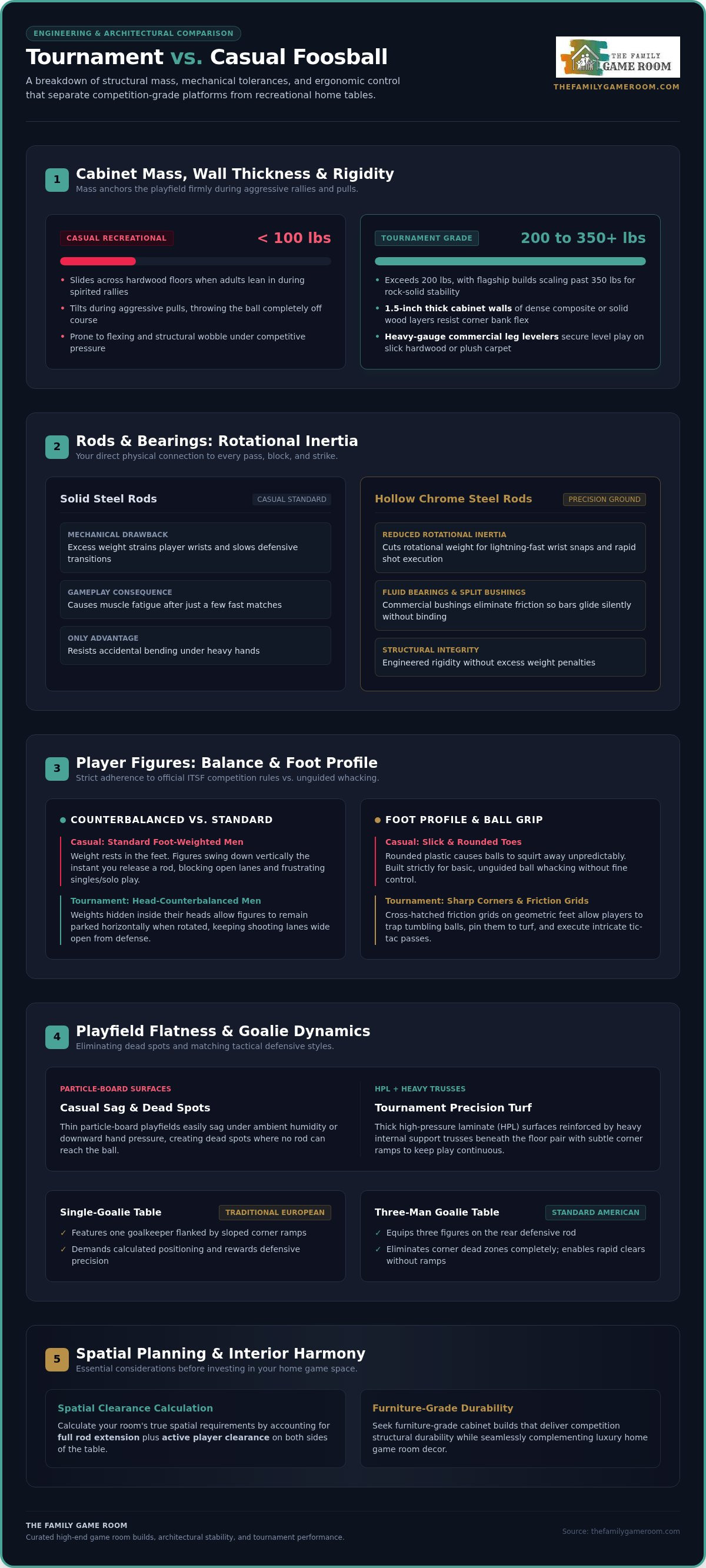
Cabinet mass directly dictates playing stability. Entry-level recreational tables often weigh under 100 pounds. When adults lean in during spirited rallies, these featherweight cabinets slide across hardwood, tilt during aggressive pulls, and throw the ball completely off course. Genuine competition platforms easily exceed 200 pounds, with flagship tournament builds scaling past 350 pounds to anchor the playfield firmly to the floor.
Much of that mass comes from cabinet sidewall construction. Competition-grade tables utilize 1.5-inch thick cabinet walls made from dense composite or solid wood layers that resist flexing during explosive corner banks. Underneath, heavy-gauge commercial leg levelers distribute table weight evenly, securing an immaculate, level surface whether resting on slick hardwood or plush carpeting.
Hollow Steel vs Solid Steel Player Rods
Player rods function as your direct physical connection to every pass, block, and strike. Casual home tables frequently install solid steel bars. While solid metal resists accidental bending under heavy hands, its excess weight strains player wrists, slows down defensive transitions, and causes muscle fatigue after just a few fast matches.
Tournament engineering favors precision-ground, hollow chrome steel rods. These lightweight rods cut rotational inertia, unlocking lightning-fast wrist snaps and rapid shot execution without sacrificing structural integrity. Commercial split bushings and fluid bearings cradle these hollow rods, eliminating friction so the bars glide silently without catching or binding during intense matches.
Performance Engineering: Men, Playfields, and Ball Return Systems
Precision gameplay relies on the tactile interaction between the ball, player figures, and playing surface. In a tournament vs casual foosball table, these components represent entirely different philosophies. Casual tables rely on basic plastic parts designed for unguided whacking. Professional-grade builds engineer every contact point according to official ITSF competition rules to maximize passing control, shot velocity, and board awareness.
Counterbalanced Figures vs Standard Weighted Men
Standard recreational figures carry weight in their feet, causing them to swing down vertically the moment you release a rod. This creates a frustrating barrier during singles matches. Tournament figures feature counterweights hidden inside their heads. Rotate a rod, and the men remain parked horizontally, leaving open shooting lanes from your defensive line.
Foot profile makes an equal difference. Casual figures feature slick, rounded toes that cause balls to squirt away unpredictably. Tournament men incorporate sharp corners and cross-hatched friction grids on their feet. This geometric profile allows players to trap tumbling balls, pin them to the turf, and execute intricate tic-tac passes between teammates.
Playfield Flatness and the Elimination of Dead Spots
Nothing stalls a heated rally faster than a dead spot where no player rod can reach the ball. Thin particle-board playfields easily sag under humidity or intense downward pressure. High-end tables solve this using thick, high-pressure laminate (HPL) surfaces reinforced by heavy internal support trusses beneath the floor.
These rigid surfaces pair with subtle corner ramps to keep the action flowing continuously. To ensure long-lasting precision in your home setup, explore the curated collection of premium builds at The Family Game Room, where structural integrity takes center stage.
Goalie Configurations: One-Man vs Three-Man Setups
Goalie setups showcase a clear regional and mechanical divide:
- Single-Goalie Tables: Traditional European platforms use one goalkeeper flanked by sloped corner ramps. This setup demands calculated positioning and rewards defensive precision.
- Three-Man Goalie Tables: Standard American tournament tables feature three figures on the rear rod. This configuration eliminates corner dead zones completely, enabling rapid clears without relying on angled ramps.
Combined with side ball returns that deliver the ball directly to your midsection rather than forcing you to reach around the table ends, professional engineering keeps your focus entirely on the game.
The Gameplay Experience: Precision Control vs Relaxed Family Entertainment
Mechanical specifications directly dictate your day-to-day playing experience. When sizing up a tournament vs casual foosball table, the divide boils down to intentional ball control versus unpredictable bouncing. Casual models often behave like chaotic pinball machines where slick plastic balls ricochet randomly off smooth player feet. Tables engineered around ITSF tournament standards replace that chaos with repeatable precision, giving every player room to develop real finesse.
Executing Advanced Shots: Snake Shots, Pins, and Passing
Controlled ball handling requires genuine surface friction. Competition tables utilize centerless-ground urethane balls that grip the laminate playfield. This tactile resistance lets you pin the ball beneath a player figure, roll it laterally across the rod, and unleash devastating snake shots or bank shots into the corner pockets.
Many homeowners worry that professional specs are too demanding for younger kids. The opposite is true. Children actually learn faster on precision equipment because the textured ball stops reliably instead of sliding away uncontrollably every time they attempt a pass.
Durability Under Fast, High-Impact Play
Spirited rallies unleash surprising kinetic force. Enthusiastic adults can bend budget rods and crack flimsy cabinet sidewalls during sudden defensive slashes. Premium tables eliminate this risk by pairing high-tensile steel rods with thick rubber shock bumpers.
These commercial bumpers cushion aggressive side-to-side movement. They absorb heavy impacts before vibration reaches the cabinet joinery, preventing structural loosening while significantly dampening acoustic clatter in open-concept living areas.
Family Friendliness and Multi-Generational Enjoyment
Heirloom-grade tables adapt seamlessly as your household evolves, enduring from early elementary play up through spirited teenage rivalries. Protective exterior rod caps prevent scratched walls and finger pinches, ensuring safe recreation in multi-use basements and bonus rooms. If you are still balancing different entertainment styles for your floor plan, review our breakdown of air hockey vs foosball to see which game pace matches your lifestyle best.
Key Buying Criteria: Matching the Table to Your Room and Lifestyle
Selecting between a tournament vs casual foosball table requires balancing spatial constraints, design preferences, and long-term utility. While commercial platforms excel in mechanical integrity, home game rooms demand furniture that integrates naturally into living spaces. Choosing the right build means finding equipment that withstands vigorous competition while enhancing your interior architecture.
Step 1: Calculate Room Dimensions and Rod Clearance
Table footprint measurements alone can be deceptive. A standard cabinet spans roughly 56 inches in length and 30 inches in width. However, fully pulled rods extend outward up to 16 inches per side during rapid defensive plays.
Plan for a dedicated player envelope of at least five feet by eight feet. This footprint gives opponents room to maneuver rods without striking walls, furniture, or passing spectators during lively family tournaments.
Step 2: Balance Tournament Specs with Furniture-Grade Aesthetics
Early coin-operated tables relied on industrial laminate boxes, sharp metal trim, and stark utility graphics. Modern luxury design takes a much warmer approach. Furniture-grade game tables encase tournament-level mechanics inside hand-rubbed timber finishes, wire-brushed accents, and clean architectural silhouettes.
These sophisticated finishes create visual harmony across large entertaining zones. You can easily coordinate your table's rich wood tones alongside handcrafted American Heritage Billiards pool tables to produce a cohesive, elevated entertainment salon.
Step 3: Factor in Long-Term Maintenance and Replacement Parts
Department-store casual tables frequently feature proprietary, non-standard parts. When a plastic rod bushing cracks or a rod bends, the entire table often becomes unusable landfill waste. Competition-grade builds rely on standardized, modular components that are simple to service over decades of regular play.
- Standardized Fasteners: Readily available split pins and silicone bumpers make figure swaps and routine rod cleaning effortless.
- Floor Protection: Heavy-duty, non-marking rubber pads fitted beneath large leg levelers protect polished hardwood surfaces from friction marks.
- Durable Finishes: Premium cross-laminated playfields resist moisture warping from accidental beverage spills and seasonal room humidity shifts.
Ready to anchor your entertainment space with an heirloom build? Explore premium game tables crafted for lasting family competition.
Elevating Your Game Space with The Family Game Room
Deciding between a tournament vs casual foosball table shouldn't force you to choose between high-performance play and upscale interior design. Too often, commercial suppliers offer cold arcade styling, while big-box department stores sell lightweight novelties that fail after a single season. The Family Game Room bridges that gap by curating heavy-duty, brand-new entertainment tables that unite professional mechanical engineering with heirloom-grade furniture construction.
Curated Craftsmanship Built for Generations
True value comes from enduring build quality. Cheap fiberboard units quickly bow, strip their screw holes, and develop permanent wobble under regular use. In contrast, our curated tables pair commercial-grade hardware, fluid bearings, and high-tensile steel rods with furniture-grade wood cabinets that hold their structural integrity year after year.
As an authorized nationwide US retailer for premier American game room manufacturers, including American Heritage Billiards and Nixon Billiards, we deal exclusively in brand-new, factory-warranted equipment. You never have to worry about the hidden wear or compromised playfields typical of used or refurbished inventory.
Creating a Cohesive Luxury Entertainment Experience
A premier foosball table works best as part of an inviting, multi-game living environment. Instead of clashing finishes and mismatched profiles, we help homeowners curate harmonious game spaces that elevate the entire home:
- Complementary Table Games: Coordinate the timber stains and leg profiles of your foosball table alongside matching indoor shuffleboard tables, air hockey tables, and poker tables.
- Seating and Storage: Integrate handcrafted bar stools, pool cue racks, and matching dartboard cabinets to create a finished clubroom atmosphere.
- Overhead Illumination: Eliminate playing surface shadows and rod glare by installing dedicated billiard light fixtures designed for optimal gaming vision.
As a family-owned small business offering dedicated nationwide customer support, our team takes the guesswork out of planning your entertainment footprint. Whether you are outfitting a dedicated basement retreat or balancing high-traffic living room play, we provide personalized guidance to ensure your gaming setup delivers decades of joyful family competition.
Choose Long-Term Playability for Your Home Game Room
Weighing a tournament vs casual foosball table ultimately comes down to structural integrity, precise ball control, and lasting enjoyment. Investing in heavy-duty cabinet architecture, counterbalanced player figures, and fluid rod bearings means you don't have to settle for warped playfields or wobbly frames. The right setup turns chaotic bounces into intentional passes, rewarding players of every skill level from the very first drop.
At The Family Game Room, we believe game room furniture should blend high-level performance with approachable excellence. As a family-owned US business and authorized retailer of top American game furniture brands, we offer a curated selection of heavy-duty, brand-new entertainment tables crafted to anchor your space for generations. Explore premium foosball tables at The Family Game Room today and elevate your family game nights with handcrafted quality.
Frequently Asked Questions
Is a tournament foosball table worth the investment for casual home players?
Yes, a tournament build is well worth the investment for casual players who prioritize durability and smooth gameplay. When comparing a tournament vs casual foosball table, entry-level models often suffer from sagging fields, dead spots, and sticky bushings that frustrate recreational players. A tournament-grade build eliminates those mechanical flaws, ensuring the table remains level, responsive, and enjoyable for decades of family gatherings.
What is the standard size of a competition foosball table?
Standard tournament foosball tables measure 56 inches in length, 30 inches in width, and 36 inches in height. These dimensions guarantee proper rod spacing and official playfield geometry. While outer cabinet walls and leg profiles vary across furniture styles, the internal playing field remains consistent at roughly 48 inches by 27 inches to support authentic tournament shot angles and ball movement.
Why are counterbalanced foosball men important during gameplay?
Counterbalanced men feature weighted heads that keep the figures horizontal when you rotate them out of play. Without internal counterweights, player figures naturally swing down vertically due to gravity. Counterbalanced men stay parked wherever you position them, which is essential during singles matches so your own forward line doesn't block defensive clear shots from the back of the table.
Can you play casual family matches on a tournament-grade foosball table?
Absolutely, tournament-grade tables offer a far superior experience for casual family game nights. High-precision surfaces, fluid bearings, and textured balls make it easier for beginners and children to control passes instead of chasing unpredictable bounces. Choosing a tournament vs casual foosball table ensures your cabinet withstands energetic matches as kids grow into competitive teenagers without wobbling or breaking down.
What is the difference between one-man and three-man goalie configurations?
The difference lies in corner ramp design and defensive pacing. Single-goalie tables require sloped corner ramps to prevent balls from stopping in dead zones, emphasizing precise positional defense. Three-man goalie setups place two extra figures on the goalie rod. This design eliminates corner dead spots entirely, enabling rapid ball retrievals and fast clears favored in traditional American competition styles.
How much floor space do I need around a full-size foosball table?
You should allocate an overall room footprint of at least eight feet wide by ten feet long for comfortable play. While the cabinet itself spans about two and a half feet in width, extended player rods push outward up to 16 inches per side during rallies. Reserving three to four feet around the perimeter keeps handles clear of walls and furniture.
Do hollow steel rods bend more easily than solid steel rods?
Quality tournament-grade hollow steel rods are heat-treated and engineered to resist bending just as effectively as solid steel. Manufacturers use high-tensile, chrome-plated steel designed to handle heavy downward torque and sudden lateral pulls. Hollow rods cut rotational weight dramatically, giving players lightning-fast shot speeds and reduced wrist fatigue compared to cumbersome solid bars.