


What if the best scorer isn’t the one with the most features, but the one everyone can see and use comfortably? A shuffleboard table with overhead electronic scorer can make it easier to follow the game without stopping to update points by hand. The right choice depends on more than the display: visibility, compatibility with the table, room dimensions, and the way your family and guests play all matter.
Because a shuffleboard table is a lasting part of a home game room, weigh convenience against fit. The overhead display should feel useful during play, not like an afterthought or an obstacle in the space.
This 2026 buying guide explains what an overhead scorer adds, which table and scorer details to compare, and how to assess room fit before choosing. Use the practical checks below to match the setup to your players and entertaining style, then plan a game room that feels polished and welcoming.
Key Takeaways
- Understand how an overhead display can help a group follow the score, and when manual scoring may be simpler.
- Use players’ usual positions and viewing angles to judge whether the display will be easy to read during a game.
- Compare the exact table-and-scorer configuration rather than assuming every setup works the same way.
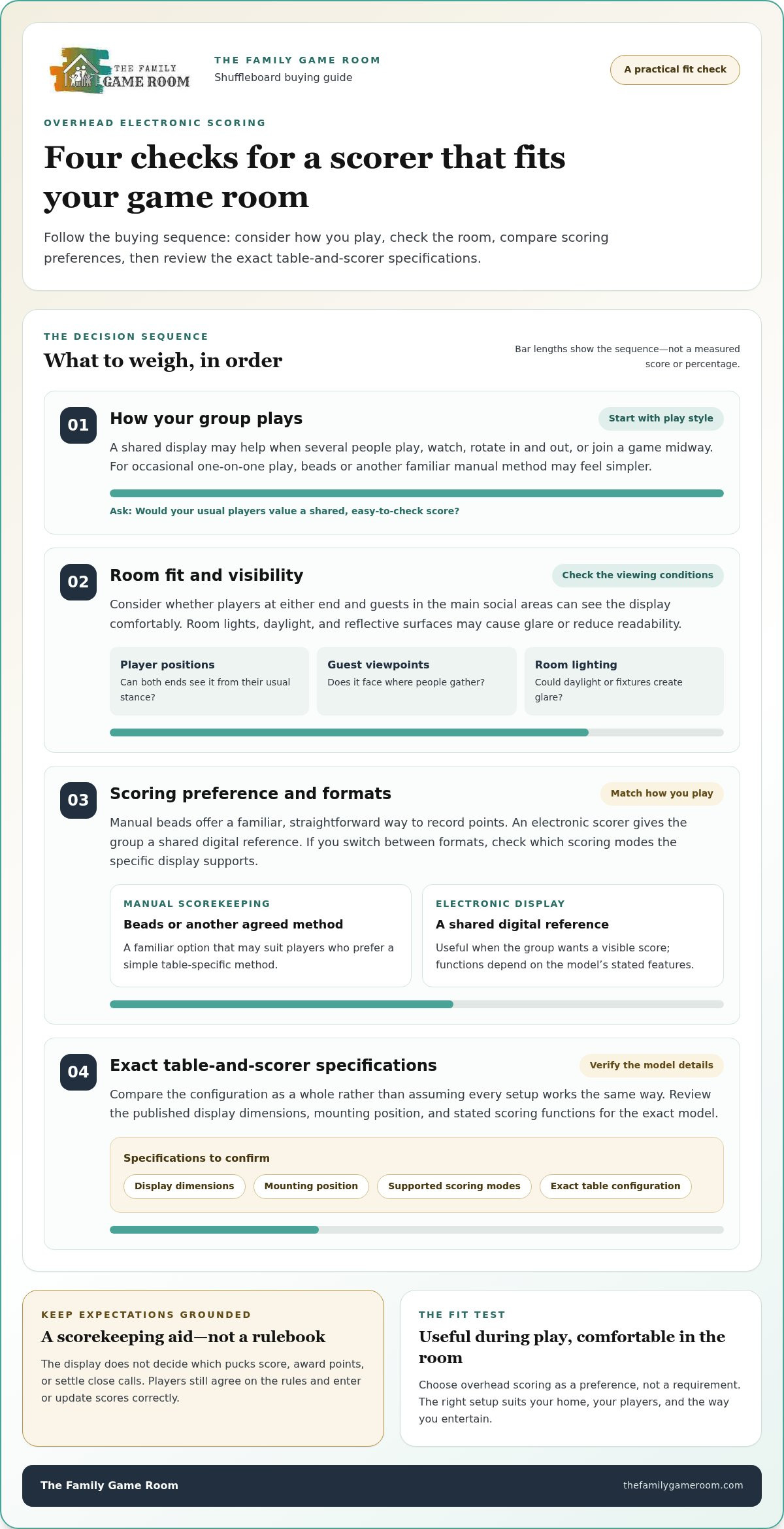
- Follow a simple buying sequence: define how you’ll play, measure the room, compare scoring preferences, and review the table specifications.
- Choose overhead scoring as a preference, not a requirement. The right setup should suit both your home and the way you entertain.
What an Overhead Electronic Scorer Adds to a Shuffleboard Table
An overhead electronic scorer is a digital display positioned above the shuffleboard playing area. Unlike manual scorekeeping, where players move beads along a scoring track or use another agreed method, it gives everyone a shared place to check the current score. That can be useful when several people are playing or watching, since the score is visible between turns.
For a shuffleboard table with overhead electronic scorer, the main benefit is convenience, not a change to the game itself. A display doesn’t determine which pucks score, how points are awarded, or how players resolve close calls. Players still need to agree on the rules and update the score as the scorer requires. For a general introduction to table-shuffleboard gameplay and scoring, see the Table Shuffleboard Overview.
How overhead scoring changes a home game
Picture a family game with players taking turns at opposite ends while others gather nearby. Instead of asking someone to recount the score or look along a scoring track after each round, players can glance at the shared display. It gives the group a visible reference point and helps everyone follow the match.
A shared view can be especially useful when players rotate in and out or a game is part of a lively evening. Guests can keep track without standing beside the person updating the score. It’s a social convenience, not a guarantee that games will move faster or scoring mistakes will disappear. Players still need to apply their chosen rules consistently and enter or update scores correctly.
Who is most likely to appreciate electronic scoring?
Households that often host group games may value a score that players and spectators can see. A display can help newcomers follow the match, whether they’re waiting for a turn or joining midway through. Families who enjoy playing several rounds may also like having the current score easy to check.
For occasional one-on-one play, manual scoring may feel perfectly natural. Beads or another familiar table-specific method keep scorekeeping simple without adding a digital display. Some players enjoy moving a bead after each turn; others prefer a prominent shared score. Neither approach is inherently better. Consider how often you play, who gathers around the table, and what makes the game enjoyable for your household.
Think of an electronic scorer as a scorekeeping aid, not a substitute for understanding the game. Before choosing, decide whether your usual players would benefit from a shared display or would rather use a familiar manual method. That preference is a useful starting point for comparing scorer and table configurations.
How to Compare Overhead Scorer Features and Scoring Options
Compare the scorer as part of the full table setup, not as a standalone promise of convenience. A product description may mention an electronic display without spelling out what it shows, where it sits, or which scoring formats it supports. Review the specifications for the exact model and consider whether those details suit your room and the way your group plays.
Display visibility, position, and readability
Imagine checking the score from both ends of the table and from the places where guests are likely to stand or sit. Review the display’s stated dimensions and mounting position. Then consider room lighting: windows, overhead fixtures, and reflective surfaces may cause glare or make a screen harder to read. A display that’s easy to see from one position may be less comfortable from another.
Use this room-and-viewing check as you compare options:
- Player positions: Consider whether players at either end can see the display without changing their usual stance.
- Viewing angles: Think about where spectators gather and whether the display faces the main social areas.
- Lighting: Account for daylight and room lights that may create glare or reduce readability.
- Stated dimensions: Compare the published display size and mounting position for each specific model rather than assuming they’re alike.
These checks help you assess visibility in your room. Use the model’s specifications to understand its dimensions and placement, since general descriptions don’t show how a particular display will look from every angle or in every lighting condition.
Electronic display versus traditional scorekeeping
Manual beads offer a familiar, straightforward way to record points. An electronic display gives the group a shared digital reference, but its usefulness depends on the functions stated for that model. Shuffleboard has a long history and has developed across formats; the History of Shuffleboard offers broader context for that evolution.
Match the stated scoring modes to the games your household actually plays. If your group sticks to one familiar format, a basic scoring method may be enough. If you switch between formats, look for explicit information about which modes the display supports. Don’t assume an electronic scorer includes every scoring variation, control, or function found on another model.
Separate confirmed product details from assumptions. A listed display dimension or scoring mode is a specification; the phrase “electronic scorer” alone doesn’t explain every capability. This makes a shuffleboard table with overhead electronic scorer easier to compare fairly with a table that uses manual scoring. To explore table options as part of a complete home setup, browse indoor shuffleboard tables and compare the table configuration alongside the scorer details.
Does an Overhead Scorer Suit Your Table, Room, and Play Style?
An overhead scorer can be a welcome feature, but it should suit the room as well as the game. Think beyond whether you like a digital display: consider where players will stand, where guests will gather, and whether the table configuration is designed to work with that scorer. A considered fit makes the display part of the setup rather than an afterthought.
Measure the room and consider sightlines
Start by mapping the planned table footprint, then account for the space players need to take turns and move around the playing area. Include the paths people will use to enter, leave, and gather nearby. You’re planning more than a furniture footprint; you’re making room for comfortable play and movement.
Next, compare the scorer’s stated position with the room’s ceiling and lighting. Look for beams, low ceilings, pendant fixtures, and other features that could intersect with the display or affect sightlines. Imagine viewing it from both ends of the table and from the places where guests are likely to watch. A layout that works for players but leaves spectators craning around a fixture may not suit your usual entertaining style.
- Mark the footprint: Use the table’s published overall dimensions, not only the playfield measurements.
- Map movement: Account for player positions and keep paths around the table clear during a game.
- Check overhead context: Compare the scorer’s specified position with ceiling features and room lighting.
- Picture the gathering: Consider whether players and guests can comfortably see the display from their usual spots.
Match the scoring setup to your household
Your play habits help clarify whether a shared display is worth prioritizing. If family members and friends regularly join in, visible game progress may help the group follow along. For occasional one-on-one play, traditional scorekeeping may be all you need. Manual scoring is a preference, not a compromise. Choose the method that feels natural for the way you use the table.
Then review the specifications for the exact table-and-scorer configuration. Don’t assume a scorer described for one model or setup automatically fits another. Compare its stated position and supported configuration with the table you’re considering, and distinguish product details from general assumptions about electronic scoring.
Use these questions to bring room and routine together:
- Will several players or guests regularly want to follow the score?
- Does the planned layout offer comfortable viewpoints without crowding the playing area?
- Do the table and scorer specifications describe the configuration you intend to choose?
If a shuffleboard table with overhead electronic scorer suits both your room and your household’s habits, the display can feel like a considered part of the setup. If not, a table with a familiar manual method may be more comfortable. Let the space and the way you play guide the decision.
A Practical Checklist for Buying a Shuffleboard Table with Overhead Scoring
A clear buying process keeps the decision focused on the complete setup, not just the appeal of a digital display. Work through these steps using the product details for the table you’re considering. The goal is to choose a configuration that suits your household, fits your room, and offers a scoring approach you’ll enjoy using.
Questions to settle before choosing a configuration
Start with your routine. Note who usually plays, how often games happen, and whether your group prefers manual scorekeeping or an overhead display. Then measure the planned room footprint and identify likely viewpoints for players and guests. These answers help you compare the setup with your actual home rather than a generic game-room scenario.
- Define how you’ll play. Consider the usual players, frequency of games, and whether visible electronic scoring or a traditional method suits your household.
- Measure the available space. Use the exact table’s published overall dimensions, then account for player movement and the paths people need around the playing area.
- Compare scoring details. Review the stated display position, dimensions, and supported scoring options. Don’t assume all electronic scorers share the same functions.
- Confirm the configuration. Check that the listing describes the table and scorer combination you intend to buy, including what comes standard and what may be an option.
Review the product listing as a complete purchase
Read the selected listing closely. Distinguish between components included with that configuration and optional upgrades described separately. A scorer mentioned in a product description isn’t necessarily part of every version of the table. Likewise, don’t apply one model’s scorer details to another model just because the tables look similar.
Review the delivery, setup, and care information provided for the specific table. These details help you plan the purchase, understand how the table will get into your home, and learn what care the product information recommends. Keep the decision focused on the exact selection rather than filling gaps with assumptions based on other tables or scorers.
Before deciding, make sure you can answer these questions: Does the table fit the room you measured? Can players and guests see the display from their likely positions? Does the listing describe the scorer configuration and included components you expect? Do the delivery, setup, and care details align with your plans?
Once those points line up, you’ll have a more confident basis for selecting a shuffleboard table with overhead electronic scorer. Explore indoor shuffleboard tables and compare the available table details as part of your home game-room plan.
Choose Your Home Shuffleboard Setup and Make the Next Move
Your final choice should bring four considerations together: room fit, scorer visibility, compatibility, and the way your household plays. A digital display may suit a lively game room where several people follow each match, while manual scoring may feel right for occasional play. Overhead scoring is a preference-led feature, not a requirement for enjoying shuffleboard at home.
Before deciding, picture the finished setup in daily use. Will players have room to take turns comfortably? Can people around the table follow the score? Does the product information describe the table and scorer configuration you want? These questions shift the focus from a single feature to a complete game-room choice that feels considered and welcoming.
Turn your shortlist into a complete game-room plan
Choose a table configuration that works with the room and the people who will play. A household that regularly hosts group games may value a display that’s easy to see from common viewing positions. If play is more occasional, a simpler scoring approach might suit the routine better. Neither choice defines the quality of the game; the aim is to make the setup feel natural in your home.
Use the specifications for each model to make your final comparisons. Check the table’s published dimensions against your available space, then review the stated scorer details and any listed accessories. Don’t assume that a feature described for one configuration carries over to another. Keep the room’s style in view, too. A shuffleboard table is both a game surface and a prominent piece of home entertainment furniture, so consider how its look and layout will work in the room.
- Room fit: Does the selected table suit the available footprint and planned activity around it?
- Display visibility: Can players and guests see the scorer from their usual positions?
- Configuration: Do the exact model specifications describe the table-and-scorer setup you intend to choose?
- Play habits: Does the scoring method match how often, and with whom, you expect to play?
Explore indoor shuffleboard tables
The Family Game Room sells new indoor shuffleboard tables and premium game-room equipment. Browse the category with your shortlist in mind, comparing the details provided for each table rather than assuming every setup includes the same scorer or accessories. This helps you focus on options that align with your space, preferences, and plans for entertaining.
Whether a shuffleboard table with overhead electronic scorer is your ideal fit or you prefer a traditional approach, let the complete setup guide your decision. Explore indoor shuffleboard tables and take the next step toward a polished home game room made for gathering and play.
Make Room for More Game-Night Memories
The right shuffleboard setup should feel at home in your space and make it easy to bring people together. Let your room, players, and preferred way of keeping score shape the decision. An overhead display can be a welcome extra, but a shuffleboard table with overhead electronic scorer is the right choice only if its configuration suits your home and the way you play.
The Family Game Room is a family-owned retailer of new indoor shuffleboard tables and game-room equipment for homes across the United States. As you explore your options, picture the table not just as a purchase, but as the setting for friendly rivalries, shared traditions, and evenings that linger a little longer.
Ready to find a table that fits your game room? Explore indoor shuffleboard tables and start planning a welcoming space for your next match.
Frequently Asked Questions
Is an overhead electronic scorer worth it for casual shuffleboard games?
It can be worthwhile if your group plays often or several people like to follow the score together. A shared display can give players and onlookers the same point of reference, especially when people take turns joining in. If you play only now and then, manual scoring may feel just as comfortable. Consider whether the display would add useful convenience to your shuffleboard table with overhead electronic scorer setup.
Can an overhead electronic scorer display different shuffleboard game formats?
Some scorers may support different formats, but the available functions depend on the specific model. Look for the scorer’s stated modes and compare them with the games your household plays. The display’s capabilities aren’t the same as the rules of the game: players still need to agree on how points are earned and counted. Don’t assume a digital unit offers multiple modes or applies official rules automatically.
Does an overhead electronic shuffleboard scorer need a power outlet?
Power requirements depend on the scorer’s design, so use the exact product specifications. Look for the stated power arrangement and account for it when planning where the table will sit. Don’t assume the unit uses a wall outlet, batteries, or any particular cable setup. Use the product’s operating information to understand its power requirements before finalizing your room plan.
Can an electronic scorer be added to an existing shuffleboard table?
Compatibility depends on both the table and scorer design. Mounting and connection requirements can differ, so don’t assume a scorer that works with one table will fit another. Compare the specifications for the exact table and scorer, including any stated compatibility details. For a retrofit, base the decision on those documented requirements rather than a general product description or an assumption that overhead units have a universal fit.
What happens if an electronic scorer stops working during a game?
Pause play and, if everyone agrees, keep score manually while you decide what to do next. This lets the game continue without relying on a display that isn’t working. For troubleshooting, follow the scorer’s operating instructions rather than guessing at a reset or repair. If you switch to manual scoring mid-game, make sure all players agree on the current score and the method you’ll use to track the remaining points.
Are overhead electronic scorers sold with every shuffleboard table?
No, table configurations vary. Depending on the specific listing, an overhead scorer may be included, offered as an optional upgrade, or sold separately. Read the configuration and included-components details carefully, and distinguish standard equipment from selectable extras. This matters when comparing similar-looking tables: a scorer shown or mentioned in a description doesn’t necessarily come with every version. Review the listing for the exact table you’re considering to understand what the purchase includes.