


What if the 14-foot premium table you’ve been dreaming of actually requires 20 feet of open floor space to be playable? You likely agree that a game room should be a sanctuary for fun, not a cramped obstacle course where you're constantly bumping into walls. With the residential segment accounting for 45% of the shuffleboard market in 2025, more families are integrating these tables into multi-purpose living areas. Getting the shuffleboard table clearance space right is the difference between a professional setup and a costly mistake.
This guide provides the exact blueprints you need to plan your room with total confidence. We will break down the industry-standard 2-to-3-foot clearance rules and explain the 36-inch pathway requirements mandated by the ADA for public spaces. You'll gain the technical specs needed to choose a high-quality table that fits your home perfectly. Explore our measurements and prepare your space; satisfied you shall be with the results.
Key Takeaways
- Distinguish between cabinet length and playfield dimensions to ensure your new furniture fits the physical room footprint.
- Calculate the ideal shuffleboard table clearance space using the "End-Zone Rule" to guarantee a comfortable shooting stance for every player.
- Discover layout strategies for multi-game rooms that allow you to share walking paths between tables and maximize floor utility.
- Identify hidden space-stealers like wall trim and electronic scoring units that can disrupt even the most precise room measurements.
- Select a premium table from industry leaders like Nixon or American Heritage that balances professional playability with your home's unique interior design.
Understanding Shuffleboard Table Dimensions vs. Play Space
Planning your shuffleboard table clearance space starts with a clear understanding of the equipment itself. You can't simply measure the length of your wall and assume a table of the same size will fit. A shuffleboard table is composed of two primary parts: the playfield and the cabinet. While the cabinet defines the physical footprint in your room, the playfield is where the action happens. High-end brands like American Heritage Billiards and Nixon Billiards prioritize a "cradle" design, which is the outer wooden frame surrounding the playing surface. This cradle isn't just an aesthetic choice; it serves as the foundation for all your room measurements.
Cabinet vs. Playfield: Why the Numbers Matter
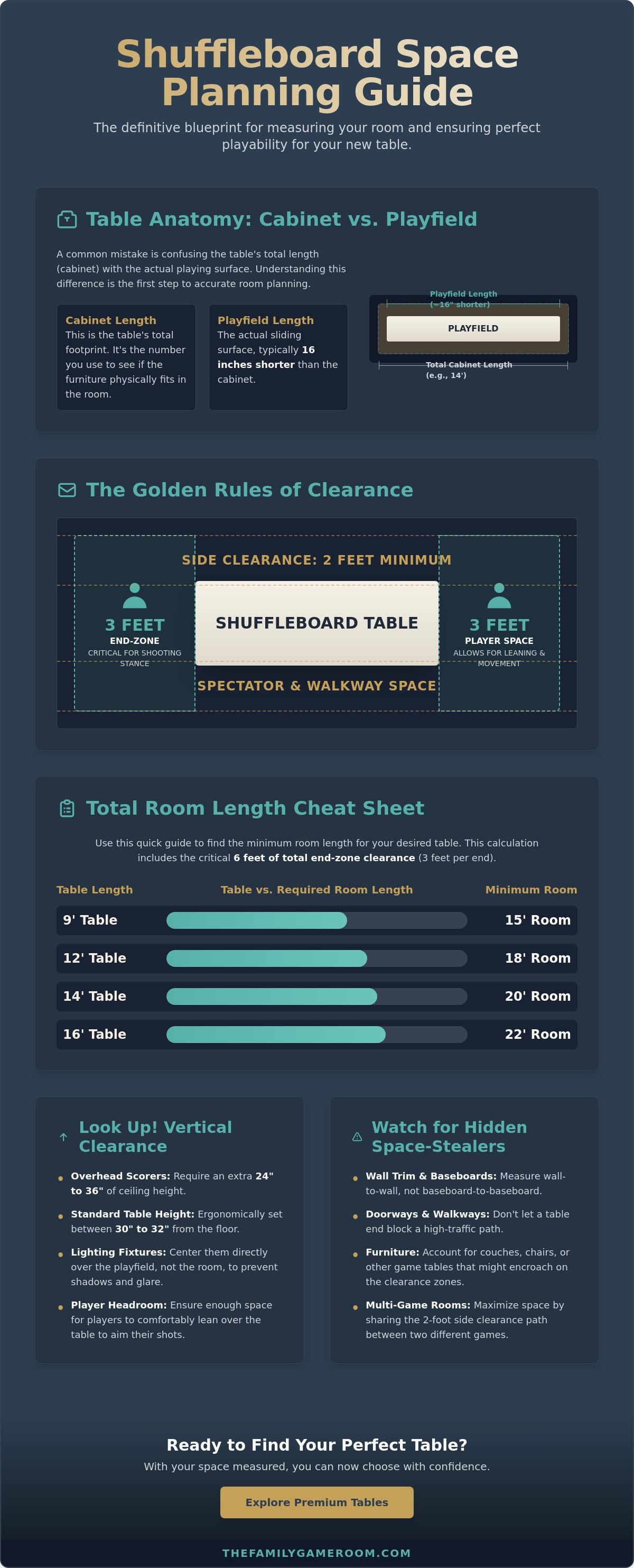
The playfield is the solid maple surface where the puck actually slides during a game. It's a common mistake to assume a 12-foot table offers 12 feet of sliding surface. In reality, the playfield is usually 16 inches shorter than the cabinet length. This means a 12-foot table provides roughly 10 feet 8 inches of actual game space. The surrounding cradle acts as a gutter for missed shots, but it also serves as the critical starting point for your measurements. Because the cradle depth dictates where a player must stand to aim their shot, you must account for this buffer when calculating your total floor requirements. Unlike some lower-end models, premium tables use a 20-inch wide playfield. This width is the gold standard for professional playability and ensures the table remains a centerpiece of your home for years.
The Vertical Dimension: Ceiling Height and Scoring Units
While floor space is the primary concern, vertical clearance is equally important for a professional setup. If you choose a table with an overhead electronic scoring unit, you must ensure your ceiling height can accommodate the extra 24 to 36 inches of height these units require. Even without a scorer, players need "headroom" as they lean over the table to judge angles and speed. When installing Table shuffleboard equipment, remember that lighting is a specialized task. Your billiard light fixtures should be centered directly over the playfield rather than the center of the room. This prevents shadows and glares that can ruin a high-stakes game. In 2026, the ergonomic standard for table height remains 30 to 32 inches, providing a comfortable reach for players of all heights. Satisfied you shall be when your layout accounts for both the horizontal and vertical needs of the game.
Measuring Your Minimum Clearance Requirements
Calculating the shuffleboard table clearance space involves more than just fitting a cabinet between four walls. You have to account for the humans interacting with the machine. Professional play requires a specific range of motion that static measurements often overlook. While the table itself is the centerpiece, the "activity zone" around it determines whether your game room feels like a luxury lounge or a cramped hallway. To maintain the high-end experience promised by brands like Nixon Billiards, you must prioritize the space where the players actually stand and move.
The Player Stance Zone: Why Ends Are Critical
Three feet of clearance behind each end is the gold standard for a proper shooting stance. When you prepare to release a puck, you don't stand perfectly upright. You lean forward, extending your arm while often bracing with a back leg. This ergonomic "lean" shifts your center of gravity and requires significant floor depth. Standing sideways to the table also means your hips and shoulders need more clearance than a person simply walking past. If you place a table end directly against a doorway or a high-traffic walkway, you risk collisions every time a family member enters the room. When researching Advanced Layout Strategies, professional designers often prioritize these buffer zones to ensure the game remains the focus, not the obstacles.
Side clearance is equally vital for a comfortable environment. Maintain at least 2 feet of space along the long sides of the table. This allows spectators to watch the action without pressing against the walls and gives players room to move from one end to the other between rounds. If you're tight on space, you can push one side closer to a wall, but never sacrifice the end-zone clearance. Browse our collection of premium shuffleboard tables to find a model that respects your room’s unique dimensions.
Total Room Footprint Cheat Sheet
To simplify your planning, use this quick-reference list for total room length. These figures include the necessary 6 feet of total end clearance (3 feet per side) added to the cabinet length. Satisfied you shall be when you follow these precise requirements:
- 9ft Table: Requires a minimum room length of 15 feet.
- 12ft Table: Requires a minimum room length of 18 feet.
- 14ft Table: Requires a minimum room length of 20 feet.
- 16ft Table: Requires a minimum room length of 22 feet.
- 22ft Table: Requires a minimum room length of 28 feet.
Before your delivery arrives, use painter’s tape to mask out these dimensions on your floor. This simple visualization trick helps you see exactly how much shuffleboard table clearance space remains for other furniture. It's better to discover a tight squeeze with tape than with a 500-pound slate table. Planning with this level of detail ensures your home entertainment investment provides years of professional-grade enjoyment.
Advanced Layout Strategies for Multi-Game Rooms
Creating a high-end entertainment hub often involves balancing multiple pieces of premium furniture. In 2026, the trend has shifted toward multi-functional spaces where a single room serves as a lounge, gym, and gaming center. Mastering your shuffleboard table clearance space in these environments requires a "shared clearance" mindset. Instead of treating every table as an island, you can overlap walking paths and activity zones to maximize your square footage without sacrificing the professional feel of the room.
The shared clearance concept works best when you pair a shuffleboard table with a pool table. While a billiard player needs roughly 5 feet of space for a full cue extension, a shuffleboard player only requires 2 feet along the sides for movement. By placing these two "activity zones" next to each other, you can reduce the total required floor space by approximately 15% to 20%. This layout ensures that the room remains open and airy, maintaining the "approachable excellence" that defines a luxury home.
The Billiards and Shuffleboard Pairing
A shuffleboard table is the ultimate perimeter game. Its long, slender profile makes it the perfect companion for a pool table, which usually anchors the center of the room. Position your shuffleboard along the longest wall to keep the central traffic lanes clear. If you use Pool Table Dining Tops to convert your billiard table for entertaining, the shuffleboard acts as an elegant sideboard for guests. Just remember to account for cue-swinging room. A player taking a shot at the pool table shouldn't have to worry about hitting the shuffleboard cabinet. Aligning the shuffleboard parallel to the wall is the most efficient way to maintain this balance.
Zoning Your Entertainment Space
Visual boundaries help define the flow of a multi-game room without building physical walls. Use premium rug placement to anchor the shuffleboard zone and separate it from the rest of the room. You can fill "dead space" near corners with dartboard cabinets or floor-standing cue racks. These accessories add to the room's character without encroaching on the critical shuffleboard table clearance space. For spectator seating, place bar stools along the "non-shooting" side of the table. This keeps guests close to the action but safely out of the player’s ergonomic stance zone. By curating your layout with brands like Nixon Billiards and American Heritage, you create a cohesive environment where every piece of furniture has a purpose. Plan your zones carefully; satisfied you shall be with the results.
Common Obstacles and Space-Saving Hacks
Measuring for your shuffleboard table clearance space requires precision that goes beyond simple wall-to-wall distances. One of the most frequent errors homeowners make is measuring from the drywall. In reality, you must start your tape measure from the baseboard or decorative trim. Standard baseboards can take up to an inch of floor space on each side. This might sound minor until you're trying to wedge a 12-foot Nixon Billiards cabinet into a tight corner. Always subtract the thickness of your trim from your room's total width and length before finalizing your purchase.
Planning for power is another critical step. If you've selected a premium table with an electronic scoring unit, you'll need proximity to an outlet. Pole-mounted scorers require extra vertical clearance and can sometimes interfere with wall-mounted decor. To avoid trip hazards, position your table so the power cord runs directly to a floor outlet or use a professional-grade cord cover that matches your flooring. Don't forget to check the swing radius of every door in the room. A heavy oak door swinging into the side of a high-quality maple cradle is the fastest way to damage your investment. Ensure all doors have at least 6 inches of clearance from the table's edge at their widest point.
Obstructions You Might Miss
Lighting placement is a frequent gap in most planning guides. While you need bright, even light across the playfield, hanging a billiard light fixture too low creates a "lean" hazard. A player focused on a long shot might bump their head when standing up. Aim for a mounting height of 30 to 36 inches above the playing surface. Additionally, look up at your HVAC vents. Blowing hot or cold air directly onto a solid wood playfield can cause the maple to warp or the wax to become inconsistent. Finally, avoid placing your table in direct sunlight. UV rays can fade the finish over time, and the glare on a freshly waxed surface makes it nearly impossible to judge distances during a game.
Small Room Solutions
If your room dimensions are borderline, choosing a 9-foot table over a 12-foot model is often the better move for overall room flow. It's better to have a smaller table with perfect clearance than a longer table that blocks traffic. In extremely tight spaces, some owners use a "One-End Access" layout by pushing one end against a wall. This limits the game to "knock-off" styles only, but it preserves space in multi-use rooms. You can also save about 6 inches of end clearance by adopting a "hock-style" stance, where you crouch lower and keep your back leg tucked rather than extended. Ready to find the right fit? SHOP NOW for premium indoor shuffleboard tables that match your space requirements.
Selecting the Perfect Table for Your Space
Choosing the right table is about more than just fitting into your shuffleboard table clearance space. It's about finding a piece of furniture that complements your home’s architecture and your family’s lifestyle. If your home features a contemporary aesthetic, Nixon Billiards offers sleek, minimalist designs that blend into modern living rooms or home offices. For those who prefer a timeless look, American Heritage Billiards provides classic wood finishes that evoke the feeling of a traditional luxury club. Since the residential segment now accounts for 45% of the shuffleboard market as of 2025, manufacturers are increasingly designing tables that serve as both professional gaming equipment and high-end furniture.
Investing in "New" equipment ensures you receive a factory-perfect, level playfield from day one. Unlike used equipment which may have hidden structural issues, new premium tables are built to withstand the test of time. Our inventory features only top-quality construction, ensuring that your investment remains a centerpiece of your home for decades. To provide total peace of mind, we offer a Price Match Guarantee on our entire collection. This commitment to value ensures you never have to choose between professional quality and a fair price.
Quality Indicators for Your Layout
Always look for climatic adjusters beneath the playfield. These heavy-duty metal bars allow you to fine-tune the curvature of the maple as your home’s humidity levels change throughout the seasons. This is a critical feature for maintaining professional playability in varied climates. The visual impact of premium wood finishes, such as those found on American Heritage Billiards models, adds a layer of domestic warmth to any room. When you choose from our professionally curated selection, satisfied you shall be with the long-term stability and aesthetic appeal of your game room.
Ready to Transform Your Game Room?
Before you finalize your purchase, run through one last checklist. Confirm your shuffleboard table clearance space measurements start from the baseboards, not the drywall. Verify that your billiard light fixtures are centered over the playfield to eliminate shadows. Ensure your walking paths remain at least 36 inches wide to maintain a comfortable flow. Once these boxes are checked, you're ready to upgrade your home entertainment. Explore our full collection to find the table that speaks to your style and fits your space perfectly. Shop our premium shuffleboard collection at The Family Game Room today and take the first step toward a professional-grade gaming experience.
Ready to Build Your Ultimate Home Game Room?
You now have the blueprints to transform your floor plan into a professional-grade arena. By prioritizing the 3-foot end-zone rule and accounting for architectural obstacles like baseboards, you've ensured every shot is comfortable and every game is competitive. A successful layout balances the static footprint of the cabinet with the dynamic needs of the player. Perfecting your shuffleboard table clearance space is the final step before bringing home a piece of approachable excellence.
As an authorized dealer for premium brands like American Heritage and Nixon Billiards, we bring family-owned expertise established in 2022 directly to your home. We stand by the quality of our inventory and back every purchase with a Price Match Guarantee to ensure you receive the best value on the market. Our team is ready to help you finalize your layout and select a table that your family will enjoy for decades. Explore our American Heritage and Nixon Billiards shuffleboard tables today! Your dream game room is within reach. Satisfied you shall be.
Frequently Asked Questions
How much room is required behind the table to play shuffleboard?
You need 3 feet of space at each end of the table. This distance accommodates the natural forward lean and back leg extension required for a professional release. While you can technically play with 2 feet, the reduced range of motion often leads to inconsistent puck speed and poor accuracy. For the best experience, stick to the 3-foot gold standard.
Can I put a shuffleboard table in a 12-foot room?
A 12-foot room is too small for a standard 12-foot table, but it can accommodate a 9-foot model if you prioritize one shooting end. To allow for the recommended 3 feet of clearance on both ends, a 9-foot table usually requires a 15-foot room. In a 12-foot space, you'll be limited to 1.5 feet per end, which is quite tight for adult players.
What is the standard width of a shuffleboard table and its clearance?
Most premium shuffleboard cabinets measure between 28 and 31 inches in width. For the best experience, add 2 feet of clearance on at least one long side to allow for player movement and spectator seating. This brings the total width requirement for your shuffleboard table clearance space to approximately 5 feet, ensuring the room remains functional and open.
How do I measure for a shuffleboard table if I already have a pool table?
Start by identifying the "cue zone" of your pool table, which is typically 5 feet from the rail. Your shuffleboard cabinet should sit outside this perimeter to prevent collisions during a player's backswing. Placing the shuffleboard parallel to a long wall often provides the most efficient use of shared floor space while keeping the center of the room clear.
Do I need extra space for an electronic scoring unit?
Yes, pole-mounted electronic scoring units require an additional 4 to 6 inches of clearance from the wall to accommodate the mounting hardware. You must also ensure your ceiling height allows for the 24 to 36 inches of vertical space these units occupy above the cradle. Planning for this height ensures the unit doesn't interfere with existing light fixtures or low ceilings.
Is 2 feet of side clearance enough for a home game room?
Two feet of side clearance is the industry standard for home game rooms. This provides enough room for players to walk between ends and for guests to watch the game without feeling crowded. If you're placing the table in a multi-use room, this 2-foot buffer helps maintain a clear pathway for foot traffic and keeps the area from feeling cramped.
What happens if I don’t have enough clearance behind the shuffleboard?
Insufficient clearance forces players into a "short-arm" release, which ruins the physics of the slide. You also risk hitting your elbows or hips on the wall behind you. If your shuffleboard table clearance space is too small, you'll likely see an increase in wall scuffs and a significant drop in game quality as players struggle with their stance.
Can a shuffleboard table be placed against a wall?
You can place one long side of the table directly against a wall to save space in narrow rooms. However, you must never place the shooting ends against a wall. Professional playability depends on having that 3-foot buffer at both ends so players can properly sight their shots and follow through without obstruction. Satisfied you shall be with a layout that respects these boundaries.