


What if the most important shot in your next match isn't the one that scores, but the one you hold onto until the very end? Most casual players overlook the strategic power of "The Hammer," yet it's the single most decisive factor in competitive play. You've likely experienced the frustration of a friendly game stalling because of a disagreement over a "hanger" or a confusing foul. It's difficult to enjoy the game when the shuffleboard rules feel like a moving target.
We're here to turn that uncertainty into expertise. This guide provides a comprehensive breakdown of the official 2025 tournament standards, ensuring you're ready for everything from a Friday night family match to the 36th annual North American Shuffleboard Championships in October 2026. You'll learn the exact mechanics of legal play, including puck weight requirements of 310 to 355 grams and proper scoring for every zone. We'll walk you through turn order, "knock-off" strategies, and the secrets to hosting a professional-grade tournament right in your own game room. Satisfied you shall be as you master the finesse of the table.
Key Takeaways
- Master the core mechanics of a match, from the initial coin toss to the strategic delivery of all eight weights.
- Learn how to accurately calculate points across three zones and identify "hanger" shots using official shuffleboard rules.
- Understand the strategic importance of "The Hammer" and how to use the last-shot advantage to control the board.
- Discover professional table etiquette and maintenance tips to protect your playfield surface and ensure consistent puck friction.
- Explore how premium table features from brands like American Heritage Billiards provide the stability needed for tournament-grade play at home.
The Fundamentals of Table Shuffleboard Rules
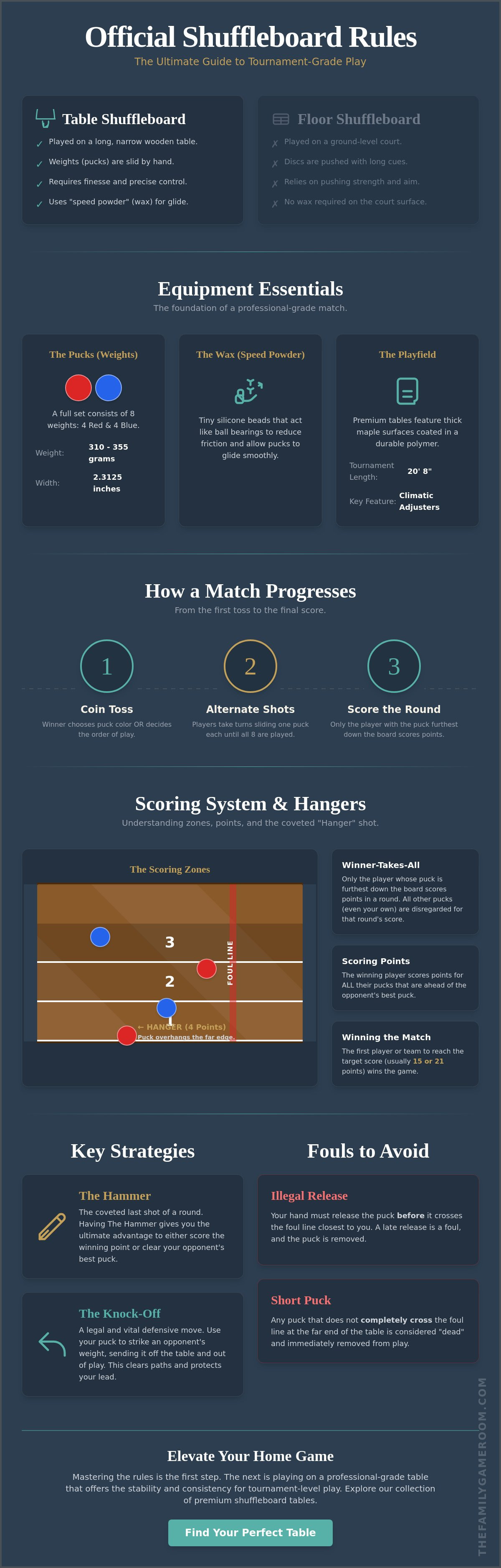
Table shuffleboard is a game of finesse and strategic positioning. It's played on a long, polished wooden surface where every millimeter of movement counts. Your primary objective is to slide weighted pucks into the highest scoring zones at the far end of the table. If a weight falls off the edge, it's out of play. You can compete in singles matches or team up for doubles. Most competitive matches follow standard shuffleboard rules that set the winning target at either 15 or 21 points. Official tournament planks, like those used in the North American Shuffleboard Championships, measure exactly 20 feet 8 inches in length.
Table vs. Floor Shuffleboard: Key Differences
Don't confuse this indoor classic with the floor-based version found at parks or on cruise decks. While floor shuffleboard relies on long cues to push discs, table shuffleboard requires you to throw metal weights by hand. This physical connection to the weight allows for much more control over spin and speed. The scoring zones also differ significantly. On a table, the zones are simple horizontal bars at the end of the playfield. You must also account for the foul line. Any weight that doesn't cross this line is immediately removed from the board. Indoor play also requires a specialized "speed powder" to create the necessary glide across the wooden surface.
Equipment Essentials: Pucks, Wax, and Playfields
Quality equipment is the foundation of a great match. Each game uses eight weights, typically split into four red and four blue pucks. These aren't just simple metal discs. Official tournament weights must measure exactly 2.3125 inches wide and weigh between 310 and 355 grams. To ensure these pucks move smoothly, you'll apply shuffleboard wax. This isn't a liquid; it consists of tiny silicone beads that act like ball bearings to reduce friction. Applying the right amount of wax is a skill in itself and is a core part of mastering shuffleboard rules for consistent play.
The playfield itself is the centerpiece of your game room. Premium tables from brands like American Heritage Billiards or Nixon Billiards often feature thick maple surfaces coated in a durable polymer. One critical component often overlooked by beginners is the climatic adjuster. These are metal brackets located under the table. They allow you to fine-tune the curve of the wood, ensuring the surface stays slightly concave despite changes in humidity. This level of technical detail ensures your home setup remains professional for years. Satisfied you shall be with a table that plays as good as it looks.
Step-by-Step Gameplay: How a Match Progresses
Every professional match begins with a simple coin toss to establish the opening rhythm. The winner of the toss makes a critical choice: they either select the color of their weights or decide the order of play. In most competitive settings, players prefer to choose the order of play first to secure a strategic advantage. Once the match starts, players alternate sliding their pucks from the same end of the table. You'll deliver one weight, then your opponent delivers one, continuing this pattern until all eight weights have been played. This alternating flow is a cornerstone of the Official Table Shuffleboard Rules, ensuring neither side can dominate the board too early.
The round is only complete after all eight weights are at the opposite end of the playfield. At this point, the scoring is calculated based on the final positions of the pucks. It's a "winner-takes-all" scoring system for the round; only the player whose weight is furthest down the board receives points. Any of the opponent's weights are ignored for scoring purposes, regardless of how well they placed. This creates a high-stakes environment where a single shot can negate an opponent's entire round. If you want to practice these maneuvers daily, investing in one of our indoor shuffleboard tables ensures your home game matches professional standards.
The Delivery: Proper Technique and Rules
Weights must completely cross the foul line to stay on the table; otherwise, they are dead and removed from play immediately. To ensure a legal delivery, your puck must be released from your hand before it crosses the first foul line closest to you. Mastering the "knock-off" is also essential. You are legally allowed to use your puck to strike an opponent's weight, sending it into the alley and out of play. This defensive maneuver is just as vital as scoring, as it clears the path for your own future shots and protects your lead.
Understanding "The Hammer" Strategic Advantage
In the world of shuffleboard rules, "The Hammer" is the most coveted position. This term refers to the very last shot of a round. Having the Hammer is a massive advantage because it allows you to have the final word on the board's layout. You can use this last puck to knock off an opponent's high-scoring "hanger" or carefully slide into a protected zone to snatch the points for the round.
The turn order is not fixed throughout the match. The player or team that scored in the previous round must shoot first in the next round. By scoring points, you effectively lose the Hammer for the following round. This creates a fascinating tactical push-and-pull where players sometimes choose to score fewer points or even "blank" a round to retain the Hammer for a more critical moment. Satisfied you shall be when you finally master this level of strategic depth.
Scoring Systems: Points, Zones, and Hangers
The scoring grid on a premium playfield is divided into three distinct zones. These areas are marked for 1, 2, and 3 points respectively. While these numbers seem straightforward, the strategy behind shuffleboard rules involves more than just reaching the end. Points are only awarded to the player or team whose weight is furthest down the board. Once the winner of the round is determined, they receive points for every one of their weights that sits closer to the far edge than the opponent's best shot. Any weight that fails to cross the short foul line is disqualified and earns zero points.
Accuracy is paramount when determining point values. To earn a higher score, the weight must completely clear the zone line. If any part of the metal puck is still touching the line between the 2-point and 3-point zones, it only earns 2 points. This "line rule" is a frequent source of debate in casual play, but official standards are clear: the weight must be entirely in the zone to claim the higher reward. This creates a game of inches where a single millimeter can be the difference between a win and a loss.
The "Hanger" and the 4-Point Rule
The most prestigious shot in the game is the "Hanger." This occurs when a weight slides so far that it actually hangs over the far edge of the playfield without falling into the alley. In most professional rule sets, a Hanger is worth a massive 4 points. It's the ultimate high-risk, high-reward maneuver. To verify a Hanger, you should never touch the table or the weight. Instead, look directly across the end of the plank. If the weight clearly overlaps the edge of the wood, the 4 points are yours. Satisfied you shall be when you land this difficult shot during a high-stakes match.
Judging Overlapping and Line Weights
Disagreements often arise when pucks are close to the lines. To judge these accurately, you must stand directly over the weight and look straight down. This "bird's eye" perspective eliminates the parallax error that happens when viewing from an angle. If even a sliver of the puck's base overlaps the line, it counts for the lower zone.
The scoring logic follows a strict "leading player" format. If you have two weights in the 3-zone and your opponent's best weight is in the 2-zone, you score 6 points for that round. Your opponent scores zero. This ensures that every round has a clear winner and keeps the game moving toward the 15 or 21-point finish established at the start of the match. Using this precise method prevents arguments and keeps the focus on the skill of the slide.
Common Fouls and Proper Table Etiquette
Maintaining the integrity of a match requires more than just a steady hand. It demands a strict adherence to shuffleboard rules regarding conduct and table care. Fouls in a competitive setting are not mere suggestions; they result in the immediate removal of the weight or significant point penalties. One of the most critical rules for preserving a premium playfield is the "no hands" policy. You must never touch the wood surface with your bare hands. Natural skin oils and perspiration can degrade the high-quality polymer finish, creating inconsistent drag that ruins the glide of a 310-gram tournament puck. Players must also remain at their designated end of the table until the entire round is finished. Walking to the other end to inspect a score before the final puck is thrown is considered poor etiquette and can result in a warning.
Illegal Shots and Interference
A "double-hit" foul occurs if a player touches a puck twice during a single delivery or "double-clutches" before the release. This mistake leads to the weight being declared dead and removed from the board. Physical interference with the table is also strictly prohibited. According to the 2025 Tournament Rules, vibrating the table or bumping the cabinet to influence a "hanger" is a serious violation. If a player intentionally moves the table while an opponent's puck is in motion, the opponent may choose to either reset the puck or take the shot over. In doubles play, shooting out of order is another common pitfall. If a team delivers a puck out of turn, that weight is removed, and the turn is forfeited. Consistent play keeps the match fair and professional.
Table Care: The Role of Speed Powder
Speed powder, or shuffleboard wax, is the engine of the game. It comes in various speed ratings, typically numbered 1 through 4. Speed 1 is the slowest, designed for shorter home tables, while Speed 4 provides the lightning-fast surface required for professional tournament play. You must apply this powder evenly across the entire plank before the match begins. Shuffleboard rules explicitly state that "re-waxing" or adding powder during an active round is illegal. This ensures that every player faces the same friction conditions for all eight shots.
Proper maintenance also involves keeping the gutters clear. Debris or spilled wax in the side alleys can migrate back onto the playfield, causing "clumps" that can deflect a perfectly aimed shot. Use a dedicated board brush to sweep the gutters after every few games to maintain a pristine environment. Satisfied you shall be when your equipment performs with the precision of a professional circuit. If you are looking to upgrade your game room with a high-performance surface, shop our premium indoor shuffleboard tables to find the perfect match for your home. This commitment to care ensures your table remains a centerpiece of entertainment for decades.
Elevating Your Home Game with a Premium Table
The quality of your table dictates the quality of your match. While understanding the shuffleboard rules is essential, those rules only remain fair on a stable, professional-grade surface. Thin, low-quality playfields can warp or vibrate, causing pucks to drift unpredictably and ruining a well-aimed shot. The Family Game Room curates high-end tables from industry leaders like American Heritage Billiards and Nixon Billiards to ensure your home game mirrors the professional circuit. These premium tables feature thick playfields and heavy cabinets that provide the necessary mass for high-stakes play. This stability ensures that every "knock-off" and "hanger" is a result of skill rather than table defects.
Choosing the Right Table Length for Your Space
Finding the perfect fit for your home involves more than just measuring the floor. While official tournament planks measure exactly 20 feet 8 inches in length, most residential game rooms find their "sweet spot" with 12-foot or 14-foot models. A shorter 9-foot table is an excellent choice for compact spaces, but it significantly increases the speed and difficulty of the game. You have less room to decelerate the weight, making finesse even more critical. Conversely, longer tables allow for more complex defensive strategies. Always ensure you leave at least 3 feet of clearance at each end of the table. This space allows players to move freely and execute a proper delivery without hitting a wall.
Why Quality Materials Matter for Competitive Play
Consistency is the hallmark of a great game. Most top-tier tables utilize North American Maple for the playfield because of its extreme density and resistance to impact. This wood is typically topped with a thick polymer finish. This coating is a game-changer for home owners; it creates a glass-like surface that eliminates the need for frequent resurfacing. It also protects the maple from the 355-gram metal pucks used in competitive play.
Another critical luxury feature is the climatic adjuster system. These metal brackets allow you to maintain a slight concave curve on the playfield regardless of seasonal humidity changes. Without these adjusters, your shuffleboard rules become impossible to enforce as pucks will naturally slide toward the gutters on a warped board. This technical precision is what separates a piece of furniture from a true piece of gaming equipment. Explore our collection of premium indoor shuffleboard tables to find a centerpiece that combines high-end aesthetics with tournament-grade performance. Satisfied you shall be with a table built for generations of family fun.
Take Command of Your Game Room
You now possess the expert knowledge required to dominate the playfield. By mastering the strategic depth of "The Hammer" and the precision of the 4-point "hanger," you've moved beyond casual play into the realm of true competitive skill. Understanding these official shuffleboard rules ensures that every match in your home is fair, professional, and free of scoring disputes. From maintaining the high-quality polymer finish to executing a perfect "knock-off," you're ready to host a tournament that rivals the 2026 North American Shuffleboard Championships.
The right equipment is the final piece of the puzzle. As a family-owned expert since 2022, The Family Game Room acts as your trusted curator for the finest recreational furniture. We are an authorized dealer for prestige brands like American Heritage and Nixon Billiards, offering top-quality tables that provide the stability your game deserves. With nationwide shipping on all our luxury collections, the perfect centerpiece is within reach. Upgrade your home entertainment with a premium shuffleboard table from The Family Game Room today. Step up to the plank with confidence; satisfied you shall be.
Frequently Asked Questions
How do you determine who goes first in shuffleboard?
A coin toss determines the starting player or team. The winner chooses either the color of the weights or the order of play. Choosing the order is often preferred to secure "The Hammer" for the first round. This initial decision sets the pace for the entire match. If you lose the toss, you receive the remaining option. Satisfied you shall be with this fair start.
What happens if a shuffleboard puck is touching the line?
If a puck is touching a line, it scores the lower point value. To earn the higher points, the weight must completely clear the line without any part of the base overlapping it. Use a bird's-eye view directly over the puck to judge accurately. This rule prevents disagreements and ensures shuffleboard rules are applied consistently across every zone on the playfield. It's a game of precise millimeters.
How many points do you need to win a standard shuffleboard game?
Standard matches are played to a set score of 15 or 21 points. In professional tournament settings, such as the 2026 North American Shuffleboard Championships, specific point targets are established before the match begins. You only score in a round if your weight is further down the board than all of your opponent's weights. This competitive structure keeps matches brisk and exciting for everyone in the game room.
Can you play shuffleboard with two people or four?
You can play shuffleboard with either two people (singles) or four people (doubles). In singles, players stand at the same end and alternate shots. In doubles, teammates stand at opposite ends of the table. This allows for continuous play without walking the length of the board between rounds. Both formats follow the same fundamental shuffleboard rules for scoring and fouls. It's a perfect social game for families.
What is a "Hammer" in shuffleboard strategy?
The "Hammer" is the final shot of a round. It provides a significant strategic advantage because the player can knock off an opponent's high-scoring weight or slide into a protected zone. The player who did not score in the previous round receives the Hammer for the next. Mastering this last-shot positioning is the key to winning close matches and controlling the flow of the game.
What is the "foul line" and what happens if I don’t cross it?
The foul line is the short horizontal mark located before the scoring zones. Every weight must completely cross this line to remain in play. If a puck stops short of the line, it's immediately removed from the board and earns zero points. This rule ensures that every legal shot has enough momentum to reach the competitive area of the playfield. It maintains the speed of the match.
Do you score points for every puck on the board?
No, you don't score for every puck. Only the player with the leading weight receives points for that round. You earn points for every puck that is further down the board than your opponent's best shot. If your opponent has the furthest puck, you score zero for that round regardless of how many pucks you have in high-scoring zones. This is called cancellation scoring.
How often should you apply wax to the shuffleboard table?
You should apply a fresh layer of wax before starting every new match. Ensure the playfield is clean and the gutters are free of old silicone beads first. Don't add more wax during a round, as this is considered an illegal modification of the playing surface. Consistent application ensures the pucks glide predictably on your premium maple surface. Proper maintenance protects your high-end investment for years.