

Is your basement actually large enough for a break shot, or are you about to buy a beautiful piece of furniture that no one can actually play? Choosing between a pool table vs shuffleboard for basement layouts often comes down to more than just personal preference. You want a space that feels like a high-end lounge, not an obstacle course. It’s frustrating to realize a support column or a low ceiling makes a standard cue stroke impossible. Many homeowners worry they'll invest in a table that guests find too intimidating or, worse, one that simply doesn't fit the room's physical constraints.
You deserve a social hub that maximizes every square foot of your home. This 2026 guide helps you decide whether a classic Nixon Billiards table or a sleek indoor shuffleboard better suits your family's lifestyle. We'll examine the specific dimensions required for comfortable play and how each game affects your hosting dynamic. From maintenance requirements to the fun-per-square-foot ratio, we provide the expert clarity you need to transform your basement into a destination for years to come.
Key Takeaways
- Master the "5-foot rule" to ensure your cue strokes aren't blocked by basement walls or structural support columns.
- Choose between the central focal point of a pool table and the perimeter-enhancing, wall-hugging layout of a premium shuffleboard.
- Evaluate the gameplay dynamics of a pool table vs shuffleboard for basement layouts to see which matches your family's social energy and skill levels.
- Identify how to solve basement-specific installation hurdles, from low-hanging light fixtures to the "Pillar Problem" that interrupts your flow.
- Explore multi-functional solutions like pool table dining tops that maximize your home's fun-per-square-foot without sacrificing style.
Pool Table vs Shuffleboard: Defining Your Basement Social Hub
Basements serve as the ultimate sanctuary for high-prestige entertainment. Because these items are heavy and require stable, level flooring, the basement provides the perfect foundation for a lifetime of recreation. Deciding on a pool table vs shuffleboard for basement entertainment depends entirely on your desired social atmosphere. A pool table commands the center of the room, demanding attention as a masterpiece of design. In contrast, a shuffleboard table acts as a perimeter enhancer, hugging the wall and leaving the center of your space open for movement and mingling. Before you choose, identify your primary goal. Do you want a room dedicated to serious, focused competition, or a social lounge where the game provides a casual background for conversation?
The Classic Appeal of American Billiards
Billiards represents a legacy of precision and domestic luxury. Owning an American Heritage Billiards pool table signals a commitment to professional-grade craftsmanship and timeless style. It's the "shark" factor that often appeals to homeowners; pool is a game of mastery that rewards practice and technical skill. When guests enter a finished basement, a felt-topped centerpiece creates an immediate visual impact that other furniture simply cannot match. Standard pool table dimensions ensure it remains the undeniable anchor of your interior design, inviting players to gather around all four sides for a shared experience.
The Modern Resurgence of Table Shuffleboard
Shuffleboard offers a refreshing, low-barrier entry for multi-generational fun. You don't need years of practice to slide a puck and score points. This accessibility makes it a hit during family gatherings where children and grandparents can compete on level ground. Because players stand side-by-side at one end of the table, the social flow remains uninterrupted. You can maintain eye contact and keep the conversation going while you play. Modern artisanal designs featuring long, wooden playfields add a warm, sophisticated texture to contemporary basement aesthetics. It’s an approachable excellence that fits perfectly into a relaxed, bar-style environment. Choosing a pool table vs shuffleboard for basement layouts often comes down to this: pool creates a stage for the players, while shuffleboard creates a lane for the party.
- Pool Tables: Best for central focal points and skill-based enthusiasts.
- Shuffleboard Tables: Best for narrow spaces and inclusive, social gameplay.
- Basement Advantage: Concrete floors provide the necessary stability for these heavy, high-value investments.
The Footprint Factor: Comparing Space Requirements
Before you commit to a specific game, you must measure your basement with surgical precision. The choice of a pool table vs shuffleboard for basement layouts is often decided by your floor plan's existing geometry. While a pool table requires a massive "dead zone" in the center of the room to allow for cue strokes, a shuffleboard table can effectively utilize long, narrow corridors or hug a single wall. Designing the ultimate game room requires balancing these table dimensions against your existing furniture and architectural features.
Pool Table Dimensions and Clearance Zones
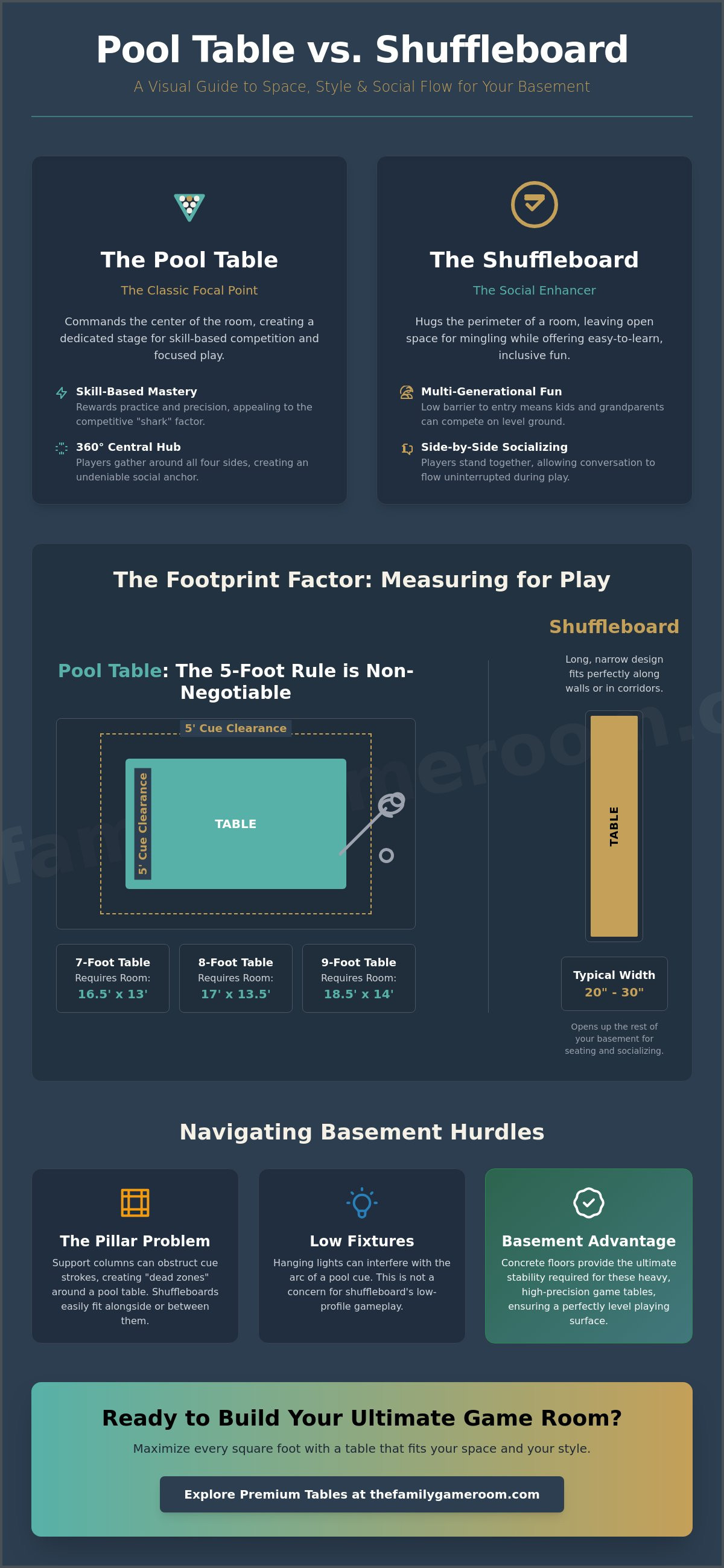
A pool table isn't just the size of its slate. You must account for the "5-foot rule," which provides 60 inches of clearance around the entire perimeter for a standard 57-inch cue. Without this buffer, your game will be interrupted by walls, support columns, or furniture. While some homeowners resort to a "short cue" for tight corners, this compromise often ruins the natural feel of the game and frustrates serious players. For those working with specific room constraints, Nixon Billiards offers models with sleek profiles that maximize playability without overwhelming the room's footprint.
- 7-Foot Table: Requires a room at least 16.5 feet by 13 feet.
- 8-Foot Table: Requires a room at least 17 feet by 13.5 feet.
- 9-Foot Table: The professional tournament standard, requiring a room of 18.5 feet by 14 feet.
Shuffleboard Sizing: Long, Narrow, and Versatile
Shuffleboard tables offer a completely different spatial dynamic. They are narrow, typically between 20 to 30 inches wide, making them ideal for placement along a basement wall or behind a sofa. However, don't forget the "End Zone" requirement. You need at least 2 to 3 feet of clearance at each end of the table so players can stand comfortably and follow through on their shots. A regulation 22-foot table requires a room at least 26 feet long. For most residential basements, the 9-foot to 14-foot range represents the sweet spot for balancing fun and floor space.
Think of your shuffleboard as a functional room divider. It can elegantly separate a TV lounge from a home bar area without blocking sightlines. If you're looking to optimize your layout, consider browsing our indoor shuffleboard tables to find a length that complements your basement's specific dimensions. This versatility allows you to maintain an open, airy feel while still providing a high-end entertainment experience. By prioritizing the flow of the room, you ensure your investment enhances your home rather than cluttering it.
Gameplay Dynamics: Skill Gaps and Social Flow
The social energy of your home often shifts based on the equipment you choose. When comparing a pool table vs shuffleboard for basement entertainment, consider the "intimidation factor" that each game presents. Billiards is widely viewed as a specialist's game, requiring precise angles, a steady bridge, and a specific stance. In contrast, shuffleboard offers a "slide and glide" ease that allows beginners to compete immediately. A typical pool rack takes 15 to 30 minutes to complete, whereas shuffleboard rounds move at a brisk, punchy pace. This difference in duration affects how guests cycle through the room and how often the "winner stays on" rotation occurs.
Physicality also plays a major role in the long-term enjoyment of the space. Pool requires constant bending and leaning over the slate, which might be taxing for some players during long sessions. Shuffleboard is played entirely from a standing, upright position, making it a more accessible choice for all ages. Even the auditory environment changes. The sharp, rhythmic "clack" of billiard balls creates a lively, energetic atmosphere reminiscent of a classic pool hall. Shuffleboard offers a sophisticated "hush" as the weights glide across the silicone-beaded wax, making it easier to maintain a conversation without raising your voice.
Hosting Large Groups vs. Intimate Play
Shuffleboard is the undisputed champion of the cocktail party. Because players stand side-by-side at one end of the table, they can easily hold a drink or socialize with onlookers between turns. It's an inclusive experience that doesn't demand 360-degree movement. To enhance the "stadium" feel of the room, many homeowners integrate high-quality bar stools along the perimeter. This creates a comfortable spectator zone where guests can watch the action without crowding the players' stroke room. While pool is a fantastic centerpiece for intimate, focused matches, shuffleboard keeps the room moving and the social flow uninterrupted.
Longevity and Replay Value for Families
A well-chosen game table should serve your family from age 8 to 80. Shuffleboard's low barrier to entry makes it an instant hit for children, yet the tactical depth of "hangers" and defensive blocks keeps adults engaged for years. Replay value remains high because the learning curve is gentle but the ceiling for mastery is high. Maintenance is another lifestyle factor to weigh. Indoor shuffleboard tables are remarkably low-maintenance, requiring only a quick wipe and a fresh application of wax. Pool tables, by comparison, eventually require professional re-felting and leveling to maintain their playability. Choosing a pool table vs shuffleboard for basement life means deciding whether you want to master a classic craft or enjoy effortless, multi-generational competition.
Navigating Basement-Specific Installation Challenges
Basements present a unique set of architectural quirks that can complicate the installation of high-end game tables. When deciding on a pool table vs shuffleboard for basement layouts, you must look beyond the floor plan and consider the vertical and structural obstacles. The "Pillar Problem" is perhaps the most frequent hurdle. Standard residential basements often feature load-bearing support columns that can interrupt a player's cue stroke. If a column sits within five feet of your pool table, it creates a permanent blind spot. Shuffleboard tables often provide a clever workaround; their narrow profile allows them to be positioned between pillars or along a wall where columns won't interfere with the side-to-side play.
Environment is just as important as architecture. Basements are prone to higher humidity levels and temperature fluctuations, which can wreak havoc on solid wood and slate. Ensure your space is climate-controlled to prevent the wood from warping or the felt from absorbing moisture. Lighting also requires careful planning. Because basement ceilings are typically lower than those on the main floor, selecting the right billiard light fixtures is essential. You need a fixture that provides even, shadow-free illumination without hanging so low that it becomes a hazard for taller players or high-arching cue shots.
Overcoming Architectural Obstacles
If a single pillar is the only thing standing between you and a pool table, consider using "short cues" for those specific shots. While not ideal for professional play, a 48-inch or 52-inch cue can help you clear a pillar without relocating the entire table. Additionally, pay close attention to the floor's level. Many basement floors slope slightly toward a central drain. Because both pool and shuffleboard tables require a perfectly flat surface, you must use precision leveling legs or shims during installation. A professional installer can ensure the table is balanced to within a fraction of a millimeter, even on an uneven concrete slab.
The Logistics of Heavy Furniture
The "Stairwell Strategy" is the final, and often most difficult, part of the process. A standard slate pool table weighs nearly 1,000 pounds, but it arrives in pieces. This makes it easier to navigate tight corners and basement stairs. Conversely, an indoor shuffleboard playfield is often a single, solid piece of wood that can be up to 22 feet long. You must measure your stairwell's turning radius and ceiling clearance before the delivery truck arrives. If your basement has a walk-out entrance, you're in luck. If not, you may need to choose a smaller table size or a multi-piece playfield to ensure it actually makes it downstairs. Don't leave your entertainment to chance. Explore our full collection of basement-ready tables and find the perfect fit for your unique home architecture.
Premium Solutions: The Multi-Functional Game Room
Maximizing the fun-per-square-foot in your home doesn't mean you have to settle for a single activity. When you're deciding on a pool table vs shuffleboard for basement layouts, remember that your choice can serve more than one purpose. Modern game rooms are evolving into multi-functional living spaces that balance high-energy play with domestic utility. If your basement needs to pull double duty as a dining area for large holiday gatherings or a workspace for family projects, the right accessories can make that transition seamless. The goal is to create a social hub that feels intentional, not cluttered.
The Rise of the Convertible Game Table
The pool table dining top is the ultimate space-saving hack for smaller basements. This sleek addition allows you to transform your Nixon Billiards table into a functional buffet or craft station in seconds. It offers a significant aesthetic benefit; you can hide the "game room" look when a more formal vibe is required for guests. For families who want to provide maximum variety, Game Table Sets offer a curated way to combine billiards with air hockey or foosball. This approach ensures your basement remains the primary destination for every age group without requiring multiple dedicated rooms.
Creating a Cohesive Luxury Aesthetic
A truly professional-grade basement feels like a private club. You can achieve this by matching your shuffleboard to your pool table using the same wood finishes and design language. Brands like American Heritage Billiards provide matching collections that ensure your room looks cohesive rather than pieced together. Integrating coordinated accessories, such as matching pool cue racks and dartboard cabinets, ties the entire environment together. Investing in new, high-end equipment beats scouring the used market because it guarantees the structural integrity and aesthetic consistency your home deserves.
Final Recommendations for Your Layout
Your final choice between a pool table vs shuffleboard for basement play should depend on the room's orientation. Use this simple guide to make your decision:
- Square Rooms: These are the natural home for a centered pool table, providing the 360-degree clearance needed for comfortable cue strokes.
- Long, Narrow Rooms: These layouts are the perfect fit for shuffleboard, which can run parallel to a long wall and leave the center of the room open for walkways.
- Open-Concept Basements: If you have the space, position a pool table as the central anchor and place a shuffleboard along the perimeter to create the ultimate entertainment destination.
By choosing equipment that matches your room's geometry and your family's social style, you create an investment that enhances both your lifestyle and your home's value. Whether you prefer the precision of billiards or the social flow of shuffleboard, your basement is ready to become the heart of the home.
Build Your Ultimate Basement Destination
Deciding on a pool table vs shuffleboard for basement layouts is a choice between a classic centerpiece and a modern social lane. You've learned that your room's dimensions and architectural quirks, like support pillars, dictate the flow of the game. While a pool table offers deep mastery and a commanding presence, shuffleboard provides inclusive, wall-to-wall fun for every guest. By integrating multi-functional solutions like dining tops, you can ensure your space remains as versatile as it is entertaining.
We are here to help you curate a room that reflects your style. As an authorized retailer for American Heritage Billiards, our team has provided family-owned expertise since 2022. We offer national shipping on all luxury game tables, ensuring your premium equipment arrives safely and ready for play. Browse our Premium Collection of Pool and Shuffleboard Tables today and take the first step toward a more social home. Your perfect game room is just a few measurements away.
Frequently Asked Questions
Can I fit a pool table in a 12x15 basement room?
A 12x15 room is unfortunately too small for a standard 7-foot pool table. You need at least 16.5 feet by 13 feet of space to accommodate the table and the 5-foot clearance required for a standard cue stroke. If your space is this tight, you'll find that a shuffleboard table placed against the long wall is a much more functional choice for your basement layout.
Is shuffleboard easier for kids to play than pool?
Shuffleboard is significantly more accessible for children because it doesn't require the complex hand bridges or specific stance needed for billiards. Kids can begin sliding pucks and scoring immediately, which keeps them engaged and excited. It's a fantastic multi-generational game that allows eight-year-olds to compete fairly with their grandparents during family gatherings.
What is the minimum ceiling height needed for a pool table light?
Your light fixture should hang approximately 30 to 32 inches above the slate playing surface for optimal visibility. For most standard tables, this requires a minimum ceiling height of about 8 feet to ensure the light is effective without becoming a physical hazard for taller players. If your basement has lower ceilings, consider flush-mount LED panels to maintain even illumination without the low-hanging obstacles.
Do shuffleboard tables need to be leveled like pool tables?
Precision leveling is absolutely vital for shuffleboard tables to prevent the weights from drifting to one side during a slide. Unlike pool tables that use heavy slate to stay flat, shuffleboard playfields are often solid wood and rely on climate adjusters underneath. These adjusters allow you to maintain a slight concave shape, which is essential for professional-grade gameplay and puck control.
How do I get a 12-foot shuffleboard table into my basement?
Navigating a 12-foot playfield through a home requires careful measurement of your stairwell's turning radius and ceiling height before the table arrives. Most premium shuffleboard playfields are a single, solid piece of wood that cannot be disassembled for transport. Always check for walk-out basement doors or large windows as alternative entry points if your indoor stairs have a sharp landing or a low overhang.
Can a pool table double as a dining table in a basement?
A pool table can easily transform into a functional dining surface with the addition of a pool table dining top. These heavy-duty covers protect the felt and provide a flat, stable area for holiday buffets, craft projects, or homework. It’s an excellent way to maximize the utility of your basement without sacrificing the high-end game room aesthetic you've worked to create.
Which table holds its value better over time?
High-end slate pool tables and solid wood shuffleboards both retain excellent resale value due to their durable, premium materials. Brands like American Heritage Billiards are considered heirloom-quality furniture that can last for decades with proper care. While pool tables have a larger traditional market, the rising popularity of shuffleboard ensures it remains a highly sought-after asset for modern home entertainment spaces.
What happens if my basement has a support pillar in the middle of the room?
A support pillar doesn't necessarily disqualify you from owning a table, but it does dictate your placement strategy. When weighing a pool table vs shuffleboard for basement layouts, remember that shuffleboard is easier to tuck alongside a column because it only requires end-zone clearance. If a pillar interrupts your pool cue stroke, you can use a shorter 48-inch cue to clear the obstacle during specific shots.