


The most critical dimension for a luxury game room isn't the physical footprint of the table. It's actually the five feet of unobstructed "active stroke zone" surrounding the slate. If you're planning a high-end entertainment space, relying on a professional pool table room size guide is just the starting point for true playability. You want to ensure that every bank shot happens without the frustration of a cue hitting a wall or clashing with your modern decor.
It's natural to worry that a stunning 8-foot American Heritage Billiards table might feel too bulky for your space or that you'll be forced into awkward short-cue shots. You deserve a room where your investment in quality craftsmanship shines without compromising the flow of the game. We promise to provide the precise calculations and aesthetic considerations needed to fit a premium table into your home perfectly.
We'll walk you through the exact clearance requirements for 7ft, 8ft, and 9ft tables. You'll also discover how to integrate Nixon Billiards' sleek profiles into multi-use rooms using functional dining tops, giving you total confidence in your final selection.
Key Takeaways
- Master the 5-foot clearance rule to define your "Active Stroke Zone" and prevent frustrating wall collisions during play.
- Navigate our pool table room size guide to find the perfect fit between 7ft casual tables and 9ft professional-grade slate surfaces.
- Learn the exact height requirements for billiard light fixtures and strategic placement tips for rooms with architectural columns.
- Explore how luxury dining tops can transform a single space into a multi-functional entertainment and dining hub without losing playability.
- Gain the confidence to choose between the minimalist modern frames of Nixon Billiards and the traditional hardwood grandeur of American Heritage Billiards.
The Golden Rule of Pool Table Space Planning
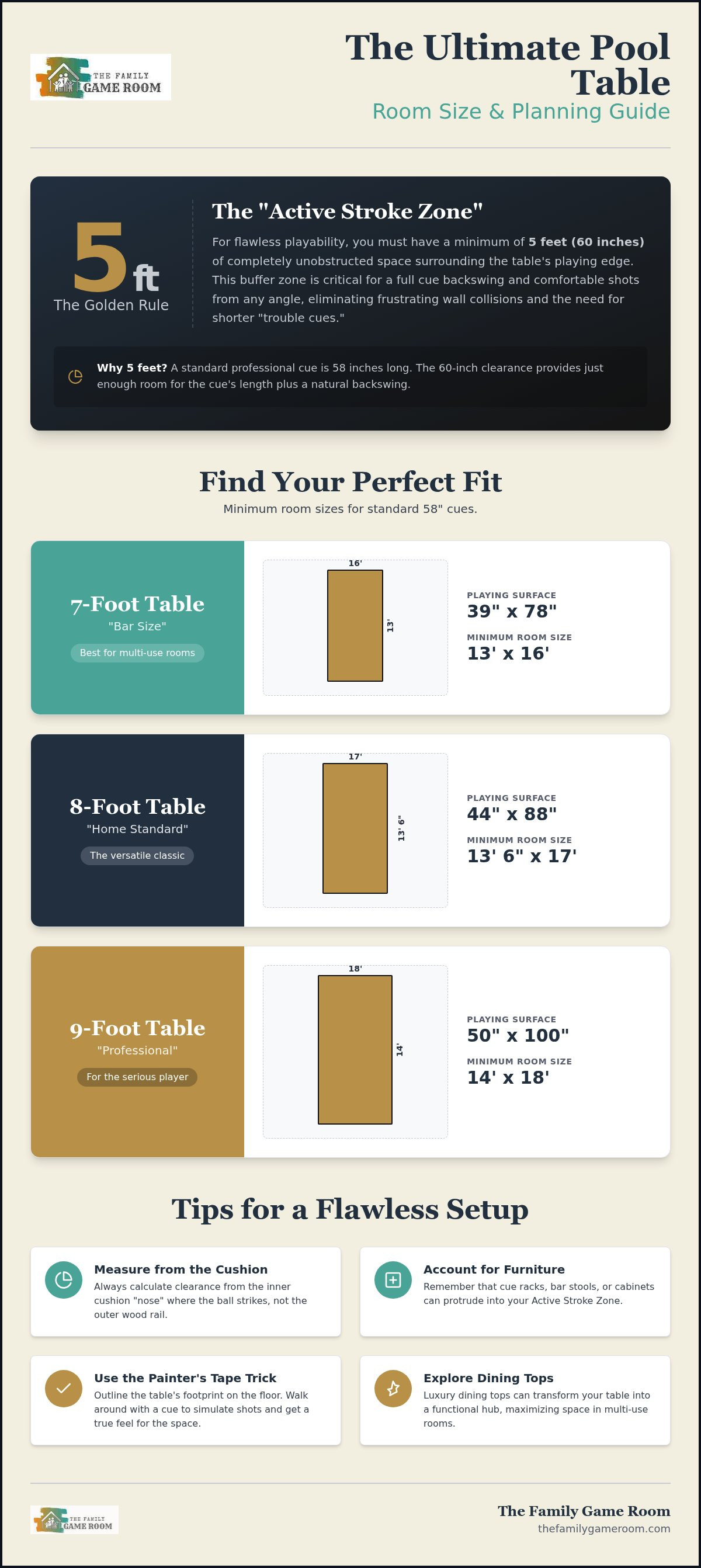
Planning a luxury game room begins long before the slate arrives. While many homeowners focus on the floor dimensions, the true constraint is actually the walls. Successful space planning centers on a single, non-negotiable principle: the 5-foot rule. This requires 60 inches of clear, unobstructed space between the table's playing edge and any vertical surface. This 60-inch buffer creates what we call the "Active Stroke Zone." This is the critical volume of air where the cue, the player's body, and the full backswing exist simultaneously.
Without this buffer, you risk the psychological burden of a cramped environment. A tight room forces players to adjust their natural mechanics, leading to "short-cue anxiety" and a degraded level of play. A premium American Heritage Billiards table deserves a room that allows for a full, confident follow-through on every shot. If you're using this pool table room size guide to design your layout, remember that a room that feels open is always more enjoyable than one that feels crowded by a table that's too large.
Why Cue Length Dictates Your Room Size
The standard professional cue measures 58 inches. This length is the primary reason why 5 feet of clearance is the industry standard. When a player prepares for a shot near the rail, they need the full length of the cue plus at least two inches of room for the backswing. If your room has a single tight corner or a structural pillar, you can occasionally use "trouble cues." These shorter 52-inch or 48-inch sticks allow for play in constrained spots without moving the entire table. However, relying on these for every shot ruins the rhythm of a high-end game. Visualizing this "swing radius" before your table is delivered ensures you won't be surprised by a wall you didn't account for.
Measuring for Success: A Step-by-Step Approach
Accuracy is paramount when preparing for your installation. Follow these steps to ensure your measurements are flawless:
- Measure from the cushion nose: Always calculate your clearance from the innermost point of the rubber cushion where the ball strikes, not the outer edge of the wooden rail.
- Account for wall furniture: Items like Pool Cue Racks, bar stools, or cabinets can protrude several inches into your Active Stroke Zone.
- Use the painter's tape trick: Mark the table's footprint on the floor with tape. Walk around the perimeter with a cue in hand to simulate shots from difficult angles.
This simple, hands-on approach ensures your pool table room size guide calculations translate perfectly into a playable, luxurious reality. By measuring for the "worst-case" shot, you guarantee a frictionless experience for every guest.
Standard Pool Table Dimensions: 7ft, 8ft, and 9ft Tables
Selecting the right dimensions for your billiards room is a delicate balance of physics and interior design. Every regulation table, regardless of its length, maintains a strict 2:1 length-to-width ratio for the playing surface. While professional tournaments often showcase massive 9-foot slates, the reality of luxury residential architecture usually points toward the 7-foot or 8-foot varieties. Using a precise pool table room size guide ensures your chosen model feels intentional in the space rather than overstuffed.
It's helpful to understand that "size" refers to the playing area, not the outer cabinet dimensions. A table with thick, ornate rails will occupy more physical floor space than a minimalist modern design, even if the playing surfaces are identical. This distinction is vital when you're working with tight tolerances in a custom-built basement or a converted loft.
The 7ft Table: Compact Power
The 7-foot table, often referred to as "bar size," is the champion of the modern loft and the multi-purpose den. With a playing surface of roughly 39" x 78", it requires a minimum room size of 13' x 16' when using standard cues. Nixon Billiards excels in this category, offering sleek, minimalist profiles that prevent a smaller room from feeling cluttered. It's the perfect choice for casual players who want a premium experience without sacrificing an entire floor of their home.
The 8ft Table: The Versatile Classic
The 8-foot table is the undisputed "home standard," accounting for approximately 75-80% of all residential sales in the U.S. It provides the ideal bridge between recreational ease and professional challenge. For a standard 8-foot table, your room should measure at least 13' 6" x 17'. This is the signature size for American Heritage Billiards Pool Tables, which are designed to anchor a room with traditional craftsmanship and timeless visual weight. In a standard 20' x 20' space, an 8-foot table sits comfortably as a centerpiece, leaving plenty of room for spectator seating.
For those seeking a bit more challenge without jumping to a full tournament size, the "Oversized 8" is a popular 2026 trend. These tables feature a 46" x 92" playing surface, requiring slightly more clearance than the standard 8-foot models. They offer a larger field of play that closely mimics professional conditions while still fitting into most generous residential game rooms. If you're still weighing these dimensions against your floor plan, you can browse our curated collections to see how different styles impact a room's visual volume.
Finally, the 9-foot tournament table remains the gold standard for the serious enthusiast. With a 50" x 100" playing area, it demands a dedicated billiards hall of at least 14' x 18' 6". This size is less about fitting into a room and more about building a room around the table. It provides the most demanding play and is the official size recognized by the Billiard Congress of America for professional competition. Relying on a pool table room size guide during the blueprint phase is essential for these larger installations.
Navigating Room Obstacles and Architectural Constraints
Even the most meticulous floor plan can be disrupted by a poorly placed support column or a low-hanging soffit. When you consult a pool table room size guide, it’s vital to look beyond the empty square footage and identify fixed architectural elements. If your basement features a structural pillar, don't panic. The trick is to position the table so the column interferes with the least frequent shots. Usually, this means aligning the pillar with the center of a long rail rather than a corner pocket, where complex angles require more clearance.
Lighting also requires a strategic approach. High-quality Billiard Light Fixtures must be perfectly centered over the playing surface to eliminate distracting shadows. To ensure professional visibility without obstructing the players' view, hang your fixture so the bottom of the shade sits 30 to 32 inches above the slate. If you have windows in the room, consider blackout shades or heavy drapery. Direct sunlight creates glare on the cloth and can even cause uneven fading or cloth tension issues over time.
Accounting for Perimeter Furniture
Your "Active Stroke Zone" shouldn't just be clear of walls; it needs to be clear of people, too. Maintain a "Bar Stool Buffer" of at least three feet between a seated guest and the edge of the table. This prevents a player’s backswing from colliding with a spectator’s knees. We recommend elevated spectator chairs. They provide a better view of the game and keep the guests' feet tucked away from the player's walking path. For storage, wall-mounted cue racks are superior in tight spaces as they don't consume precious floor area or create trip hazards during a match.
The 'Short Cue' Strategy
Sometimes, a single "tight" wall is unavoidable. Rather than downsizing your entire table, use a deliberate "short cue" strategy. Keeping a 48-inch cue specifically for shots where the cue ball is frozen against a problematic corner allows you to maintain a full-size 8-foot table elsewhere. Professional players often use this tactic in residential settings to preserve the integrity of the game. It’s a smart compromise that lets you enjoy the "full-size" feel of a premium American Heritage or Nixon table without the need for a major renovation. This flexibility is a core component of a modern pool table room size guide, proving that smart accessories can solve architectural headaches.
Planning for Multi-Functional Spaces: The Dining Table Factor
The rise of the convertible "Dining Pool Table" represents one of the most significant shifts in 2026 home design. Modern homeowners are increasingly reclaiming formal dining rooms and transforming them into hybrid entertainment hubs. This dual-purpose approach requires a specialized pool table room size guide strategy. You aren't just calculating for the "Active Stroke Zone" anymore; you must also account for the ergonomics of a seated dinner party. A room that feels perfect for a match might feel cramped during a holiday meal if you don't plan for the extra furniture.
Standard billiards clearance focuses on the 60-inch cue radius. However, when the dining top is on, your primary concern shifts to chair "pull-out" space. We recommend a minimum of 36 inches behind each chair to allow guests to sit and stand comfortably. If your room is tight, this can overlap with your cueing space, provided you move the chairs when it's time to play. Transitioning between modes should be seamless. Always plan a dedicated, padded storage area for your dining top inserts. This prevents warping or scratches and keeps your home looking polished even when the game is in full swing.
Converting the Dining Room into a Game Room
For a standard 8-foot table used in a dining conversion, aim for room dimensions of at least 14' x 18'. This provides enough clearance for the table, chairs, and a sideboard without feeling claustrophobic. Pedestal-style bases, frequently found in Nixon Billiards collections, are ideal for these spaces. They offer significantly more legroom for diners than traditional four-legged designs, which can often feel restrictive during long meals. To protect your investment, ensure you use spill-proof dining inserts. These hidden gaskets prevent liquids from reaching the felt, preserving the table's playability for years. This is a crucial step in any pool table room size guide for multi-use environments.
Selecting the Right Seating
Seating choice is as much about space as it is about style. Modern benches are often superior to individual chairs for multi-functional rooms. They provide a clean, minimalist look and can often be tucked completely under the table frame when the game is on. This instantly clears the floor for players and eliminates the need for extra storage space. Coordination is key for a luxury aesthetic. Ensure the wood finishes of your benches match the table's cabinet perfectly to create a unified look. If you're ready to maximize your home's square footage, you can explore our premium pool table dining tops to find the perfect fit for your lifestyle.
Executing Your Vision with Premium Billiards
Applying a pool table room size guide involves more than just a measuring tape; it requires an eye for architectural volume. Once you've confirmed your clearance, the final step is selecting a table style that complements the physical dimensions of your room. The visual weight of a table can change how a space feels. A heavy, ornate table might overwhelm a small room, while a minimalist frame could look lost in a grand, vaulted hall. Balancing the table's footprint with its aesthetic profile is the secret to a professional-grade home installation.
Beyond the look, remember that quality performance depends on a perfectly level surface. Every table we offer features high-grade slate, which is the industry standard for durability and accuracy. Because these tables can weigh nearly a thousand pounds, professional installation is critical. Expert setup ensures the slate is precisely joined and the cloth is tensioned correctly. This white-glove service protects your investment and guarantees that your home play matches the conditions of a professional tournament.
Nixon Billiards: Sleek Solutions for Modern Spaces
Nixon Billiards specializes in designs that maximize the feeling of openness. Their collections often feature thin-profile frames and industrial metal legs that significantly reduce visual "clutter" near the floor. This makes them the premier choice for contemporary lofts and open-concept homes where you want to maintain a sense of flow. Many Nixon models also utilize internal drop pockets. This choice creates a cleaner, more streamlined silhouette that saves a few extra inches of perceived space, making a 7-foot or 8-foot table feel perfectly integrated into a modern minimalist environment.
American Heritage: Heirloom Quality for Grand Rooms
If you have a dedicated billiards hall or a large formal basement, American Heritage Billiards provides the architectural presence needed to anchor the room. These tables are crafted with solid wood legs and often feature intricate, ornate carvings that demand attention. Because of their substantial visual weight, AHB tables require more "visual breathing room" than their minimalist counterparts. They function as a true centerpiece, evoking a sense of timeless tradition and domestic warmth. In a large room, the grand proportions of an American Heritage table fill the space elegantly, ensuring the environment feels curated and intentional rather than empty.
Choosing the right brand ensures your game room is as beautiful as it is playable. Whether you prefer the industrial edge of modern design or the classic beauty of handcrafted wood, your table should reflect your personal style. Explore our curated collection of Nixon and American Heritage tables to find the perfect match for your home's unique dimensions.
Transform Your Vision Into a Playable Masterpiece
Mastering the 60-inch clearance rule is the first step toward a flawless game room. You've learned how to navigate architectural obstacles and the benefits of multi-functional dining tops. Whether you select a sleek Nixon model for a modern loft or a hand-carved American Heritage piece for a formal hall, your decision is now backed by precise measurements. This pool table room size guide ensures your investment provides a lifetime of unobstructed play and aesthetic harmony.
We're here to help you finalize the details. As an authorized Nixon and American Heritage dealer, we specialize in matching premium craftsmanship with your home's unique dimensions. Our family-owned and operated business has served homeowners since 2022. We provide national white-glove installation to ensure your table is perfectly leveled and ready for its first break. Precision matters. Your long-term satisfaction is our priority.
Find the Perfect Table for Your Space at The Family Game Room
Your dream entertainment space is within reach. We look forward to helping you create a gathering spot where memories are made and quality is felt in every shot. It's time to play.
Frequently Asked Questions
What is the minimum room size for an 8ft pool table?
The minimum recommended room size for a standard 8-foot pool table is approximately 13' 6" x 17'. This measurement provides the necessary 5 feet of clearance on all sides of the 44" x 88" playing surface. Using a professional pool table room size guide ensures you have enough space for a full 58-inch cue stroke without hitting your walls.
Can I use a 7-foot pool table in a 12' x 15' room?
A 12' x 15' room is technically too tight for a 7-foot table if you plan to use standard cues. You would find yourself restricted on almost every shot along the side rails. To make this space functional, you would need to rely on 48-inch or 52-inch "short cues" for a significant portion of the game, which can compromise the quality of play.
How much space do I need around a pool table for a standard 58-inch cue?
You need exactly 5 feet of unobstructed space around the entire playing perimeter of the table. This 60-inch buffer allows for the length of the cue plus a few inches for your backswing and follow-through. It's the gold standard for luxury home planning to ensure no player ever feels the frustration of a wall-bound shot.
What happens if my room has a support beam near the table?
Position your table so the support beam aligns with the center of a long rail rather than a corner. This placement minimizes interference because most shots are aimed toward the pockets at angles that move away from the center rail. You can manage the few shots blocked by the beam by keeping a shorter "trouble cue" on your rack for those specific moments.
Are dining pool tables higher than regular dining tables?
Yes, dining pool tables typically sit about 1 to 2 inches higher than a traditional dining table. While a standard dining table is usually 30 inches high, a regulation pool table playing surface must be between 29.25 and 31 inches. We suggest choosing chairs or benches with a slightly higher seat height to maintain proper ergonomics during dinner service.
Do I need a different size room for a snooker table vs. a pool table?
Snooker tables require a much larger room because the tables themselves are significantly bigger than standard pool tables. A full-size snooker table can reach 12 feet in length, demanding a room that is at least 15' x 20' 6". This is why a standard pool table room size guide for 8-foot home tables cannot be used when planning for snooker equipment.
How do I measure my room if it is an L-shaped space?
Focus your measurements on the largest rectangular area within the "L" where the table will be centered. You must have the required 5-foot clearance from the table's edge to every wall within that rectangle. The extra space provided by the "L" section is perfect for spectator seating or a bar, but it doesn't change the clearance needs for the walls closest to the slate.
Is it okay to use a shorter cue for every shot if my room is small?
Using a shorter cue for every shot is not recommended for serious players as it fundamentally alters your stroke mechanics and balance. Shorter cues lack the weight and reach of a standard 58-inch stick, making it difficult to develop consistent skill. They are best used as a strategic solution for specific architectural "tight spots" rather than a primary equipment choice.