


The table with the most games may be the one your household uses least. With multi game table sets, the better choice is usually the configuration built around the games people will actually play, not the biggest number on the box. If your home has limited room, players of different ages, or varied interests, compare how each set fits your everyday routine before choosing.
An all-in-one table can offer more ways to play without requiring several dedicated tables. But conversion styles involve different trade-offs, and more game options don’t automatically mean each playing surface will suit every player. The goal is to balance variety, playing experience, and practical details such as setup and storage.
This guide compares fixed, flip, swivel, and topper designs, explains what to assess in each game format, and helps you match a set to your room and household routines. You’ll be better prepared to choose a combination that gets regular use instead of judging by game count alone.
Key Takeaways
- Start with the games your household plays most often, not the advertised game count.
- Compare fixed, flip, swivel, and topper designs to find a conversion style that fits your routine.
- Assess how each format balances game variety with the playing experience you want.
- Measure the room for play clearance, walking routes, doors, and space to store conversion pieces.
- Use this guide to narrow down multi game table sets that suit your players, room, and preferred games.
What Are Multi Game Table Sets, and When Do They Make Sense?
A multi-game table set uses one table with interchangeable or convertible surfaces to support more than one game format. Depending on the design, it may switch between games such as pool, air hockey, foosball, or table tennis. Unlike a room with several dedicated tables, an all-in-one design shares a footprint and changes configuration as needed.
That shared footprint is the main appeal. One table can broaden game-night options without taking up the floor space required for several full-size tables. It can suit a family room or compact entertainment area where play space, seating, and clear walkways all matter. The trade-off is specialization: a table designed for multiple formats may not offer the same features as equipment dedicated to one game.
How Multi-Game Tables Change Between Games
Conversion surfaces let one table support different games. Some designs rotate or swivel to bring another surface into position; others flip between playing faces. With a topper design, a separate panel sits over the table and is lifted off or replaced to reveal another surface. Compare the actual mechanism, since the steps and space needed differ by design.
Changing games takes more than turning a surface. Removable panels and accessories need a safe storage spot, and the table may need resetting before play begins. Think through who will handle the change and whether that process fits your usual game night. If the conversion is straightforward for the people who’ll use it, the different formats are more likely to stay in rotation.
Who Gets the Most From a Multi-Game Table Set?
These sets can suit households that enjoy changing activities but don’t have space for several dedicated tables. They may also work for families where children and adults want different kinds of play in the same room. The right combination depends on who will play and which activities are likely to come out repeatedly.
Compare that with a household that plays one game most evenings. Frequent players may prefer a dedicated table with features tailored to that activity instead of maximizing variety. Before choosing, list the regular players, the games they enjoy, and how often the table will be used. Occasional family play calls for a different balance than a routine centered on one favorite game.
Start with your household’s routine, not the number of games on offer. If variety is the priority, a convertible design can make one room more versatile. If consistent play in a particular game matters most, give its playing surface and setup the closest attention. That distinction makes it easier to judge whether multi game table sets fit your home and how you play.
Which Multi Game Table Set Formats Offer the Games You Want?
Look beyond the game names. A combination may use a rotating frame, a flipping surface, or a separate topper, and each setup affects how quickly you can switch games and where unused pieces go. The formats below are useful ways to compare possibilities, not a guarantee that every combination comes in every design.
| Format | How it converts | Likely users | Practical trade-off |
|---|---|---|---|
| Pool and table tennis | A table-tennis surface may sit over a pool table, or a convertible design may switch between play surfaces. | Households that enjoy cue sports and paddle play. | A topper needs safe storage; switching surfaces means resetting the table. |
| Air hockey and foosball | Depending on the design, players rotate or flip the table, or change a playing surface. | Families and friends who like quick, head-to-head rounds. | Both games are lively, but their play areas and equipment differ. Check how each setup fits the room. |
| Poker or dining-oriented formats | A dining or poker top may cover a game surface, then lift away when play begins. | Homes that want the table to serve meals or card games as well as recreation. | The removable top needs storage, and changing uses takes setup time. |
Pool and table tennis can make a natural pairing for players who want both a cue sport and paddle play from one footprint. The Business Research Company’s report on pool table market trends discusses multi-game tables and convertible formats. For your own choice, focus on whether both surfaces suit the players who’ll use them rather than assuming each format will get equal play.
Flip, Swivel, and Topping Formats Compared
With a flip design, players turn the playing surface to expose another game. A swivel design rotates a section or frame into position. Both can keep conversion pieces attached to the table, though the movement and access needed vary. A topper is a separate panel placed over a surface. It can be simple to remove, but it needs a dedicated storage spot. The best fit depends on your room layout and routine.
Match the Game Combination to Your Household
Choose the pairing around who plays and how often. Pool plus table tennis can suit households that switch between focused cue play and group paddle games. Air hockey and foosball suit players looking for energetic, face-to-face competition; compare their different pace and style in this guide to air hockey versus foosball. Poker or dining tops add another use, but typically rely on a removable top or accessory rather than a second built-in game surface.
Before narrowing your shortlist, decide which game needs to stay ready for spontaneous play and which can involve a setup step. If you’re comparing game table sets, use that routine to guide your choice of format, storage, and game mix.
Do Multi Game Table Sets Sacrifice Playing Quality for Variety?
They can, but the advertised game count alone won’t tell you how each option plays. A table designed for several formats has to accommodate different surfaces and conversion methods. It may not deliver the same specialized feel as a dedicated table for a game you play often. For casual variety, the convenience can be worth the compromise. For regular practice, look more closely at the playing experience.
Judge the trade-off game by game. A household might enjoy having several options for guests, while one player cares most about consistent pool play. In that case, value depends less on how many activities the set lists and more on whether its main surface meets that player’s expectations. Usage habits should drive the decision.
When a Dedicated Table May Be the Better Fit
Prioritize a dedicated table if one game dominates your evenings or frequent practice makes specialized features important. A player focused on pool, for example, may care more about the playing surface than having several occasional alternatives. By contrast, a family that plays different games now and then may value shared use and variety. Choose for the routine you have, not an imagined one.
Before settling on a multi-game format, identify the game you’d be least willing to compromise on. Then consider what matters for that activity: the feel and continuity of its playing surface, stability during use, and how the table returns to that configuration after conversion. If the set’s primary game falls short of your needs, extra formats may not make up for it.
How to Judge the Games Included in a Set
Read the details for each game separately. Product descriptions may explain the playing surfaces, what changes during conversion, and which components are included. Look for a clear account of how surfaces attach or rest in place, how the table is supported in each mode, and whether accessories or toppers need separate storage. Don’t assume that a high game count means every format gets equal attention.
- Surface: Note how each game’s playing area is described and whether it uses a dedicated surface, a reversible face, or a topper.
- Conversion: Consider the steps involved and whether the table appears stable in each playing position.
- Components: Check which game pieces are included and what must be stored or added between sessions.
- Priority: Decide whether the set’s strongest fit aligns with the game your household will play most.
If air hockey is your leading priority, assess that format on its own rather than treating it as just one item in a bundle. Our air hockey table guidance can help you focus on what to consider for that game. Apply the same care to every other format you expect to use regularly. The right balance gives your favorite games a satisfying setup while making occasional changes worthwhile.
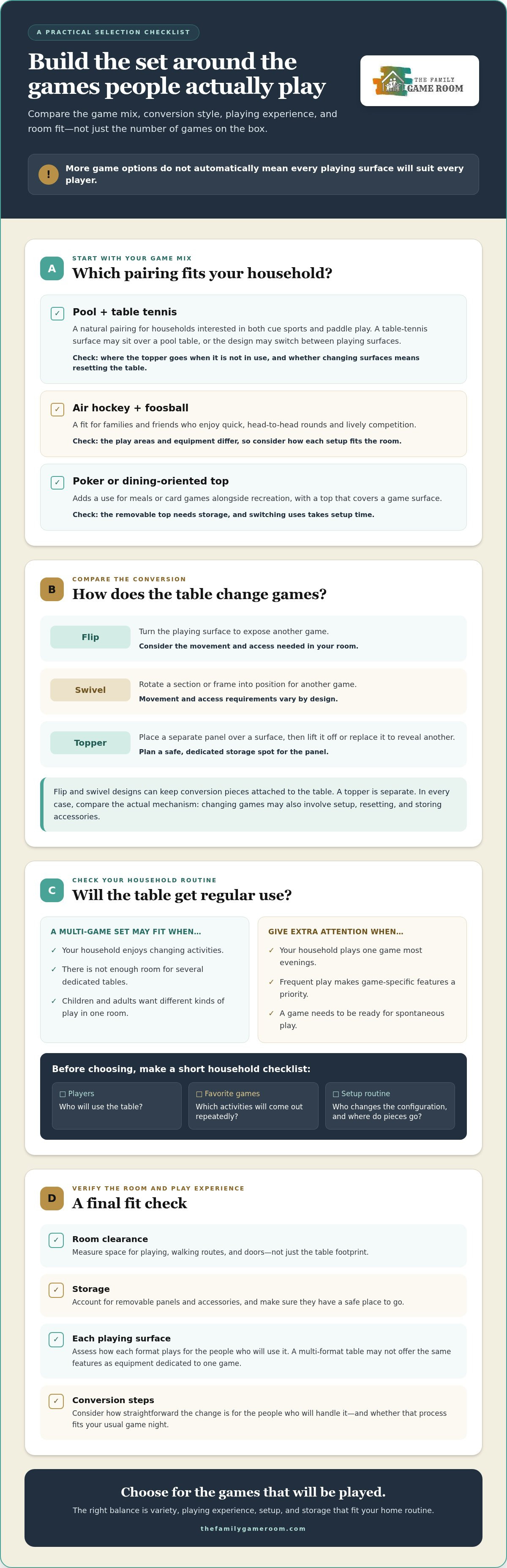
How to Choose a Multi Game Table Set for Your Room and Routine
A good shortlist starts with the way your household actually uses its space. Think through the games, players, setup habits, and room layout before comparing multi game table sets. This keeps an appealing feature list from distracting you from practical fit.
- List favorite games. Write down the games your household enjoys, then rank them by how often you expect to play. A set with fewer formats may be a better match if those are the options people will return to.
- Count regular players. Consider who’ll usually join in and whether players need room to move around the table. Include the people who may take turns converting or resetting the surface.
- Measure the room. Note the available space where the table will sit, but don’t stop at the table’s dimensions. Account for play, chairs, walking routes, nearby doors, and how the room needs to function when no one is playing.
- Compare conversion styles. Decide whether a flip, swivel, or removable topper suits your routine. Consider who will change the setup and where detached surfaces or accessories will be stored.
- Shortlist by fit. Compare product descriptions for dimensions, components, and configuration details. Keep options that suit your favorite games and room, then set aside those that create storage or movement problems.
Plan Space for Play, Conversion, and Storage
Measure the intended table footprint and the surrounding area players need to use it comfortably. Include chairs where relevant, space to move around the table, and the path a surface takes when it flips or rotates. For a topper design, identify a storage location that won’t block a door or walking route. Required space varies by table size and game format, so use the specific product dimensions rather than a generic clearance rule.
Picture the room beyond game night, too. A table may share space with seating or serve another purpose, so check that its full setup won’t disrupt everyday routines. Think through where conversion pieces will live and whether they’ll be easy to retrieve without moving other furnishings.
Make a Shortlist Based on Real Use
Rank each game by expected frequency, then match the conversion process to the people who’ll set up and reset the table. A complicated change may be less convenient if the table is used for quick, spontaneous play. Compare each option’s stated dimensions and included components, and make sure its described configurations align with your room and priorities.
Once you know your preferred games and space requirements, explore game table sets and game room options to build a shortlist that fits your home.
Find Multi Game Table Sets for a More Versatile Home Game Room
The right multi-game table can be the starting point for a home entertainment space that feels welcoming and works for your household. The Family Game Room sells new game room equipment, including game table sets, pool tables, poker tables, air hockey tables, and foosball tables. As a family-owned business, it brings a home-focused perspective to choosing equipment for shared play and hosting.
Build a Game Room Around the Table Set
Let the table lead the layout. Once you know its footprint and the room it needs for play, consider what would make the space comfortable for guests without crowding the games. Purposeful furnishings can support conversation and make it easier for players to take turns. Bar stools, for example, can provide seating near a game room area, while complementary furniture can help the space feel cohesive.
Choose additions around how you’ll use the room. If the table is the main attraction, keep walkways open and arrange seating so people can watch or join a game. If your household also enjoys distinct activities, separate equipment such as a poker table, air hockey table, or foosball table may suit the room better than trying to make one table serve every purpose. Accessories and furnishings should support the play and hosting you expect, not simply fill the space.
A well-planned game room doesn’t need to include every category. Start with the table set that best suits your favorite games, then consider whether another piece would add a genuinely different experience. This creates a more intentional entertainment space and helps keep the room practical between game nights.
Turn Your Shortlist Into a Confident Choice
Before choosing, revisit the details that shaped your shortlist. Rank the games by how often your household expects to play them, consider who will use and convert the table, and compare the product’s stated dimensions with your room measurements. Look closely at the described surfaces, conversion method, and included components so you understand what each configuration involves.
Then picture the set in your regular routine. Will it be easy to switch into the game your family reaches for most? Is there space for the table in play mode, and a sensible place for any removed surface or accessory? Does the room still work for everyday movement and hosting? These practical checks can help separate an exciting feature list from a configuration that truly fits.
The Family Game Room brings game table sets together with complementary game room equipment and furnishings, making it easier to consider the wider space as you decide. Choose with your players, favorite games, and room in mind. Explore The Family Game Room to find equipment and furnishings suited to the way your household plays.
Make Your Next Game Night One to Look Forward To
Picture the first evening with your new table: which game comes out first, who gathers around, and what would make the room feel ready for everyone? Let that scene guide your final choice. The most satisfying multi game table sets aren’t simply a collection of options; they’re a thoughtful fit for the people who’ll play and the moments you want to make room for.
Choose a setup that feels inviting on an ordinary evening, not just during a big gathering. Leave space for players to move, keep conversion pieces manageable, and let the table support the way your household likes to spend time together. A considered choice can turn an underused corner into a natural place to reconnect, compete, and laugh.
The Family Game Room sells game table sets and complementary game room furnishings. Explore the assortment and take the next step toward a space that brings your favorite games together.
Explore game tables and game room furnishings at The Family Game Room to plan a more versatile space for your household.
Frequently Asked Questions
Are multi game table sets worth it for a family game room?
They can be worthwhile if your household enjoys rotating between games and wants one shared setup. A set may give family members different ways to join in, from a quick match to a longer game night. Think about how often each person will play and whether switching formats feels manageable. If one game gets nearly all the use, a table designed around that activity may be a better fit.
Can one multi-game table support every game equally well?
No. Each format may feel different because the surfaces, equipment, and table setup serve different kinds of play. A casual round can be enjoyable without matching the experience of a dedicated table, but frequent players may notice distinctions. Consider what matters for each favorite game, such as a stable surface or room to use the equipment comfortably. Give the most-played format the most weight in your decision.
How many games should a multi-game table set include?
Choose the number of games your household will actually use, rather than treating a higher count as better value. If two formats cover your regular game nights, extra options may add little beyond occasional novelty. Make a short list of games people ask to play, then compare sets that include those activities. This keeps the choice focused on repeat enjoyment instead of a long feature list.
What is the difference between a flip table and a table-top conversion?
A flip table changes its playing face by turning the surface, often keeping the alternate side attached to the table. A table-top conversion uses a separate panel that rests over the base surface and is removed to switch games. The practical difference is where the unused surface goes and who handles setup. Consider whether you have space to store a panel and whether players can manage the conversion comfortably.
Do multi-game table sets include the accessories needed to play?
Included accessories depend on the specific set and its listed configuration. Check the product details for the components required for each game, such as playing pieces or equipment, and note anything described as separate. This matters if you expect to use several formats right away. Make a checklist of what’s included for the games your household prioritizes, so setup doesn’t hinge on an overlooked component.
Can a multi-game table set work in a smaller room?
It can, provided there’s enough space for the table in use and for players to move around it. A compact footprint alone doesn’t guarantee a comfortable fit. Before deciding, consider the table’s position relative to doorways, seating, and everyday paths through the room. A layout that lets people reach the game without shifting furniture each time is more likely to work well in a smaller space.
Are multi-game tables suitable for adults as well as children?
Yes, adults can enjoy them too, especially in households where friends and family like different kinds of play. The right choice depends on the games, table dimensions, and playing experience adults expect. For example, adults who want relaxed variety may value multiple formats, while regular players may prioritize a dedicated setup for their favorite game. Consider all intended players before choosing the game mix.