


Imagine unboxing a handcrafted Nixon Billiards table only to realize your 58 inch cue hits the wall on every corner shot. It's a common fear for homeowners who realize too late that the minimum space for 8ft pool table layouts involves much more than just the table's footprint. You want a high quality game room that feels like a luxury lounge, not a cramped storage unit where you're constantly shortening your stroke.
We believe your home deserves the best in premium billiards without the stress of measuring twice and still getting it wrong. To ensure a pro style experience, you typically need a clear 13' 4" by 17' area to accommodate a standard 8 foot table and full length cues. Getting these dimensions right is the difference between a functional family centerpiece and an expensive piece of furniture you can't actually use.
This 2026 guide provides the definitive room dimensions for the standard 44" x 88" playing surface, including how to account for bar stools and cue racks. We will explore how shorter 52 inch cues can save space and help you plan a layout that guarantees long term satisfaction. Your journey toward a perfect home gallery starts here, and satisfied you shall be.
Key Takeaways
- Learn the subtle size differences between standard and "Pro" 8ft models to ensure your playing area meets professional standards.
- Master the "Golden Rule" formula to calculate the minimum space for 8ft pool table layouts, allowing for a full 58 inch cue stroke.
- Navigate common room obstacles like support pillars and low ceilings to prevent "dead zones" from ruining your best shots.
- Plan for multi-functional use by accounting for dining tops and bar stools that can impact your overall room flow.
- Discover how premium brands like American Heritage and Nixon Billiards provide the perfect balance of luxury and standard dimensions.
Understanding 8ft Pool Table Dimensions & Playing Area
The 8-foot pool table is the undisputed champion of American game rooms in 2026. It provides a professional feel without requiring the massive footprint of a 9-foot tournament model. This size is the "Goldilocks" choice for homeowners; it's large enough for serious skill development but compact enough for standard residential layouts. When you invest in a premium table from brands like American Heritage Billiards, you're choosing the industry standard for home play.
Confusion often arises when buyers see "Pro 8ft" labels. In the billiards world, a "Pro 8" is actually an 8.5-foot table. This subtle six-inch difference can ruin your room planning. If you're calculating the minimum space for 8ft pool table installations, stick to the standard 8-foot measurements to avoid hitting walls with your cue. Precision is everything when creating a luxury entertainment space.
Standard 8ft Table Dimensions vs. Playing Surface
Don't mistake the outer cabinet size for the area where the balls actually roll. The 8-foot table playing surface dimensions are strictly 88 inches long by 44 inches wide. Every regulation billiard table must follow a precise 2-to-1 ratio where the length of the playing area is exactly twice the width. While the play area is consistent, the outer dimensions of the furniture typically range from 100 to 102 inches long and 56 to 58 inches wide.
Cabinet Styles and Their Impact on Floor Space
The physical design of the table determines how players move around the room. Consider these factors when mapping out your floor plan:
- Leg Style: Traditional tapered legs offer more "toe room" for players leaning over the rails. Pedestal bases look grand but can sometimes interfere with foot placement during complex shots.
- Rail Width: High-quality rails are usually 4 to 6 inches wide. This provides a stable surface for your bridge hand but adds to the total minimum space for 8ft pool table requirements.
- Profile Design: Modern, slim-profile tables from Nixon Billiards create an airy feel in smaller rooms. Ornate, heavy cabinets require more visual "breathing room" to avoid looking cramped.
Choosing a table with a sleek cabinet can make a tight room feel more accessible. The internal slate and playing surface remain the same regardless of the exterior style. Focus on the total footprint, including the rails, to ensure your room remains a functional and welcoming space for family and friends. Select the right footprint for your home, and satisfied you shall be.
Calculating the Minimum Room Size for an 8ft Table
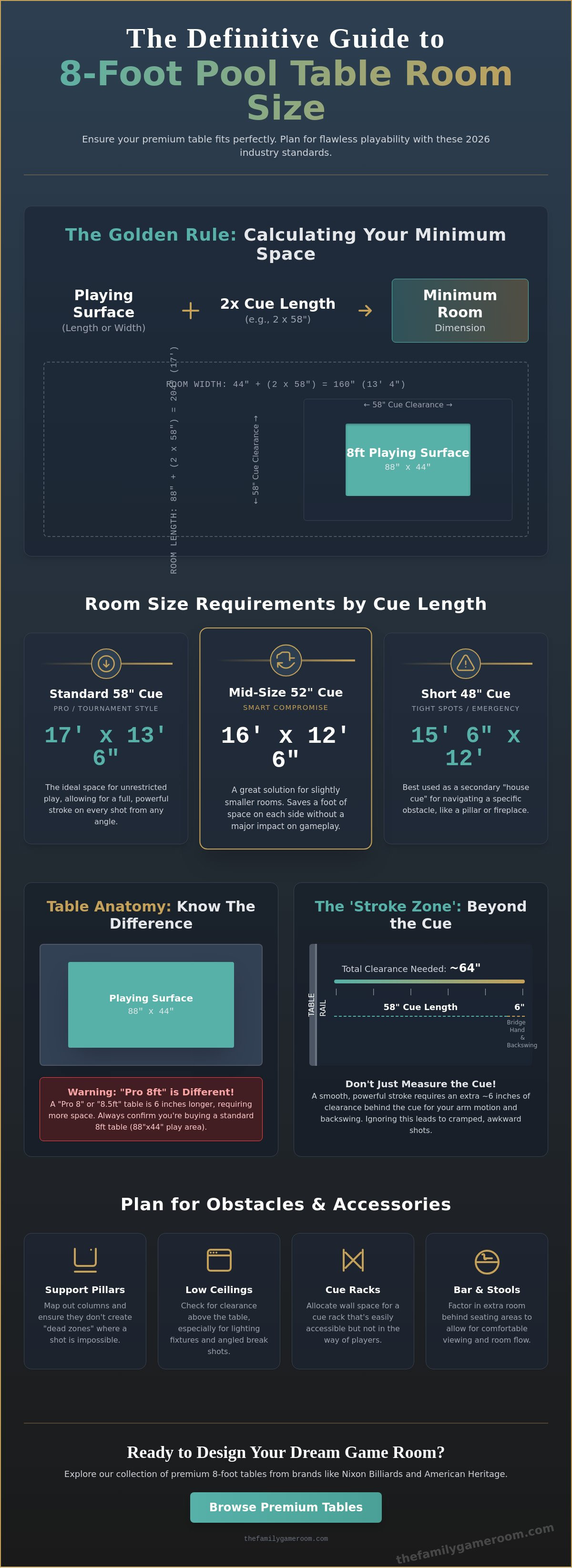
Success in billiard room design starts with a simple mathematical formula. To find the minimum space for 8ft pool table placement, use the Golden Rule: take the dimensions of your playing surface and add twice the length of your cue to each side. For a standard 8-foot table, this means adding roughly 116 inches (two 58-inch cues) to both the 88-inch length and the 44-inch width. This calculation creates a perimeter where the cue can move freely without striking a wall.
Many homeowners make the mistake of measuring only for the table itself. Professional room planning requires you to account for the "Stroke Zone," which is the extra space needed for a full backswing and follow-through. While a cue might be 58 inches long, the player's arm and the backswing motion require an additional 6 inches of clearance. If you ignore this buffer, you'll find yourself "poking" at shots near the rail rather than executing a smooth, professional stroke.
Room Size Requirements by Cue Length
Your choice of cue directly dictates your room's viability. If your space is slightly under the recommended dimensions, switching to a shorter cue can save the day without compromising the table size. Here are the 2026 industry standards for an 8-foot table:
- Standard 58" Cues: These require a room at least 13' 6" x 17' 0". This is the benchmark for tournament-style play.
- Mid-Size 52" Cues: These allow for a more compact 12' 6" x 16' 0" layout. It's a great compromise for finished basements with tight corners.
- Short 48" Cues: These work in rooms as small as 12' 0" x 15' 6". Use these as an "emergency" option for specific tight spots in an otherwise large room.
The 'Stroke Zone' and Clearance Math
A 58-inch cue actually demands 64 inches of total clearance to function properly. This extra 6 inches accounts for the bridge hand and the rear extension of the cue during a high-power break or a deep draw shot. You can test your room's minimum space for 8ft pool table compatibility by using a mock cue, such as a broomstick cut to 64 inches. Walk the perimeter of your intended table location and simulate shots from every angle to identify hidden "no-go" zones. If you find a tight spot, consider exploring The Family Game Room for premium accessories like short cues or wall-mounted racks that maximize your available square footage. Remember to check vertical clearance too. Low-hanging light fixtures or HVAC soffits can interfere with your stroke just as much as a solid wall. Measure twice to ensure your play stays unobstructed, and satisfied you shall be.
Navigating Common Room Obstacles & Tight Fits
Even with the perfect minimum space for 8ft pool table calculations, real-world architecture often presents challenges. Basements frequently feature load-bearing pillars, while modern open-concept rooms might have low-hanging soffits or large windows. These aren't deal-breakers, but they require a curated layout strategy to maintain playability. When a corner remains stubbornly tight despite your best efforts, keeping a 48-inch "trouble cue" on your rack provides a professional solution for those rare, obstructed shots.
Safety is a priority in any premium game room. Always maintain at least 6 inches of extra clearance beyond your standard cue length when playing near windows or glass doors. This buffer prevents the back of the cue from shattering glass during an aggressive backswing or a high-intensity break. If you're a fan of jump shots or high-arch masse shots, vertical clearance is vital. Standard 8-foot ceilings are usually sufficient, but a low-hanging HVAC duct can restrict your cue's upward movement. Aim for at least 8 feet of vertical space above the table surface to avoid ceiling scuffs.
The Pillar Strategy: Angling for Success
A support pillar doesn't have to ruin your game if you place it in a "finesse zone" rather than a "break zone." The break zone is the area at the head of the table where high-power shots occur; keep this area completely clear. If a pillar is unavoidable, try the 45-degree angle trick. Rotating the table slightly can often move the pillar from a direct line of sight to a corner where it interferes with fewer shots. You can use a laser level to project cue arcs from the table's edge, mapping exactly where the cue will hit the pillar before you commit to the final installation.
Furniture Clearance: Seating, Bars, and Cue Racks
A luxury game room is a social hub, but furniture shouldn't crowd the table. Bar stools require at least 3 feet of depth from the wall to accommodate a seated guest and still allow a player to walk behind them. If space is tight, choose wall-mounted cue racks that sit flush against the wall. A rack that protrudes even 4 inches can snag a player's clothing or interrupt a backswing. Place your spectator seating in a designated "Spectator Zone" at the ends of the table rather than the long sides. This keeps the flow of the game moving and ensures your guests are part of the action without being in the line of fire. Follow these layout tips, and satisfied you shall be.
Designing Your Game Room Layout for Peak Playability
A premium game room is more than a table in a box; it's a choreographed environment where every element supports the game. When planning the minimum space for 8ft pool table setups, homeowners often overlook the room's "flow." You must ensure that entryways and high-traffic paths remain clear even when a player is leaned over for a long shot. If a doorway sits within the stroke zone, you risk constant interruptions or accidental collisions during a heated match. Aim for a layout that invites movement without compromising the 5 foot clearance needed around the rails.
Structural integrity is equally vital for a professional grade experience. A standard 8 foot slate table weighs approximately 850 pounds, which exerts significant point load pressure on your flooring. Ensure your subfloor is reinforced and perfectly level before installation. On carpeted surfaces, use specialized shims or furniture cups to prevent the table from settling unevenly over time. A stable foundation is the only way to guarantee the "true roll" that premium brands like American Heritage Billiards are known for.
Billiard Light Fixture Placement
Lighting is a technical tool, not just an aesthetic choice. Position your fixture exactly 30 to 36 inches above the playing surface for optimal visibility. Crucially, the light must be centered on the table, not the room. If you've offset your table to accommodate a tight corner, your electrician must move the junction box accordingly. Traditional 3 light fixtures provide a classic look, but modern linear LED panels offer superior edge to edge illumination without the harsh shadows that can obscure the head and foot spots.
Planning for Pool Table Dining Tops
The trend toward multi-functional furniture has made Pool Table Dining Tops a 2026 staple for modern homes. However, these conversions require additional storage planning. You need a nearby closet or a specialized wall rack to safely house the dining leaves when they aren't in use. Don't forget about the chairs; choose "tuck under" models that fit between the table legs to keep the perimeter clear during play. Integrating these pieces into a formal dining layout allows you to maximize your square footage while maintaining a luxury aesthetic. Select the right multi use setup for your home, and satisfied you shall be. Explore our premium game room collections today.
Premium 8ft Tables for Your Home: The Family Game Room Collection
Choosing an 8-foot table is the ultimate home entertainment investment for 2026. It provides the perfect balance between professional playability and residential comfort. While a 9-foot table often dominates a room, the 8-foot model allows for a more versatile social environment. Now that you've mastered the minimum space for 8ft pool table calculations, you can focus on selecting a centerpiece that reflects your personal style. At The Family Game Room, we curate only the highest quality brands to ensure your investment lasts for generations.
Our collection focuses on durability and aesthetic excellence. We understand that a pool table is a significant addition to your home gallery. That's why we offer a Price Match Guarantee on our entire inventory. We want you to feel confident that you're receiving the best value for a premium product. From the initial measurement to the final break, our goal is to provide a frictionless experience. Partner with us to transform your spare room into a world-class gaming suite, and satisfied you shall be.
American Heritage Billiards: The Professional Choice
For those who value time-honored techniques, American Heritage Billiards Pool Tables represent the pinnacle of classic craftsmanship. These tables feature solid wood construction and 1-inch certified slate beds for a perfectly level playing surface. Whether your decor is rustic, traditional, or transitional, these models serve as a powerful anchor for any luxury game room. They are the preferred 8ft choice for US families who refuse to compromise on the "true roll" of a professional game. The heavy, ornate cabinets provide the stability needed for aggressive play while exuding an air of established elegance.
Modern Innovations with Nixon Billiards
If your home leans toward contemporary or industrial design, Nixon Billiards Pool Tables offer the ideal solution. These tables utilize slim-line cabinets and modern geometry to maximize the visual space in your room. This is particularly helpful when you're working with the minimum space for 8ft pool table requirements, as the sleek profiles prevent the room from feeling overcrowded. Nixon tables often feature unique metal accents and minimalist legs that complement 2026's most popular interior design trends. You can further customize your experience by choosing from a wide array of premium felt colors, ensuring the table perfectly matches your room's specific lighting and color palette. Explore our collection today to find the perfect match for your family's lifestyle.
Elevate Your Home with a Professional Billiard Layout
You've done the math and mapped the perimeter. You now know that a 13' 4" x 17' area is the gold standard for 58 inch cues. You've also learned how to navigate basement pillars and low ceilings without sacrificing playability. Securing the minimum space for 8ft pool table installations is the final hurdle before transforming your home into a luxury entertainment hub. Proper planning ensures that every break and bank shot feels professional rather than cramped.
Since 2022, our family owned business has helped curators find the perfect balance of domestic warmth and professional polish. We feature top quality brands like American Heritage and Nixon Billiards to guarantee craftsmanship that lasts for generations. With our Price Match Guarantee, you can invest in your home gallery with complete confidence. Don't let a narrow room or a tight corner hold you back from the premium experience you deserve.
Shop Our Premium 8ft Pool Table Collection today to start your journey. Your dream game room is waiting, and satisfied you shall be.
Frequently Asked Questions
What is the absolute minimum room size for an 8ft pool table?
The absolute minimum room size for a standard 8-foot table using 58 inch cues is 13' 4" x 17'. This dimension ensures that you have enough clearance for a full stroke from any angle on the 44" x 88" playing surface. If your room is smaller than this benchmark, you will likely encounter wall interference on shots where the cue ball is near the rail.
Can I fit an 8ft pool table in a 12' x 15' room?
A 12' x 15' room is too small for a standard 8-foot table and will result in a poor playing experience. Even if you use the shortest 48 inch "trouble cues," you still require a minimum space for 8ft pool table layout of at least 12' 0" x 15' 6". Attempting to squeeze a premium table into a 15 foot long room leaves zero space for a backswing on the end rails.
Is it okay to use short cues for an 8ft table in a tight space?
Using short cues is a perfectly acceptable professional solution for navigating specific room obstacles like support pillars or tight corners. While a 58 inch cue is the standard for adults, keeping a 48 inch or 52 inch cue on your rack allows you to play through "dead zones" without moving the table. It's a smart way to maintain the table size you want in a room that has one or two narrow spots.
How much clearance do I need for a pool table with a dining top and chairs?
You should plan for at least 3 feet of clearance behind your dining chairs to allow guests to sit and rise comfortably. When the dining top is removed for play, ensure your chairs can "tuck under" the table or be moved to a designated spectator zone. This prevents seating from infringing on the minimum space for 8ft pool table requirements during your match.
Does a pool table have to be centered in the room?
Your table does not have to be centered in the room, but it must be centered under its light fixture. Many homeowners offset their table toward one side to create a larger walkway or to accommodate a bar area. As long as you maintain the required cue clearance on all four sides, an asymmetrical layout can actually improve the social flow of a multi-functional game room.
What happens if my ceiling is too low for an 8ft pool table?
Low ceilings primarily restrict vertical cue movement for specialized shots like jump shots or high-angle masse shots. Most standard 8-foot ceilings are adequate for level play, but HVAC soffits that drop below 7 feet can interfere with your stroke. If your ceiling is low, prioritize a linear LED light fixture that sits closer to the ceiling to maximize your overhead "swing room."
How much space is needed for a wall-mounted cue rack?
A wall-mounted cue rack typically protrudes 4 to 6 inches from the wall, which must be added to your total clearance calculations. If your room is exactly 13' 4" wide, placing a rack on the side wall will reduce your available stroke space. To avoid this, mount your rack in a corner or on a wall that already has extra clearance beyond the minimum requirements.
Is an 8ft table too big for a standard basement?
An 8-foot table is the "Goldilocks" size for most American basements because it offers professional play in a residential footprint. While a 9-foot tournament table often requires a massive, unobstructed basement, the 8-foot model fits comfortably in most finished lower levels. Measure your space carefully and follow our guide; satisfied you shall be.