


The biggest pool table you can fit isn’t always the best choice for your home. If you’re asking, is a 7 foot pool table too small, the answer depends on how you play and how much room you have. A 7-foot table can work well for casual games and family play, but it offers a different experience from a larger table.
Consider more than the table’s footprint. You also need room to move and cue comfortably, especially near walls or furniture. A common guideline is to allow about 5 feet of clearance around the table. Shorter cues may help with some tight shots, but they don’t replace planning enough space.
This guide compares 7-foot, 8-foot, and 9-foot tables, explains how playing dimensions affect cueing room, and walks you through measuring your space. Use the steps to match your table to your household’s playing goals and the room you have available.
Key Takeaways
- Whether is a 7 foot pool table too small depends on your playing style, available room, and practice goals.
- A table’s playing surface and its outside dimensions are different measurements, and both matter when planning your game room.
- Compare 7-foot, 8-foot, and 9-foot tables based on the experience and practice each size can support.
- Measure the table footprint and cueing space before choosing a size.
- Before ordering, confirm the specific model’s dimensions and installation requirements.
Is a 7-Foot Pool Table Too Small for Home Use?
No, a 7-foot pool table isn’t automatically too small for home use. It can be a practical fit when your household values convenient, enjoyable games more than reproducing the feel of a larger table. Think about who will play, what kinds of games you enjoy, and whether anyone plans to practise for a particular league or competition.
“7-foot” is a table category, not a promise that every model has identical measurements. A common 7-foot playing surface is about 39 by 78 inches, though dimensions vary by model. Check the manufacturer’s specifications for the playing surface instead of relying on the category name alone. For a broader overview of standard pool table dimensions, see Wikipedia’s guide to billiard tables.
Who is most likely to enjoy a 7-foot pool table?
A 7-foot table can suit households looking for shared recreation, casual games, or a more compact setup. It gives players room to choose shots and practise basic skills without making the largest possible table the centre of the room. If regular family or guest play matters more than matching a competition setup, a 7-footer may be a good fit.
However, the playing area and shot patterns differ from those on larger tables. Before choosing, consider the games your household plays and whether the players want a familiar practice setup or a convenient table for home recreation.
When might a 7-foot table feel too small?
If you regularly practise on a larger table and want your home setup to feel familiar, a 7-footer may not match your expectations. Players preparing for a particular league or competition should check the table size used in that setting. The World Pool-Billiard Association recognizes 9-foot tables as the professional tournament standard, so practising on a smaller home table won’t provide an identical setup.
Still, “too small” is a personal judgment, not a universal verdict. A casual player may prefer the convenience of a 7-foot table, while someone focused on competition-style practice may want a closer match to their playing venue. Ask yourself which matters more: fitting the table comfortably into your home or reproducing the conditions where you plan to compete.
In short, choose a 7-foot table when it fits your room and suits the way you want to play at home. Consider another size if matching a larger playing environment is central to your goals.
How 7-Foot Table Dimensions Affect the Playing Experience
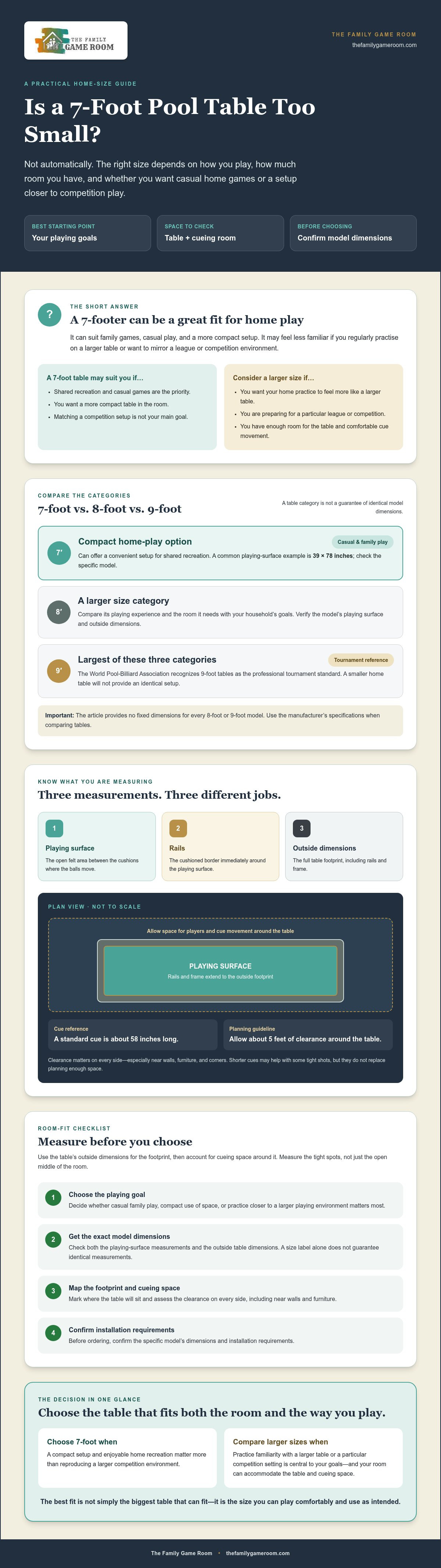
A table’s nominal size, playing surface, and outside footprint are different measurements. The playing surface is the open area between the cushions where the balls travel. Rails surround that surface, and the frame and cabinet add to the table’s overall dimensions. Knowing which measurement you’re comparing makes it easier to assess both the playing area and the space the table will occupy.
What does “7-foot” measure on a pool table?
“7-foot” is a size category, not a guarantee that the playing surface or cabinet measures exactly seven feet. A common playing-surface example is 39 by 78 inches, but dimensions vary by model. Check the manufacturer’s specifications before using any measurements to plan a purchase. The Billiard Congress of America provides a reference for standardized equipment specifications, while the exact measurements of a home table should come from its maker.
Simple plan-view guide, not to scale:
Playing surface: the open felt area where balls move
Rails: the cushioned border immediately around the playing surface
Outside table dimensions: the full footprint, including rails and frame
Use the playing-surface dimensions to understand the area of play. Use the outside dimensions to check how much floor space the table itself occupies. Then allow additional room for players to stand and use a cue.
How does table size change shot-making at home?
A smaller playing area means less distance between some shots, which can make the game feel more compact. The effect on any particular shot depends on the ball positions, the game, and the player’s experience. Someone used to a larger table may find the shorter layout unfamiliar, while a casual player may simply value a table that fits the room.
Illustrative example: Imagine the cue ball and object ball near opposite ends of the playing surface. On a smaller table, the shot has less available distance than the same end-to-end setup on a larger one. This illustrates the difference in layout, not a universal claim about difficulty or performance.
Clearance around the table affects play as much as the felt dimensions. A cue needs room to move on every side, including near walls, furniture, and corners. A standard cue is about 58 inches long, and a common planning guideline is roughly 5 feet of clearance around the table. Check the specific model’s footprint and measure using the cue you expect to play with. Pay particular attention to shots near walls, where an open stretch of floor elsewhere in the room won’t help.
If you’re weighing is a 7 foot pool table too small, consider the playing surface and cueing room together. Once you know what size suits your space, you can explore pool table options and compare each model’s specifications.
7-Foot vs. 8-Foot vs. 9-Foot Pool Tables: Which Fits Your Goals?
Each size balances room fit and playing experience differently. A 7-foot table is commonly called bar size, an 8-foot table is a popular middle ground for home use, and a 9-foot table is the professional tournament standard recognized by the World Pool-Billiard Association. These labels describe categories, not guaranteed playing-surface measurements. Exact dimensions vary, so check each model’s specifications and use a room-sizing reference such as Colorado State University’s Required Room Sizes when comparing clearance needs.
| Nominal size | Typical buyer priorities | Room demands | Practice considerations |
|---|---|---|---|
| 7-foot | Casual home games and a more compact setup | Generally needs less floor space than larger options, but still requires cue room on every side | Useful for home recreation; may feel different from practice on larger tables |
| 8-foot | A balance between home play and a larger playing area | Needs more space than a 7-foot table; confirm the model footprint and cue clearance | Can suit players who want more room for shots without choosing the largest category |
| 9-foot | A larger playing surface and closer alignment with professional tournament play | Requires the most room of these three sizes to allow comfortable cueing | Consider it if you want home practice to better match a 9-foot tournament table |
The trade-off is straightforward: a larger table provides more playing surface, while a compact table may be easier to fit and use comfortably at home. A 9-footer isn’t automatically the better choice if it leaves too little room for a full cue stroke or makes the room awkward to use. A table that fits well may make for more enjoyable games than a larger one that restricts shots near the walls.
When does a 7-foot table make more sense than an 8-foot table?
Consider a 7-footer if your room is limited or your household mainly wants casual games. Before deciding, mark each candidate table’s outside footprint on the floor and test the cueing space around it. This can show whether an 8-foot table leaves comfortable room to play or whether a 7-footer makes better use of the space.
Who should consider an 8-foot or 9-foot table?
An 8-foot table may appeal if you want a larger playing area and can still maintain comfortable clearance. Consider a 9-footer if longer shots and practice on a tournament-size table matter to you. Game, league, and venue conventions can differ, so confirm any formal size requirements before buying. You don’t need a larger table simply to enjoy playing at home.
How to Check Whether a 7-Foot Pool Table Fits Your Room
A table can fit on the floor and still leave too little room for a comfortable cue stroke. Check the outside footprint, the playing area, and the space needed for the cue you plan to use. Also account for obstacles and everyday traffic that a basic room measurement can miss.
How much clearance does a 7-foot table need?
Room needs depend on the model’s playing-surface dimensions and the cue length you plan to use. As a starting point, add twice the cue length to each playing-surface dimension, allowing one cue length on each opposing side. For example, a 78-inch playing surface and a 58-inch cue give an illustrative length calculation of 78 + 58 + 58 = 194 inches, or 16 feet 2 inches. This is a planning estimate, not a guarantee of fit. Confirm the model’s measurements and room guidance, and account for its rails and frame when checking the full footprint.
How can you test the layout before buying?
Use this measuring process before choosing a table:
- Get the exact specifications. Check the manufacturer’s playing-surface dimensions, outside dimensions, and installation requirements for the model you’re considering.
- Mark the table footprint. Use removable tape to outline the outside dimensions on the floor. This shows how much room the rails and frame will occupy.
- Mark cueing zones. Measure outward from the playing area using the cue length you expect to use. Check all four sides, not just the room’s longest dimension.
- Check obstacles and access. Look for doors, columns, heaters, furniture, irregular walls, and walkways. Try a cueing motion near each one, and consider how players will move around and use the room between games.
- Reassess tight spots. If a shot near a wall or furnishing feels restricted, compare another placement or table size. Don’t assume a shorter cue will solve every clearance issue.
For a close fit, compare your layout with the specific model’s instructions and seek knowledgeable guidance before ordering. A dining top can make a game room more versatile, but it doesn’t reduce the clearance needed for play.
Still wondering is a 7 foot pool table too small? Test the footprint and cueing zones first, then compare pool table options against your measured room.
Choose a 7-Foot Pool Table with Confidence
The right table size balances your room, the people who’ll play, and the games you enjoy. A 7-footer can be a strong home choice if it leaves enough room to move and suits your household’s expectations. If you want to practise on a setup closer to a larger table, weigh that goal against the room available. There’s no need to choose the largest size if doing so compromises comfortable play or how you use the room.
A quick checklist before choosing your table size
- Measure the room and cue clearance. Check the planned table position, including space to cue around every side.
- Set your playing priorities. Decide whether casual family games or practice that matches a larger table matters more.
- Confirm the model details. Compare the manufacturer’s playing-surface and outside dimensions, and review its installation requirements before ordering.
Answering these questions makes “is a 7 foot pool table too small” easier to resolve: choose a size that supports the play you want without making the room feel cramped.
What else should you plan for in a home game room?
Plan the lighting along with the table location. Position fixtures to illuminate the playing surface without interfering with cue strokes or movement around the table. Check the ceiling height and fixture placement before settling on a layout. For a multipurpose room, a pool table dining top is another option for when the table isn’t being used for play. It can adapt the room for other activities, but it doesn’t reduce the clearance needed for cueing.
The Family Game Room sells new pool tables from American Heritage Billiards and Nixon Billiards. It also offers billiard light fixtures and pool table dining tops, which can help you plan the room around how you intend to use it. Compare the specific table’s dimensions and setup details before making your final decision.
Choose the Table That Fits Your Home and Your Game
So, is a 7 foot pool table too small? Not if it suits the way your household wants to play and leaves enough room for comfortable cueing. A 7-footer can work well for casual games and shared recreation, while an 8-foot or 9-foot table may better match your practice goals or preference for a larger playing surface. The best choice isn’t simply the biggest one. Check the room, cue clearance, and exact model dimensions before deciding.
With your measurements in hand, compare tables by their playing dimensions and overall footprint. The Family Game Room offers pool tables from American Heritage Billiards and Nixon Billiards, along with billiard lighting and pool table dining tops for a coordinated or multipurpose game room.
Explore pool tables for your home and find a size that suits your space, your players, and the games you want to share.
Frequently Asked Questions
Is a 7-foot pool table big enough for adults?
Yes, adults can enjoy a 7-foot pool table for casual games and home recreation. Its smaller playing surface doesn’t make it unsuitable for adult players, though the game may feel different from play on a larger table. Make sure the room allows comfortable cueing from every side, and consider the games your household enjoys. The best fit depends on both available space and players’ expectations.
Is a 7-foot pool table the same as a bar-size table?
Usually, yes. A 7-foot table is commonly called a bar-size or bar-box table, but the label describes a general size category, not an identical specification for every model. Playing-surface and outside measurements can vary. Check the manufacturer’s dimensions to understand how much room the playing area and full table footprint will occupy.
How much room do you need for a 7-foot pool table?
For a 7-foot table and a standard 58-inch cue, a common recommended minimum room size is approximately 13 by 16 feet. Treat this as a planning guideline, not a guarantee of comfortable fit for every model. Exact needs depend on the table’s dimensions, cue length, and obstacles such as walls or furniture. Check the model specifications and measure clearance around all sides.
Can you play standard pool games on a 7-foot table?
Yes, familiar games such as eight-ball and nine-ball can be played on a 7-foot table. The smaller playing area changes the layout and distances between balls, so the experience may differ from play on a larger table. If you’re joining a league or practising for a specific competition, check its rules and venue conventions, since the required table size can vary.
Is a 7-foot or 8-foot pool table better for home use?
Neither size is automatically better. A 7-foot table may suit a compact room or a household focused on casual play, while an 8-foot table offers a larger playing surface if the room can accommodate it with comfortable cue clearance. Measure the space around the intended table position before deciding. An 8-footer that restricts cue strokes may be less enjoyable than a well-fitting 7-footer.
What cue length should you use with a 7-foot pool table?
A standard pool cue is about 57 to 58 inches long and works well when the room provides adequate clearance around the table. In tighter spaces, 48- or 52-inch cues may help players reach shots near a wall, but they don’t replace comfortable room planning. Check the cue length you expect to use and test whether players can stroke freely from every side.
Does a 7-foot pool table feel too small for experienced players?
It can, especially for players who regularly practise on larger tables and want a familiar setup at home. But experience alone doesn’t determine the right size. A 7-footer may still suit experienced players who mainly want convenient recreational games. Consider your preferred game formats and practice goals, then compare the model’s playing dimensions with the table size you’re used to.