


What if your first shuffleboard game felt less like guesswork and more like a simple, satisfying challenge? If you’re learning how to play shuffleboard for beginners, it’s natural to wonder where to stand, how to slide a puck, and whose turn comes next. A few basic rules are enough to get started.
This guide focuses on indoor table shuffleboard, played by sliding pucks along a raised table. It differs from floor or deck shuffleboard, where players use long cues to push discs across a court. Once you know which version you’re playing, the rest is easier to follow.
You’ll learn the basic setup, how a round of Knock Off works, when a shot counts, and how scoring zones determine points. Then you’ll practise a steady release and simple aim. Start with the flow of the game, build a repeatable slide, and leave advanced tactics for later. By the end, you’ll be ready to play casually with family or friends and agree on house rules before the first puck moves.
Key Takeaways
- Learn how to play shuffleboard for beginners by following a clear turn sequence, from choosing teams to alternating shots.
- Agree on the scoring target and table-specific house rules before play to keep the first game smooth.
- Read the marked scoring zones, and settle how your table’s values work before keeping score.
- Build a steady routine: pick a target, align calmly, push smoothly, and notice where the puck finishes.
- Practise controlled shots, then adjust one element at a time as you move into a casual match.
How indoor table shuffleboard works: the beginner’s starting point
Indoor table shuffleboard is played by sliding weighted pucks along a long, smooth table toward marked scoring zones. The goal is simple: finish with a puck in a higher-value position than your opponents. Players aim to place a puck in a scoring zone or move an opponent’s puck out of a strong position.
If you’re learning how to play shuffleboard for beginners, start by identifying the basic equipment: the table, the pucks, and the markings that show where points can be earned. Slide each puck rather than throwing it, and use the table’s scoring layout as your guide. Designs and scoring conventions can vary, so learn the markings on the table you’re playing.
What equipment and playing area do beginners need?
Stand at the shooting end designated for play, with the table in front of you and the scoring zones at the opposite end. Before taking a turn, locate the zone markings and check where each zone begins and ends. A puck’s final position relative to those lines helps determine its value, so use the actual table as your reference instead of relying on assumptions from another setup.
You don’t need complicated equipment to learn the basics. Get familiar with how the pucks move on your table and where the scoring areas are. That’s enough to follow the action and start making deliberate shots.
How table shuffleboard differs from other versions
The word “shuffleboard” can describe several games. In table shuffleboard, players slide pucks across a raised table. In deck or floor shuffleboard, players move discs over a court, often using long cues. Tabletop versions use a smaller playing surface and may have their own equipment and rules.
These formats aren’t interchangeable. Their equipment, playing areas, markings, and scoring conventions can differ, so don’t assume a rule from one version applies to another. This guide focuses on indoor table play. For more context on its terminology, history, and variations, see Table shuffleboard.
Keep the language straightforward as you learn: the table is the playing surface, the puck is what you slide, the shooting end is where you play from, and the scoring zone is where a puck can earn points. Once those pieces are clear, it’s easier to follow the game and enjoy it with family or friends.
How to set up a beginner shuffleboard game and take turns
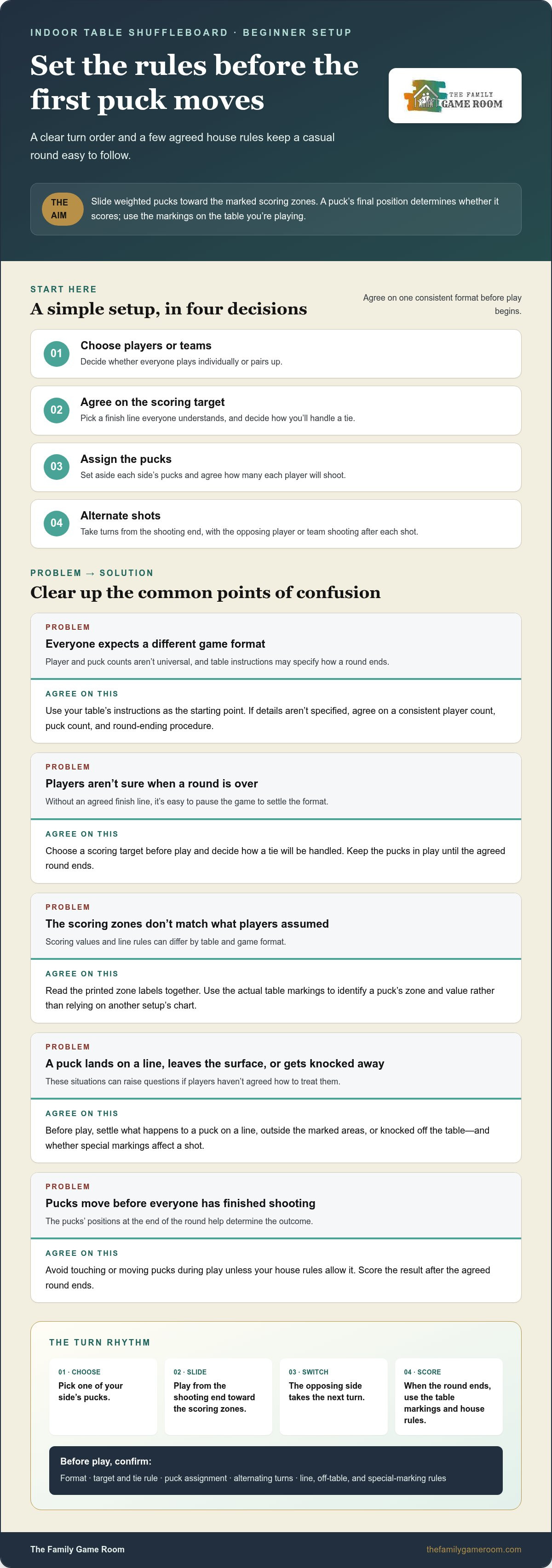
A quick setup keeps the focus on the game, not on sorting out rules mid-round. Before anyone shoots, agree on the format, the target score, and how a round ends. If you’re learning how to play shuffleboard for beginners, use this sequence to get everyone on the same page:
- Choose players or teams. Decide whether everyone plays individually or pairs up.
- Agree on the scoring target. Pick a finish line everyone understands, and decide how you’ll handle a tie.
- Assign the pucks. Set aside each side’s pucks and agree how many each player will shoot.
- Alternate shots. Take turns from the shooting end, with the opposing player or team shooting after each shot.
In this format, turns alternate puck by puck rather than having one side shoot all its pucks before the other starts. This gives both sides a chance to respond to the changing positions on the table. Keep the pucks in play until the agreed round ends, then score the result using the table’s markings and your house rules.
Settle house rules before play so everyone knows what to expect. Agree on what happens if a puck leaves the playing surface, how to treat a puck that stops on a line, and whether special table markings affect a shot. Rules can vary by table and format; the Table Shuffleboard Association is a useful reference for players looking into formal rules and tournament play.
How many players can play shuffleboard?
Casual games work well with individuals or teams. For a team game, agree how teammates will alternate their shots so both sides follow the same approach. Player and puck counts aren’t universal, so use the rules for your table or agree on a balanced format before you begin. Keep the first match simple and easy to follow.
What happens during a turn?
Choose one of your side’s pucks, take your position at the shooting end, and slide it toward the scoring zones. The opposing side then takes a turn. Continue alternating until the agreed round is complete. Avoid touching or moving pucks during play unless your house rules allow it; their positions at the end help determine the outcome.
If the table’s instructions specify a player count, puck count, or round-ending procedure, use those as your starting point. Otherwise, agree on one consistent version before the first puck moves. A clear routine helps new players focus on their shots and enjoy the game. If you’re planning a game room at home, explore indoor shuffleboard tables as one way to bring the game into your gathering space.
How shuffleboard scoring works, and what beginners should agree on
Scoring starts with the markings on the table. A puck’s final position determines whether it earns points and, if so, how many. Values and line rules can differ by table and game format, so don’t rely on a scoring chart from another setup.
Table shuffleboard scoring conventions can vary, so agree on the applicable rules before play. For a beginner game, read the printed zone labels together and decide how you’ll handle pucks on a line, outside the marked areas, or knocked off the table.
How do scoring zones and winning positions work?
Look from the shooting end toward the scoring end and read the labels on the playing surface. Use those markings to identify a puck’s zone and value. The table below is a guide to what to check, not a universal score chart. Zone placement and point values depend on the specific layout.
| Zone location | Relative value | Beginner interpretation |
|---|---|---|
| Near the scoring end | Check the printed value | A puck may occupy a higher-value zone, depending on the table. |
| Closer to the shooting end | Check the printed value | Read the zone label rather than guessing from distance alone. |
| On a boundary or outside the zones | Depends on the agreed rule | Decide whether it scores, stays in play, or is out. |
In a common Knock Off format, the side with the puck farthest toward the scoring end is the only side that scores for that round. The table’s markings and the rules you chose determine how points are counted. Compare puck positions after the round ends, and leave every puck undisturbed until then.
Which rules should beginners agree on before playing?
Settle the details that can affect the result before the first shot. Choose the winning score and decide what counts as a completed round. Agree how to handle pucks outside marked areas, boundary-line disputes, and shots that leave the table. If the table has printed instructions, use them as your starting point, then apply any casual adjustments consistently for everyone.
Keep formats separate. Deck shuffleboard and tournament play may use different equipment, markings, or scoring conventions from a casual indoor table game. If you’re learning how to play shuffleboard for beginners, one clear set of table-specific rules is easier to remember than a mix of rules from different versions.
Beginner shuffleboard technique: aim, release, and learn from each shot
A reliable beginner shot starts with a clear target, not extra force. Choose a visible scoring zone, get comfortable at the shooting end, and use a smooth forward push to send the puck gliding. Focus first on control and placement. A puck that travels steadily is easier to learn from than one sent down the table without a clear aim.
A repeatable release and deliberate aim make it easier to learn from each shot. Use this simple routine:
- Choose: Pick a visible target or a position you want the puck to reach.
- Align: Get comfortable at the shooting end and face the target without rushing.
- Slide: Push the puck forward smoothly. Avoid throwing it or making a sudden, forceful movement.
- Observe: Notice where it finishes and compare that with your intended target.
How should a beginner aim and release a puck?
Keep your stance comfortable and balanced. Set the puck down as directed for your table, then guide it forward in a controlled sliding motion. Aim for a specific marking or open space rather than simply pushing toward the far end. Your movement may depend on the table, so follow its handling guidance and focus on a release you can repeat. Keep your hands clear of other players and wait until the playing area is safe before shooting.
What common beginner mistakes should players avoid?
Don’t change everything after one shot. If you alter your stance, aim, and release speed together, it’s difficult to tell what affected the result. Keep your starting position consistent and adjust one element at a time. For example, aim at the same zone for a short practice round, then make a small change to your release and observe the result.
More force doesn’t automatically lead to a better position. A hard shot may send the puck past the target or disrupt a position you meant to keep. Start with controlled placement and see how the puck responds. Before your next turn, check that the pucks are settled and the playing surface is clear. Don’t reach across the table or move a puck while another player is preparing to shoot.
If you’re learning how to play shuffleboard for beginners, short, focused practice is more useful than changing your approach every turn. Repeat a comfortable starting position, aim deliberately, and review each result. When you’re ready to practise at home, explore indoor shuffleboard tables for a game friends and family can enjoy together.
From first game to game-room favourite: practise and explore indoor shuffleboard
Confidence comes from a few focused turns, not from memorizing every possible shot. Start by learning your table’s zone markings, practise sliding toward a chosen target, then use the same setup and scoring rules for a short casual match. This helps beginners connect what they see on the playing surface with how each shot affects the game.
How can beginners practise without making the game feel complicated?
Keep practice simple and repeatable:
- Read the zones. Identify the markings and decide which visible area you’ll aim for.
- Take a few practice shots. Focus on a smooth, controlled slide before keeping score.
- Review each result. Notice whether the puck stopped short, reached the target, or travelled past it.
- Adjust one thing. Change your aim or release slightly, then see how that affects the next shot.
- Play a short match. Keep the agreed setup and scoring rules consistent so everyone can focus on learning.
Invite family or friends to join in, and keep early rounds relaxed. A missed target gives you useful information; it doesn’t spoil the game. If a shot doesn’t go as planned, talk through what happened and make just one adjustment before the next turn. That makes it easier to tell which change helped.
What makes indoor table shuffleboard enjoyable at home?
Indoor table shuffleboard brings a shared activity into the home, giving family and guests an easy way to gather, take turns, and enjoy friendly competition. New players can learn at their own pace, while familiar opponents can add strategy over time. Each turn offers a fresh chance to aim, respond, and improve.
Practising at home also gives players a chance to become familiar with the table’s markings and puck movement. The Family Game Room offers indoor shuffleboard tables for a dedicated game-room experience. As you learn how to play shuffleboard for beginners, start with the basics, keep the first match friendly, and develop your skills one shot at a time.
Ready to picture shuffleboard in your own home? Explore indoor shuffleboard tables.
Bring your first shuffleboard game to life
You now have the essentials for how to play shuffleboard for beginners: agree on the game format and house rules, take turns consistently, and use the table’s own markings to understand scoring. For your first match, focus on a controlled slide toward a clear target. Notice where each puck finishes, then adjust one part of your approach at a time.
Shuffleboard is easy to enjoy casually, and practice gets more rewarding as you learn how your table plays. Invite family or friends, keep the first game relaxed, and let the friendly competition grow naturally. A dedicated indoor shuffleboard table can make that shared game-room experience part of home life. The Family Game Room offers indoor shuffleboard tables.
Ready to explore a table for your home? Explore indoor shuffleboard tables, then gather your players and enjoy the first slide.
Frequently Asked Questions
How do you play shuffleboard for beginners?
To play table shuffleboard, take turns sliding pucks from the shooting end toward the scoring zones. Before starting, choose individual or team play, agree on a target score, and settle how a round ends. In the common Knock Off format, players alternate shots, trying to place a puck farther down the table or knock an opponent’s puck out of position. Use the table’s markings and agreed rules to score.
How do you score points in table shuffleboard?
Score points according to where pucks finish in the table’s marked scoring zones. Read the values printed on your playing surface, since layouts and rules can differ. In Knock Off, the side with the puck farthest toward the scoring end is typically the only side to score in that round. How many of its pucks count, and how boundary positions are treated, depend on the rules you agree to use.
How do you hold and slide a shuffleboard puck?
Follow the table’s handling guidance, then hold the puck securely but comfortably at the shooting end. Aim at a visible zone or position and guide the puck forward in a smooth, controlled sliding motion. Don’t throw it or assume extra force will improve the result. A repeatable release helps you see how your aim and movement affect the puck. Keep your hands clear when another player is preparing to shoot.
Is table shuffleboard the same as outdoor shuffleboard?
No. Table shuffleboard uses pucks that slide along a raised playing surface toward marked scoring zones. Outdoor or deck shuffleboard is played on a court, often with larger discs moved using long cues. The equipment, playing area, markings, and scoring conventions can differ. Learn the rules for the version in front of you rather than carrying assumptions from one format into another.
What happens if a shuffleboard puck lands outside the scoring area?
It depends on where the puck stops and the rules for that table. A puck that remains on the playing surface but outside a marked scoring zone may not earn points; a puck that leaves the table is commonly treated as out of play. Line calls can also vary. Agree before the game how to handle these positions, and leave pucks undisturbed until the round ends.
How can beginners get better at shuffleboard?
Practise with a consistent starting position and aim at one visible zone for several shots. Notice whether each puck stops short, reaches the target, or travels past it. Then adjust one element, such as your aim or the smoothness of your push, rather than changing everything at once. After practice shots, play a short casual game using the same setup and scoring rules. Focus on control before advanced tactics.