


The difference between a casual basement hobby and a professional-grade competition often comes down to the first rack of the night. You've invested in a premium space with high-end equipment, yet your matches still devolve into debates over "bar rules" versus official tournament standards. It's frustrating when a lack of clarity on the technicalities of biliard 8 ball prevents you from fully enjoying your game room. You deserve a match that reflects the quality of your surroundings.
We agree that a home game room should be a place of precision and fair play, not confusion. This guide will help you master the official 2025/2026 international rules and setup techniques used by the pros. By following these standards, you'll turn every match into a legitimate, high-stakes experience that respects the integrity of the sport and your investment.
We'll walk you through the nuances of the perfect rack, clarify how to handle fouls without the usual arguments, and provide the etiquette tips needed to host a flawless tournament. From utilizing your professional cue racks to maximizing the play on your American Heritage or Nixon table, you're about to elevate your home entertainment to a world-class level.
Key Takeaways
- Learn the "call-shot" fundamentals to ensure every pocketed ball is intentional and follows professional tournament standards.
- Master the art of the tight rack and proper ball positioning to guarantee a fair and consistent break every time.
- Eliminate game-room arguments by understanding official foul definitions and the specific requirements for a legal biliard 8 ball shot.
- Gain a competitive advantage by learning how to analyze an open table and strategically choose your ball group after the break.
- Discover how premium equipment and proper lighting fixtures elevate your home entertainment experience to professional levels.
Mastering the Basics of Billiard 8 Ball
Success on the table begins with a clear understanding of the fundamental framework. Unlike casual games where "anything goes," professional 8-ball is a disciplined "call-shot" game. This means you don't just aim and hope; you must clearly indicate which ball you intend to pocket and which pocket it will enter. The game uses fifteen object balls and a single cue ball. Remember that the cue ball is your only point of contact; it's the only ball you're allowed to strike with your cue stick. Understanding Mastering the Basics of Billiard 8 Ball is essential for any player looking to move beyond basic recreation into true competitive play.
Your ultimate goal is to clear your assigned group of balls from the table before legally pocketing the 8-ball. These groups are categorized into "solids" (balls 1 through 7) and "stripes" (balls 9 through 15). The table is considered "open" immediately after the break, meaning groups haven't been determined yet. You claim a group only after you legally pocket a called ball. Mastery of biliard 8 ball requires more than just sinking shots. You have to manage the "leave," ensuring the cue ball settles in a position that makes your next shot effortless.
Essential Equipment for a Home Game
A professional-grade experience requires professional-grade tools. Most experts insist on a slate-bed table. Slate is a heavy, natural stone that provides a perfectly level surface, ensuring a consistent biliard 8 ball roll that won't warp like cheaper wood alternatives. Your cue stick is equally vital. Don't overlook tip maintenance; a well-scuffed leather tip holds chalk better and prevents the dreaded miscue. Finally, ensure you have a standard 15-ball rack and high-quality phenolic resin balls. These materials provide the weight and balance necessary for predictable physics during every match.
The Language of the Table
To communicate like a seasoned player, you need to know the terminology. Beginners should distinguish between the "foot spot," where the balls are racked, and the "head string," the line you break from. You'll also hear players talk about "English." This refers to putting spin on the cue ball by striking it away from its center. It's a powerful technique that allows you to curve the ball's path or change how it bounces off the rails. Common terms include:
- Scratch: When the cue ball is pocketed or leaves the playing surface.
- Open Table: The state of the game before groups (solids or stripes) are assigned.
- Behind the Headstring: The area between the head rail and the head string line, often used for placing the cue ball after certain fouls.
Learning these basics ensures you spend more time playing and less time debating the rules. It sets the stage for a fair, competitive environment in your home game room.
The Professional 8-Ball Setup: Racking and Positioning
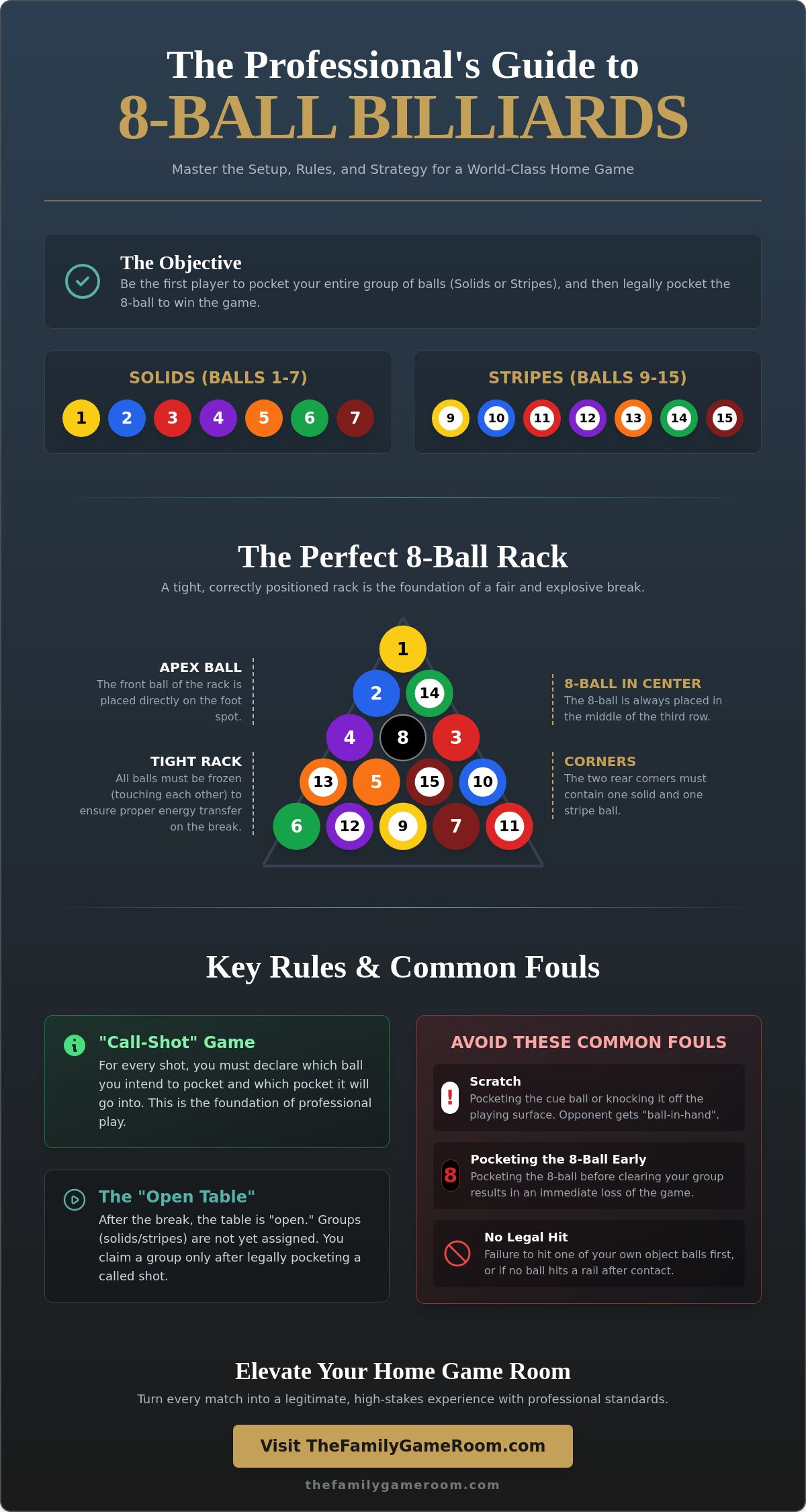
Achieving a professional-grade game starts before the first shot is even taken. A sloppy rack leads to a "dead" break, where energy dissipates and balls barely move. To set up a legitimate game of biliard 8 ball, you must ensure the rack is perfectly tight, meaning every ball is "frozen" or touching its neighbors. Start by placing the apex ball directly over the foot spot. Use your fingers to press the balls toward the front of the triangle while removing the rack to maintain this compression. Investing in a high-quality American Heritage Billiards table ensures the slate surface remains perfectly level, allowing your rack to stay exactly where you place it without drifting.
According to the Official UPA 8-Ball Rules, the 8-ball must be positioned in the exact center of the triangle. This is the middle of the third row. To ensure fairness, place one solid ball and one stripe ball in the two rear corners of the rack. The remaining balls should be placed randomly throughout the triangle. Before you step away, perform a final visual check. If you see daylight between any of the balls, the energy from your break won't transfer correctly. A tight rack is the only way to ensure the balls scatter across the table as intended.
Ball Placement Nuances
The 8-ball sits in the third row to prevent it from being easily pocketed on the break, which maintains the competitive balance of the match. While the rest of the balls are random, the "solids and stripes" corner rule is a hallmark of professional play. This prevents one side of the rack from being "loaded" with a single group. Visualize a "power triangle" where the energy from your cue ball hits the apex and radiates through the center. This mental map helps you identify if the rack is stable enough for a high-speed hit.
The Break: Starting the Game with Power
Position the cue ball anywhere behind the headstring to begin. You aren't restricted to the center; many pros prefer an angled approach to increase the chances of pocketing a ball. For a break to be considered legal, the player must either pocket an object ball or drive at least four object balls to the cushions. If you pocket the 8-ball on the break, don't pack up just yet. Under professional standards, you typically have the option to re-spot the 8-ball and continue or simply re-rack and break again. Mastering this opening ritual is the first step in dominating the biliard 8 ball circuit in your own home.
Executing the Perfect Break and Choosing Your Group
The dust has settled and the balls have stopped rolling. Now, the real game of biliard 8 ball begins. One of the most common mistakes in home game rooms is the "take what you make" myth. Many casual players believe that if they pocket a stripe on the break, they must play stripes for the rest of the match. This isn't the case in professional play. According to the Billiard Congress of America Official 8-Ball Rules, the table remains "open" immediately after the break, regardless of which balls were pocketed. You only claim a group once you legally pocket a called ball in a subsequent shot.
This "open table" state is a strategic gift. It allows you to analyze the entire layout without being locked into a difficult run. Look for "problem balls" early. These are object balls frozen against a rail or trapped in a cluster. If you see a difficult solid but an easy path for stripes, choose the stripes. Your goal is to clear the table, so prioritize the group that offers the most direct path to the 8-ball. Don't let personal preference override a smart tactical decision.
The 'Open Table' Strategy
While the table is open, you have unique tactical freedom. You can actually strike a solid to pocket a stripe, or vice versa, as long as the shot is called correctly. This is the perfect time to use your opponent's balls to break up your own clusters. If you have two solids tied up near a corner, you might use a stripe as a "combo" ball to knock them loose. Always prioritize the run that feels most fluid. A professional-grade biliard 8 ball match is won by the player who identifies the easiest path to victory before they ever touch the chalk.
Bridge and Stance Fundamentals
Your physical connection to the table dictates your accuracy. Most players utilize an "open bridge" for standard shots, providing a clear line of sight along the cue. However, for power shots or when you need extra stability, a "closed bridge" where the index finger loops over the cue is superior. Pair this with a stable tripod stance. Keep your feet shoulder-width apart and your weight evenly distributed to prevent swaying during the stroke. Follow-through is the key to cue ball control. By accelerating through the ball rather than poking at it, you ensure the tip stays in contact long enough to apply the desired spin or "English."
Standard 8-Ball Rules and Common Fouls to Avoid
In many casual settings, players rely on "slop" play, where a ball counts regardless of how it enters the pocket. Professional biliard 8 ball demands a higher standard known as the "Call Shot" rule. You must clearly identify the specific ball and the intended pocket before every stroke. You don't need to specify banks, kicks, or kisses, but the final destination must be intentional. If the ball enters a different pocket, your turn ends. This ensures that every point is a product of skill rather than luck.
Defining a legal shot is the most common source of home-game friction. To keep the match fair, you must strike one of your group's balls first. Following that contact, at least one ball (either the cue ball or any object ball) must touch a rail. Failure to hit a rail results in a foul. The penalty for any foul, including a scratch, is "Ball in Hand." This allows your opponent to place the cue ball anywhere on the entire playing surface. This rule prevents players from intentionally leaving their opponents in impossible positions through illegal shots.
Automatic loss conditions are the most dramatic moments in a match. You lose immediately if you pocket the 8-ball before clearing your entire group of solids or stripes. Sinking the 8-ball into a pocket you didn't call also ends the game in your opponent's favor. To maintain the professional polish of your matches, ensure everyone understands these stakes before the first break. To keep your equipment in tournament condition, consider adding professional pool cue racks to your game room setup.
Navigating Common Fouls
Precision is required when the cue ball is close to your object ball. A "double hit" occurs if the cue tip strikes the ball twice or remains in contact too long; this is a foul. Similarly, a "no rail" foul happens if nothing hits a cushion after the initial impact. If you need to clear an obstacle, remember that "scooping" under the ball to create a jump is illegal. Legal jump shots must be struck from above with a downward motion.
The 8-Ball Finale
The match concludes with the 8-ball shot. You must call the exact pocket for this final ball. Pocketing the 8-ball in an uncalled pocket results in an automatic loss. However, scratching while the 8-ball remains on the table is usually just a foul, not a loss, unless the 8-ball also drops. Adopting a "gentleman's game" approach means calling your own fouls. This practice preserves the integrity of your biliard 8 ball arena and fosters a respectful competitive environment.
Creating the Ultimate 8-Ball Experience at Home
Your environment dictates your level of play. A high-end setup isn't just about aesthetics; it's about the physics of the biliard 8 ball. High-quality American Heritage Billiards Pool Tables provide the rigid slate foundation needed for tournament-grade precision. Without a perfectly level surface, even the most accurate "Call Shot" will drift off course. Invest in a table that maintains its integrity over years of consistent use.
Proper lighting is equally vital for professional play. Install dedicated billiard light fixtures directly over the center of the table. This eliminates distracting shadows on the felt that can distort your perception of the ball's edge or the pocket's depth. Also, measure your room layout with care. You need a minimum of 5 feet of clearance around the entire table perimeter. This space ensures a standard 57-inch cue can be used at any angle without hitting walls or furniture.
Choosing the Right Table for Your Space
While 7ft "bar boxes" are common in local pubs, the 8ft table is the recognized "home standard." For those seeking the true tournament experience, a 9ft table with a playing surface of 100 inches by 50 inches is the professional choice. If your game room serves multiple purposes, Premium Game Table Sets offer the versatility of a dining top without sacrificing the quality of the slate bed. Keep your felt fast and clean by brushing it regularly in a single direction to remove chalk dust and debris.
Accessories that Elevate the Game
Don't settle for basic polyester balls that chip and lose their balance. Professional-grade balls made of phenolic resin are the industry standard for biliard 8 ball. These regulation 2.25-inch balls are more durable and provide the consistent roll required for advanced "English" and spin shots. Protect your investment by using dedicated cue racks to store your sticks vertically. Leaning cues against a wall is a primary cause of warping over time. Finally, complete the arena with high-quality bar stools or spectator chairs. A comfortable, social atmosphere turns a simple game into a premier home entertainment event.
Elevate Your Game to Professional Standards
Transitioning from casual play to the refined world of biliard 8 ball requires more than just practice. It demands a commitment to professional "Call Shot" standards and a mastery of the physical mechanics we've discussed. By implementing a tight rack and understanding the strategic freedom of an open table, you've moved beyond "bar rules" and into the realm of true competitive play. These technical nuances ensure that every victory in your home game room is earned through skill and precision.
Your developing expertise deserves a surface that doesn't compromise. Since 2022, our family-owned business has provided homeowners with an expertly curated selection of Nixon and American Heritage Billiards equipment. We provide national US shipping on all premium game tables to ensure your home arena is equipped for tournament-grade action. Upgrade your home game room with a professional American Heritage Billiards table today and experience the flawless roll that only a high-end slate bed can provide.
Step up to the table with newfound confidence and enjoy the long-term satisfaction of a game played the right way. It's time to let the competition begin.
Frequently Asked Questions
What happens if I pocket the 8-ball on the break?
Pocketing the 8-ball on the break is not an automatic win under professional standards. You typically have two options: re-spot the 8-ball and continue play from the current position or re-rack the balls and break again. This rule ensures the match remains a test of skill rather than a lucky opening shot. Check your specific league guidelines, as some casual house rules may differ.
Do I have to call every shot in a casual 8-ball game?
While many casual players enjoy "slop" play, official rules define 8-ball as a call-shot game. You must identify the intended ball and the target pocket for the shot to be legal. You don't need to specify details like banks or kisses. Adopting this standard in your home game room prevents arguments and elevates the competitive atmosphere of your matches.
Is it a foul if the cue ball hits the opponent's ball first?
Yes, hitting your opponent's group first is a standard foul. You must always make initial contact with a ball from your assigned group, whether you are playing solids or stripes. If the cue ball strikes the wrong group first, your turn ends immediately. Your opponent then receives the "ball in hand" penalty to begin their visit to the table.
What is 'Ball in Hand' and when do I get to use it?
Ball in hand is a strategic advantage awarded after an opponent commits a foul. It allows you to place the cue ball anywhere on the biliard 8 ball surface before taking your shot. This rule is vital for professional play because it discourages players from committing intentional fouls to leave their opponents in a difficult or "snookered" position.
Can I win the game if I pocket the 8-ball and the cue ball at the same time?
No, pocketing the 8-ball and scratching the cue ball simultaneously results in an automatic loss. Even if the 8-ball enters the correct called pocket, the scratch on the same stroke ends the game in your opponent's favor. This high-stakes rule makes the final shot the most pressurized moment of the match, requiring absolute focus and cue ball control.
How much space do I actually need for an 8ft pool table?
An 8ft table requires a room that is at least 17 feet long by 13 feet 6 inches wide. This space allows for the physical dimensions of the table while providing the necessary 5 feet of clearance on all sides. This clearance ensures that players can use a standard 57-inch cue without hitting walls or furniture during backswings.
What is the difference between solids and stripes in 8-ball?
The difference is strictly categorical to divide the fifteen object balls into two groups. Solids are the low balls numbered 1 through 7, while stripes are the high balls numbered 9 through 15. In a game of biliard 8 ball, players must clear their specific group entirely before they are eligible to shoot at the black 8-ball for the win.
Do I lose if I accidentally hit the 8-ball before my other balls are gone?
No, hitting the 8-ball early is a foul but not an automatic loss. As long as the 8-ball remains on the table and isn't pocketed, the game continues. Your opponent will receive ball in hand as a penalty for the illegal contact. You only lose the game if the 8-ball is pocketed illegally or knocked off the table playing surface.