


What if the best way to outfit a new pool table is to buy less at first? The essential accessories for a new pool table start with a few basics: cues, a set of balls, a rack, and chalk. It’s easy to get distracted by upgrades before you know what you’ll use, or to overlook simple ways to protect and organize your equipment.
Your first game should feel ready to play, not like the start of another shopping list. This checklist helps you prioritize the essentials, distinguish useful upgrades from optional extras, and choose accessories that suit your table and the way you play. You’ll also find practical ways to care for the playing surface and store cues neatly.
Start with what makes a game possible, then consider protection, maintenance, and finishing touches. A table cover and brush can support routine care, while a cue rack and well-planned billiard lighting help organize and finish the room. Add only what suits your games and your space, and your new table will be ready to play and feel at home.
Key Takeaways
- Use the essential accessories for a new pool table checklist to separate first-game necessities from upgrades you can add later.
- Match accessory priorities to how often you play, the games you enjoy, and your household’s needs.
- Build simple care habits around storing equipment, covering the table when appropriate, and keeping the playing area clear.
- Consider how cue storage and billiard lighting can bring an organized, finished feel to your game room.
Essential accessories for a new pool table: what belongs on your checklist?
What do you need for an enjoyable first game? Start with the equipment that lets everyone play, then add items that protect the table or solve a practical need in your game room. That’s the simplest way to distinguish essential accessories for a new pool table from upgrades that can wait.
Use this checklist as a starting point, not a requirement to buy everything at once. Consider who will play, how often you expect to use the table, what games you’ll play, and which accessories you already own.
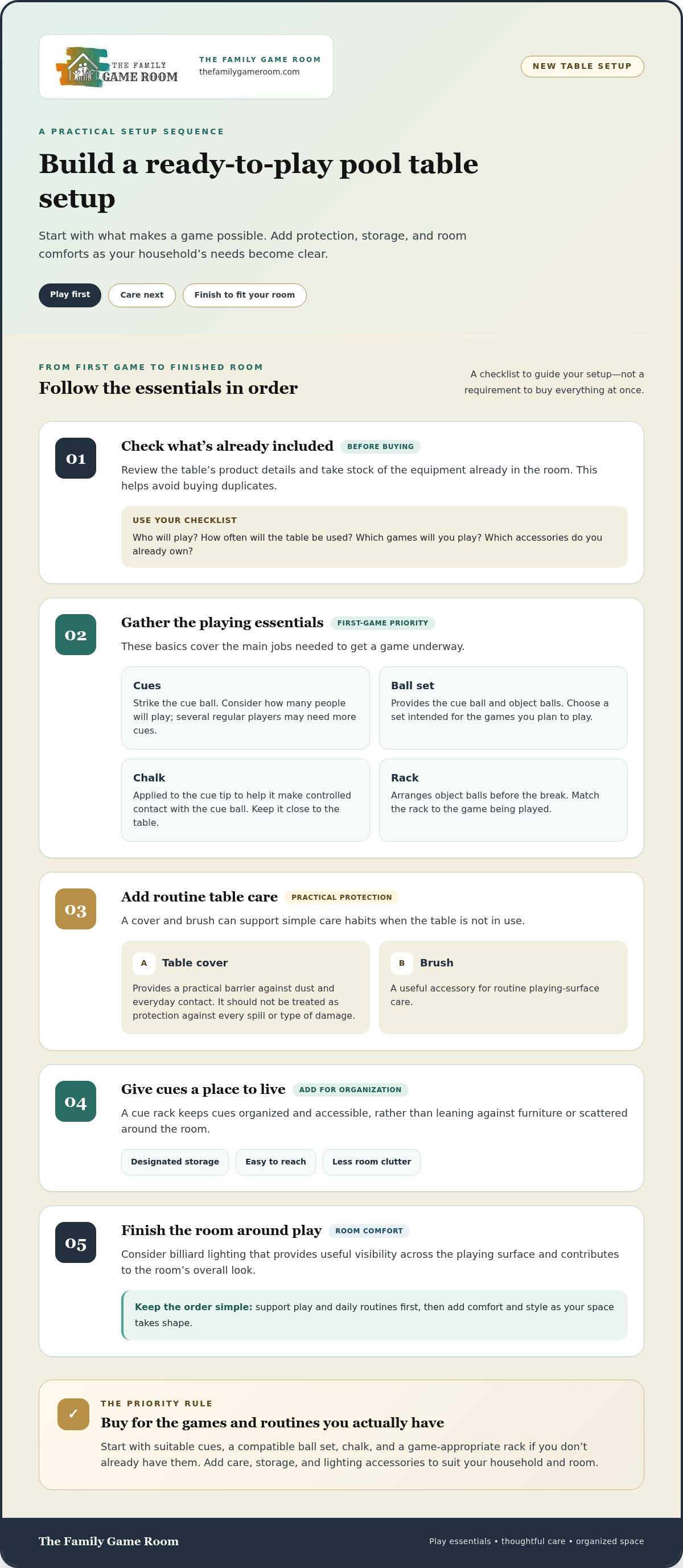
- Play: Suitable cues, a compatible ball set, chalk, and a rack suited to your chosen game.
- Care: A table cover and a brush for routine surface care.
- Storage: A cue rack to keep cues organized and accessible.
- Room comfort: Billiard lighting that provides useful visibility across the playing surface.
What do you need to play your first game?
Cues are used to strike the cue ball, while a compatible ball set supplies the balls required for your chosen game. Chalk helps the cue tip make controlled contact with the cue ball. A rack arranges the object balls before play begins. For quick explanations of billiards terms, the Glossary of cue sports terms covers equipment such as cues, chalk, bridges, and racks.
Before shopping, take stock of what’s already in the room and consider who will play. A household with several regular players may need more cues than one with occasional games. Choose a ball set and rack for the formats you expect to play, and review the table’s product details to see what equipment is included before buying duplicates.
Which accessories protect the table and improve the room?
A table cover provides a practical barrier against dust and everyday contact when the table isn’t in use. It can be useful in a busy room, though it should not be treated as protection against every spill or type of damage. A cue rack gives cues a designated place, keeping them organized and easy to reach instead of leaning against furniture or scattered around the room.
Lighting deserves a place on the checklist, too. A well-considered fixture above the playing surface can make the table easier to see during a game while contributing to the room’s overall look. The Family Game Room offers billiard light fixtures and pool cue racks to bring function and a coordinated feel to a home game room. Start with what supports play and daily routines, then add comfort and style as your space takes shape.
Pool cues, balls, chalk, and a rack: understand the playing essentials
Each item in a basic playing setup has a distinct job. A pool cue is used to strike the cue ball. A ball set supplies the cue ball and object balls used in a game. Chalk is applied to the cue tip to help it make controlled contact with the cue ball. A rack arranges the object balls before the break.
Together, these essentials support different parts of play: cues make shots, balls provide the targets, chalk helps players manage contact, and the rack sets up a game. Use the table as a starter-priority guide, then choose equipment for the games your household enjoys.
| Accessory | Purpose | Starter priority |
|---|---|---|
| Pool cues | Strike the cue ball during play. | Essential for each player to take a turn. |
| Ball set | Provides the balls needed for the games you play. | Essential; choose a set suited to your preferred games. |
| Chalk | Helps the cue tip make controlled contact. | Essential for a ready-to-play setup. |
| Rack | Arranges object balls before the break. | Essential for games that begin with a rack. |
How should a new owner think about pool cues and balls?
Think first about who’ll play and how often. A household with several players may want enough cues for everyone to join in, while a casual player may focus on having a cue suited to regular use. For more guidance on choosing a cue, explore this pool cue guide.
Choose ball sets for the games you plan to play. Rather than choosing by appearance alone, consider the formats your household enjoys and select a set intended for them. That keeps your starter kit aligned with actual game nights.
Why are chalk and a ball rack useful?
Keep chalk close to the table so players can use it as needed. A rack holds object balls in position before the break, giving players a consistent way to prepare a game. The right rack depends on the game being played, so let your household’s preferred formats guide the choice.
Once you know which playing essentials fit your routine, explore pool cue racks as a practical way to keep cues organized and ready for the next game.
Which pool table accessories should you buy now, and which can wait?
You don’t need every pool table accessory on day one. Start with what supports the games you plan to play, then add items as your household’s habits and room needs become clear. This keeps the first setup practical instead of turning a checklist into a shopping mandate.
Use this comparison to sort immediate needs from considered upgrades. Priorities depend on what you already own, how many people will play, and how often you expect to use the table.
| Accessory | Purpose | Priority | Who benefits most |
|---|---|---|---|
| Cues, a compatible ball set, chalk, and a suitable rack | Provide the basic equipment for your intended games. | First priority if you don’t already have them. | Every new owner preparing to play. |
| Extra cues | Make cues available for additional players. | Add based on player count. | Households that often play together or host guests. |
| Table cover | Helps shield the table from dust and everyday contact. | Consider based on room conditions and routines. | Owners whose table is exposed to household activity or dust. |
| Cue rack | Keeps cues organized and accessible between games. | Useful when you need a dedicated storage spot. | Players who want a tidier, ready-to-play room. |
| Specialized or extra equipment | Supports particular games, preferences, or practice needs. | Wait until a clear use emerges. | Players whose interests call for a specific addition. |
Which accessories are useful from the first game?
Make the playing kit your first purchase priority. Choose cues, balls, chalk, and a rack suited to the games your household intends to play. Chalk and a suitable rack make preparation more straightforward: players can chalk as needed and arrange the object balls before the break. Your starting list may be shorter if you already own some equipment, or include more cues if several people will play.
What can wait until your playing habits are clear?
Specialized or extra equipment can wait until you know which games and routines have taken hold. A table cover may be especially useful in a dusty or busy room, while storage needs depend on where you’ll keep equipment between games. There’s no universal list. Add pieces because they solve a real problem or support regular play, not because a checklist says you must have them.
Once the essentials are in place, consider whether a dedicated pool cue rack would keep your cues organized and your game room composed.
Protect and organize your new pool table with the right room accessories
A simple after-game routine can keep your space orderly: return cues to their rack, cover the table when it’s not in use and the room’s conditions call for it, then clear the playing area. These essential accessories for a new pool table support everyday care and comfort, but they don’t replace routine table care or prevent every kind of damage.
How do a pool table cover and cue rack help?
A cover helps reduce dust exposure while the table is idle. It can be a practical choice in a room where dust or everyday activity reaches the playing surface, though it’s not a guarantee against spills or damage. Keep the routine simple: use the cover when appropriate, and remove it before play.
A cue rack gives cues a dedicated place, helping keep them together and reducing clutter around the table. That makes equipment easier to find before a game and helps keep walkways clear. For ideas on organizing your setup, read this pool cue rack guide.
When should you consider billiard lighting?
Consider lighting if players have trouble seeing the playing surface clearly or the room’s existing light leaves uneven shadows. Aim for useful, even coverage across the table without creating glare that distracts during a shot. The fixture should also suit the room’s décor, since it’s both a functional feature and a visible part of the game-room design.
For more planning ideas, explore this billiard lighting guide. Keep the surrounding area clear of furniture and loose equipment so players can move comfortably around the table. You don’t need to redesign the room; focus on a clear path and lighting that suits how the space is used.
Build your setup around the room you have. Explore pool cue racks and billiard light fixtures to bring considered storage and lighting into your game room.
Finish your pool table setup with accessories that fit your home
A finished setup isn’t the one with the most accessories. It’s the one that suits your games, household routines, and room. Bring the checklist together in four parts: playing essentials for the games you enjoy, protection that fits the room, storage that keeps equipment orderly, and comfort that makes it pleasant to gather and play.
Choose additions with everyday use in mind. A busy family room may call for an easy place to put cues away and a cover when the table isn’t in use. A dedicated game room may benefit from billiard lighting that complements its furnishings. The Family Game Room offers pool cue racks and billiard light fixtures to bring practical function and a considered finish to the space.
How can accessories make a game room more comfortable?
Suitable lighting helps players see the playing surface, while clear equipment storage makes cues easier to find and keeps clutter out of the way. Think about how people move through the room and where accessories can sit naturally between games. If your space is designed for socializing, bar stools can offer optional seating nearby. Keep the focus on what makes your usual game nights more comfortable, rather than filling every corner.
What is a simple final checklist before your first game?
Before inviting everyone to the table, check the essentials and the space around them. Match equipment to the games your household plans to play, then decide which care or comfort items suit your room. The essential accessories for a new pool table should support actual play and daily routines, not create extra clutter.
- Playing: Cues, a suitable ball set, chalk, and a way to rack the balls.
- Protection: Decide whether a cover makes sense for your room and how the table is used.
- Organization: Consider a cue rack if equipment needs a dedicated storage spot.
- Comfort: Think about billiard lighting and, if it suits your social setup, nearby seating.
Keep the first setup simple, then add accessories as your routines take shape. To browse options for your space, explore pool tables and game-room accessories from The Family Game Room.
Build a Game Room That’s Ready for Your Next Match
The best setup starts with the equipment that makes your preferred games possible, then grows around your household’s routines. Choose cues, balls, chalk, and a rack for the games you plan to play. Add protection and storage where they’ll make everyday care easier, and consider lighting for a comfortable, clear view of the playing surface.
That’s the value of a thoughtful checklist of essential accessories for a new pool table: it helps you prioritize what you’ll use instead of buying every extra at once. The Family Game Room carries pool cue racks and billiard light fixtures, along with pool tables from American Heritage Billiards and Nixon Billiards, to help you shape a coordinated home game room.
Ready to plan your space? Explore pool tables and game-room accessories from The Family Game Room and choose the pieces that fit your setup.
Frequently Asked Questions
What accessories do you need for a new pool table?
The essential accessories for a new pool table are the items needed for your chosen games: cues, a suitable ball set, chalk, and a way to rack the balls. A cover can help reduce dust exposure between games, while a cue rack keeps equipment organized. Before buying, note what you already own and what comes with your table, then fill only the gaps in your playing setup.
Do new pool tables come with accessories?
Included accessories can vary by table, so don’t assume every purchase comes with the same equipment. Review the specific product details and make a list of what’s included. Then compare it with the cues, ball set, chalk, and rack needed for your preferred games. You may already have some pieces at home, which can help you avoid buying duplicates.
Is a pool table cover necessary?
A cover can help reduce dust settling on the playing surface when the table isn’t in use. It may also be useful in a shared room where everyday activity takes place near the table. Whether it’s a priority depends on the room’s conditions, how often you play, and your household routine. Think of it as a practical care accessory, not a guarantee against every spill or type of damage.
Can you use any pool balls on a new pool table?
Choose a ball set suited to the games you plan to play and the table’s specifications. Different games can use different ball arrangements, so start with equipment for the format your household expects to play most often. If you’re new to pool, one suitable set is a sensible starting point. You can consider additional sets later if your game preferences expand.
How many cues should you have for a home pool table?
The number of cues to keep depends on how many people usually play at once and whether guests often join. Start with enough cues for your regular players, then add more if larger game nights become part of your routine. Also consider storage: a cue rack can keep the equipment together and accessible, rather than leaving cues leaning against furniture or scattered around the room.
What does chalk do in pool?
Chalk is applied to the cue tip to help it make controlled contact with the cue ball. Keep it close to the table so players can use it during a game, but store it neatly between turns. A small tray or another designated spot can help prevent loose accessories from cluttering the playing surface or walkways. Chalk is a simple, useful part of a ready-to-play kit.
Do you need special lighting above a pool table?
Good lighting across the playing surface can make it easier to see shots and enjoy a game. A billiard light fixture is one option if the room’s existing light leaves shadows or uneven visibility. Consider the table’s position, nearby light sources, and even coverage across the surface. The right placement depends on the room, so avoid assuming one arrangement suits every home.