


A casual 8-ball game can stall over one shot: Does a scratch mean ball-in-hand anywhere, or only from behind the head string? The answer depends on the rules you agreed to play. There isn’t one universal home-play rulebook, so use the official rules of 8-ball for home play as a recognized framework, not an assumption everyone shares.
It’s easy to see why disagreements happen. WPA, BCA Pool League, and APA rules each govern their own competitions, while familiar house rules may differ on the break, when solids or stripes are assigned, or what happens if the 8-ball drops early. A quick agreement before the first break can keep those differences from interrupting a friendly game.
This guide explains standard 8-ball rules, clarifies common fouls and ball-in-hand decisions, and highlights where major rule sets differ. You’ll also find a house-rules checklist to settle called shots, the 8-ball, and other frequent questions before play begins. Then you can focus on the company, the next shot, and making your home game room a welcoming place to gather.
Key Takeaways
- Use the official rules of 8-ball for home play as a clear reference, then name the specific rule set your group will follow.
- Settle the opening sequence before you rack: the chosen rules determine how the break is handled and when solids or stripes are assigned.
- Learn to distinguish a foul from a missed shot so everyone knows what happens next without pausing to debate.
- Use the pre-game checklist to agree on called shots, foul penalties, and 8-ball outcomes before the first break.
Official 8-ball rules for home play: which rule set counts?
In 8-ball, players aim to pocket all the balls in one group, solids or stripes, then legally pocket the 8-ball to win. The goal is straightforward, but the details that determine whether a shot is legal depend on the rulebook in use.
There’s no single rule set that governs every game at home. The World Pool-Billiard Association (WPA) publishes international standardized rules, while the Billiard Congress of America (BCA) Pool League and American Poolplayers Association (APA) publish rules for their own competitions. Each provides a reference for play, but the rules aren’t interchangeable in every situation. Local house rules can add further variations.
What makes a rule set official?
“Official” means a governing body or league has published rules for play under its authority. This guide uses the WPA’s currently published standardized rules as its reference. The BCA Pool League’s comprehensive rules were published October 28, 2022, and the APA’s current digital rulebook references a 2025 copyright. Those dates identify separate rulebooks, not a universal home-play standard.
Published rules differ from customs a family or group may have picked up over time. One household might use ball-in-hand after a scratch; another might expect the incoming player to shoot from behind the head string. Neither custom becomes an official rule simply because it’s familiar. For wider background on the game and its variations, see Official 8-Ball Rules on Wikipedia.
Why home players should agree on rules first
Small differences can change the result of a rack. One player might expect an early 8-ball to end the game, while another expects a different ruling under their chosen rules. A scratch can raise the same kind of dispute. These disagreements usually come from different expectations, not anyone trying to gain an advantage.
Published competition rules govern play under their issuing body; home-play conventions are the rules everyone agrees to use together.
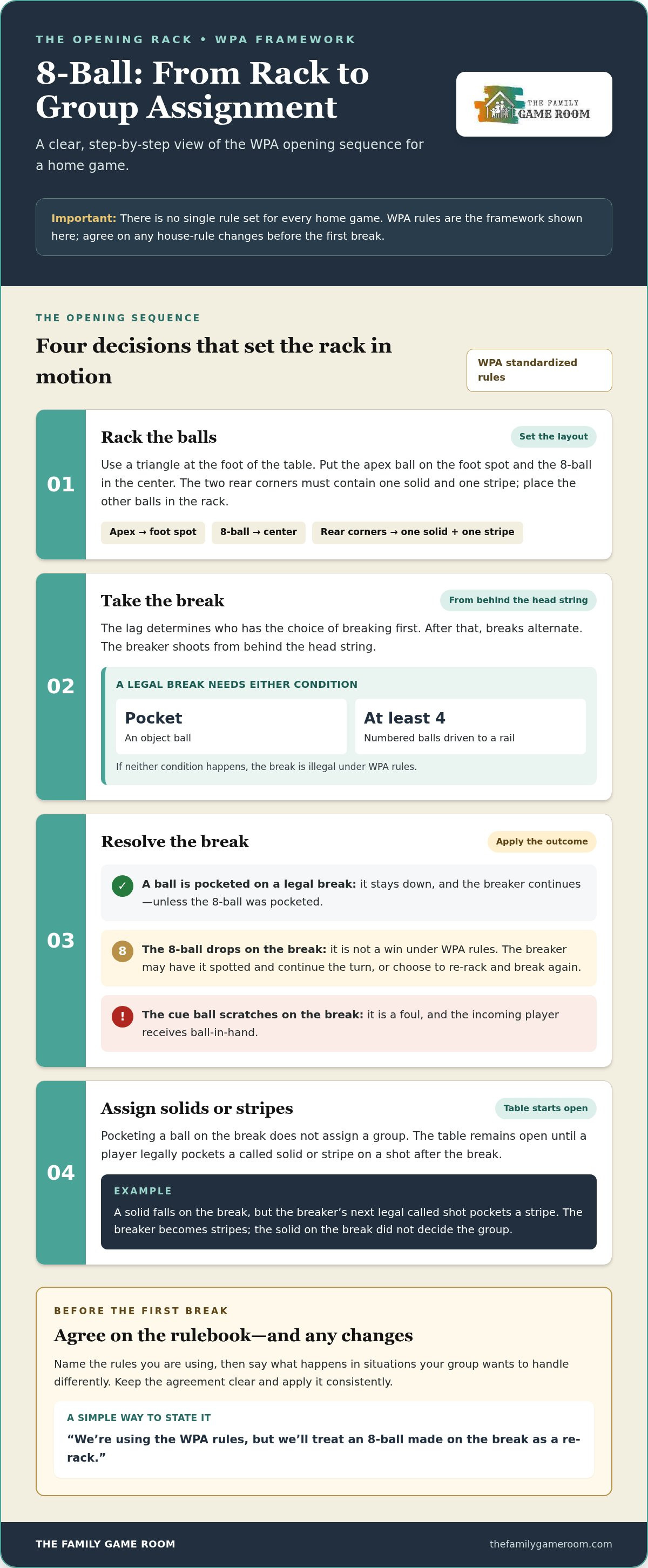
Before racking, name the reference rule set, then agree aloud on any changes. For example: “We’re using the WPA rules, but we’ll treat an 8-ball made on the break as a re-rack.” Keep the agreement simple: say what happens in each situation and make sure everyone understands. If the group prefers a familiar house rule, label it as a house rule and apply it consistently.
That shared understanding is the practical heart of the official rules of 8-ball for home play. Choose the framework for this game, clarify the differences that matter to your players, and let the next shot decide the rest.
How an 8-ball game works: the rack, break, and group assignment
Use one rules authority from the opening rack onward. The sequence below follows the World Pool-Billiard Association (WPA) standardized rules, rather than blending them with league or house-rule variations. Under this framework, pocketing a ball on the break doesn’t automatically make that player solids or stripes.
Racking and making a legal break
Set the balls in a triangle at the foot of the table. The apex ball sits on the foot spot, the 8-ball goes in the center, and the two rear corners contain one solid and one stripe. Place the other balls in the rack. The lag determines who has the choice of breaking first; breaks alternate after that.
For a legal break, the breaker shoots from behind the head string and must either pocket an object ball or drive at least four numbered balls to a rail. If neither happens, the break is illegal under WPA rules. A cue-ball scratch on the break is a foul, and the incoming player receives ball-in-hand. A ball pocketed on a legal break stays down, and the breaker continues, unless the 8-ball is pocketed.
If the 8-ball drops on the break, WPA rules don’t count it as a win. The breaker may have it spotted and continue the turn, or choose to re-rack and break again. Agreeing on this ruling before play keeps a dramatic opening shot from becoming a debate.
Choosing solids or stripes
After the break, the table is open: neither player has a group yet. A ball pocketed during the break doesn’t assign one. A group is established only when a player legally pockets a called ball on a shot after the break. Until then, either group can be played first, subject to the rules for the shot.
Under WPA rules, a player becomes solids or stripes only after legally pocketing a called ball of that group after the break.
For example, suppose the breaker pockets a solid but doesn’t scratch. The table remains open. If their next shot legally pockets a called stripe, they become stripes, even though a solid fell on the break. If the shot doesn’t legally pocket the called stripe, neither player has a group yet.
Follow the opening sequence
- Rack: Arrange the balls using the WPA layout, with the 8-ball centered and the apex on the foot spot.
- Break: The player entitled to break makes a legal shot from behind the head string.
- Resolve the break: Apply the WPA ruling for pocketed balls, a scratch, an illegal break, or the 8-ball falling.
- Assign groups: Keep the table open until a player legally pockets a called solid or stripe after the break.
That’s the opening framework for applying the official rules of 8-ball for home play consistently. If a dedicated table is part of your plans for a welcoming game room, explore pool tables for home play.
8-Ball shots and fouls: how to decide what happens next
Use the same WPA framework for ordinary shots and fouls. A foul is a rules violation, not simply a shot that fails to pocket a ball. Missing your target usually ends your turn, but it doesn’t automatically give your opponent ball-in-hand. If you legally pocket one of your group’s balls, you generally continue shooting. If a foul occurs, the foul penalty applies even if a ball also drops.
Common fouls and cue-ball-in-hand rulings
Under WPA rules, most fouls give the incoming player cue-ball-in-hand anywhere on the playing surface. A scratch, meaning the cue ball is pocketed, is a common example. Other fouls include failing to hit the correct object ball first or failing to drive a ball to a rail after contact when no ball is pocketed. The WPA has a specific ruling for an illegal break that fails its break requirements, so don’t assume every break situation follows the ordinary ball-in-hand procedure.
Use this quick ruling guide for common situations under the WPA framework:
- Scratch during an ordinary shot: Foul. The opponent gets cue-ball-in-hand anywhere on the table.
- Wrong ball contacted first: Foul. The opponent gets cue-ball-in-hand anywhere on the table.
- Miss with no foul: The turn ends, but the opponent doesn’t receive ball-in-hand solely because the shot missed.
- Ball pocketed legally: The shooter continues if the pocketed ball is legally playable for their turn.
- Illegal break: Apply the WPA’s break-specific options rather than assuming an ordinary foul ruling.
For a disputed shot, pause before anyone touches the balls. Identify the suspected foul, agree on whether it happened, then apply the matching ruling. If the group can’t resolve it, return to the rule set named before the rack rather than inventing a penalty in the moment.
Calling shots and legally pocketing the 8-ball
WPA 8-ball is a call-shot game, but obvious shots don’t need a separate announcement. If the intended ball and pocket aren’t clear, call them before shooting. The 8-ball pocket must be called. A simple “8 in the corner” is enough to make the intention clear.
To win, a player must first pocket all balls in their group, then legally pocket the 8-ball in the called pocket. Pocketing the 8-ball early, pocketing it in an uncalled pocket, or scratching while pocketing it means loss of game under WPA rules. By contrast, scratching on a shot at the 8-ball without pocketing it is a standard foul, not automatically a loss.
That distinction prevents a common mix-up: a missed 8-ball is not the same as illegally pocketing it. Apply the foul ruling when the shot is a foul, and reserve loss of game for the specific 8-ball outcomes set by the rules. These details are central to using the official rules of 8-ball for home play consistently.
Common 8-ball disagreements at home: settle the break, fouls, and 8-ball
Most table-side disputes start with a reasonable question: “Was that a foul?” or “Does the break count?” The quickest fair answer is to stop before the next shot, identify the rule everyone agreed to use, and apply it to the position as it stands. Don’t move balls or take another shot while the ruling is unclear.
Disputed shots are easier to settle before play continues, because each new shot can change the position you’re trying to resolve.
What if the break or first shot is disputed?
Governing-rule guidance: Under WPA rules, a legal break must pocket an object ball or drive at least four numbered balls to a rail. If someone questions the break, pause and check those conditions against the agreed rule set. Don’t substitute a familiar bar or house rule without the group’s agreement.
Governing-rule guidance: If a ball drops on the break and players disagree about whether groups are assigned, remember that the WPA table stays open after the break. A group is assigned only after a player legally pockets a called ball on a shot after the break. If the first shot is disputed, stop before the next player shoots and determine whether it legally pocketed a called ball.
House-rule option: If your group prefers to assign solids or stripes based on a ball pocketed on the break, agree to that variation before racking and apply it to both players. It’s a house convention, not the WPA ruling.
What if a foul or 8-ball ruling is unclear?
Governing-rule guidance: Suppose the cue ball appears to touch the wrong object ball first, but the players saw the shot differently. Pause, state the possible foul, and agree whether the cue ball contacted the correct ball first. If it didn’t, apply the WPA foul penalty: the incoming player receives cue-ball-in-hand. If no foul occurred and the shot simply missed, the incoming player comes to the table, but there’s no ball-in-hand penalty for the miss alone.
Governing-rule guidance: If a player pockets the 8-ball in a pocket they didn’t call, that’s a loss under WPA rules. If they scratch while attempting the 8-ball but don’t pocket it, that’s a standard foul, not automatically a loss of game. If the 8-ball drops on the break, use the WPA break ruling: the breaker may have it spotted and continue, or choose a re-rack and break again.
House-rule option: Your group may choose a different 8-ball-on-the-break outcome, but decide before play. Don’t switch rulings mid-game based on who benefits.
Keep the process calm: pause, name the agreed rule, decide what happened, then resume from the resulting position. That’s the practical value of the official rules of 8-ball for home play: a shared standard lets family and friends get back to enjoying the game. Ready to plan a dedicated spot for your next rack? Explore pool tables for your home game room.
A simple 8-ball home-play agreement to use before the first rack
A short agreement can prevent a long pause later. Pick one rules framework, identify any house-rule changes, and make sure everyone understands the choices before the opening break. The goal isn’t to make a friendly game feel formal. It’s to give every player the same answer when a close shot comes up.
Agree on these decisions before play begins
Use this checklist as a quick pre-game conversation. Keep the governing-rule baseline separate from any changes your group chooses:
- Name the rules. Governing-rule baseline: Choose one authority, such as the WPA, and follow its 8-ball rules. House-rule option: If you prefer casual rules, describe them clearly instead of calling them official.
- Set the break ruling. Governing-rule baseline: Agree to the selected rule set’s legal-break requirements and its ruling if the 8-ball is pocketed on the break. House-rule option: Choose a different result, such as re-racking, only if everyone agrees before play.
- Decide how groups are assigned. Governing-rule baseline: Under WPA rules, the table stays open after the break; a player’s group is assigned by legally pocketing a called ball after the break. House-rule option: If the first ball pocketed on the break assigns groups, state that variation plainly.
- Agree on foul penalties. Governing-rule baseline: Use the selected rule set’s foul rulings, including cue-ball placement after a scratch. House-rule option: If scratches mean shooting from behind the head string instead of ball-in-hand anywhere, write that down.
- Clarify called shots. Governing-rule baseline: WPA rules use called shots, with obvious shots treated differently from unclear ones; the intended pocket for the 8-ball must be called. House-rule option: Decide whether your group will require every shot to be called.
- Set 8-ball outcomes. Governing-rule baseline: Agree on the selected rules for an early 8-ball, an uncalled pocket, a scratch while pocketing it, and an 8-ball made on the break. House-rule option: Change any outcome only by mutual agreement before the rack.
Keep the game welcoming and the rules consistent
Write down only the variations your group has chosen. A short note beside the table is easier to check than trying to remember what everyone meant several racks later. If a situation isn’t covered, pause before the next shot, consult the named rule set, and agree on the ruling calmly.
Apply the same decision to every player. Consistency matters more than choosing the strictest or most relaxed version, and it keeps attention on the game and good company. These shared choices make the official rules of 8-ball for home play practical: a clear framework, adjusted only by agreement.
If you’re planning a dedicated place for those games, explore the American Heritage Billiards pool table guide as you shape a welcoming home game room.
Make your next game night your own
A clear agreement gives everyone room to focus on the fun, whether you’re introducing a new player to the table or settling in for a familiar family match. Keep your chosen rules handy, welcome questions, and let each game become easier to enjoy together. The official rules of 8-ball for home play are a starting point; the best home game is one everyone feels good joining.
The Family Game Room is family-owned and operated, with pool tables from American Heritage Billiards and Nixon Billiards to help shape a home space for gathering and play. Explore pool tables for your home game room, and get ready to make room for one more rack, one more laugh, and another great evening together.
Frequently Asked Questions
Are there official rules of 8-ball for home play?
There isn’t one universal rulebook for every home game. Governing bodies and leagues publish official rules for their own competitions, including the WPA, BCA Pool League, and APA. For casual play, choose one as your baseline and say which one before the game starts. The official rules of 8-ball for home play are the rules your group agrees to follow, including any clearly stated house-rule changes.
Can you call a pocket when playing 8-ball at home?
Yes. Under WPA rules, 8-ball is a call-shot game, and players call the pocket when the intended ball and pocket aren’t obvious. The 8-ball pocket must be called. For example, if a ball is near two pockets and you’re playing it into the far corner, state that intention before shooting. Your group can use another league’s calling requirements, so name the rule set you’re using.
What happens if you sink the 8-ball on the break?
The result depends on the rules you chose. Under WPA rules, pocketing the 8-ball on the break isn’t a win: the breaker may have it spotted and continue, or choose a re-rack and break again. APA rules count it as a win unless the cue ball is also pocketed, which is a loss. BCA rules give the breaker the option to re-rack or spot the 8-ball and continue.
Is scratching on the break an automatic loss in 8-ball?
No, a cue-ball scratch on the break isn’t automatically a loss under WPA rules; it’s a foul, and the opponent receives ball-in-hand. Don’t confuse that with the APA exception when the 8-ball is pocketed on the break and the cue ball scratches, which is a loss under APA rules. Agree on the rule set first, since the result can change with the governing rules and exact outcome.
How do you decide who gets solids or stripes?
Under WPA rules, the table remains open after the break, even if a solid or stripe was pocketed during it. A group is assigned when a player legally pockets a called solid or stripe on a later shot. For example, if a stripe drops on the break, that alone doesn’t make the breaker stripes. Confirm the rule set before assigning groups, especially if players are used to a break-ball house rule.
What happens after a foul in 8-ball?
Under WPA rules, the incoming player generally receives cue-ball-in-hand after a foul and may place the cue ball anywhere on the playing surface. A scratch is one example; contacting the wrong object ball first is another. Break fouls can have specific rulings, so check the rule set rather than assuming every situation is identical. Before resuming, agree on what happened and let the incoming player place the cue ball.
Do you have to call every shot in 8-ball?
No, not under WPA rules. An obvious ball and pocket don’t need a separate call, but call a shot if the intended ball or pocket could be unclear. In home play, a brief call such as “stripe in the side” helps everyone understand the plan. If your group wants every shot called, agree on that house rule before the rack begins.